Container Service for Kubernetes
A Kubernetes-based service that ensures high efficiency for enterprises by running containerized applications on the cloud
Learn More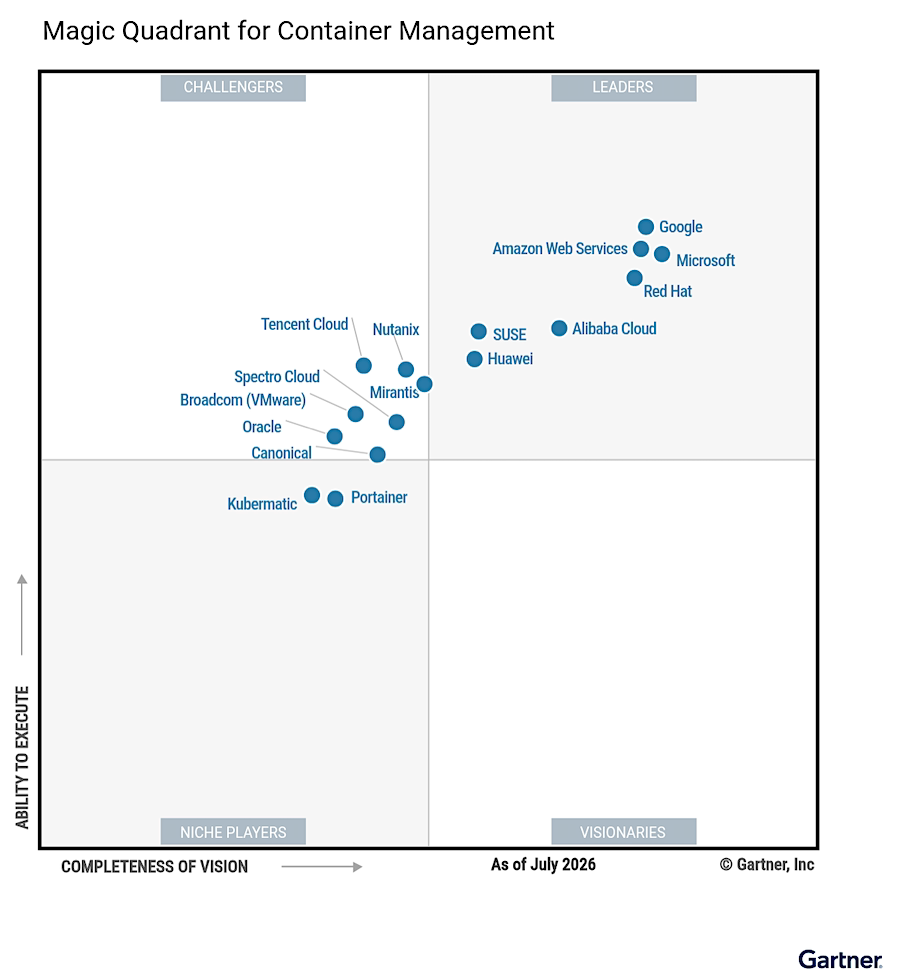
Introduction
Recently, Gartner released its 2026 Magic Quadrant for Container Management report. Alibaba Cloud has been placed in the "Leaders" quadrant for the fourth consecutive year, making it the only Chinese technology company in the Asia-Pacific region to be named to the "Leaders" quadrant for four consecutive years.
Highlights of the Report
In terms of product completeness, Alibaba Cloud continues to deliver very comprehensive functionality coverage in container services and management, with capabilities that surpass those of U.S. Leader vendors.
Meanwhile, in Gartner’s Critical Capabilities for Container Management report, based on the scoring across six use-case scenarios, Alibaba Cloud’s container service ranked in the top two in four of the six scenarios.
Continuously Upgrading AI Infrastructure Capabilities
During the Apsara Conference, Alibaba Cloud further upgraded its heterogeneous compute scheduling, inference service acceleration, and multi-cluster governance capabilities around model training, model inference, and agentic applications.
Container Service for Kubernetes (ACK) fully supports the Zhenwu M890 supernode, enabling multi-level topology-aware scheduling across single nodes, single supernodes, and multiple supernodes. It supports strategies such as binpack, spread, gang, segment affinity, and network topology awareness, and provides more than 80 standard Prometheus monitoring metrics for the Zhenwu PPU along with supernode-level fault self-healing. The AI Serving Stack was upgraded at the same time, accelerating startup through GDR- and RDMA-prioritized direct weight transfer, operator compilation reuse, and parallelization of the engine initialization process. Combined with NUMA, segment affinity, and NCCL tuning, it improves inference service performance while supporting hot switching between multiple models.
Agent Sandbox was officially released on September 22, providing an out-of-the-box, elastically scalable, and securely isolated execution environment for Agentic RL, model RSI, as well as Agent Serving and Agent Use. Co-optimized through CIPU and virtualization technologies, the product provides MicroVM-level isolation for each agent. A single region can host millions of sandboxes, and 100,000 sandboxes can be created per minute, with creation and cold-start P99 latency below 180 milliseconds after template warm-up. Agent Sandbox is natively compatible with the E2B API and provides a Kubernetes API, supporting code execution, file operations, browser automation, and state persistence—helping enterprises and developers move agents from prototype validation to production.
At the same time, Agentic RL on ACK connects the entire workflow from data preparation to task execution. The Agent RL data pipeline transforms raw datasets into Harbor tasks and images, while RolloutServer provides unified management of the RL task lifecycle. Combined with RL intelligent routing, ContainerSight environment anomaly observability, and HBO historical-profile resource recommendations, it optimizes task execution. ACK One further supports unified multi-cluster scheduling of Agent Sandbox, multi-cluster disaster recovery, and consistent API access, improving the stability and continuity of agentic workloads running across clusters.
Accelerating Adoption Across Industries
● Qwen Office Powered by Alibaba Cloud Agent Sandbox to run multi-device office tasks, it reduces environment startup wait time from tens of seconds to about one second, and supports continuous multi-day task execution through state persistence;
● Moonshot AI Kimi leverages Agent Sandbox to achieve elastic scaling of tens of thousands of sandboxes per minute, reducing startup time by 50%;
● MiniMax relies on Agent Sandbox to support large-scale Agent Serving, capable of spinning up 5,000 sandboxes within 10 seconds and reducing overall TCO by 25%;
● Xiaohongshu (RED) uses Alibaba Cloud container services to enable colocation of online and offline workloads, improving CPU utilization by 45%.
Source: Gartner, Magic Quadrant for Container Management, By Dennis Smith et. al, 2 September 2026
Gartner and Magic Quadrant are trademarks of Gartner, Inc., and/or its affiliates. Gartner does not endorse any company, vendor, product or service depicted in its publications, and does not advise technology users to select only those vendors with the highest ratings or other designation. Gartner publications consist of the opinions of Gartner’s business and technology insights organization and should not be construed as statements of fact. Gartner disclaims all warranties, expressed or implied, with respect to this publication, including any warranties of merchantability or fitness for a particular purpose. This graphic was published by Gartner, Inc. as part of a larger research document and should be evaluated in the context of the entire document. The Gartner document is available upon request from ALIBABA CLOUD COMPUTING LTD