By Qian Xi and Xue Ren
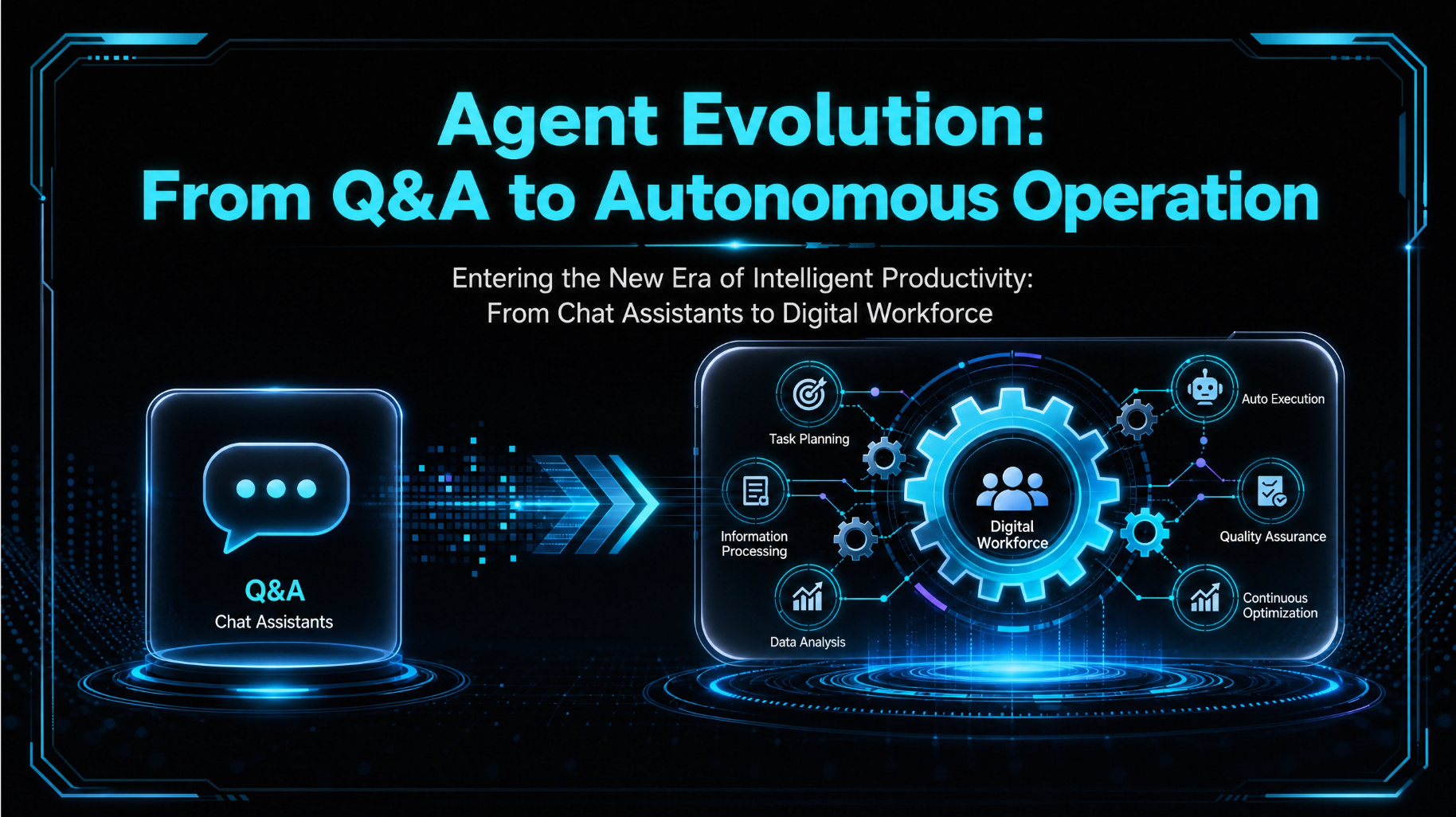
As AI model capabilities continue to grow stronger and Agent frameworks become more complete, Agent is evolving from a Q&A assistant that answers questions one by one into a digital worker that can automatically execute tasks. Agent has the ability to perceive time, perceive events, and continuously execute long-chain tasks, allowing it to replace humans in automated work.
In this transition, scheduled orchestration is the primary trigger form for Agent to move toward autonomous operation—letting Agent run on a fixed schedule so it becomes a digital employee that can clock in and work on its own. In current mainstream AI Agent products, driving Agent execution through scheduled orchestration is also placed in an important position:
One very notable signal is that leading commercial products generally place "scheduled orchestration" in paid tiers. This means that this capability is no longer a small add-on feature, but a key piece of infrastructure for Agent to upgrade from a "tool" to a "role".
The community has seen many Claw products that support scheduled tasks to help Agent automatically execute tasks. We reviewed mainstream open-source projects such as OpenClaw and Hermes Agent, and summarized the following pain points.
Open-source Agent products, such as OpenClaw, store scheduled task configurations and execution records in local files. If the machine crashes or the disk is damaged, the scheduled task information will be lost.
Open-source Agent products all use a single-process architecture. If the machine crashes or the process crashes, the service becomes unavailable.
For open-source Agent products, each Agent has an independent console to manage scheduled tasks. If an enterprise has 1,000 OpenClaws and needs to manage scheduled tasks across all 1,000 Claws at the same time, it becomes very cumbersome. How do I know which task is on which Agent? How can I quickly view the execution records of a certain task? This creates a huge challenge for operations teams.
Open-source Agent products do not support task-level permission management, so if different users need different task permissions, it cannot be done.
Open-source Agent products have relatively weak task observability. For example, for task execution records, OpenClaw does not provide paginated display, and Hermes Agent even lacks task execution records entirely, requiring you to look in conversations. If you want to view the history of a certain task, open-source products do not provide search or filtering conditions, making it very troublesome.
The scheduled task feature of open-source Agent is embedded in the Agent process, so the Agent must stay running to execute tasks normally. If you deploy OpenClaw on a local personal computer, you have to keep the computer on 24/7 for it to work properly, which is obviously unrealistic. If the Agent is deployed in the cloud, it also must remain running.
However, in many AI task scenarios, the scheduling frequency is not high (for example, once a day), resulting in very low resource utilization and wasted cost.
Facing the pain points above, as more and more AI Agents are deployed inside enterprises, and each Agent is equipped with the scheduled tasks required for business automation, the task definitions, execution records, and operations logic are fragmented across different Agent instances. How to manage them efficiently has given rise to the idea of a unified AI task scheduling platform. The core idea of AI task scheduling is to decouple scheduled orchestration from inside each Agent and let a task scheduling platform manage it uniformly. If each Agent that runs on a schedule is seen as a member of digital productivity, then the AI Agent task scheduling platform is the Agent's "OA system". Therefore, the platform will be built around the following capabilities.
Scheduled orchestration is the starter for Agent autonomous operation, and its reliability directly determines whether the entire task chain is trustworthy. Alibaba Cloud MSE AI Task Scheduling is built on a highly available distributed scheduling kernel and provides truly production-grade triggering and fault tolerance:
An enterprise's Agent technology stack is naturally diverse—there may be self-developed Agents, hosted Agents integrated through BaiLian, business Agents built on platforms such as Dify, and deployments based on OpenClaw/HermesAgent. AI task scheduling is positioned to gather the task configurations, runtime states, and execution logs scattered across different Agents into a unified control plane, so teams do not need to repeatedly build scheduling, monitoring, and operations capabilities inside each Agent:
Once you move into enterprise production scenarios, cost control and permission isolation change from an "optional" item to a "must-have":
Integrates Alibaba Cloud observability, logging, monitoring, and alerting products to achieve full-link observability and quickly locate why a task failed, why it met expectations, or why it ran slowly.
Task execution in AI task scheduling can support session management, with the following options:
In many AI scheduled task scenarios, the scheduling frequency is not high (for example, once a day). If you use an open-source Agent solution such as OpenClaw, the Agent must stay running all the time to execute scheduled tasks, which wastes resources.
The AI task scheduling platform can integrate with sandbox elastic scaling. When a task is about to be scheduled, it can bring the Agent up in advance. When there are no tasks scheduled for a future period, it can scale all the way down to zero, helping users reduce costs.
AI task scheduling provides a distributed task model that supports task batching across multiple Agents. A large task can be split into multiple smaller tasks and assigned to different Agent nodes for execution, speeding up task completion. For example, the sharding model.
AI task scheduling can collect logs, tracing, results, error information, and more from each task execution. In task-level session isolation mode, it shares all context for that task. If a task fails at first or performs poorly, AI task scheduling can dynamically adjust prompts and parameters based on historical information, making the task better over time and truly enabling self-evolving Agent scheduled tasks.
To present the difference between platform-based capabilities and single-machine open source more intuitively, the table below compares mainstream community projects OpenClaw and Hermes Agent across dimensions such as storage, service, performance, monitoring, and observability.
| Capability dimension | OpenClaw (open-source single machine) | Hermes Agent (open-source single machine) | MSE AI Task Scheduling (enterprise-grade) |
|---|---|---|---|
| Highly available storage | Task configuration and execution records are stored locally, with no high availability | Task configuration and execution records are stored locally, with no high availability | Cloud storage, multi-zone disaster recovery |
| Highly available service | Single-process operation, no high availability | Single-process operation, no high availability | Distributed architecture, automatic failover |
| Performance | Minute-level scheduling, limited task volume | Minute-level scheduling, limited task volume | Massive task volume, second-level scheduling |
| Session isolation | Supported | Not supported | Supported |
| Notification delivery | webhook | webhook | SMS, email, webhook |
| Prompt version management | Not supported | Not supported | Supports versioned management, with traceable changes |
| Observability | Only task execution records, but no pagination or search | Only task execution records, but inconvenient to query in sessions | Execution records, monitoring center, log queries, event center, operation audit |
| Workflow dependency orchestration | Not supported | Not supported | Supports dependency orchestration between tasks to build complex Agent workflows |
From the comparison, we can see that open-source solutions can quickly meet the "scheduled triggering" needs of individuals or small teams, but they have inherent shortcomings in production-grade stability, large-scale scheduling, monitoring and alerting, and observability. MSE AI Task Scheduling consolidates these capabilities into a unified platform foundation, making it better suited to support Agent scheduled task execution.
AI Task Scheduling is now open for a free beta and supports access for both public network and private network Agents:
If you have any questions, feel free to join the DingTalk group (group number 23103656) and discuss together.
Apache RocketMQ for AI: Strategic Upgrade Ushers in the Era of AI MQ

776 posts | 60 followers
FollowAlibaba Cloud Native Community - December 11, 2025
Alibaba Cloud Native Community - October 10, 2025
ApsaraDB - July 23, 2026
Alibaba Cloud Native Community - May 26, 2026
Alibaba Cloud Native Community - July 20, 2026
Alibaba Cloud Native Community - June 5, 2026
776 posts | 60 followers
Follow Token Plan
Build more, spend less. One plan, every modality.
Learn More QwenWork
QwenWork is dedicated to helping employees strengthen their professional competitiveness in the AI era and to enabling enterprises to improve organizational effectiveness.
Learn More
Alibaba Cloud Model Studio
A one-stop generative AI platform to build intelligent applications that understand your business, based on Qwen model series such as Qwen-Max and other popular models
Learn More Microservices Engine (MSE)
MSE provides a fully managed registration and configuration center, and gateway and microservices governance capabilities.
Learn MoreMore Posts by Alibaba Cloud Native Community

