A special half marathon has just concluded in Beijing. More than 300 humanoid robots competed alongside humans, vying across dimensions such as autonomous navigation, dynamic balance, and multi-robot coordination, setting a global record for the scale of human-robot co-running events. When hundreds of robots collectively run 21 kilometers, what we see is not just a race, but a large-scale public stress test for the realm of embodied intelligence. As the race ends, a bigger challenge has emerged beyond the racecourse—
In the face of new embodied intelligence scenarios characterized by clustering, mobility, and complexity, the industry urgently needs a standardized, reusable, integrated O&M system that adapts to outdoor weak-network and multi-device heterogeneous environments. Leveraging Alibaba Cloud's full-spectrum observability capabilities, with Simple Log Service (SLS), CloudMonitor (CMS), and Application Real-Time Monitoring Service (ARMS) as the core foundation, a collaborative O&M observability system for humanoid robots has been built. This system precisely matches the requirements of typical scenarios involving long-distance movement, multi-robot formation coordination, and full environment variable interference, providing a practical reference for the industry to solve large-scale O&M challenges.
The 21-kilometer open course of the half marathon is an extreme stress test of the comprehensive stability of humanoid robots. It also exposes the three core bottlenecks in deploying embodied intelligence clusters at scale — a common challenge across all outdoor large-scale scenarios.
● Environmental uncertainty is the primary challenge of outdoor operations. In open scenarios, temperature, humidity, and lighting conditions change in real time, while uncontrollable factors such as road bumps, ramps, curves, pedestrian crossings, and wireless signal fluctuations persist, continuously interfering with sensor detection accuracy, communication transmission stability, and power system payload balance. Especially under high-temperature conditions, prolonged high-load operation of robot active joints, computing power modules, and battery components accelerates hardware aging and significantly increases component failure rates. Device operation remains in a state of Dynamic fluctuation, where a single environmental disturbance can trigger cascading abnormalities.
● Hidden damage and coupling threats from highly integrated devices further amplify operational risks. Humanoid robots tightly integrate motion modules, multiple sensor types, edge computing, AI inference, wireless communication, and other multilayer systems with precise structure and high interdependency. Minor vibrations and low-speed collisions during movement do not cause obvious skin damage but can easily lead to irreversible hidden issues such as slight displacement of lidar and vision cameras, loose joint wiring, and micro-deformation of internal support structures, which in turn cause navigation and obstacle avoidance inaccuracy, intermittent signal breaks, task execution bias, and other problems. Combined with individual device differences introduced by manual assembly, a minor abnormality in one device can quickly propagate to the entire formation, causing coordination disorder, rhythm desynchronization, and even cluster-level security risks.
● Traditional O&M patterns are completely unable to adapt to new scenarios. Previously, fixed devices relied on post-incident emergency repair, manual offline troubleshooting, and standalone independent management — a passive pattern with delayed response, entirely unsuitable for humanoid robots that operate with Dynamic mobility, all-weather jobs, and multi-robot collaboration. To support stable operation of large-scale clusters, it is essential to break down data silos among hardware indicators, system logs, algorithm links, and environmental data, move beyond experience-based manual O&M, and complete the transformation from passive remediation to active defense through full-dimension status visualization, proactive threat prediction, and rapid abnormal loss containment.
Based on the natural properties of humanoid robots — large-scale movement, unstable network environments, multi-brand heterogeneity, and long-duration continuous operations — the ideal O&M architecture for the industry must balance low-latency edge self-healing with cloud-based global unified management. By adopting a Layer 3 cloud-edge collaborative design spanning terminal body, edge gateway, and cloud platform, the solution reasonably separates the responsibilities of data collection, local management, computing power processing, and global analysis. Built around the three core O&M modules of real-time status monitoring, intelligent failure prediction, and hierarchical emergency response, Alibaba Cloud observability products form a complete capability matrix integrating indicators, traces, and logs to address industry pain points such as fragmented embodied device logs, difficulty in quantifying hardware indicators, and difficulty in troubleshooting hidden algorithm faults.
At the data access layer, the solution provides two highly available and flexible deployment modes to adapt to different outdoor conditions and network environments.
● The lightweight LoongCollector and Simple Log Service software development kit direct collection mode features extremely low resource usage on the device side and high compression and transmission efficiency. It meets high real-time monitoring requirements and supports dynamic adjustment of collection policies from the cloud, eliminating the need for frequent OTA upgrades on devices. LoongCollector is a new-generation Database Collector launched by Alibaba Cloud Simple Log Service that integrates performance, stability, and programmability. It extends and integrates the observability technology stack, breaking the single-scenario limitations of traditional log collectors, and supports the collection, processing, ingress, and sending of Logs, Metrics, Traces, Events, and Profiles.
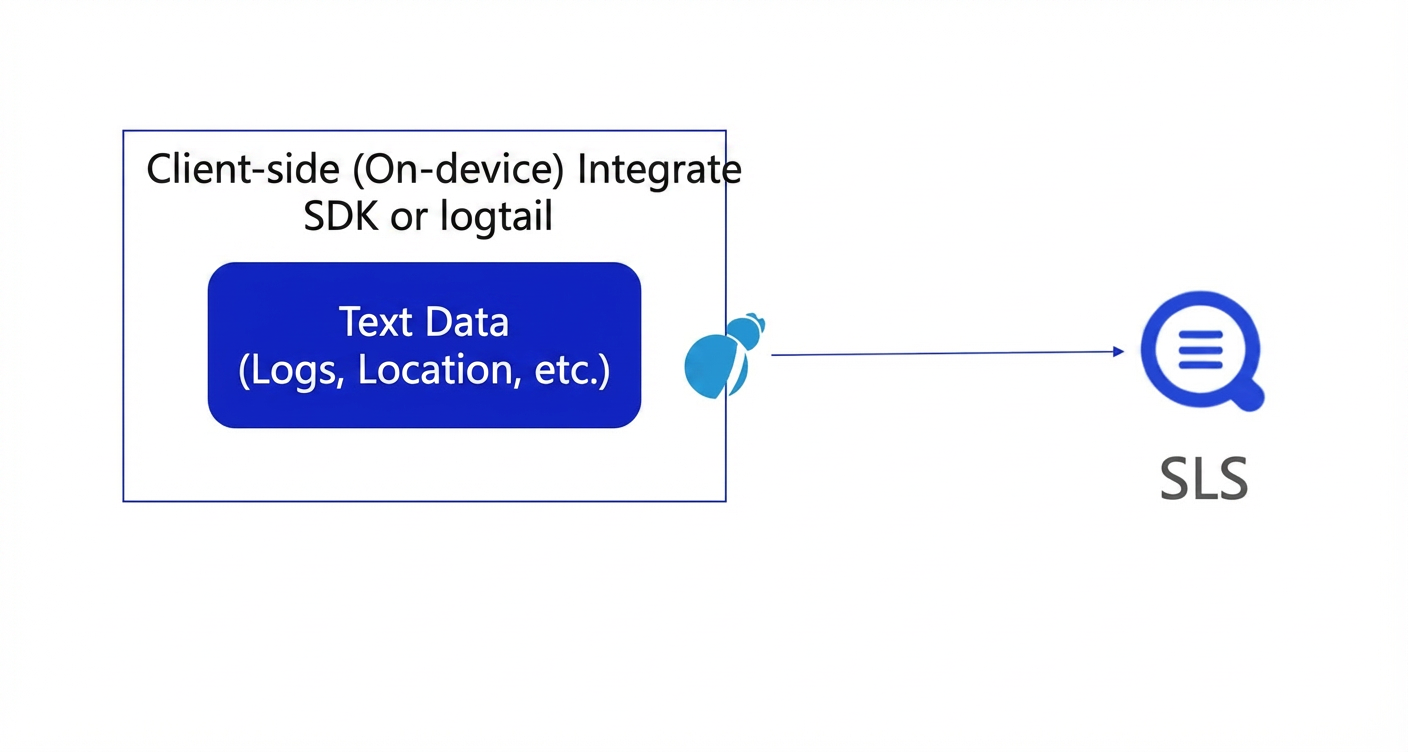
● Based on the S3 protocol + Simple Log Service architecture, this mode is suitable for weak network and intermittent connectivity scenarios. Data is cached and encrypted locally and uploaded during off-peak hours. It is low-cost, highly reliable, not attached to a single vendor, and more extensible.
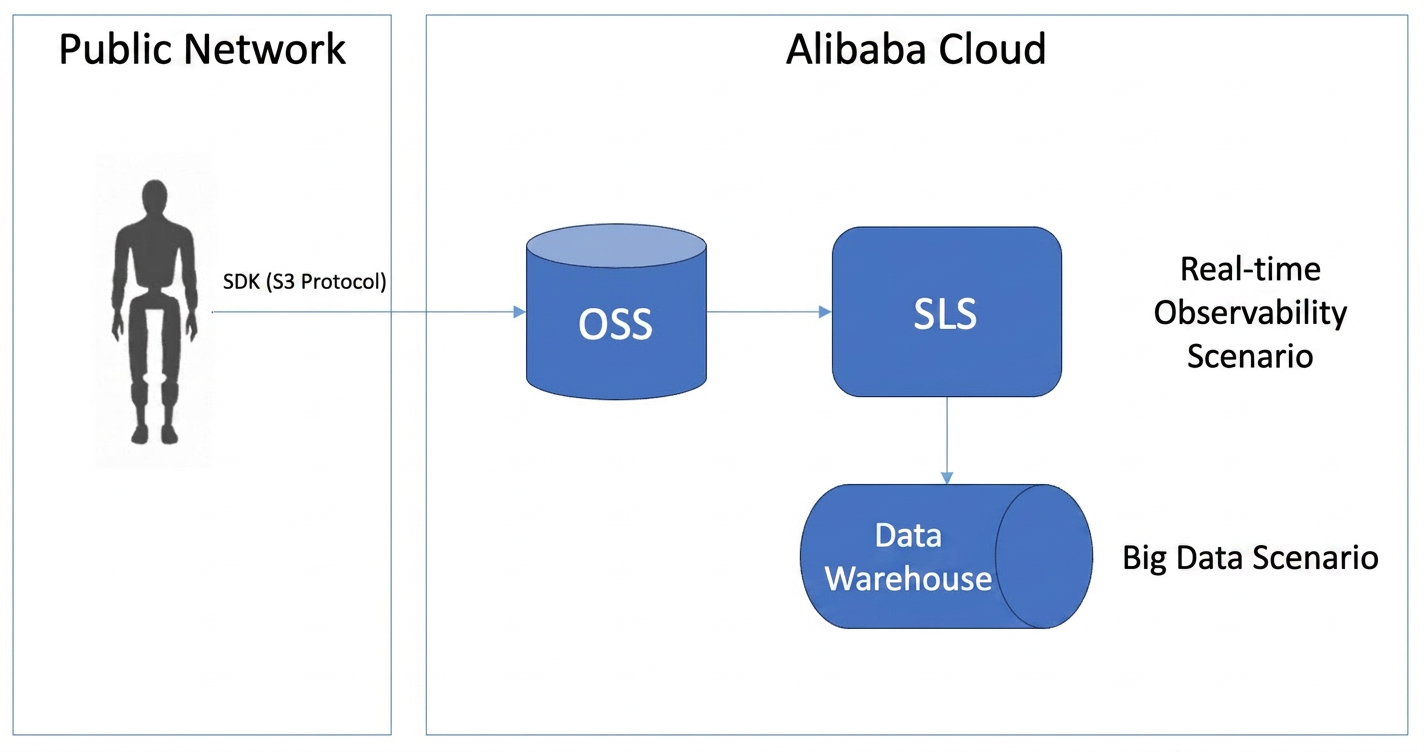
Both modes are fully compatible with 5G, Wi-Fi, IoT, and other communication methods, fully adapting to the complex and dynamic network environment of mobile robots.
Full-Domain, All-Dimension Observability for a Transparent Robot Cluster Operation System
Whether for outdoor formation movement or routine commercial deployment, the foundation for stable operation of large-scale embodied intelligence clusters lies in full-dimension, full-epoch, and full-link observability.
● At the hardware level, core indicators such as joint motor payload, current temperature, power supply health status, compute unit resource usage, inertial navigation calibration accuracy, sensing device data streams, sensor readings, and network quality are continuously collected to fully grasp the health status of core components and detect hardware threats such as overload, overheating, abnormal power supply, and sensor attenuation in advance.
● At the business and algorithm level, the running status of underlying core processes is monitored in real time, and various management events are managed at different levels, with a focus on intercepting faults and fatal exceptions. Key indicators such as perception and decision inference latency, path planning efficiency, and collaborative execution success rate are continuously tracked to fully restore algorithm running health and detect performance degradation and logical exceptions in a timely manner.
● At the scenario and environment level, full-epoch job info, device running status transitions, outdoor temperature and humidity environment data, physical collision management events, and other real-scene information are recorded. Through multi-dimension data cross-referencing, different failure root causes such as environmental interference, mechanical damage, algorithm bugs, and human operations are quickly distinguished, providing an objective basis for daily O&M and post-event review.
For the above observation scenarios, the three core dimensions of indicator monitoring, Tracing Analysis, and log administration are built in depth to form a full-coverage, strongly collaborative, and closed-loop global observability capability, targeting industry pain points such as invisible operation of embodied devices, difficulty in detecting exceptions, and difficulty in tracing failures.
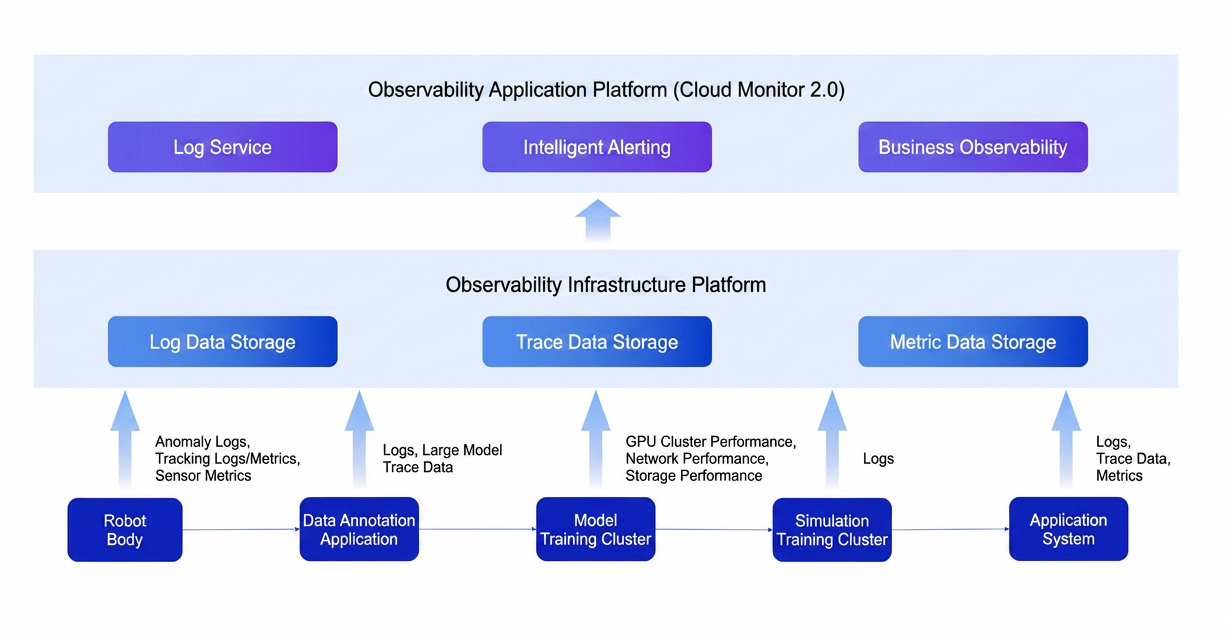
● Indicator monitoring focuses on the model training realm, covering full-dimension timing monitoring and visualization management of AIBoost cluster AI infrastructure. Through continuous statistics on training resource payload, hardware conditions, environment parameters, and cluster running status, the training procedure can be quantified and abnormal threats can be warned in advance, ensuring the stability and reliability of AI model iteration from the ground up.
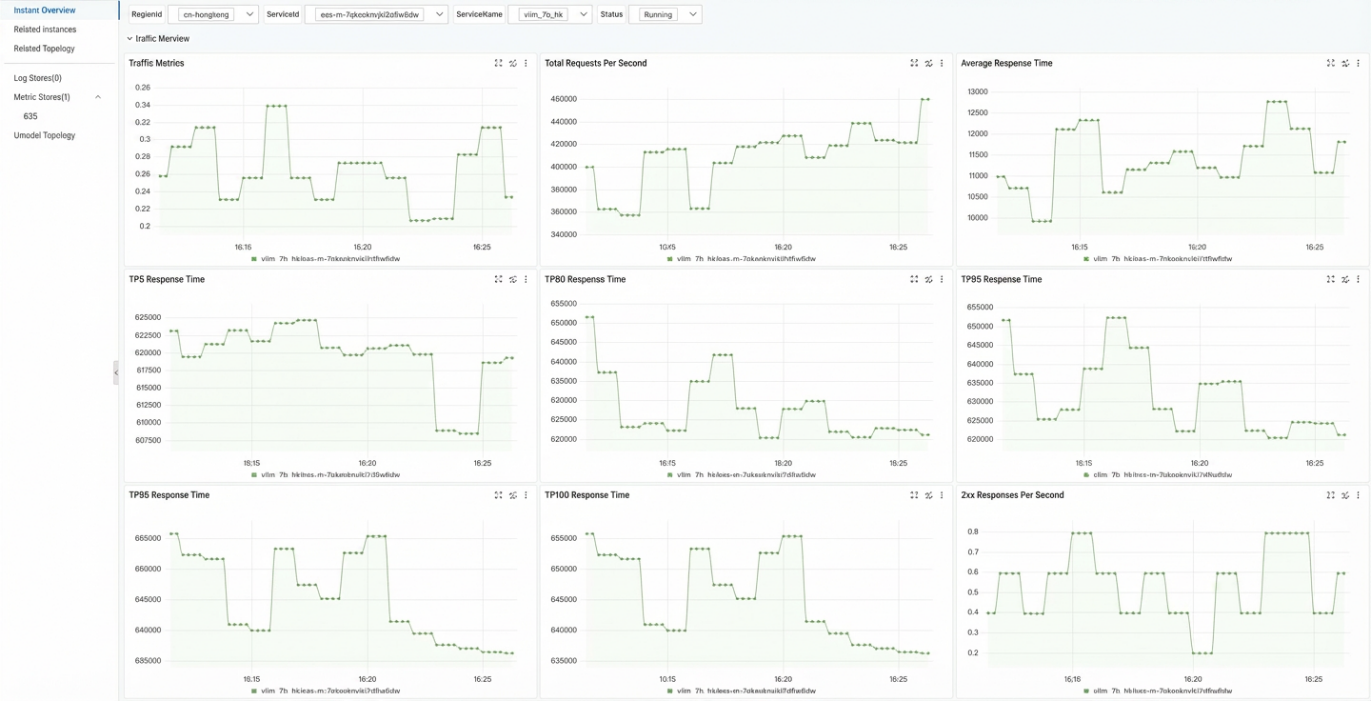
● Tracing Analysis provides deep, end-to-end visibility into service operations, enabling full-link visualization and tracing across the CDN mapping system, motion control services, AI inference links, and cross-device interface interactions. It accurately captures hidden application layer failures such as algorithm drift, background service stuttering, remote instruction blocking, and multi-machine collaborative scheduling conflicts, making previously invisible software and algorithm issues fully transparent and significantly improving the efficiency of troubleshooting soft abnormal issues.
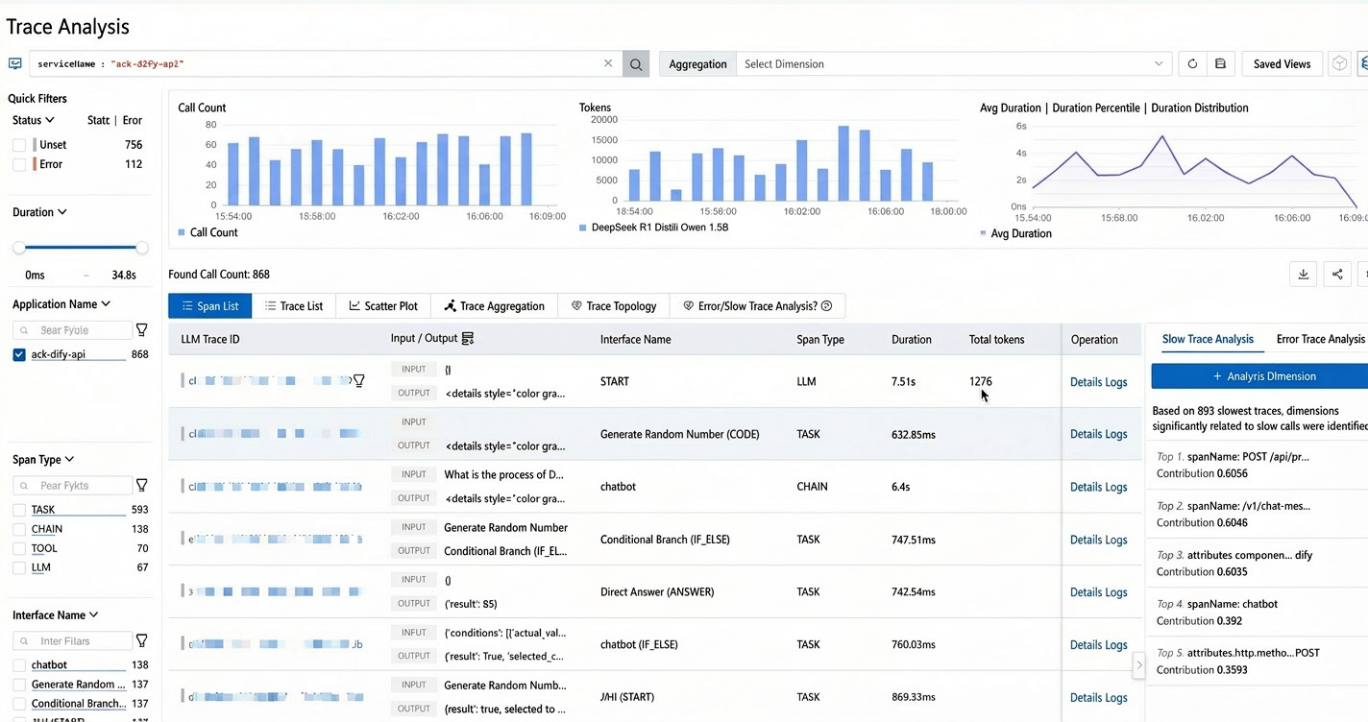
● Log Administration: provides unified collection and standardized administration of end-to-end logs, including hardware operational logs, system process logs, AI module operation records, edge node management events, and job operation traces. It effectively addresses the challenges of scattered logs from heterogeneous devices, inconsistent formats, fragmented data, and difficulty in correlating and tracing issues. With high-throughput ingestion and second-level retrieval capabilities, it delivers complete, objective, and verifiable data support for failure review, root cause analysis, accountability determination, and batch issue tracing.
With global visualization and management capabilities, you can gain a macro-level view of overall cluster status, device online status, and overall payload fluctuations, while also drilling down into individual device details, achieving bidirectional integration between macro management and micro-level positioning. Combined with dynamic thresholds and intelligent anomaly detection, real-time alerts are triggered for high-frequency threats such as sudden power drops, high-temperature overloads, network disconnections, and data drift, enabling true proactive threat prevention and control.
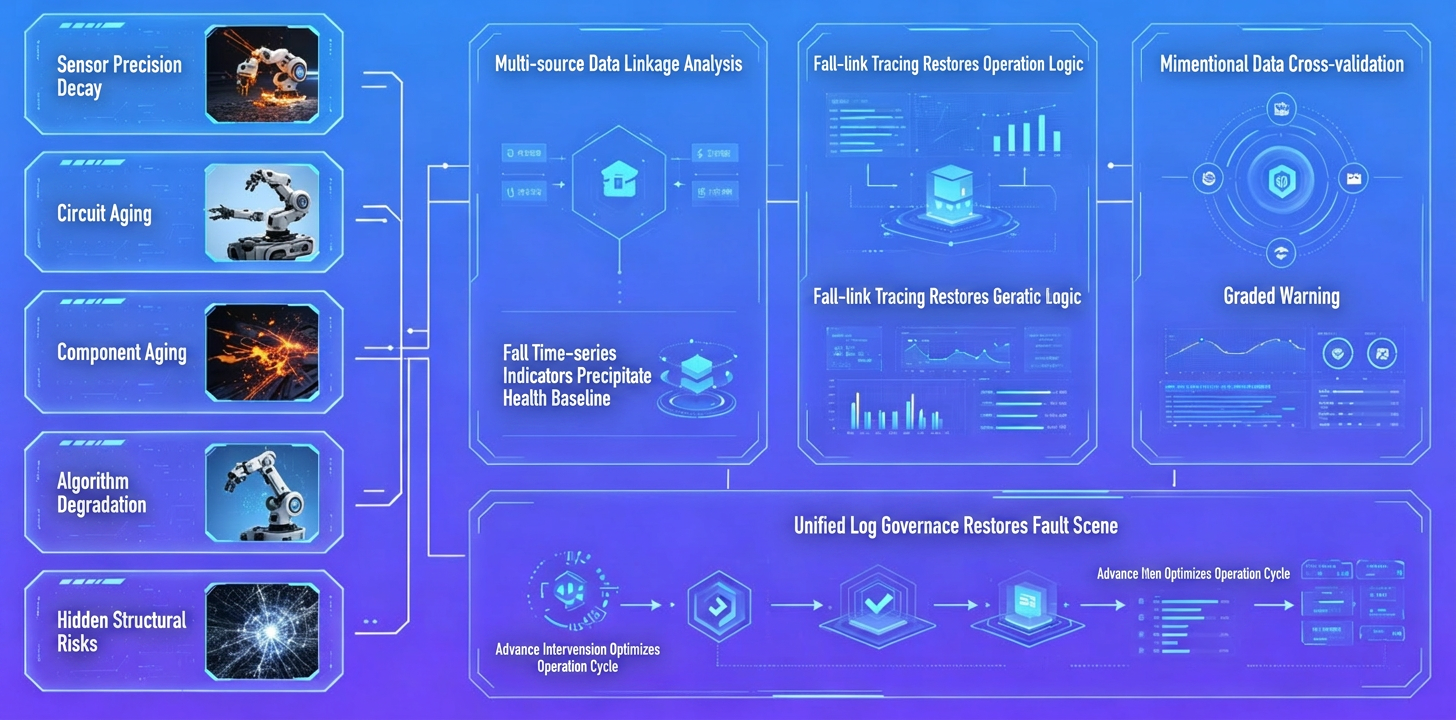
Compared with obvious hardware corruption, the slow attenuation of sensor accuracy, line contact fatigue, chronic component aging, algorithm performance degradation, and hidden structural hazards caused by long-term vibration are the key factors affecting the long-term stable operation of humanoid robots. Such progressive issues cannot be detected through manual inspection and require multi-source data field dependency analysis to implement data-driven predictive O&M.
Leveraging full-volume timing indicator data, this capability accumulates long-term insights into basic resource O&M, model training and inference efficiency evaluation, device payload changes, environmental impact patterns, and hardware aging trends to form a quantifiable health assessment baseline. Through end-to-end Tracing Analysis, the complete flow logic of instruction routing, service invocation, and algorithm computation is fully restored to quickly locate coordination bottlenecks and program anomalies. Combined with unified log administration, system events, error records, environmental changes, and external interference before and after an anomaly are correlated to fully reconstruct the failure scene.
Multi-dimension data association and cross-validation enable accurate discovery of potential patterns in device operation and early detection of hidden risks. Combined with a tiered alerting mechanism that filters invalid fluctuations and duplicate alerts, threats are escalated and handled by tiering. During the early stage of failure emergence, proactive intervention through parameter automatic rotation tuning, run policy optimization, and remote fine-grained control effectively extends the stable operation epoch of devices, reducing failure rates and burst maintenance costs at the source.
The deeper value of observability goes beyond ensuring current stable operation — it uses data from real, complex scenarios to feed back into product R&D and process upgrades, paving the way for long-term commercialization of humanoid robots. By leveraging comprehensive data accumulation, you can horizontally compare operational differences across devices of the same model and batch, quickly identify common issues caused by component batch bugs, schema design shortcomings, and manual assembly process bias, and help manufacturers optimize supply chains and production flows. Through quantitative analysis of algorithm performance, component payload, and sensing stability under different operating conditions, hardware limitations and algorithm bottlenecks are precisely distinguished, helping R&D teams optimize motion control, autonomous navigation, and coordination policies in a targeted manner.
Meanwhile, massive scenario data such as real road conditions, crowd interference, complex lighting, extreme temperature and humidity, and collision anomalies can continuously enrich the simulation training sample library, narrow the gap between the simulation environment and real outdoor scenarios, accelerate algorithm iteration and real-machine adaptation efficiency, and enable humanoid robots to move faster from competition demonstration scenarios to normalized, large-scale deployment.
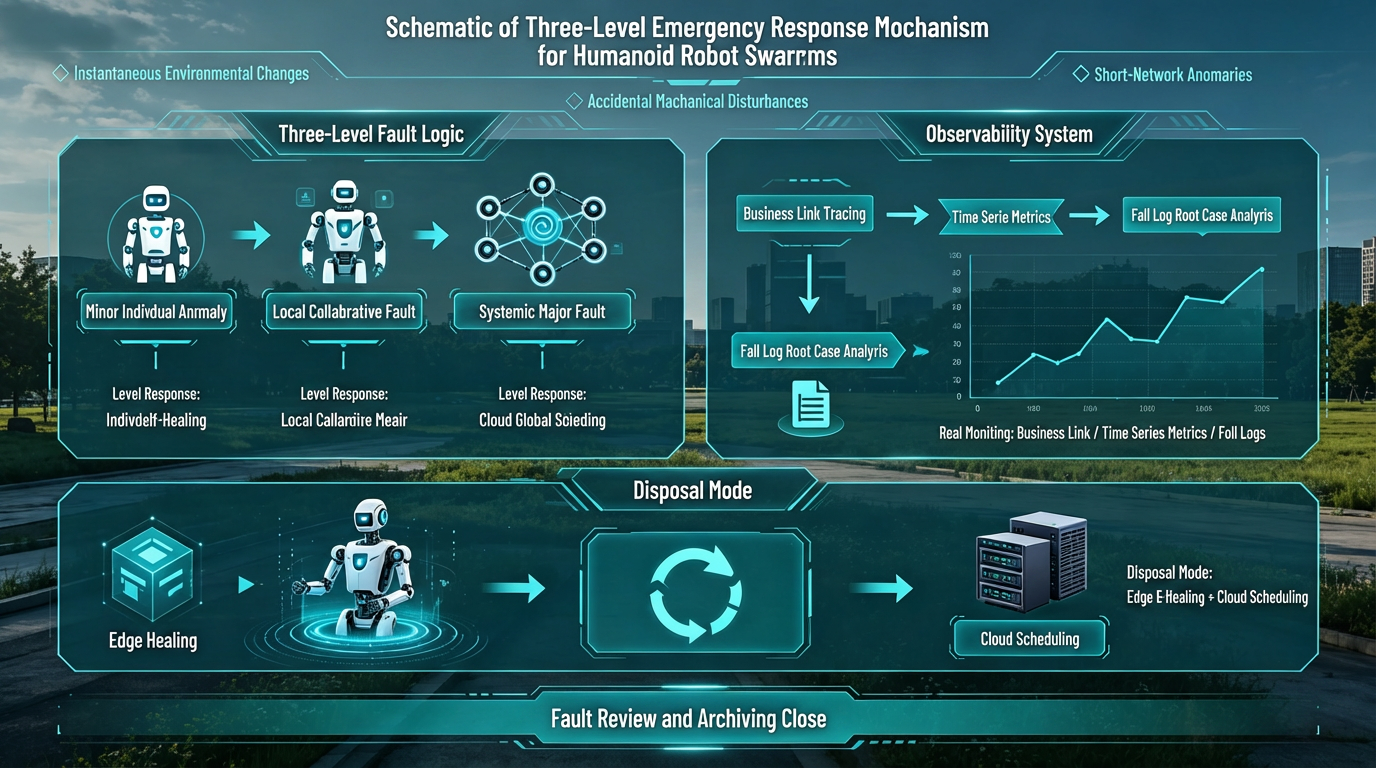
Open outdoor scenarios inherently involve uncertainty. Instantaneous environmental changes, accidental mechanical disturbances, and short-term network anomalies cannot be completely eliminated. A standardized, tiered, and automated emergency response mechanism is the key line of defense for ensuring continuous and stable cluster operation. Based on the business characteristics of multi-robot formation operation, a comprehensive three-level failure handling logic is established: minor individual anomalies, local coordination failures, and systemic major failures. O&M resources are reasonably allocated through tiered control to avoid excessive response or delayed handling.
When an abnormal event occurs, leverage the observability system to quickly locate the root cause: troubleshoot algorithm and schedule issues through business trace analysis, pinpoint the scope of hardware, power supply, and network anomalies using timing indicators, and restore the complete on-site context with full logs, significantly reducing failure troubleshooting and fix time. After each abnormal event is handled, the complete failure timeline, alerting records, root cause conclusions, and handling reports are automatically accumulated and archived. This not only forms an O&M closed loop, but also builds reusable practical experience for optimizing handling policies and iterating management rules for similar scenarios in the future.
The Beijing Yizhuang Humanoid Robot Half Marathon vividly demonstrates the rapid rise of China's humanoid robot industry and clearly signals that clustering, outdoor operation, and scenario-based deployment are the inevitable direction for the future development of embodied intelligence. As hardware integration and AI algorithms continue to break through, O&M capabilities are becoming a key variable that widens the industry gap. Multi-robot collaboration, hidden threat prevention, and full lifecycle management in open and complex environments are common challenges that all humanoid robot companies must address.
Alibaba Cloud's full-domain observability solution for embodied intelligence, built on a cloud-edge collaboration architecture, integrates three core capabilities: indicator monitoring, Tracing Analysis, and log analysis. It fully addresses the scenario features of humanoid robots, including mobile operations, cluster formation, weak network adaptation, and long-duration runs. Rather than being limited to a single event application, it provides a mature, standardized, and replicable O&M capability frame for similar outdoor cluster, dynamic operation, and large-scale deployment scenarios across the industry.
In the future, as the mass production scale of humanoid robots continues to expand and application scenarios keep extending, data-driven artificial intelligence for IT operations, proactive predictive protection, and full-link observability systems will become the core foundation for high-quality development of the embodied intelligence industry, continuously helping China's humanoid robot technology advance from technical demonstration to full-scale commercial deployment.
What Challenges Does Agent Face on the Path from Q&A to Autonomous Execution?

776 posts | 60 followers
FollowAlibaba Cloud Community - June 17, 2026
Alibaba Cloud Community - June 17, 2026
Alibaba Cloud Community - June 17, 2026
Alibaba Cloud Native Community - June 23, 2026
Alibaba Clouder - September 30, 2017
Alibaba Cloud Community - September 4, 2026
776 posts | 60 followers
Follow Application Real-Time Monitoring Service
Build business monitoring capabilities with real time response based on frontend monitoring, application monitoring, and custom business monitoring capabilities
Learn More CloudMonitor
Automate performance monitoring of all your web resources and applications in real-time
Learn More Global Application Acceleration Solution
This solution helps you improve and secure network and application access performance.
Learn More ADAM(Advanced Database & Application Migration)
An easy transformation for heterogeneous database.
Learn MoreMore Posts by Alibaba Cloud Native Community

