Recently, EventHouse, a new capability of Alibaba Cloud EventBridge, was officially launched and is now in public preview.
This is more than just a new query interface; it is a redefinition of the value of event data. EventHouse transforms transient "fire-and-forget" event streams into durable data assets that can be stored, governed, analyzed, and directly used by AI agents.
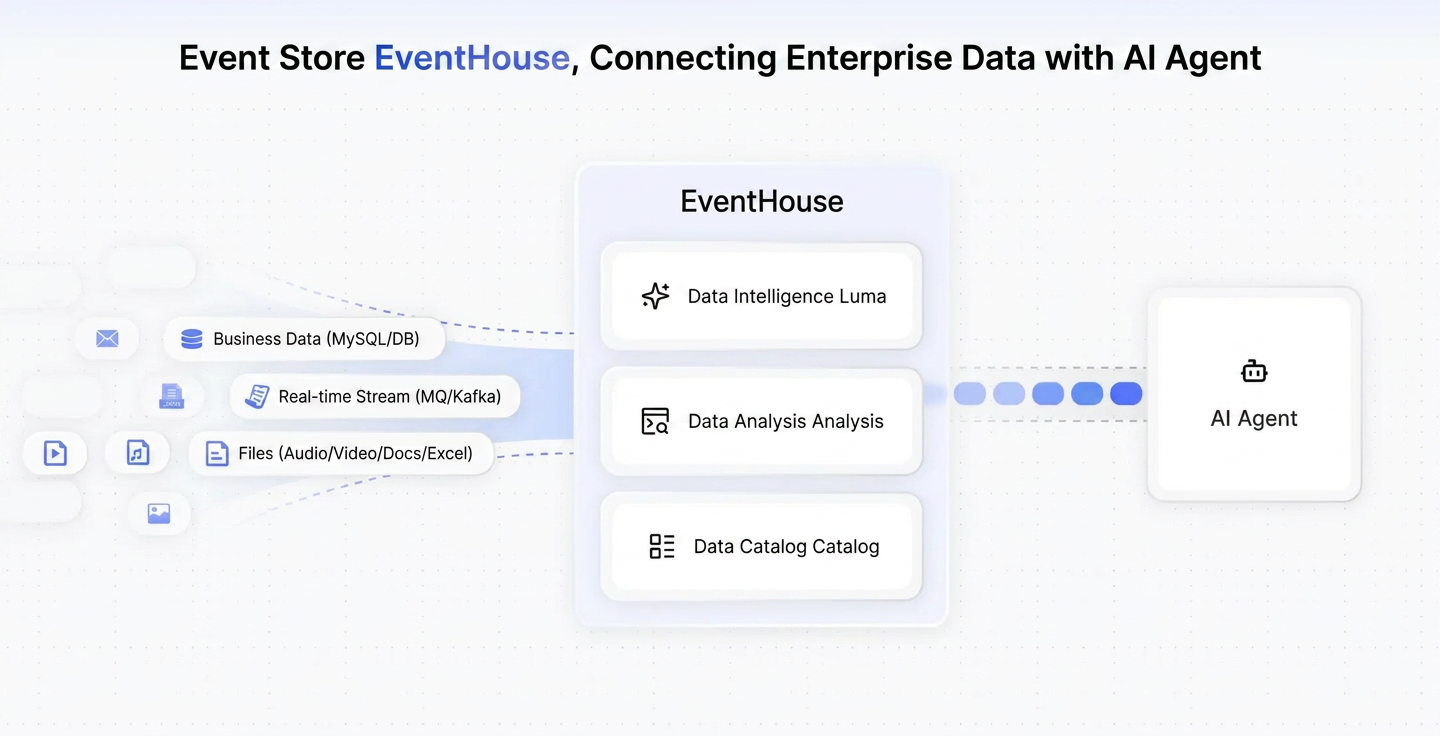
In digital enterprise operations, event data such as user behavior, system status, and transaction flows are continuously generated. This data is closely tied to business operations, highly time-sensitive, and extremely valuable. However, traditional event buses primarily focus on event routing and distribution. Once consumed, this data often lacks unified storage, governance, and analysis, eventually becoming "dark data" that is scattered, siloed, and difficult to reuse.
EventHouse serves as a bridge between enterprise data and AI agents. It combines the openness and flexibility of a data lake with the high-performance governance of a data warehouse to offer three key capabilities:
● Seamless integration: Supports multi-source, heterogeneous data ingestion from services such as Kafka, RocketMQ, MySQL, and Object Storage Service (OSS), eliminating the need for complex ETL development. Future updates will include support for Zero-ETL cross-source federated queries.
● Transparent governance: Establishes a unified Data Catalog to centrally manage metadata, schemas, permissions, and data lineage. This transforms data from "invisible and uncontrollable" to "manageable, traceable, and reusable."
● Conversational analytics: With natural language queries, built-in AI capabilities automatically perform queries and analysis. This enables business users to achieve "Analysis via Conversation" without writing a single line of SQL.
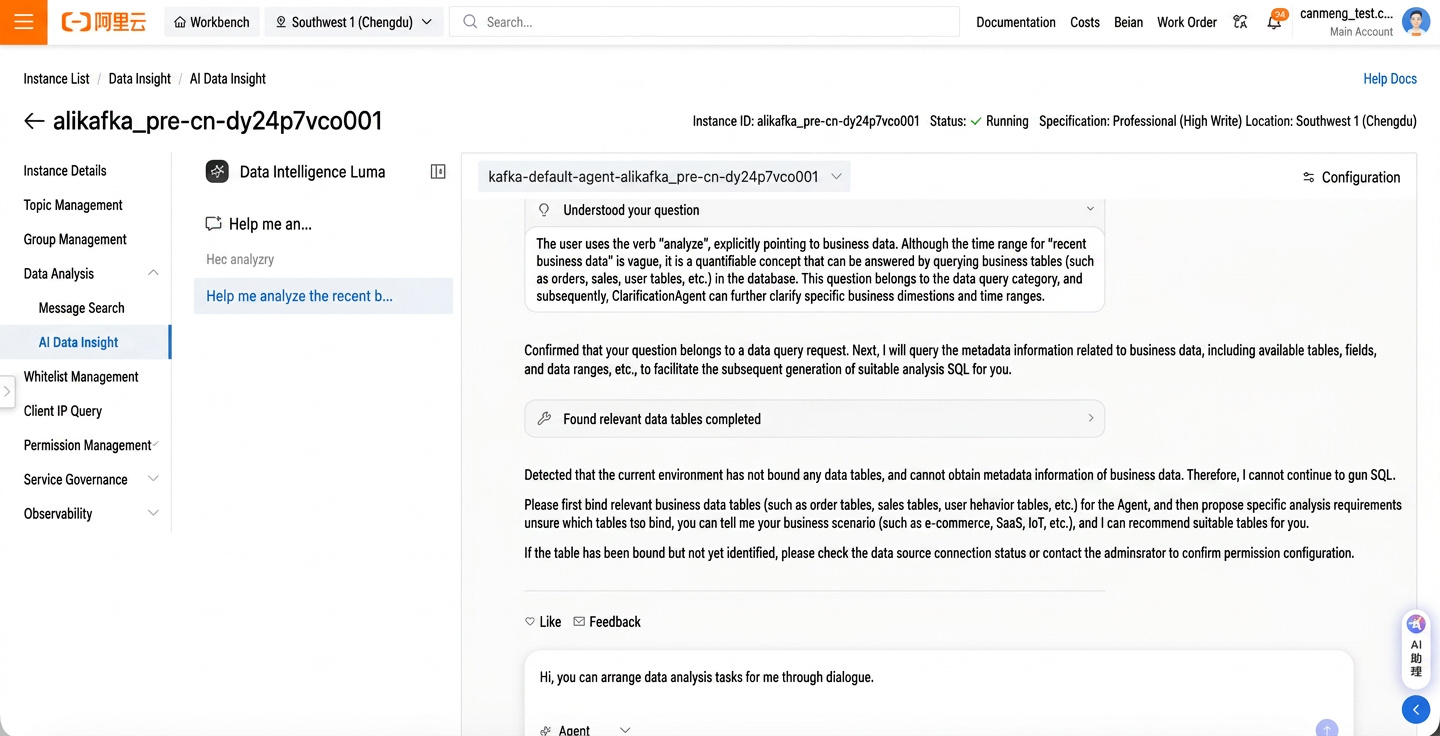
Additionally, Alibaba Cloud messaging products such as ApsaraMQ for RocketMQ and ApsaraMQ for Kafka provide one-click analysis entry points for EventHouse. This allows enterprises to gain real-time insights directly from their message streams, moving beyond "message transmission" to "message analysis."
The challenge for many enterprises is not a lack of data, but the lack of a unified way to manage it. When data is scattered across multiple systems, it is common to find inconsistent field definitions, unclear permission boundaries, and low collaboration efficiency.
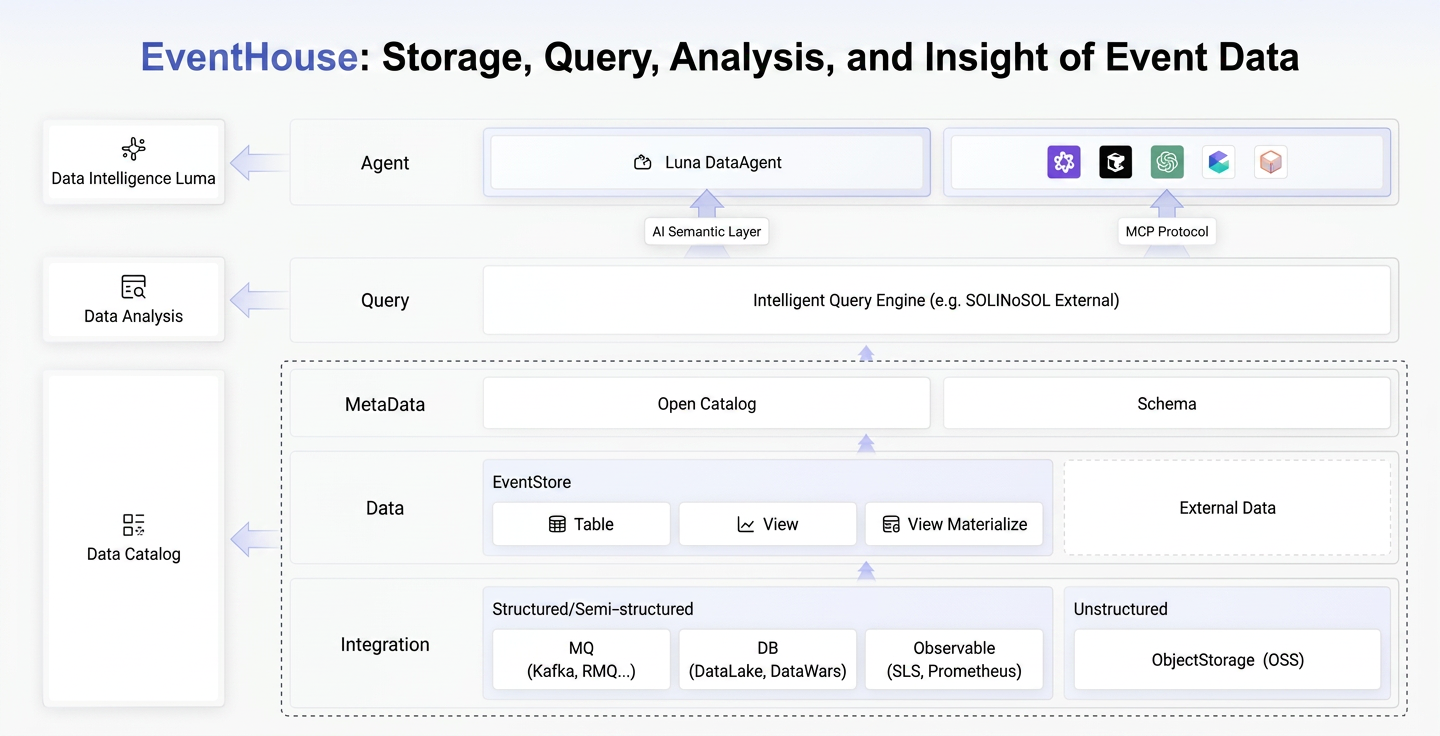
As the metadata management center of EventHouse, the Data Catalog provides unified management of metadata, schemas, access permissions, and data lineage for all connected data sources. It centralizes the ingestion, storage, and governance of scattered data to shorten the data-to-value time.
● Unified ingestion: Supports various data sources, including Kafka, RocketMQ, MySQL, and OSS.
● Persistent storage: Event data is stored in EventStore, which uses columnar compression for JSON and other event formats to significantly reduce storage costs.
● Unified governance: Connects to heterogeneous data sources via an Open Catalog. It supports automatic discovery and registration of multi-source metadata, automatically infers and manages schema versions, and is compatible with the Hive Metastore Thrift API and open table formats like Iceberg, Hudi, and Delta Lake. It also provides fine-grained access control at the database, table, and column levels.
The ability to quickly generate insights from ingested data determines its true business value. However, traditional data warehouses often struggle with the high throughput and low latency of real-time event streams, while messaging systems lack the capabilities for complex joins, aggregations, and multi-table analysis.
Analysis, the computing engine of EventHouse, provides high-performance SQL queries and stream processing. It enables real-time querying, aggregate analysis, and visualization of event data, helping businesses discover anomalies, analyze root causes, and respond faster.
● Multimodal queries: Supports SQL, NoSQL, and External query modes.
● Unified stream and batch processing: Uses the same SQL to query both historical data and real-time event streams.
● Real-time anomaly detection: Calculates metrics such as transaction success rates and latency distribution in real time, with automatic alerts triggered by configurable thresholds.
● Zero-ETL federated queries (planned): Enables unified analysis of real-time events, historical data, and external data without requiring data migration.
Often, the biggest barrier to solving business problems is not the data itself, but the inability to write SQL. While general-purpose LLMs can generate SQL, they often lack an understanding of internal field meanings, status code definitions, and business-specific statistical logic, leading to comprehension errors that affect the accuracy of the analysis.
Luma is the AI-native analysis capability of EventHouse and the primary entry point for users to interact with data. Through an AI Semantic Layer and a built-in DataAgent, it translates natural language into executable SQL, allowing business users to obtain reliable analysis results without writing code.
● AI semantic layer: Enhances text-to-SQL accuracy by adding descriptions, business aliases, and calculation logic to fields, helping the AI better understand business context.
● DataAgent autonomous analysis: Automates the entire workflow—from understanding the problem and probing metadata to generating, validating, and executing SQL—and outputs reports with root-cause analysis and recommended actions.
● MCP protocol integration (planned): Encapsulates data queries and operations as tools callable by intelligent agents, supporting integration with LangChain, Dify, and custom agents.
● Real-time context (planned): Provides AI agents with a real-time data context, updated to the second, to support Agentic RAG.
Data is scattered across systems such as MySQL, Kafka, RocketMQ, and OSS, featuring inconsistent data definitions and fragmented permissions. Analysts must query and export data from multiple systems and then correlate it manually—a process that is both inefficient and error-prone.
In EventHouse, when a new data source is connected, the Open Catalog automatically captures its schema, partition information, and data types, registering them as directly queryable logical tables. Analysts can query data through a unified view without needing to manage the underlying storage.
For example, order payment results are sent in real time via RocketMQ, while user profiles are stored in MySQL. By creating a virtual view named Order_View in the Catalog to join these sources, they can be queried together through a unified interface.
Messages from sources such as RocketMQ and Kafka provide first-hand data that reflects business changes, but building analysis pipelines with traditional methods is complex. With the one-click analysis entry point in EventHouse, enterprises can conduct real-time analysis directly from the message perspective for use cases such as transaction monitoring, link troubleshooting, operational analysis, and real-time IoT insights.
Examples:
● Analyze spikes in payment failure messages from a topic over the last 10 minutes and cross-reference them with historical logs to identify recurring errors.
● Identify backlogs in key stages, such as "paid but not shipped," from the order status stream to pinpoint at-risk orders like those placed successfully despite insufficient stock.
● Aggregate device alerts by model, region, and batch to build device health profiles and quickly identify concentrated failures.
Business users are often unfamiliar with SQL, and generic Text-to-SQL tools are prone to generating incorrect queries due to ambiguous field meanings and complex status code definitions. EventHouse empowers business users to shift their focus from "how to write SQL" to "how to ask the right business questions," enabling true zero-code analysis.
For example, when a user asks, "Which channels had the most payment failures in the last hour?", Luma uses semantic tagging to understand the specific fields and status codes associated with "payment failure," generating accurate SQL and returning reliable results.
With its mature and leading product capabilities, Alibaba Cloud EventBridge has been production-verified by tens of thousands of enterprises worldwide across industries including the Internet, finance, automotive, and education.
With the launch of EventHouse, EventBridge now offers a complete, fully managed, serverless event data ecosystem:
● EventBus: For receiving, routing, and distributing events.
● EventStreaming: For high-throughput event channels.
● EventHouse: For event data storage, querying, and analysis.
This ecosystem helps enterprises expand their event data capabilities from "transmission" to "storage, governance, analysis, and intelligent applications," providing a solid data foundation for real-time business insights and AI-driven decision-making.
Moving forward, Alibaba Cloud will continue to enhance the AI-native capabilities of EventHouse, enabling more roles to access data using natural language. This will shift analysis from "manual troubleshooting" to "proactive discovery and recommendations by AI agents," making it simpler, smarter, and more scalable to unlock the value of real-time data.
EventHouse is now in public preview! We invite you to be among the first to experience it and join us in shaping the future of real-time data analysis.
👉 Click here to join the public preview:
https://eventbridge.console.alibabacloud.com/cn-chengdu/event-house/overview
👥 Join our DingTalk group: 44552972

Put a Microscope on Hermes: Full Visibility into Agent Execution

776 posts | 60 followers
FollowAlibaba Cloud Native Community - May 9, 2026
Alibaba Cloud Native Community - June 4, 2026
Alibaba Cloud Native Community - September 30, 2026
Alibaba Cloud Big Data and AI - August 21, 2026
Alibaba Cloud Community - January 4, 2026
ApsaraDB - June 22, 2026
776 posts | 60 followers
Follow Token Plan
Build more, spend less. One plan, every modality.
Learn More QwenWork
QwenWork is dedicated to helping employees strengthen their professional competitiveness in the AI era and to enabling enterprises to improve organizational effectiveness.
Learn More
Alibaba Cloud Model Studio
A one-stop generative AI platform to build intelligent applications that understand your business, based on Qwen model series such as Qwen-Max and other popular models
Learn More EventBridge
EventBridge is a serverless event bus service that connects to Alibaba Cloud services, custom applications, and SaaS applications as a centralized hub.
Learn MoreMore Posts by Alibaba Cloud Native Community

