By Jing Cai (Xuejng)
In the cloud-native era, more and more users are using multiple Kubernetes clusters to manage their business due to the expansion of business (such as global business spread reaching single-cluster capacity limits), the shortage of resources in a single region (such as GPUs), and the growing requirements of disaster recovery and security compliance. The multi-cluster application distribution capacity of the Distributed Cloud Container Platform for Kubernetes (ACK One) can distribute Kubernetes resources in the Fleet instance to multiple clusters based on various policies, such as static weights, dynamic resource scheduling, and gang scheduling. ACK One also provides intelligent resource scheduling, rescheduling, and failover capabilities across multiple regions and clusters. You can easily integrate your existing single-cluster CD system with the multi-cluster application distribution of ACK One to minimize the transformation cost. You can quickly build a multi-cluster CD system with no modifications to the YAML file of the original application resources, and obtain powerful multi-cluster resource scheduling and distribution capabilities.
Alibaba Cloud DevOps is an all-in-one DevOps platform provided by Alibaba Cloud. It offers R&D toolchains and management services for the entire software R&D lifecycle. Applications can be deployed to ACK clusters through pipeline flows. This article takes Alibaba Cloud DevOps as an example, combining the CD capability of Alibaba Cloud DevOps with ACK One's multi-cluster application distribution, to demonstrate how to quickly transform from a single-cluster CD system to a multi-cluster CD system.
Distributed Cloud Container Platform for Kubernetes (ACK One) is an enterprise-level cloud-native platform provided by Alibaba Cloud. This platform can be used in hybrid cloud, multi-cluster, distributed computing, and disaster recovery scenarios. It provides unified multi-cluster management capabilities. Through ACK One registered clusters, you can connect your other public cloud vendors' or on-premises Kubernetes clusters to the Container Service for Kubernetes (ACK) console. Then, the Fleet instance performs unified multi-cluster application distribution, traffic management, observable O&M management, and security management for these registered clusters, as well as ACK and ACK Edge clusters.
Multi-cluster application distribution of ACK One provides the ability to manage application resources across multiple clusters in a unified manner for multi-cluster and hybrid cloud scenarios. If a single ACK cluster cannot meet the resource requirements of workloads, for example, a single region cannot meet the GPU resource requirements of inference services, you can use the resource scheduling capability of multi-cluster application distribution to locate available GPU resources across regions and clusters to fulfill the resource requirements. If you need to release applications to multiple clusters at the same time or improve application reliability through multi-region and multi-cluster deployment, this capability provides an efficient solution. This capability has the following main distribution and scheduling features:
1. Intelligent multi-region and multi-cluster resource scheduling: Search for resources across regions and clusters, including existing nodes of multiple clusters and Elastic Compute Service (ECS) or serverless resources, to minimize shortages, optimize resource utilization, and improve business efficiency.
2. Multi-cluster gang scheduling: Ensure multi-cluster gang scheduling for workloads through preemption or dynamic resource detection. This guarantees that tasks can be scheduled after they are sent to sub-clusters, improving task scheduling efficiency.
3. Multiple distribution strategies: Support replication, static weight, and dynamic weight.
4. Rescheduling and failover: If a workload fails in a sub-cluster, the Global Scheduler reclaims the workload, and reschedules or fails over it to other qualified clusters with sufficient resources.
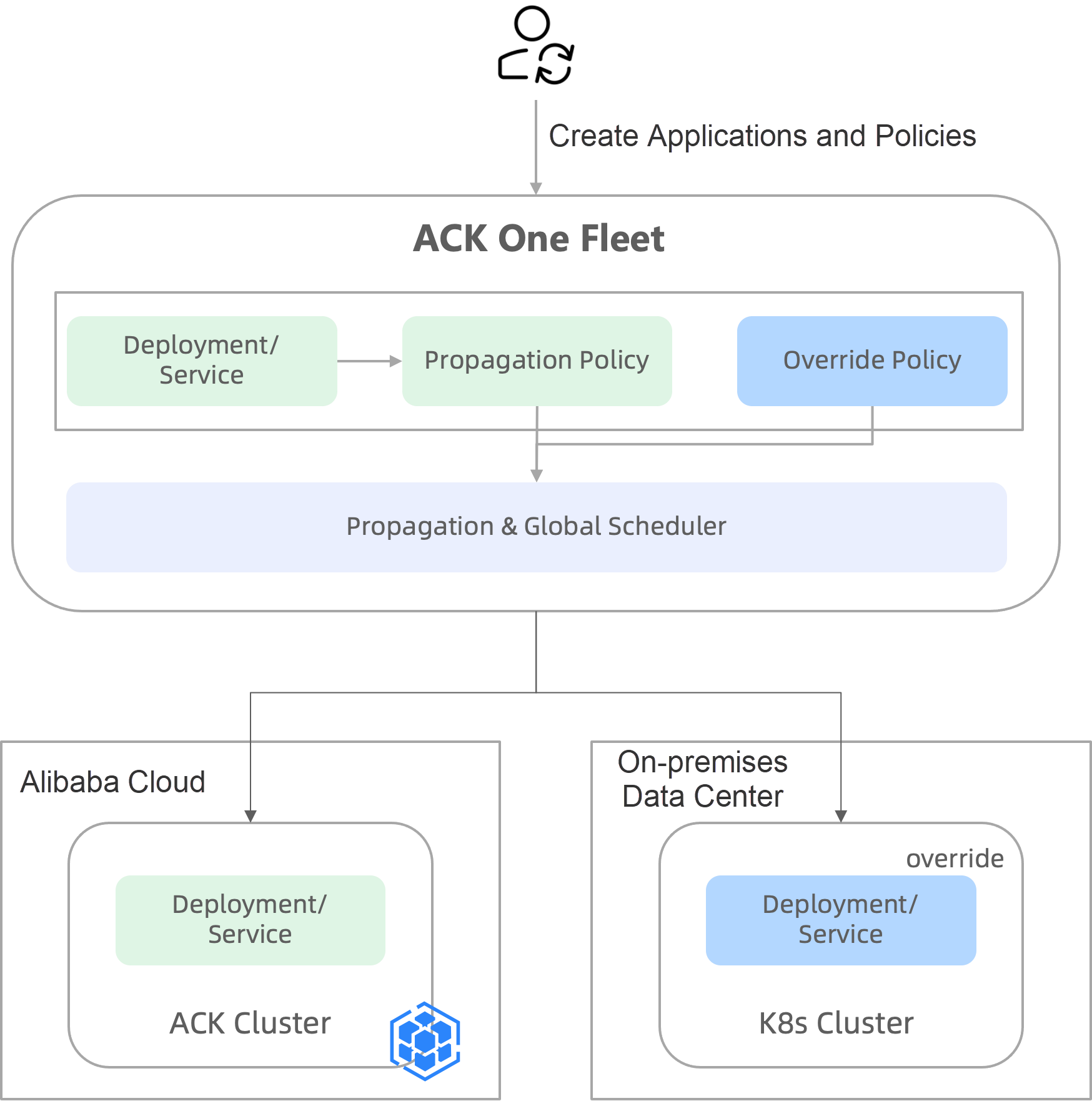
The following content describes the process in detail:
PropagationPolicy on the Fleet instance.The following example shows how to transform a single-cluster CD system into a multi-cluster CD system by using multi-cluster application distribution of ACK One.
Combined with multi-cluster application distribution of ACK One and Alibaba Cloud DevOps, a single-cluster CD system can be quickly changed into a multi-cluster CD system:
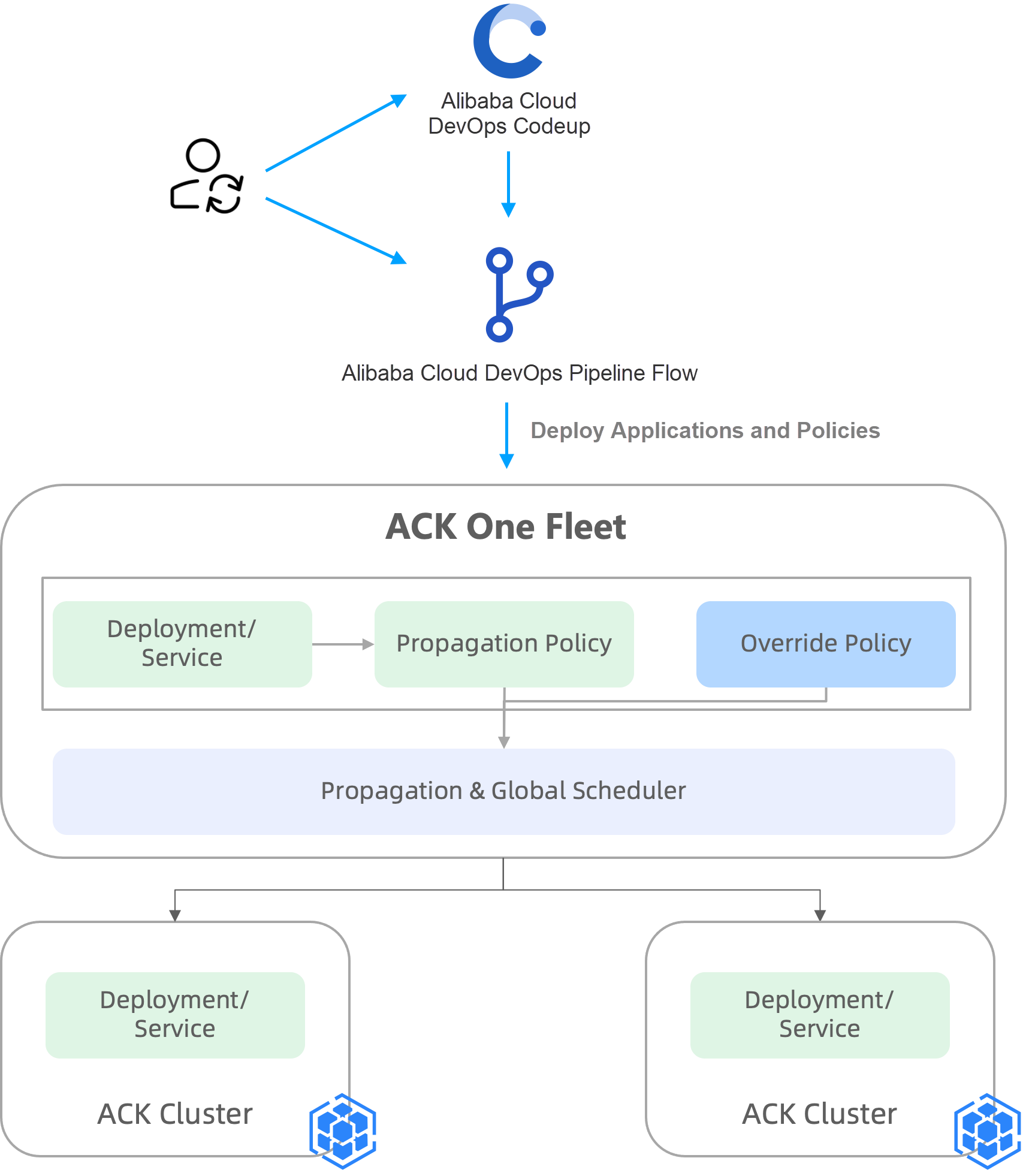
The architecture is shown in the preceding figure. The main process is as follows:
1. Create an ACK One Fleet instance and associate multiple clusters with the instance.
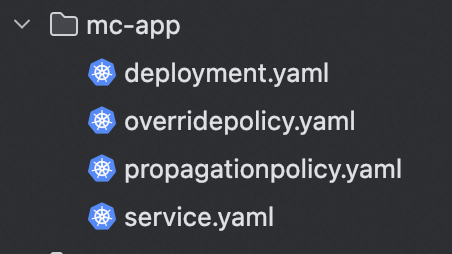
2. Submit the PropagationPolicy and the OverridePolicy to the application directory of Codeup without modifying the original YAML file.
a) The following figure shows the ACK One demo directory.
b) If you need multi-cluster resource scheduling capabilities, you can specify them in the PropagationPolicy.
3. Modify the existing single-cluster CD Alibaba Cloud DevOps pipeline and configure the deployment of applications and policies to the ACK One Fleet instance.
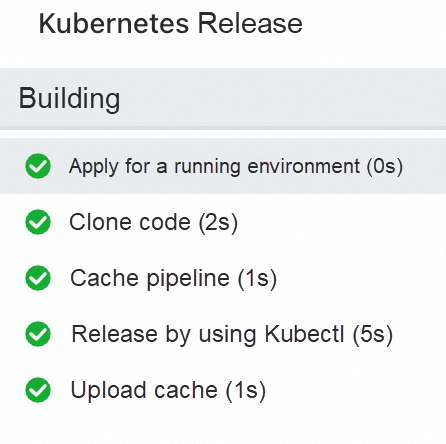
Kubernetes release - The cluster configuration file in the release is changed from the kubeconfig file of the single cluster to the kubeconfig file of the Fleet instance. You can enter the Fleet ID in Cluster ID.
4. After you trigger the pipeline execution, the application resources and policies are deployed to the ACK One Fleet instance. Then, applications are distributed to multiple clusters based on the policies. The system takes over the application deployed in the single cluster without causing any service interruption or restart of workloads (provided the YAML file of the application remains unchanged).
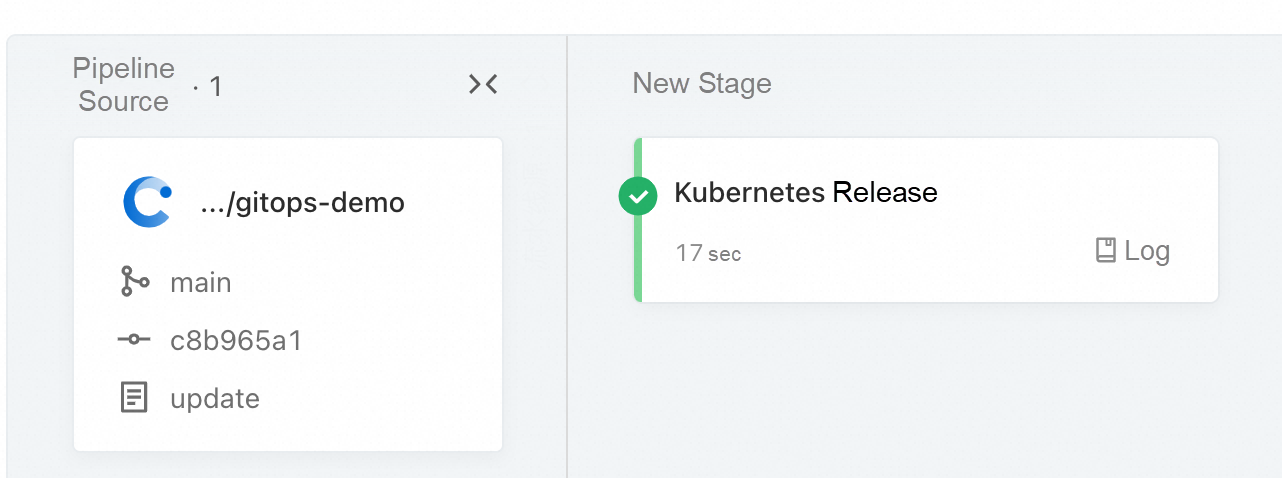
After running the Alibaba Cloud DevOps pipeline, the console displays the following information. Then, you can check the Fleet instance to verify whether resources are deployed and monitor the distribution status of sub-clusters.
Multi-cluster application distribution of ACK One focuses on providing superior unified application management capabilities across multiple clusters, reducing the management cost and allowing you to concentrate on your business. It provides intelligent resource scheduling capabilities across multiple regions and clusters to maximize resource availability and enhance your business efficiency. Additionally, it can also be easily combined with your existing single-cluster CD system. With just two simple modifications, you can quickly and losslessly upgrade a single-cluster CD system to a multi-cluster CD system to obtain the above powerful capabilities:
You do not need to change the YAML file of the original application resources and will not cause pod restarts in the original cluster.
For more information, see Multi-cluster CD with ACK One and Alibaba Cloud DevOps and Multi-cluster application distribution of ACK One.
StrmVol Volumes: Boosting Kubernetes Object Storage Performance for Small Files
Simplified Deployment Tutorial of the Qwen3 LLM on Alibaba Cloud Container Service for Kubernetes

229 posts | 34 followers
FollowAlibaba Container Service - April 17, 2024
Alibaba Container Service - December 5, 2024
Alibaba Container Service - December 26, 2024
Alibaba Container Service - June 26, 2025
Alibaba Container Service - November 21, 2024
Alibaba Container Service - April 24, 2025
229 posts | 34 followers
Follow ACK One
Provides a control plane to allow users to manage Kubernetes clusters that run based on different infrastructure resources
Learn More
Container Service for Kubernetes
Alibaba Cloud Container Service for Kubernetes is a fully managed cloud container management service that supports native Kubernetes and integrates with other Alibaba Cloud products.
Learn More
Container Compute Service (ACS)
A cloud computing service that provides container compute resources that comply with the container specifications of Kubernetes
Learn More API Gateway
API Gateway provides you with high-performance and high-availability API hosting services to deploy and release your APIs on Alibaba Cloud products.
Learn MoreMore Posts by Alibaba Container Service

