Autoregressive large language models (LLMs) usually decode one token at a time. For every output token, the serving system runs the target model, samples or selects the next token, appends it to the sequence, updates the key-value (KV) cache, and repeats the cycle. This design is faithful to the model, but it creates a structural serving bottleneck: the decode stage is sequential, memory-bandwidth-heavy, and often unable to fully exploit modern parallel accelerators. Speculative decoding changes the shape of this bottleneck. Instead of asking the expensive target model to produce every next token one by one, the system asks a cheaper drafter to propose several future tokens and then asks the target model to verify those candidates in parallel. When the target accepts a long prefix of the draft, the serving system advances by multiple output tokens in one target-model step.
The most important point for product and technical leaders is that speculative decoding is not merely a model-side optimization. It is a serving-system pattern. A drafter proposes candidate tokens, the target model remains the authority, the sampler accepts the longest valid prefix, and the runtime commits only the accepted state. In exact speculative sampling, this can preserve the target model’s output distribution except for normal numerical precision effects. The practical value, however, depends on how well the technique is integrated with the scheduler, KV cache, quantization stack, and operator/kernel runtime layer. In a production Model-as-a-Service (MaaS) platform such as Smart Studio or TokenWorks, speculative decoding should therefore be treated as part of a broader token-level service-level objective (SLO) and cost-optimization architecture, not as a standalone “make decoding faster” switch.
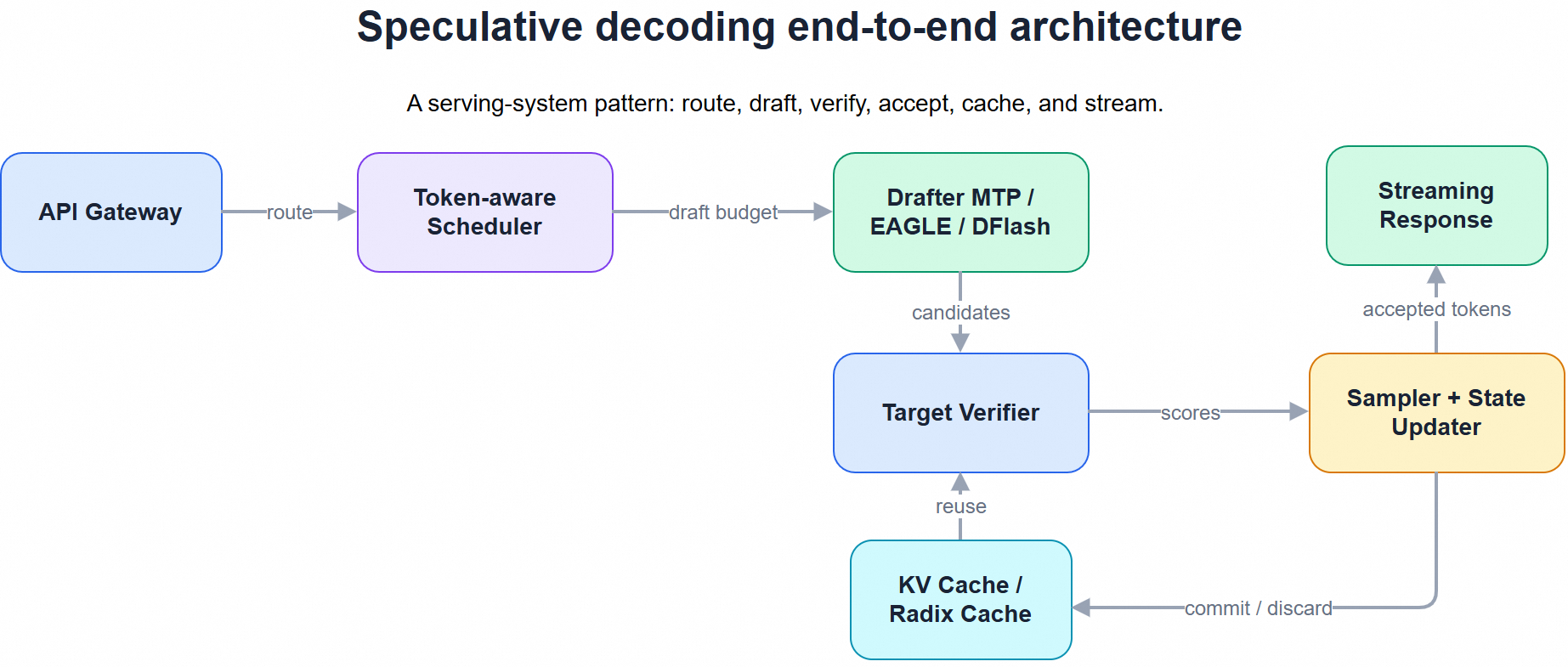
The promise is straightforward:
REMINDER
The caveat is just as important: speedup is workload-sensitive, implementation-sensitive, and scheduler-sensitive. A drafter that works well for code completion may be weak for open-ended chat. A method that improves latency at low QPS (queries per second) may compete with normal batching at high QPS. A theoretically elegant algorithm can still underperform if KV-cache bookkeeping, sampling, or operator launch overhead is inefficient.
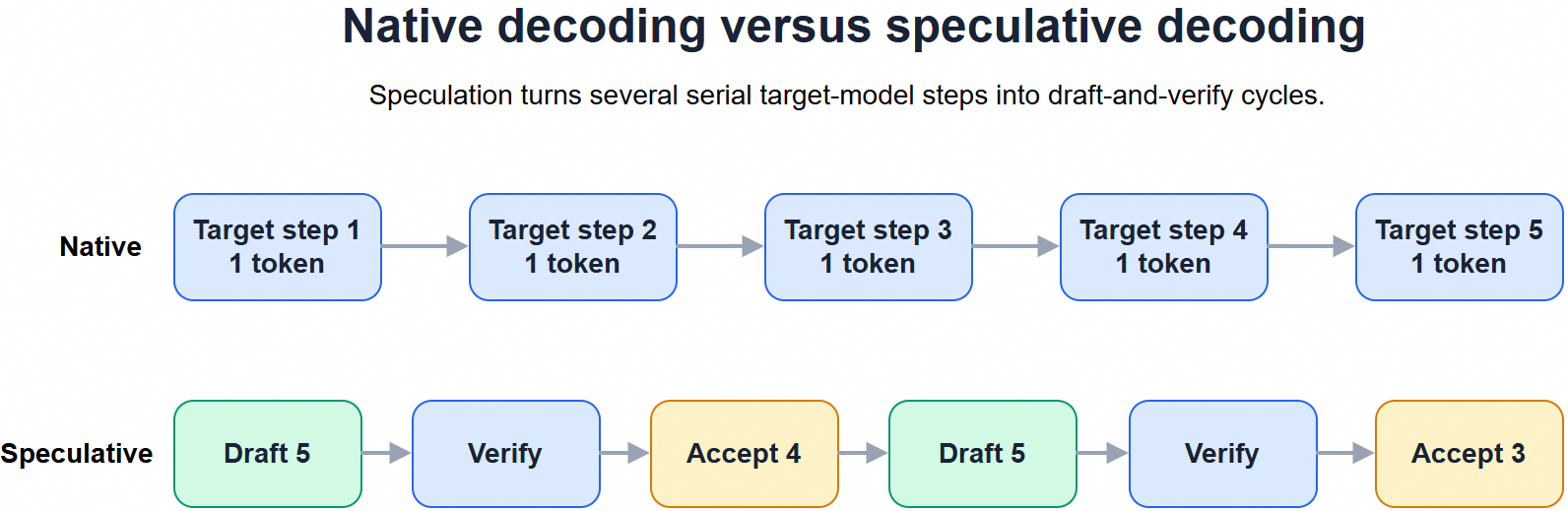
The core loop has four stages:
Exact speculative sampling is attractive because the target model remains the final decision maker. The user should receive target-model-quality output, while the serving system gets more useful output tokens per expensive target-model invocation when the draft is accurate. The original speculative decoding paper reports 2×–3× acceleration for T5-XXL (the extra-extra-large variant of the Text-to-Text Transfer Transformer) without changing the output distribution, and serving frameworks such as vLLM (an open-source LLM serving engine built around paged attention) position speculative decoding as a way to reduce inter-token latency when the method matches the model family, hardware, QPS, and sampling configuration.
Different drafter families make different operational trade-offs:
NOTE
The economic center of speculative decoding is acceptance rate. A larger draft length does not automatically mean higher speed. If the drafter proposes fifteen tokens but the target model accepts only one or two, the system has paid draft overhead and verification overhead without advancing far.
A useful operational metric is mean acceptance length, which captures how many tokens the system effectively produces per verification step. Internal Qwen3.6-35B-A3B testing illustrates the point (the name denotes 35 billion total parameters with about 3 billion active per token): HumanEval and GSM8K (Grade School Math 8K) showed stronger gains and higher acceptance, while open-ended conversation and long-form summarization had lower acceptance and smaller gains. Code and structured reasoning contain repeated patterns, syntax conventions, and predictable templates; open-ended generation gives the target model and drafter more room to diverge.
Consider a code-completion endpoint exposed through a MaaS platform. A developer sends a prompt such as:
def calculate_discount(price, user_tier):The scheduler classifies the request as latency-sensitive and likely to have high draft acceptance because code has indentation, syntax, keywords, repeated function patterns, and common control-flow structures. The platform enables speculative decoding with MTP or EAGLE3 and allows a draft length of five tokens. The drafter proposes a continuation such as:
if user_tier ==The target model verifies the candidate block in one pass, and the runtime accepts most or all of that prefix. The stream advances by several tokens per target-model step, lowering TPOT (time per output token) and making the completion feel more immediate to the developer.
A simplified scheduler policy might look like this:
if workload == "code" and acceptance_rate >= target_threshold:
    enable_speculation(method="MTP_or_EAGLE3", draft_length=5)
elif acceptance_rate < minimum_threshold or kv_cache_pressure == "high":
    reduce_or_disable_speculation()
else:
    keep_native_decoding_or_short_draft()
Now compare that with an open-ended design chat, such as “brainstorm ten unusual metaphors for enterprise GPU monetization.” The output space is wider. Many continuations may be valid, and the target model may choose a path that the drafter did not predict. In that case, the acceptance length can collapse.
A mature scheduler should react in one of three ways:
REMINDER
Speculation is therefore a runtime policy tied to workload type, sampling settings, measured acceptance, cache pressure, and SLO tier, not a static inference flag.
Both halves of this example can be explored with the code shipped alongside the article; see the closing section for what each file does.
The scheduler is the control-plane component that decides which requests run together, how many tokens can be processed in a batch, and which workers should serve each request. With speculative decoding, its job expands. It must decide whether speculation should be enabled for a request, how many draft tokens the drafter may propose, how to budget target verification tokens, and whether invoking the drafter is worthwhile under current load.
In ordinary decoding, scheduling mostly balances queueing latency, batch size, KV capacity, and fairness. With speculation, the scheduler also needs token-level controls. A request may consume draft compute, verification compute, and temporary or branch KV state before the system knows how many proposed tokens will be accepted. Under low QPS, speculation can be especially attractive because target-model decode steps may underutilize the GPU. Under high QPS, normal batching may already keep the hardware busy, so speculative decoding can still help but may also compete with batch-token budget and KV memory. Method selection therefore cannot be separated from traffic conditions.
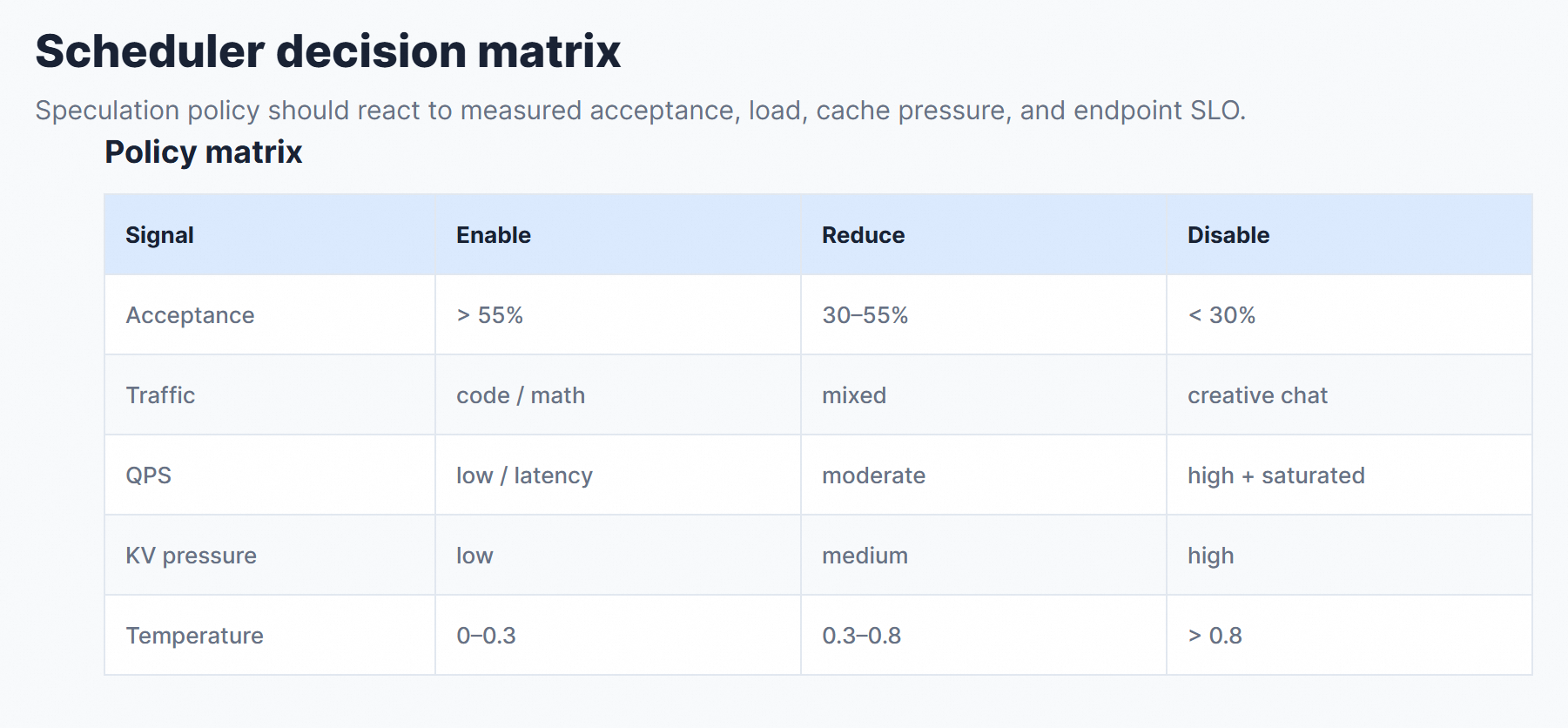
A production scheduler can apply clear policies:
NOTE
The key principle is that speculation should be scheduled inside a token-aware control plane, not bolted behind a stateless gateway.
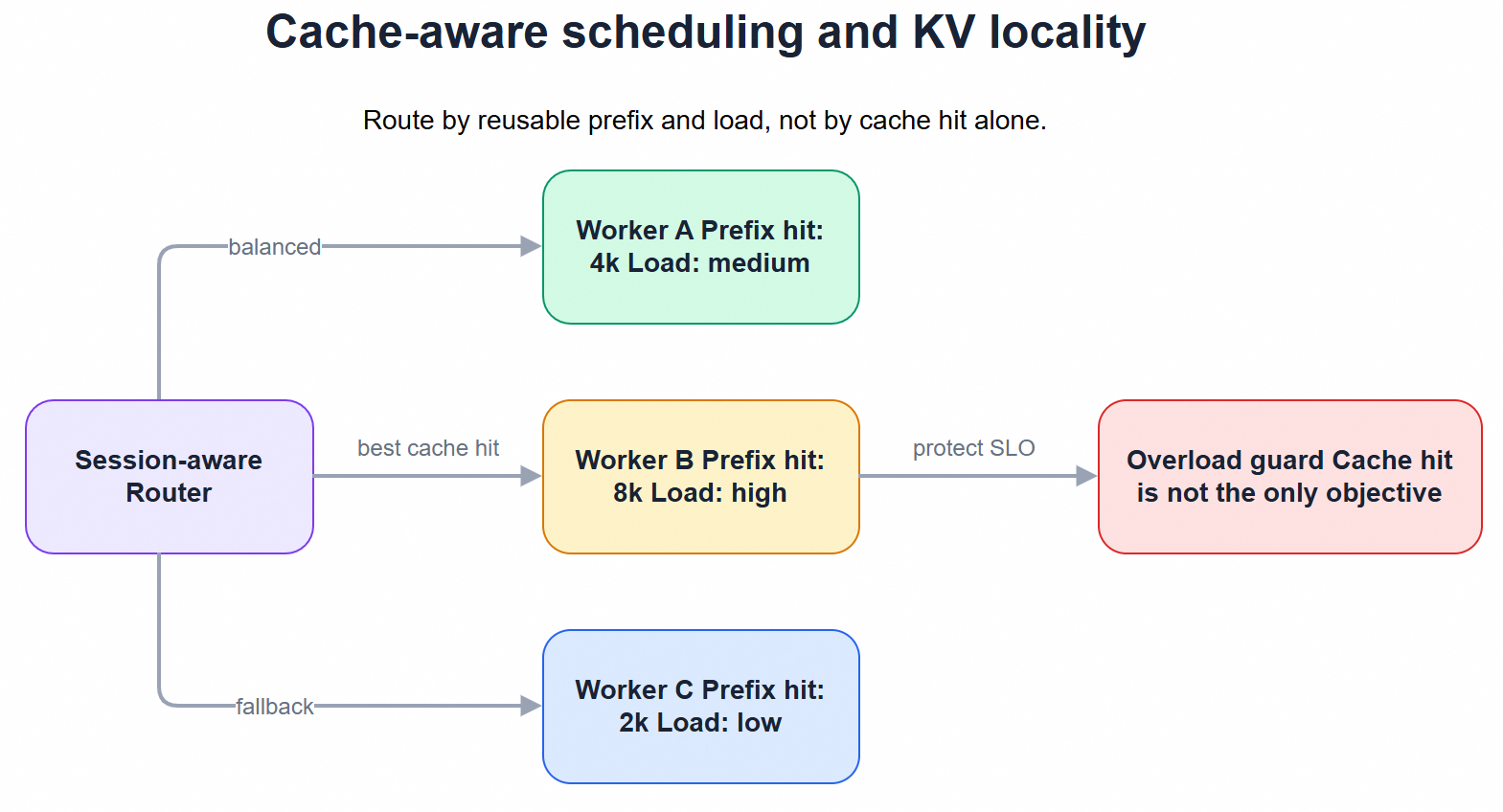
Cache-aware and session-aware routing also matter. If a multi-turn session has reusable prefix KV on one worker, moving the request to another worker may erase a valuable cache advantage. TokenWorks frames enterprise inference around token-level limits, PD orchestration, session-aware scheduling, cache-aware scheduling, and DP-rank-aware (data-parallel-rank-aware) scheduling for MoE (mixture-of-experts) decode. Smart Studio’s high-performance inference stack similarly depends on KV cache, prefill/decode separation, long/short request isolation, and dynamic batching.
The KV cache is both an enabler and a constraint. It lets the model reuse attention keys and values for previous tokens instead of recomputing the entire context each step. Speculative decoding increases the number of candidate tokens considered per iteration, so the runtime must track which of those candidates deserve a permanent place in the cache and reuse prefix blocks efficiently across verification passes. If KV bookkeeping is inefficient, speculation can lose much of its theoretical advantage.
The simplest mental model is accepted-token KV versus rejected-token KV:
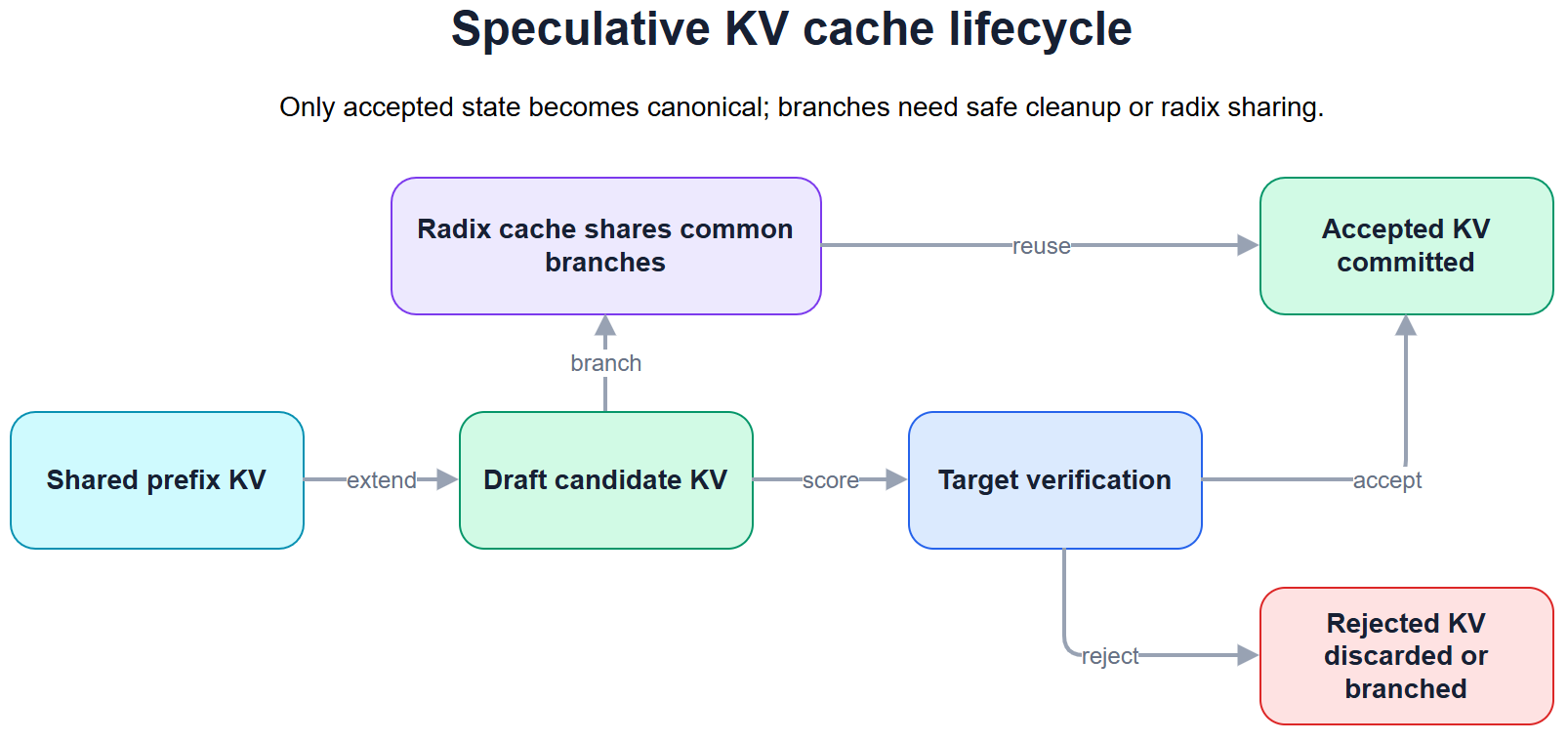
Prefix reuse and cache-aware placement connect the KV layer back to scheduling. NVIDIA’s KV cache reuse work describes cache-aware routing that sends requests to executors already holding reusable KV blocks rather than simply choosing the least-loaded worker. TokenWorks describes cache-aware scheduling that routes to the node with the longest prefix hit while still protecting overloaded instances. RTP-LLM (Real-Time Prediction Large Language Model), Alibaba’s real-time-prediction LLM inference engine, describes cache affinity for decode, unified prefix matching, and multi-tier KV cache across GPU memory, local CPU (central processing unit) memory, remote CPU memory reached over RDMA (remote direct memory access), and distributed storage. Speculation raises the stakes on all of these designs: accepted multi-token steps make correct KV placement more valuable, and rejected branches make poor state management more expensive.
A useful production pattern is to combine speculative decoding with decode radix cache. TokenWorks mentions PPD (partial prefill on decode nodes) and Decode Radix Cache: PPD lets decode nodes handle incremental prefill locally in multi-turn conversations, while Decode Radix Cache organizes KV as a prefix tree so speculative sampling and multi-branch decode candidates can share physical KV without redundancy. That is the natural memory architecture for speculation.
Quantization reduces the cost of moving and computing model data. It compresses model weights, activations, and sometimes KV cache into lower-precision formats such as FP8 (8-bit floating point), FP4 (4-bit floating point), NVFP4 (NVIDIA’s FP4 variant), MXFP4 (microscaling FP4), INT8 (8-bit integer), or INT4 (4-bit integer). TensorRT-LLM, NVIDIA’s TensorRT runtime for large language models, supports several quantization paths, including FP8, FP4/NVFP4/MXFP4, AWQ (activation-aware weight quantization), GPTQ (post-training quantization for generative pre-trained transformers), and FP8/NVFP4 KV-cache options depending on hardware. Smart Studio deployment mapping uses low-precision formats such as NVFP4 for several large models on latest-generation data-center GPUs, showing that low precision is already part of the commercial MaaS deployment assumption.
Speculative decoding interacts with quantization in two places:
RTP-LLM analysis notes on-the-fly KV cache quantization to INT8 or FP8 with per-tensor or per-block scaling, reducing memory occupancy and bandwidth pressure, and reports significant batch-latency reduction for Qwen3-32B under FP8 KV cache.
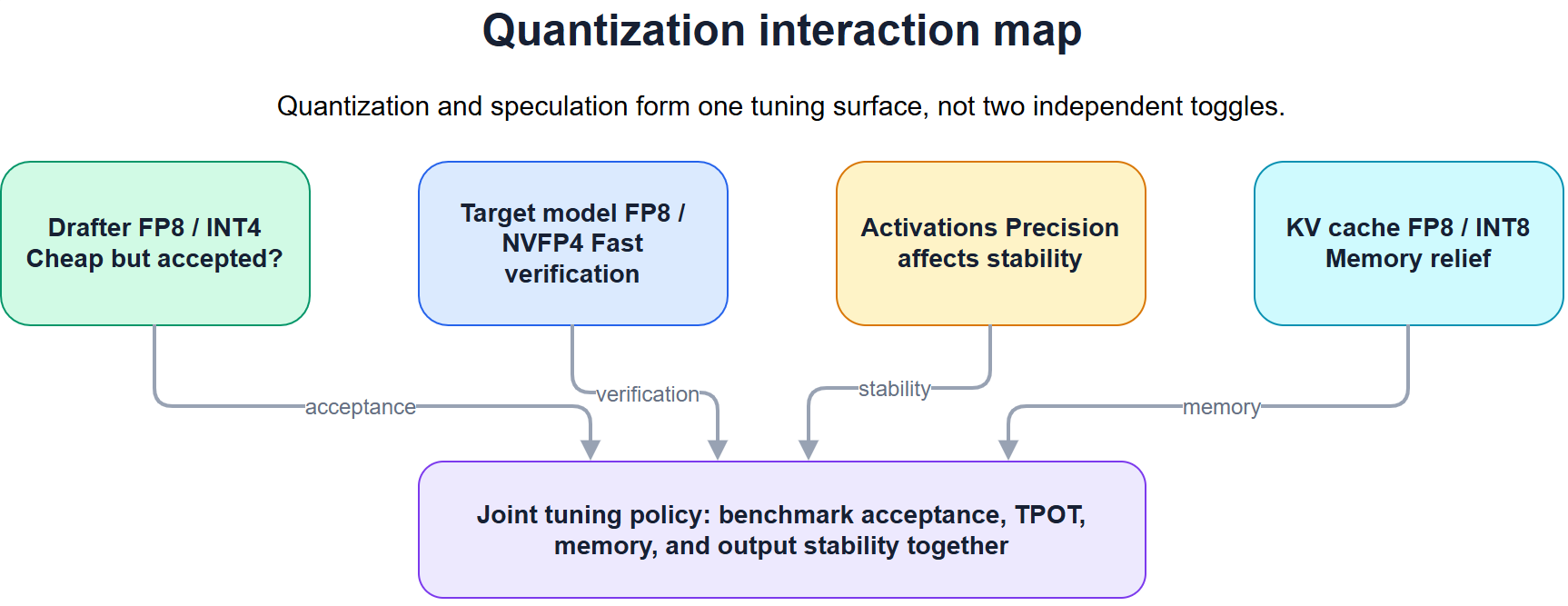
The practical recommendation is to benchmark speculation and quantization together. A platform team should measure:
REMINDER
Quantization and speculation are not independent toggles; they are part of the same performance surface.
Speculative decoding shifts the hot path from pure memory-bound single-token decode toward a mixed workload:
If those steps are launched as many small Python-level operations, overhead can dominate. The operator layer needs fused kernels, native runtime integration, efficient attention kernels, low-overhead sampler/update logic, and hardware-specific optimization.
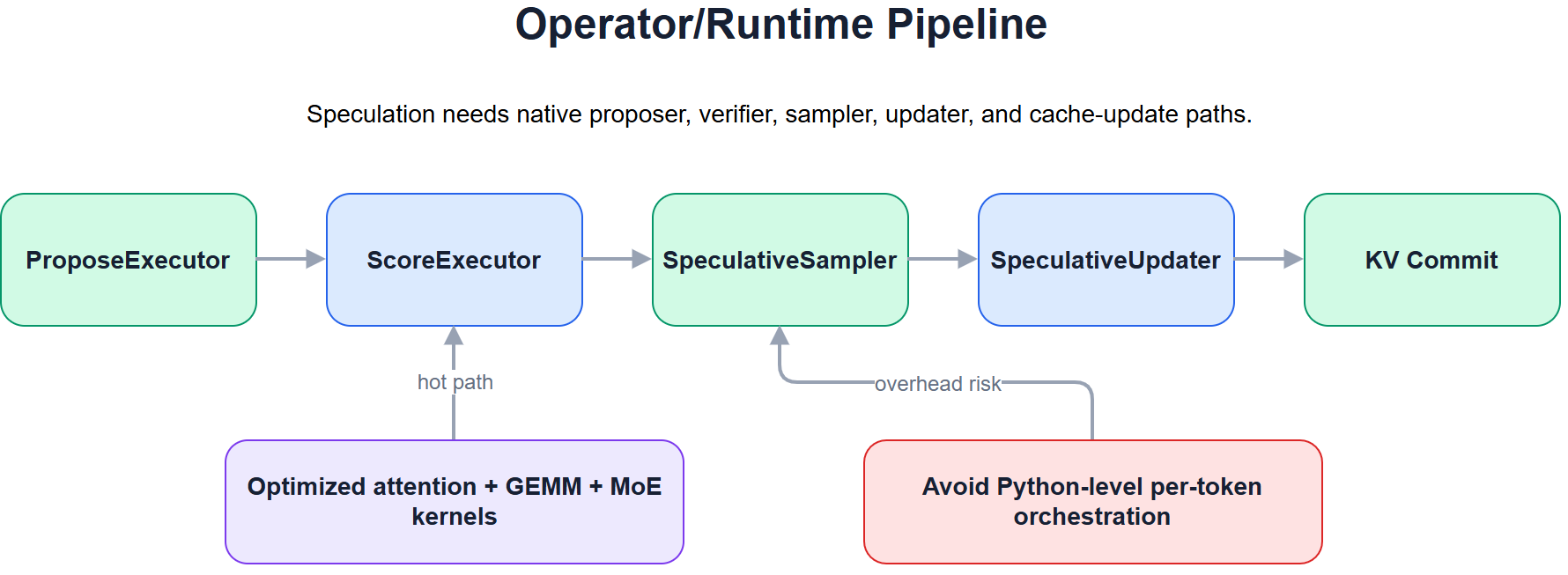
The target verification path is especially important. It should use the same optimized attention and GEMM (general matrix multiplication) stack as normal decode, but over a block of speculative tokens. On hardware where verifying many tokens is nearly flat-cost or highly parallel, block verification creates major upside. Google’s DFlash writeup for its TPU (tensor processing unit) hardware says modern TPU-class accelerator verification can make the cost of verifying many tokens almost identical to verifying a much smaller block in the studied setup, which explains why block drafting can work particularly well there.
The sampler and updater should be first-class runtime operators. RTP-LLM’s speculative sampling framework is decomposed into four parts:
The C++ native implementation is intended to avoid Python-to-C++ operator launch overhead. That decomposition reveals what a mature implementation actually requires. Speculative decoding is not only “run a drafter, then run the model.” It is a native inference-engine pipeline that must update sequence state and KV state efficiently under batching and streaming constraints.
MoE and hardware-specific operators add another layer. Smart Studio deployment guidance calls out latest-generation GPU-native fused megamoe, data-parallel attention (DP-Attention) to reduce KV redundancy, EP (expert parallelism) scaling, and low-precision mapping for advanced GPU deployments. TokenWorks mentions network and operator co-optimization on 真武 PPU (Parallel Processing Unit) accelerators for MoE communication primitives and hot operators. Speculative decoding amplifies the value of these kernels because every accepted multi-token step increases useful work per scheduler iteration.
Traditional draft models may still generate K draft tokens sequentially. DFlash changes the drafter itself by using block diffusion to propose multiple future tokens in one forward pass, conditioned on target-model hidden states. This attacks the draft bottleneck directly. Instead of asking the drafter to walk token by token, DFlash produces a block proposal that the target model can verify. Public DFlash materials report large speedups in favorable hardware and workload settings, and the public z-lab/dflash repository provides implementation artifacts readers can inspect for code, checkpoints, and integration details.
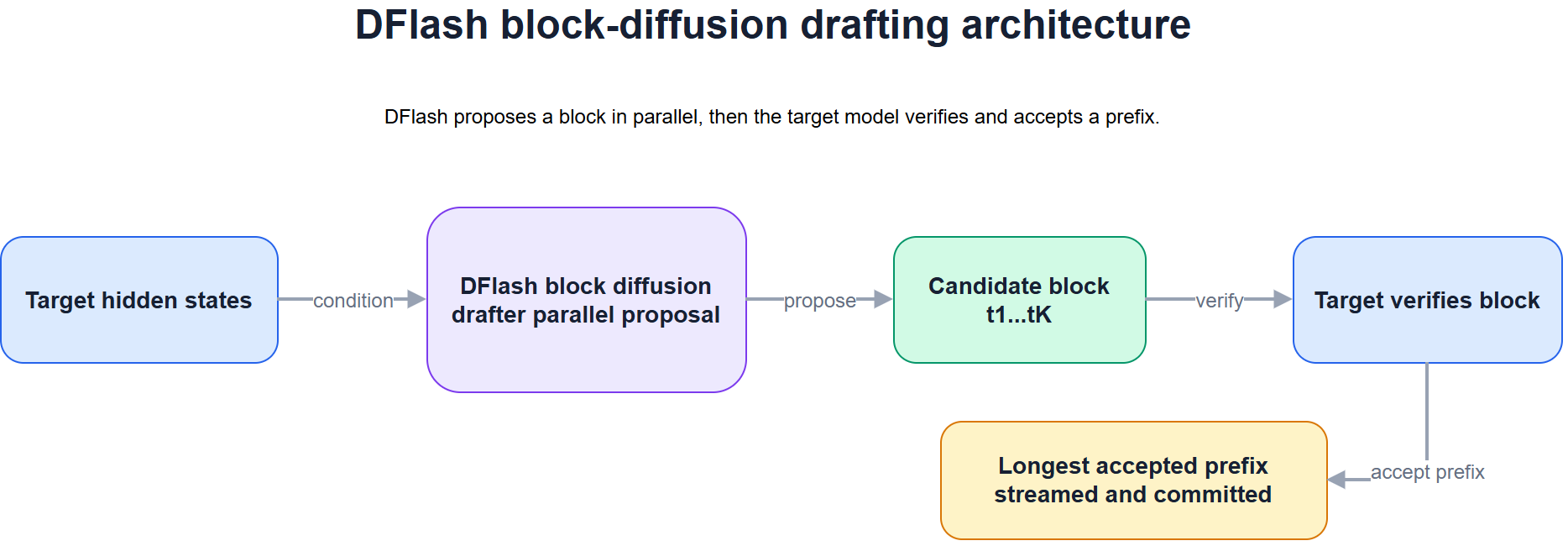
The public benchmark story is promising:
WARNING
The internal benchmark story is more cautious, which is exactly why it is valuable. In Qwen3.6-35B-A3B pressure testing, DFlash with step=15 averaged about 1.49× output-throughput speedup, behind native MTP at about 1.86× and EAGLE3 at about 1.81×. The report notes implementation instability in vLLM at some low-concurrency settings, including repeated-character output in some cases. It also observes that DFlash can show high mean acceptance length in some settings, but draft computation overhead and instability can eat the advantage.REMINDER
DFlash is promising, yet deployment maturity, hardware match, framework support, and workload distribution decide its production value.
In Smart Studio or TokenWorks, DFlash should be positioned as a candidate for decode acceleration inside a token-aware MaaS stack. TokenWorks already mentions DSpark/DFlash block-diffusion speculative sampling as a self-developed speculative sampling engine that produces longer candidate sequences per forward pass and performs batch verification. If DFlash is integrated with routing, KV cache, quantization, and operator optimization, it can become a monetizable latency/cost feature rather than a research demo.
The main benefits can be remembered as three operating outcomes:
NOTE
TokenWorks frames enterprise inference around “P99 first-token latency × token throughput × cache hit rate × unit cost,” where P99 denotes the 99th-percentile value across requests. That is the right lens. Speculation affects token throughput and unit cost, but it also depends on cache hit rate and latency SLOs.
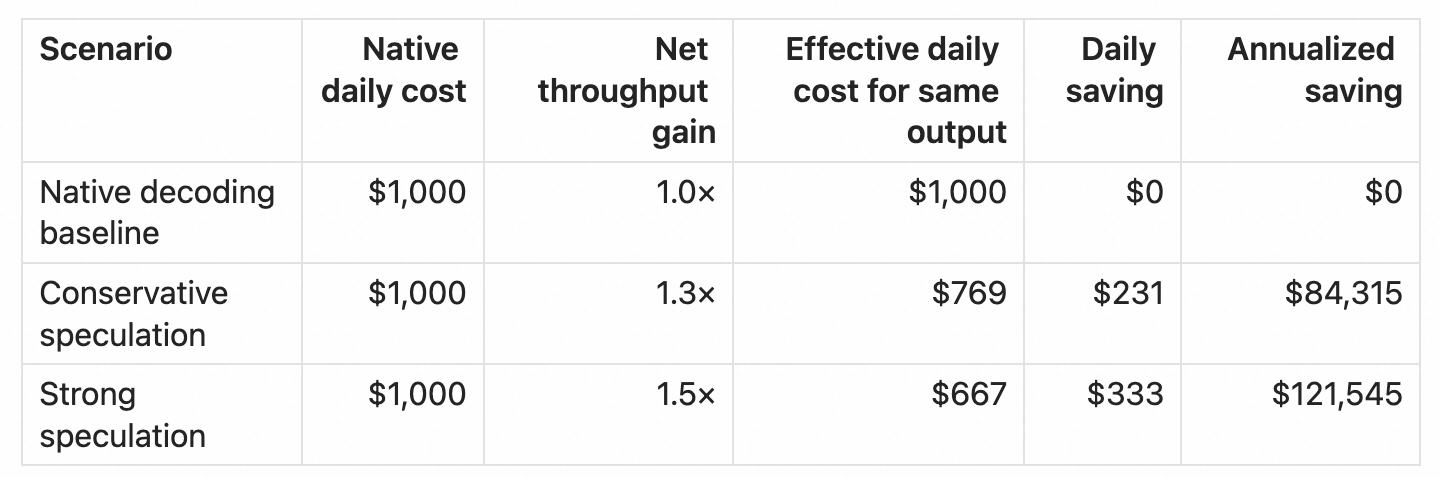
A simple token-economy example makes the business value easier to remember. The table below is intentionally easy to adjust: change the native daily cost or the net throughput gain, then recompute effective daily cost = native daily cost / net throughput gain.
Example 1: dollar cost for the same daily output volume
Example 2: operational efficiency view
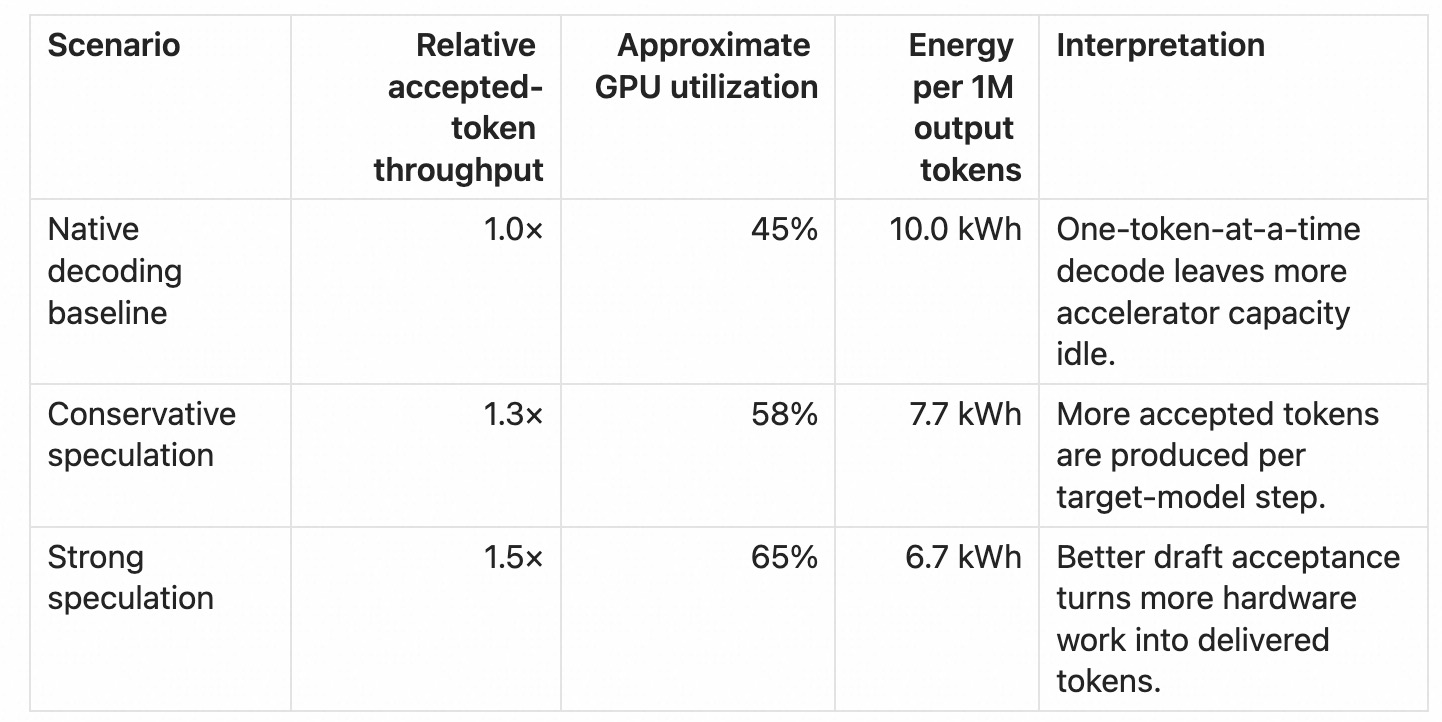
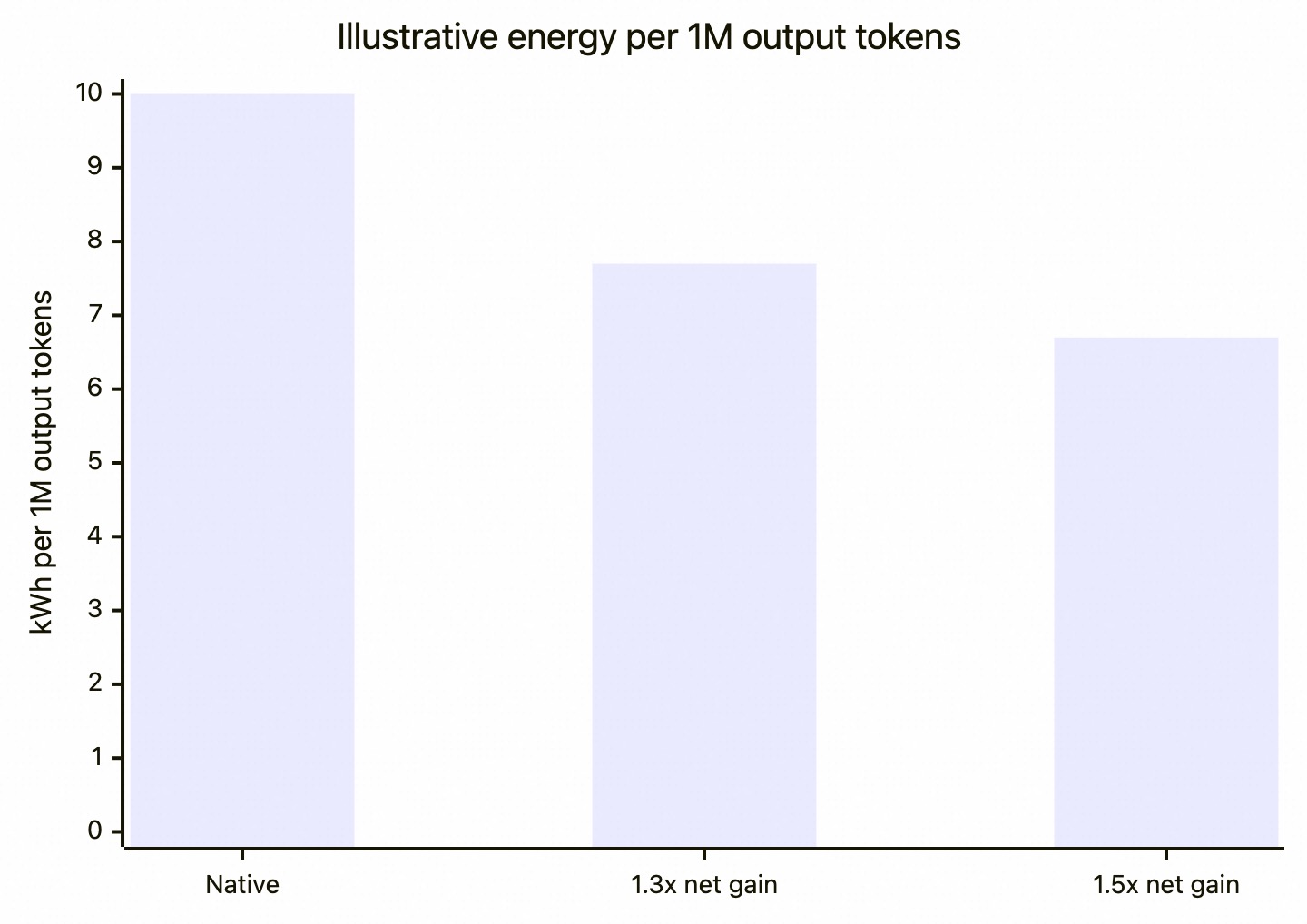
This second illustration shows the same idea from the infrastructure side. If speculative decoding increases useful accepted-token throughput while the machine power draw stays roughly in the same range, the energy needed per delivered token falls. The numbers below are illustrative and easy to adjust.
REMINDER
Treat these dollar and energy values as illustrative token-economy calculations, not guaranteed benchmarks. Real savings depend on model price, accelerator utilization, batch size, acceptance rate, drafter cost, KV-cache pressure, power profile, and SLO requirements.
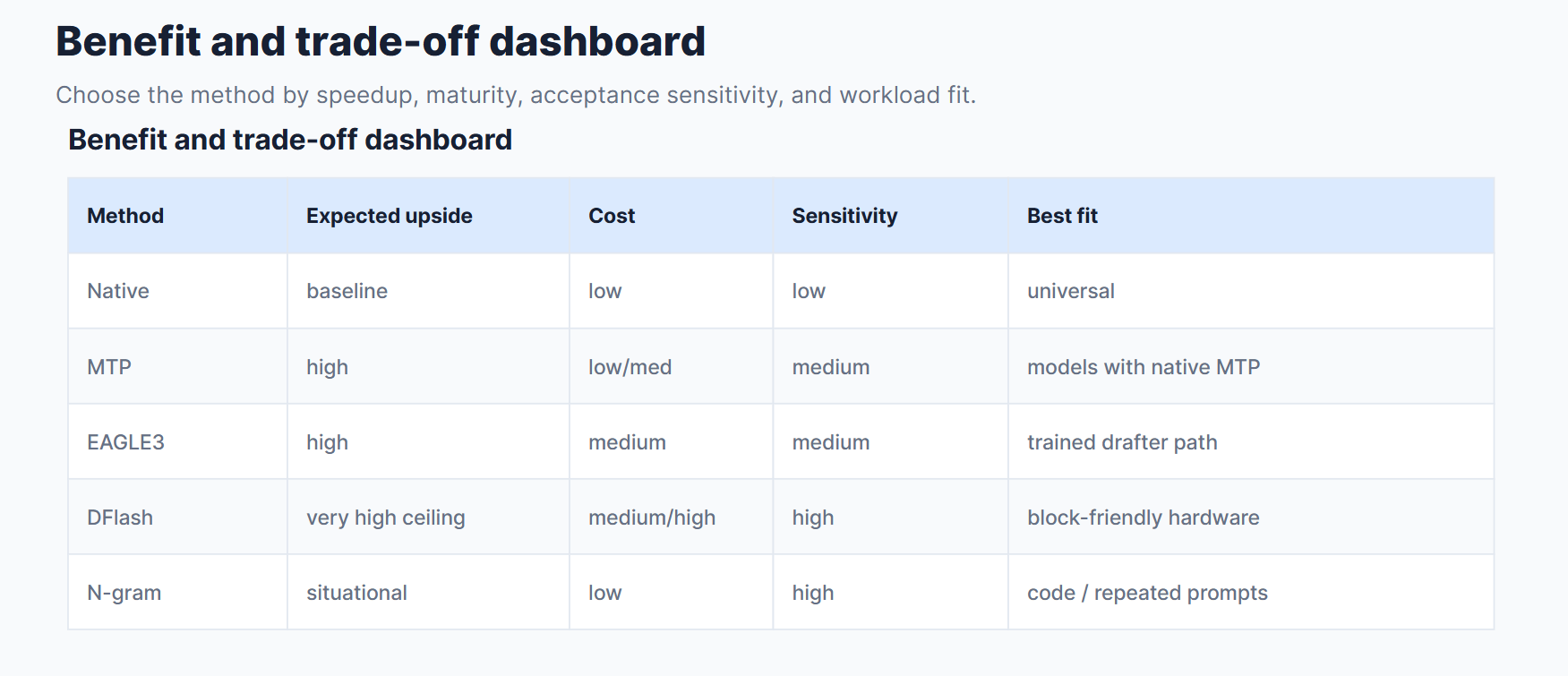
The trade-offs are real:
WARNING
Production teams should define guardrails: disable or reduce speculation when acceptance falls, TPOT worsens, memory pressure rises, or output stability degrades.
A production platform can use this rollout checklist:
Speculative decoding is one of the clearest ways to improve decode-stage economics, but it only becomes production-grade when the serving platform treats tokens, cache, scheduling, quantization, and runtime operators as first-class resources. DFlash raises the ceiling by parallelizing the draft phase itself, but the production lesson is broader: the winner is not the single fastest drafter in a benchmark, but the platform that can route, cache, quantize, verify, and update state coherently under real traffic.
REMINDER
For Smart Studio, TokenWorks, or any MaaS platform, the practical path is: benchmark by workload, integrate with cache-aware scheduling, validate quantization recipes, optimize the operator path, and roll out with guardrails.
[1] Yaniv Leviathan, Matan Kalman, and Yossi Matias, “Fast Inference from Transformers via Speculative Decoding,” arXiv:2211.17192, International Conference on Machine Learning (ICML) 2023 Oral. https://arxiv.org/abs/2211.17192
[2] vLLM documentation, “Speculative Decoding,” developer preview, July 2026. https://docs.vllm.ai/en/latest/features/speculative_decoding/
[3] Jian Chen, Yesheng Liang, and Zhijian Liu, “DFlash: Block Diffusion for Flash Speculative Decoding,” arXiv:2602.06036, ICML 2026. https://arxiv.org/abs/2602.06036
[4] NVIDIA Technical Blog, “Boost Inference Performance Using DFlash Speculative Decoding on Latest-Generation GPU Systems,” June 23, 2026, modified July 9, 2026. https://developer.nvidia.com/blog/boost-inference-performance-up-to-15x-on-nvidia-blackwell-using-dflash-speculative-decoding/
[5] NVIDIA TensorRT-LLM documentation, “Quantization,” last updated July 14, 2026. https://nvidia.github.io/TensorRT-LLM/latest/features/quantization.html
[6] NVIDIA Technical Blog, “Introducing New KV Cache Reuse Optimizations in NVIDIA TensorRT-LLM,” January 16, 2025, modified April 23, 2025. https://developer.nvidia.com/blog/introducing-new-kv-cache-reuse-optimizations-in-nvidia-tensorrt-llm/
[7] NVIDIA TensorRT-LLM documentation, “Speculative Decoding,” last updated July 14, 2026. https://nvidia.github.io/TensorRT-LLM/features/speculative-decoding.html
[8] Google Developers Blog, “Supercharging LLM inference on Google TPUs: Achieving 3X speedups with diffusion-style speculative decoding,” May 4, 2026. https://developers.googleblog.com/supercharging-llm-inference-on-google-tpus-achieving-3x-speedups-with-diffusion-style-speculative-decoding/
[9] DFlash GitHub repository, z-lab/dflash. https://github.com/z-lab/dflash
[10] Alibaba Cloud documentation, “TokenWorks quick start,” Platform for AI. https://help.aliyun.com/en/pai/tokenworks-quick-start
[11] Alibaba Cloud documentation, “Model deployment,” Model Studio. https://help.aliyun.com/en/model-studio/model-deployment-introduction
[12] Alibaba Cloud documentation, “PAI-TokenWorks product introduction,” Platform for AI. https://help.aliyun.com/zh/pai/tokenworks/
[13] Boyu Tan et al., “RTP-LLM: High-Performance Alibaba LLM Inference Engine,” arXiv:2605.29639; Alibaba RTP-LLM GitHub repository. https://arxiv.org/abs/2605.29639 and https://github.com/alibaba/rtp-llm
[14] Alibaba Cloud Blog, “Alibaba Cloud Smart Studio Self-Service Edition Now Live Internationally,” July 29, 2026. https://www.alibabacloud.com/blog/alibaba-cloud-smart-studio-self-service-edition-now-live-internationally
[15] Alibaba Cloud Developer Community / Qwen Community, public article on Qwen3.5-27B DFlash speculative decoding speedup, May 23, 2026. https://developer.aliyun.com/article/1736393
I Tested 19 LLM API Workloads on Real Calls and Cut Costs 79% — Here's the Data
ApsaraDB - February 4, 2026
Alibaba Cloud Community - October 14, 2025
ApsaraDB - December 29, 2025
Alibaba Cloud Community - May 6, 2026
Alibaba Cloud Community - June 30, 2025
Alibaba Cloud Community - January 9, 2026
 Alibaba Cloud Model Studio
A one-stop generative AI platform to build intelligent applications that understand your business, based on Qwen model series such as Qwen-Max and other popular models
Learn More QwenWork
QwenWork is dedicated to helping employees strengthen their professional competitiveness in the AI era and to enabling enterprises to improve organizational effectiveness.
Learn More
Token Plan
Build more, spend less. One plan, every modality.
Learn More Qwen
Qwen
Full-range, open-source, multimodal, and multi-functional
Learn MoreMore Posts by Farruh


