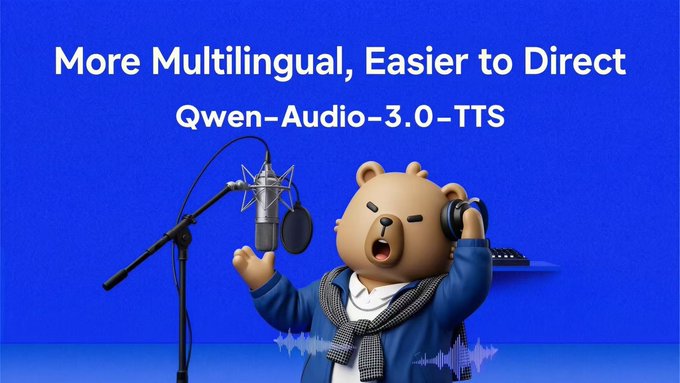
Qwen-Audio-3.0-TTS is our latest text-to-speech model release. It ships as two variants from the same lineage:
API: Model Studio
Release Blog: Blog
This release focuses on four things developers actually run into in production: broader language coverage, natural-language style control, fine-grained tag control, and robustness when the reference audio isn’t clean.
Qwen-Audio-3.0-TTS-Plus currently ranks #1 on Artificial Analysis, the independent third-party TTS leaderboard.
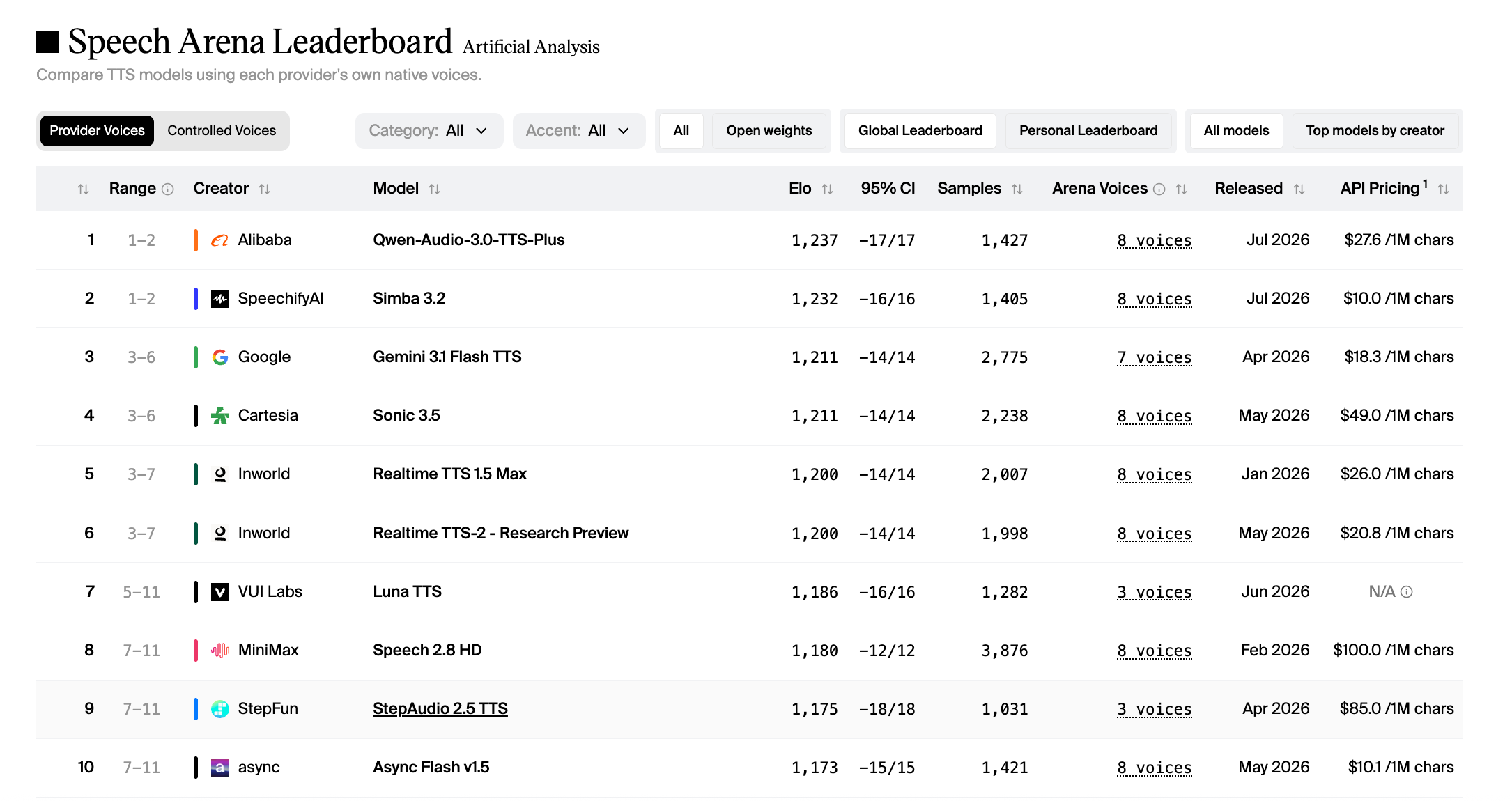
Here’s what changed and what the numbers look like.
Qwen-Audio-3.0-TTS was optimized across English, Chinese, Japanese, Korean, German, and 16 languages total, plus improved fidelity on several Chinese dialects.
Supported languages (16): Arabic, Chinese, English, French, German, Indonesian, Italian, Japanese, Korean, Malay, Portuguese, Russian, Spanish, Tagalog, Thai, Vietnamese.
*Full language support rolling out soon.
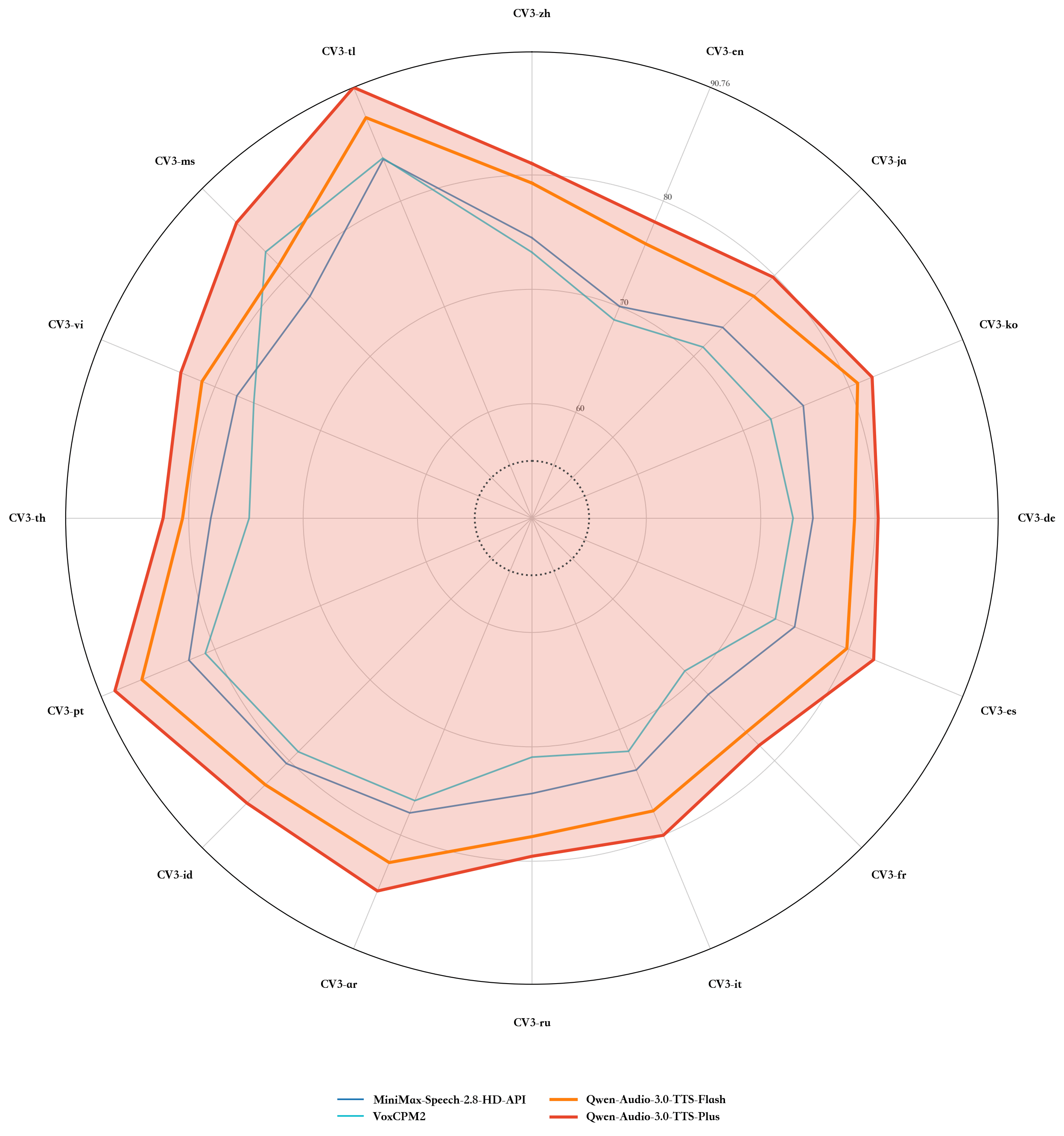
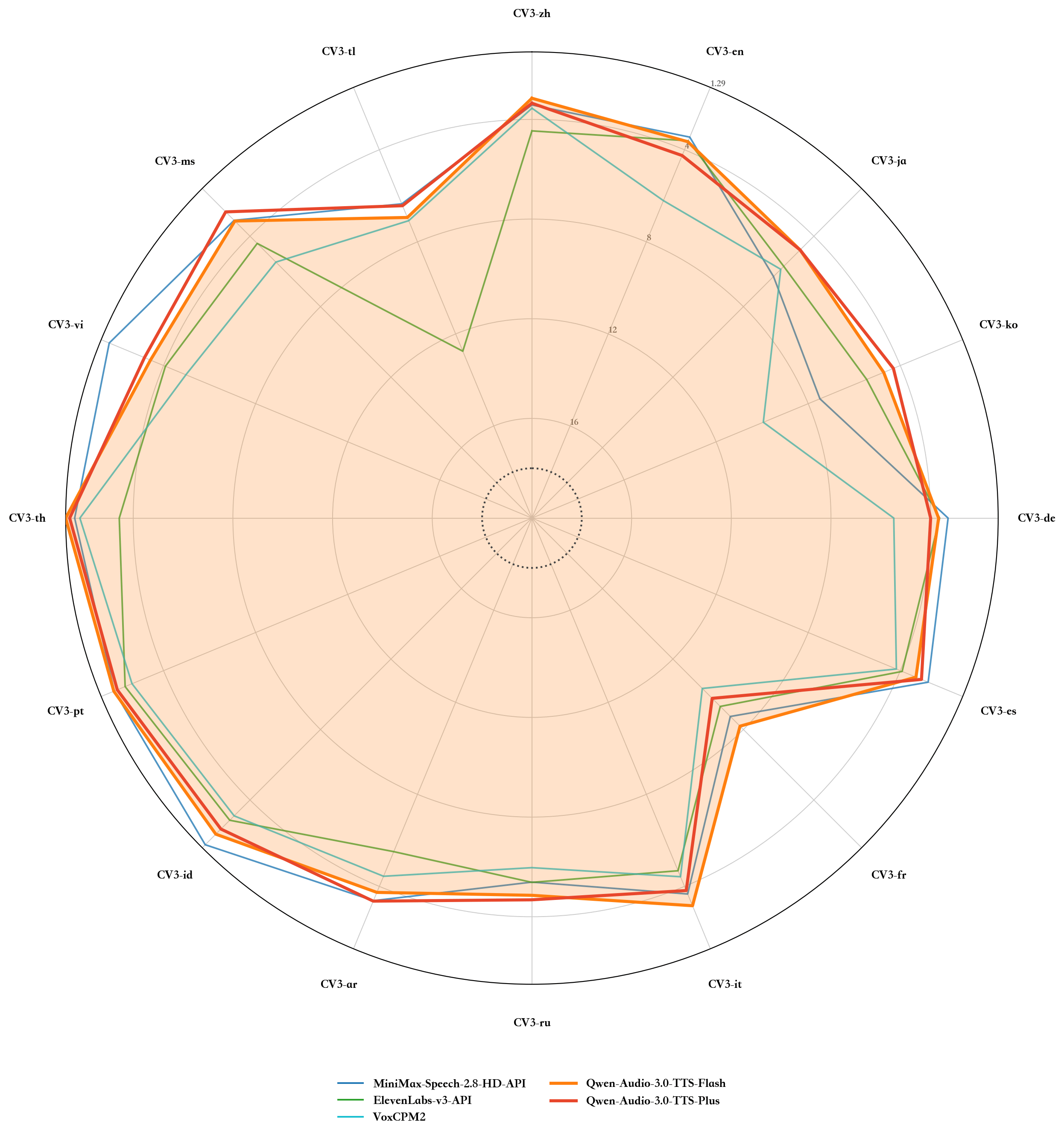
You can describe the delivery you want in natural language instead of hand-tuning acoustic parameters.
Simple prompts with plain language steer emotion, role, scenario, and pace without any labeling expertise.
When you need precise control over the non-verbal details — a breath, a laugh, a shift in tone — you can embed inline tags directly in the target text, like [gasp], [giggles], or [angry].
This makes the model useful for narration, games, and dubbing where the non-verbal cues carry as much as the words.
Reference clips from the real world are rarely studio-clean. Qwen-Audio-3.0-TTS was trained with targeted acoustic simulation so speech enhancement is built into the cloning path. The model suppresses reverb and noise while preserving timbre.
In our high-noise and high-reverb tests, this release produced noticeably cleaner output than previous versions from the same degraded references.
Qwen-Audio-3.0-TTS is available now. Grab the model here:
If you build something with it, we’d genuinely like to hear what worked and what didn’t — the failure cases are where the next version comes from.

1,568 posts | 524 followers
FollowAlibaba Cloud Community - July 24, 2026
Alibaba Cloud Community - August 4, 2026
Alibaba Cloud Community - November 24, 2025
Alibaba Cloud Community - October 12, 2026
Alibaba Cloud Community - November 20, 2024
Alex - August 14, 2018
1,568 posts | 524 followers
Follow Alibaba Cloud Model Studio
A one-stop generative AI platform to build intelligent applications that understand your business, based on Qwen model series such as Qwen-Max and other popular models
Learn More QwenWork
QwenWork is dedicated to helping employees strengthen their professional competitiveness in the AI era and to enabling enterprises to improve organizational effectiveness.
Learn More
Token Plan
Build more, spend less. One plan, every modality.
Learn More Intelligent Speech Interaction
Intelligent Speech Interaction is developed based on state-of-the-art technologies such as speech recognition, speech synthesis, and natural language understanding.
Learn MoreMore Posts by Alibaba Cloud Community

