We’ve been testing Qwen3.8-Max on Qoder CLI since its Preview stage, running evaluations and validation as the model evolved. Now that the final version is out, we wanted to see what it can really do when put to work on Qoder CLI.
For the test, we picked a fresh batch of hard, long-horizon tasks and gave Qoder CLI complete autonomy — no human intervention, just hundreds of tool calls, self-debugging, and a goal to reach.
We handed the same five tasks to Claude Opus 4.8, GPT-5.6 Sol, and Claude Fable 5 for a side-by-side comparison. (The external models were run through an experimental setup, not their shipping products, and the results are for this comparison only.)
In this evaluation, Qoder CLI isn't just a way to call a model — it's the agent harness that carries the work. It gives every model the same toolset, execution environment, and feedback loop, so the model can take a single prompt and run long stretches of autonomous execution and self-verification from there. Under identical conditions, all four models ran to completion on their own and submitted their deliverables, with no follow-up prompting from us. Some tasks ran for hours and involved hundreds of tool calls. On the "Along the River During the Qingming Festival" task, for instance, Qoder CLI ran autonomously for 4 hours and 23 minutes, grabbing roughly 378 screenshots of its own work to iterate on.
Everything from this evaluation is open source — see the appendix at the end.
Laying the painting flat onto a web page is easy. The hard part is this: without using the original artwork as a backdrop, have the model build — from nothing — a 3D world you can step into, tour, and view from any angle.
The prompt: Starting from an empty directory, and working from a high-resolution scan of "Along the River During the Qingming Festival," produce a single-file, offline-capable, genuinely 3D handscroll. It must include six chapters and 24 fixed camera positions, with every object built from procedural solid geometry — no images standing in for the 3D scene. The task is a test of image understanding, spatial reasoning, and sustained autonomous execution.
What we wanted to see was whether a model could make three leaps in a row:
First, understand the source. The painting is extraordinarily dense. The model has to pick out crowds, boats, buildings, carts and horses, and street stalls across the scroll — and grasp how they relate to one another — rather than latching onto a handful of landmarks like the Rainbow Bridge or the city gate.
Then, build it out. The original is flat. The model has to infer depth, scale, and layout on its own, turning a picture you can only look at into a 3D world you can move a camera through.
Finally, go the distance. This can't be done in a single generation. Across hours and hundreds of tool calls, the model has to keep inspecting the render, editing code, and re-rendering — without drifting away from what it set out to do.
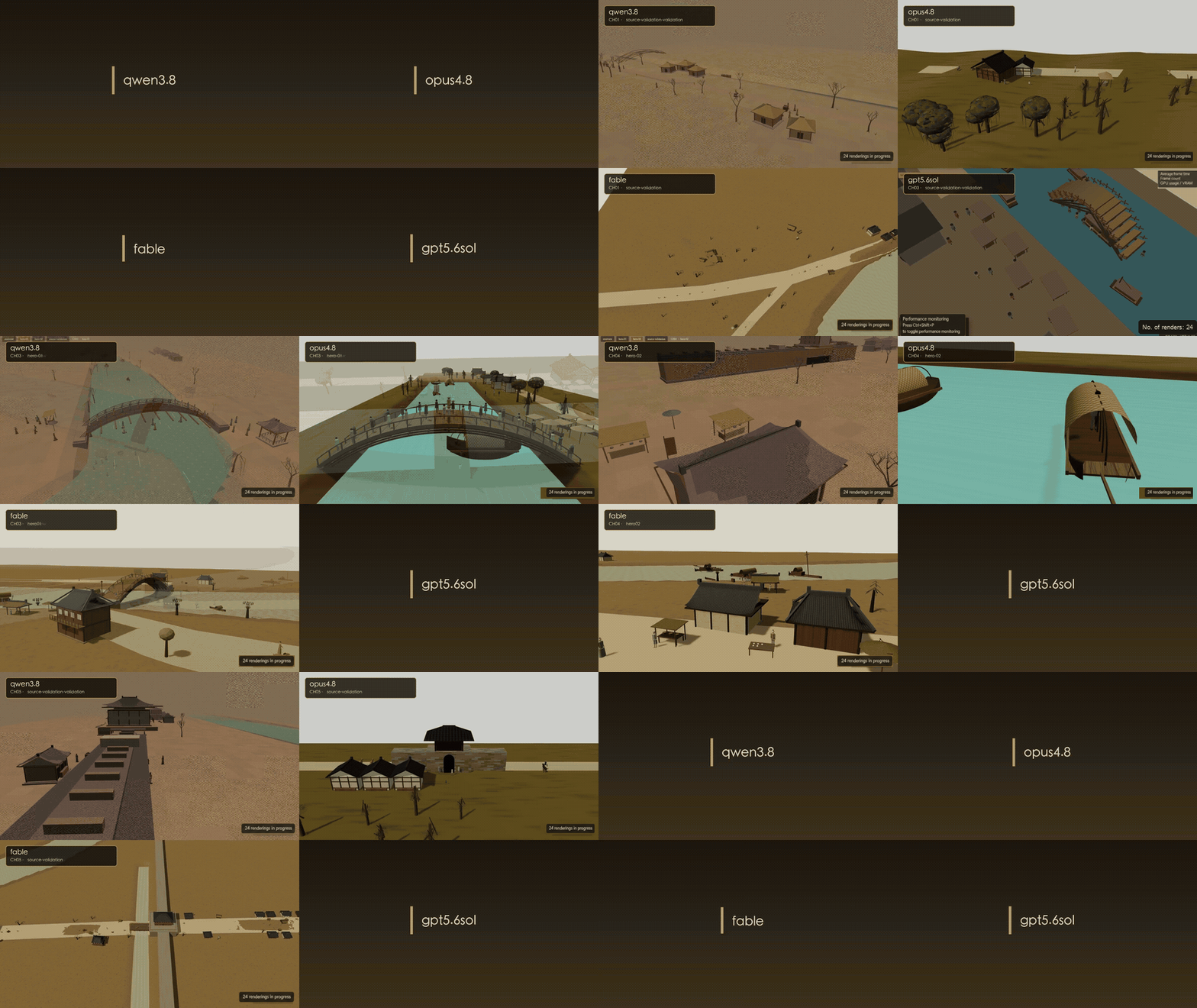
Figure 1: The four models' "Along the River During the Qingming Festival" 3D scrolls, side by side
All four delivered real 3D scenes; none faked it with imagery. Scoring five categories — feature delivery, 3D geometry, storytelling, visual fidelity, and engineering quality — at 20 points each, Claude Fable 5 took 73, Claude Opus 4.8 72, Qwen3.8-Max 63, and GPT-5.6 Sol 56. Run times were 189, 72, 263, and 47 minutes, respectively.
Qwen3.8-Max took an engineering route unlike the other three: rather than reaching for an existing 3D engine, it wrote a renderer from scratch. Its file was also the smallest at 123 KB, against Claude Fable 5's 822 KB and Claude Opus 4.8's 549 KB, and it was the most efficient — asking the GPU to draw only about 46 batches of objects per frame, where Claude Fable 5's scene needed 3,000 to 5,700.
The trade-off showed up on screen. The six chapters felt sparse — no carts, horses, or market bustle at the city gate — and the ground and sky carried grainy, patch-like artifacts. Those patches weren't a bug; the model added them on purpose, spending many rounds tuning the image's grain so its computed similarity to the original would climb. The metric went up; the picture, to the eye, got worse. It was also the slowest of the four.
Opus 4.8 produced the most finished-looking scene: crowds on the Rainbow Bridge, boats beneath it, stalls along both banks — closest to the market life of the original. Claude Fable 5 had the sturdiest 3D structure but a similarly empty picture. GPT-5.6 Sol's bridge components were visibly misaligned and interpenetrating, and in the end it filed an "unfinished" report rather than dressing up incomplete work as done.
Getting a model to write code is nothing new. The difficulty here is two hard things at once: Rust and databases, each demanding in its own right.
The prompt: Implement a high-performance in-memory KV store from scratch in Rust, using a specified QKV binary protocol and four commands. The core logic has to be written by hand — no async runtime, no networking or storage frameworks, no third-party caching, hash-table, or memory-allocation libraries, and no io_uring — all completed offline. The starting directory offers only the task brief, the protocol spec, and basic tests.
This is genuinely hardcore. A real high-performance key-value store needs at least five things working together:
A networking layer that serves many connections at once. Protocol parsing that tolerates data arriving in arbitrary fragments. A storage structure that handles concurrent reads and writes without corruption. Expiration handling that reclaims stale data automatically. And overload protection that kicks in when traffic exceeds capacity.
The upshot: all four models finished the task on Qoder CLI, averaging 860 to 1,615 lines of code, all produced autonomously from a single prompt. All 27 private tests passed, so correctness didn't separate them. The gap was all in performance.
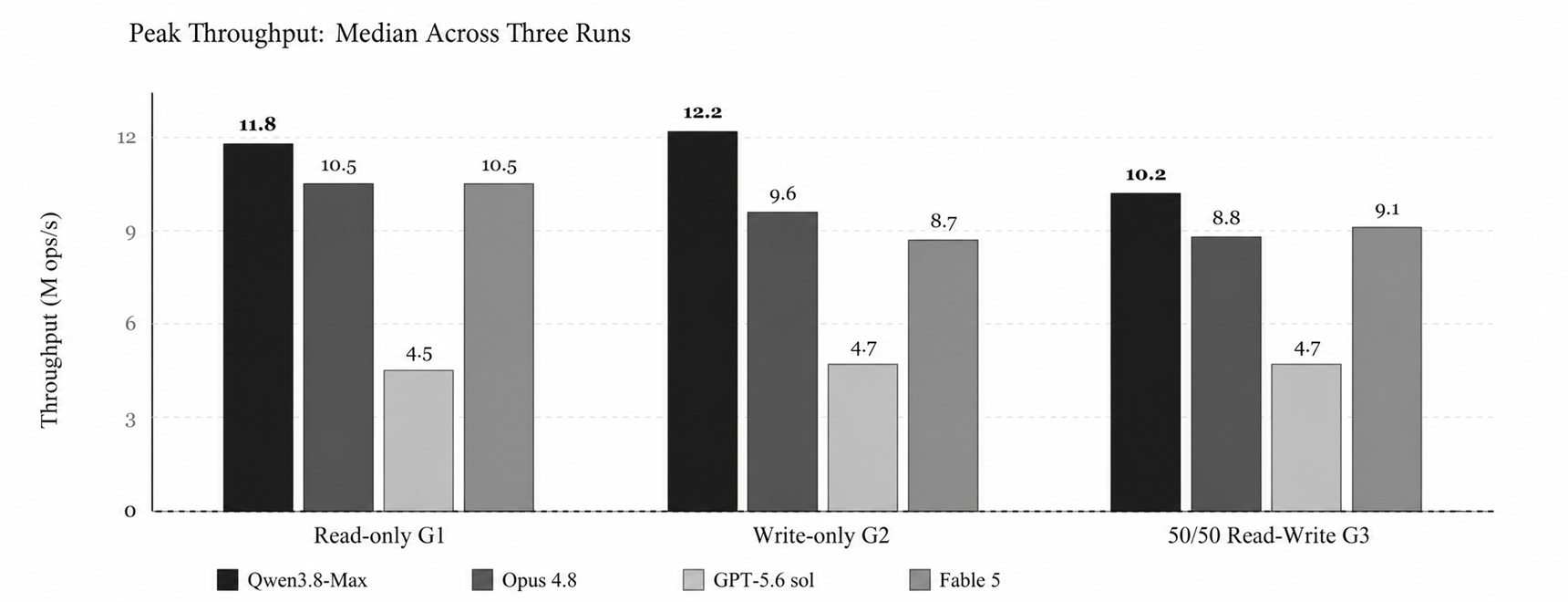
Figure 2: Peak-throughput results
Peak read throughput, in order, was Qwen3.8-Max 11.8M, Claude Opus 4.8 10.5M, GPT-5.6 Sol 4.5M, and Claude Fable 5 10.5M ops/s; peak write was 12.2M, 9.6M, 4.7M, and 8.7M; a 50/50 read-write mix came in at 10.2M, 8.8M, 4.7M, and 9.1M.
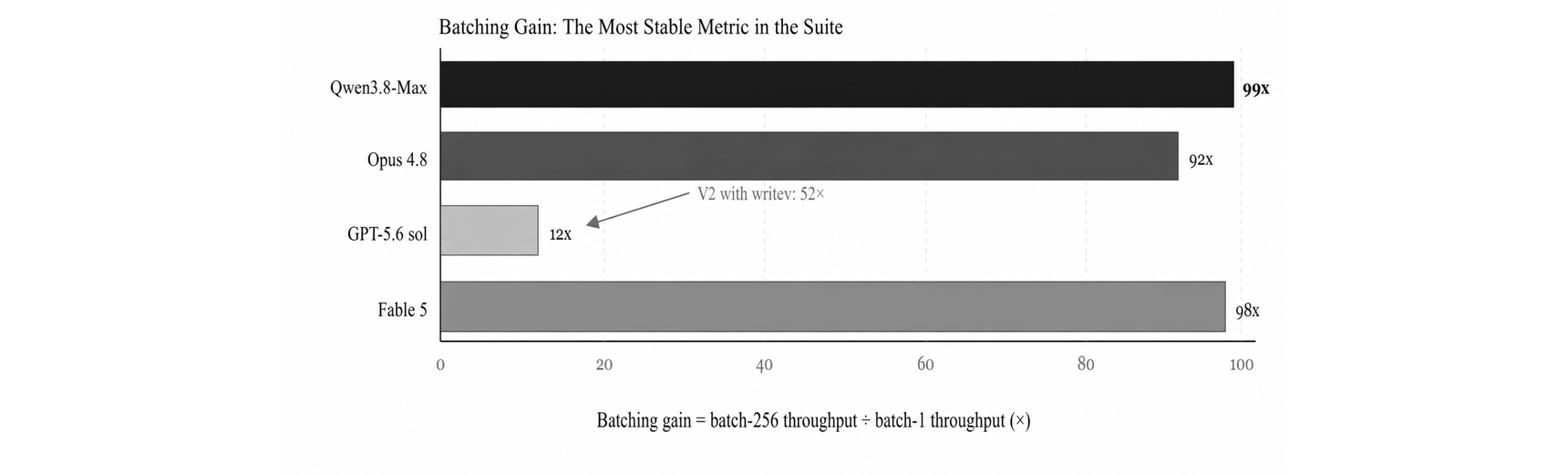
Figure 3: Batching gain compared
The biggest driver of the throughput gap was write-path batching. Qwen3.8-Max, Claude Opus 4.8, and Claude Fable 5 each parsed all commands in one read and wrote the concatenated responses out in a single block; GPT-5.6 Sol, in its first-round build, called write() once per command — its libc bindings didn't even declare writev. The batching gain (batch-256 throughput over batch-1 throughput) came out at 99x, 92x, 12x, and 98x; GPT-5.6 Sol climbed to 52x once it added writev in its second-round build (v2). This is the most stable metric of the whole set: it's a ratio, with numerator and denominator on the same machine and the same code, so hardware speed cancels out — it holds its tier even when cross-run throughput swings by ±55%.
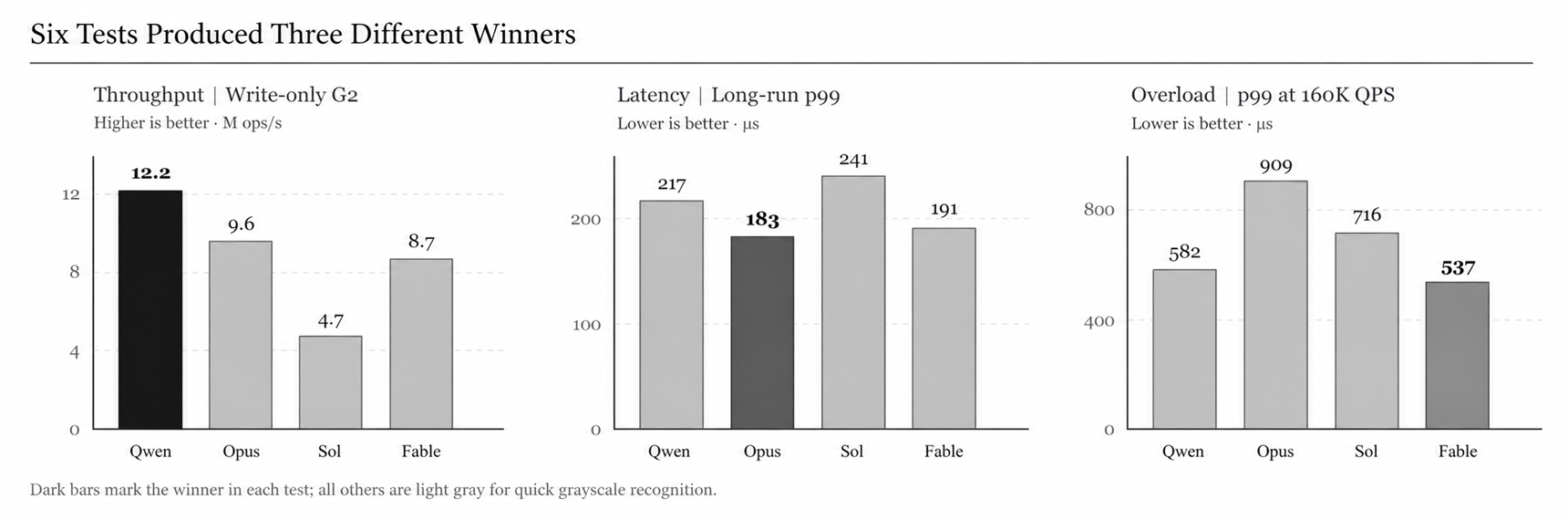
Figure 4: Six tests, three different kinds of "first place"
Latency and throughput told different stories. In the long-horizon test, Claude Opus 4.8 had the lowest p99 latency at 183μs, followed by Claude Fable 5 (191μs), Qwen3.8-Max (217μs), and GPT-5.6 Sol (241μs). In the 160K QPS overload test, Claude Fable 5 was the steadiest at a p99 of 537μs; Qwen3.8-Max and GPT-5.6 Sol came in at 582μs and 716μs; Claude Opus 4.8 rose to 909μs. The main reason: its backpressure threshold was set to 16MB, which struggles to hold back a backlog of small responses, whereas Claude Fable 5 disables EPOLLIN once the backlog passes 4MB and re-enables it after it drops below 64KB — real, working backpressure.
The source code told the same story of trade-offs. Qwen3.8-Max used 1,024 shards, giving it the best write scalability and peak write performance — a 31% lead — but its home-grown fxhash64 was only used to pick a shard, while the internal HashMap still ran the default SipHash, which drove its long-horizon p99 up. Claude Fable 5's implementation was the most balanced, with every key technique fully in place: second in five tests, first in one, no obvious weak spot.
Taken together, the results fall into three buckets: order-of-magnitude gaps, batching-gain tiers, and "throughput ranking isn't latency ranking." Among the top three, the precise ordering differed by just 0.5% to 9% — smaller than the cross-run variance, and not statistically significant. The absolute throughput numbers apply only to this setup: each task ran in a fresh container, the server was pinned to 4 cores and 3GB of memory and compiled with networking off, the load generator had 8 dedicated cores, and each grid point was repeated 5 times and reported at the median. Any cross-machine comparison has to re-run every baseline in the same environment.
The six tests produced leaders on three fronts: Qwen3.8-Max led on all three throughput metrics and on CPU efficiency, Claude Opus 4.8 on low-load latency and memory footprint, and Claude Fable 5 on overload stability. There's no single best answer here, and picking on one metric alone is a good way to reach the wrong conclusion.
Weather card
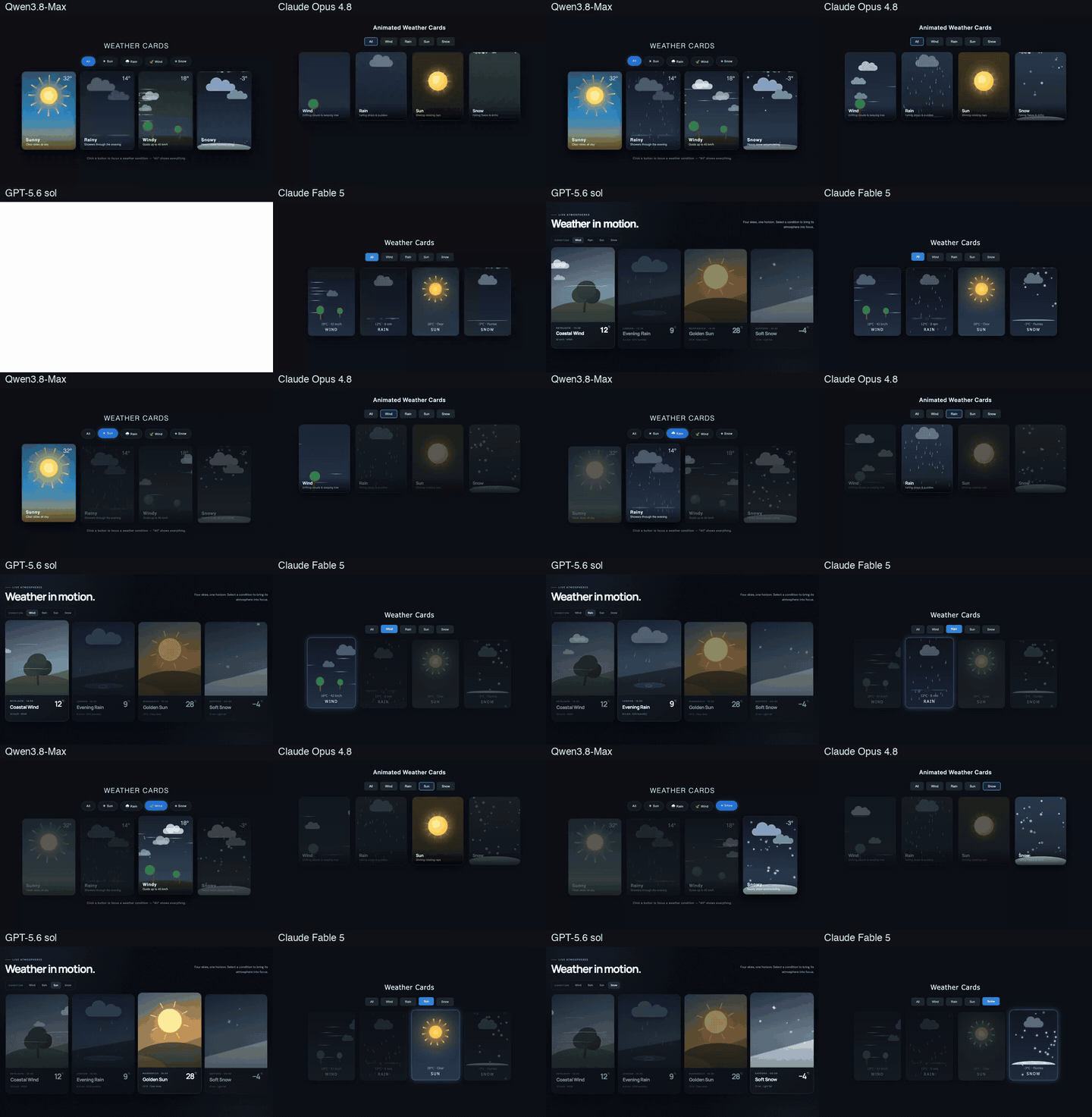
Figure 5: Weather card, four models compared
One prompt: four weather types, dark background, switchable.
Qwen3.8-Max had the richest CSS illustration, with the temperatures — 32° / 14° / 18° / −3° — tucked into the card's corners. Claude Opus 4.8 was the most restrained, and the only build with zero critical axe issues, but there isn't a single temperature figure anywhere in it, and after an 8px Gaussian blur the card has no focal point at all. GPT-5.6 Sol was the only one that looked deliberately designed, with an editorial header carrying three lines of metadata (city · time · condition); its 36px temperature is 3.6× the size of the 10px kicker. Claude Fable 5 had the weakest hierarchy, burying the temperature inside the meta line "18°C · 42 km/h."
Coffee-roaster landing page
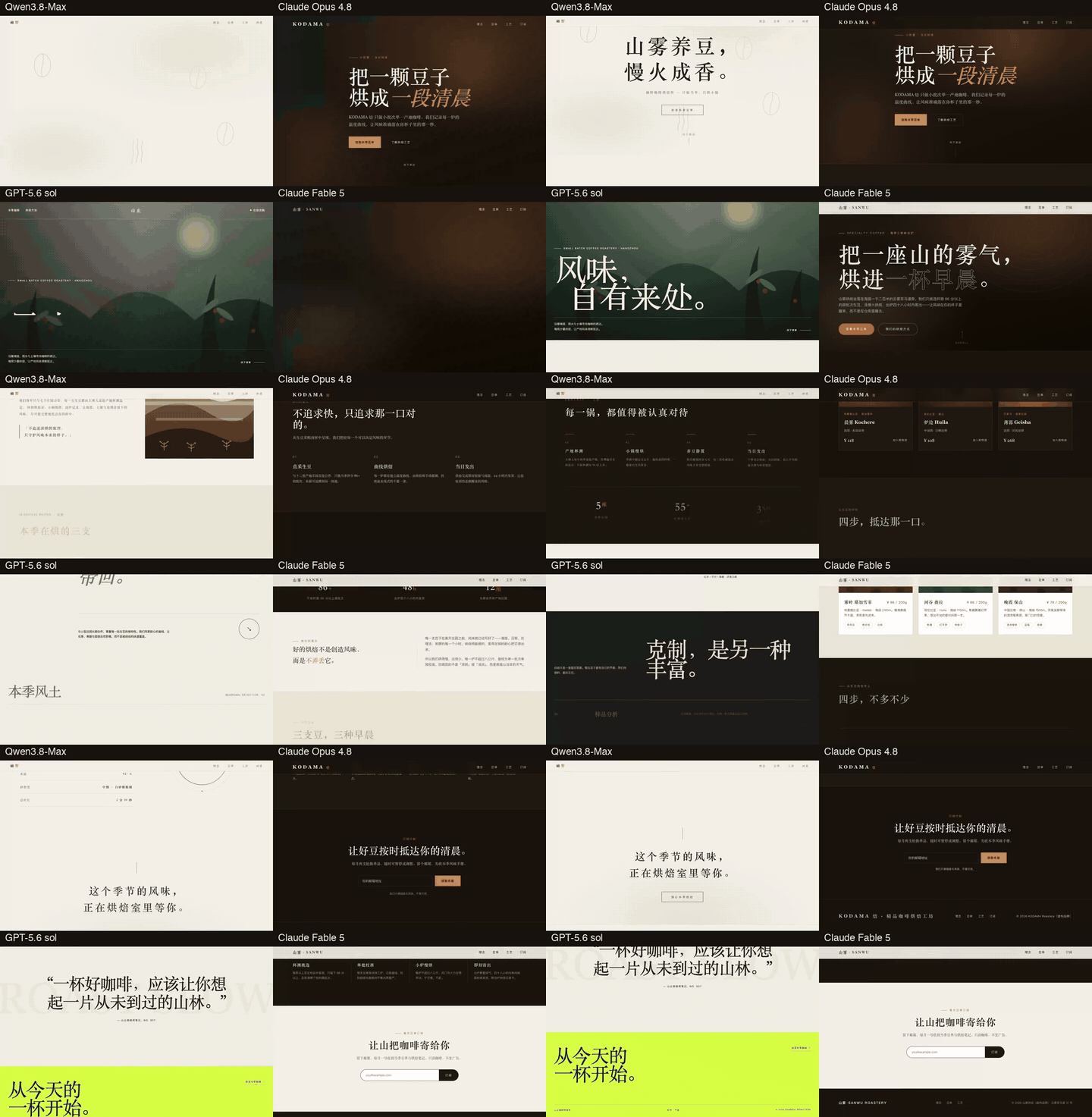
Figure 6: Coffee-roaster landing page, four models compared
The prompt asked for scroll-in animations, image hover feedback, and a hero that grabs you — and made a point of it: "keep the motion restrained, not noisy."
Qwen3.8-Max went minimal: a pale beige background, a big line of copy — "Mountain-mist beans, slow-fire roast" — a line-drawn coffee bean, and a single outlined button, with the most whitespace of the group. Claude Opus 4.8 went dark brown with "Roast a single bean / into a morning," setting "into a morning" in orange italics for emphasis. GPT-5.6 Sol was the only one to paint a full illustrated scene — layered mountain silhouettes, mist, a soft glow, and coffee branches with red cherries. Claude Fable 5 landed close to Opus 4.8 — dark brown with orange accents — and added concentric arcs on the right.
Procedural planet
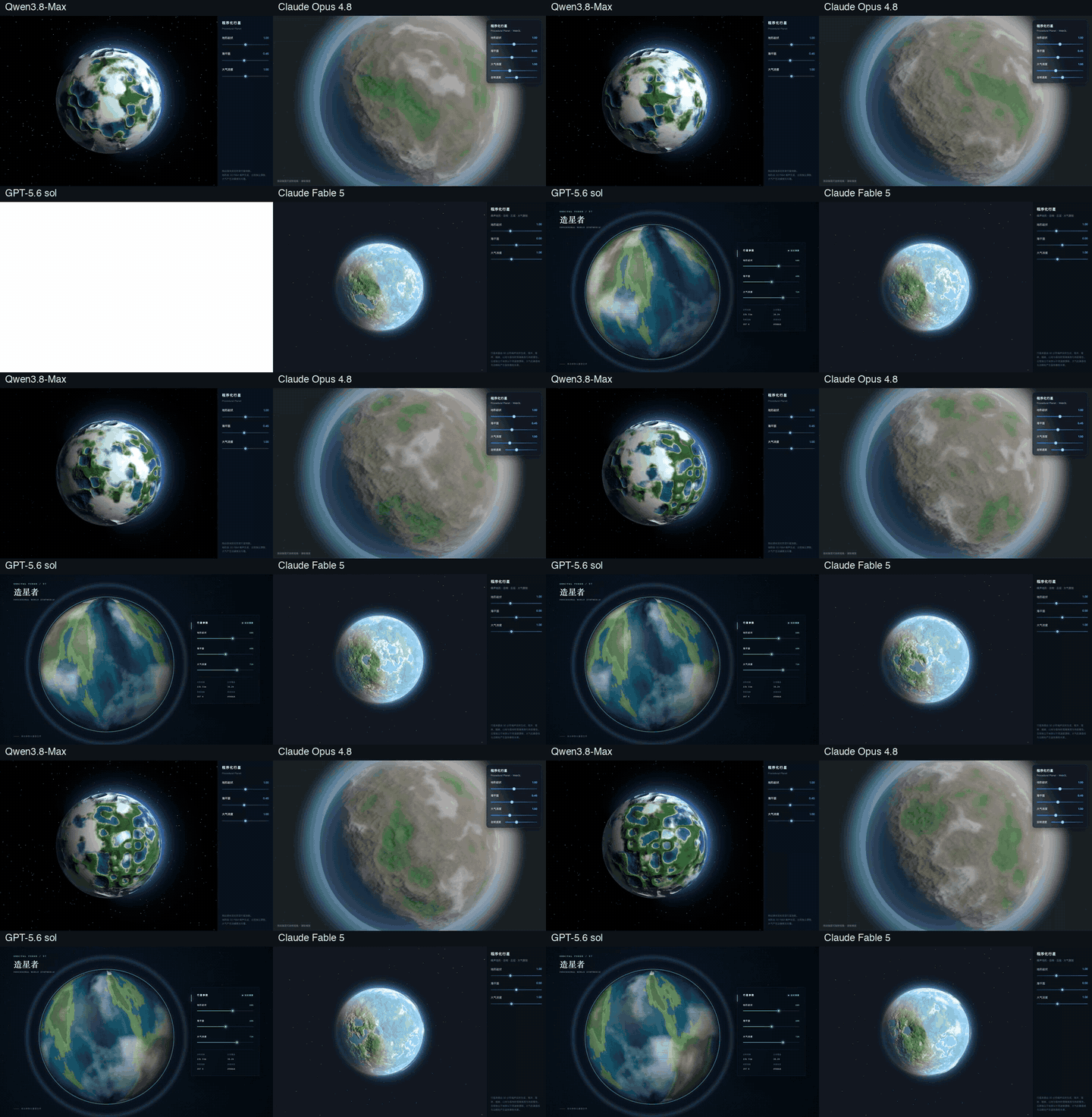
Figure 7: Procedural planet, four models compared
The prompt called for a procedurally generated, self-rotating planet with an atmosphere and clouds, plus three sliders on the right for terrain relief, sea level, and atmospheric density.
Qwen3.8-Max had the strongest atmospheric glow, with a crisp blue rim light and distinct ice-cap clouds. Claude Opus 4.8's planet filled the frame but read grayish-white overall, with a fuzzy atmospheric edge; it threw in an extra slider for rotation speed. GPT-5.6 Sol turned it into a product UI called "Star Maker," with a latitude-longitude grid on the planet and a parameter panel that offered live values alongside the sliders. Claude Fable 5's build was complete but small and dark.
Chiptune sync
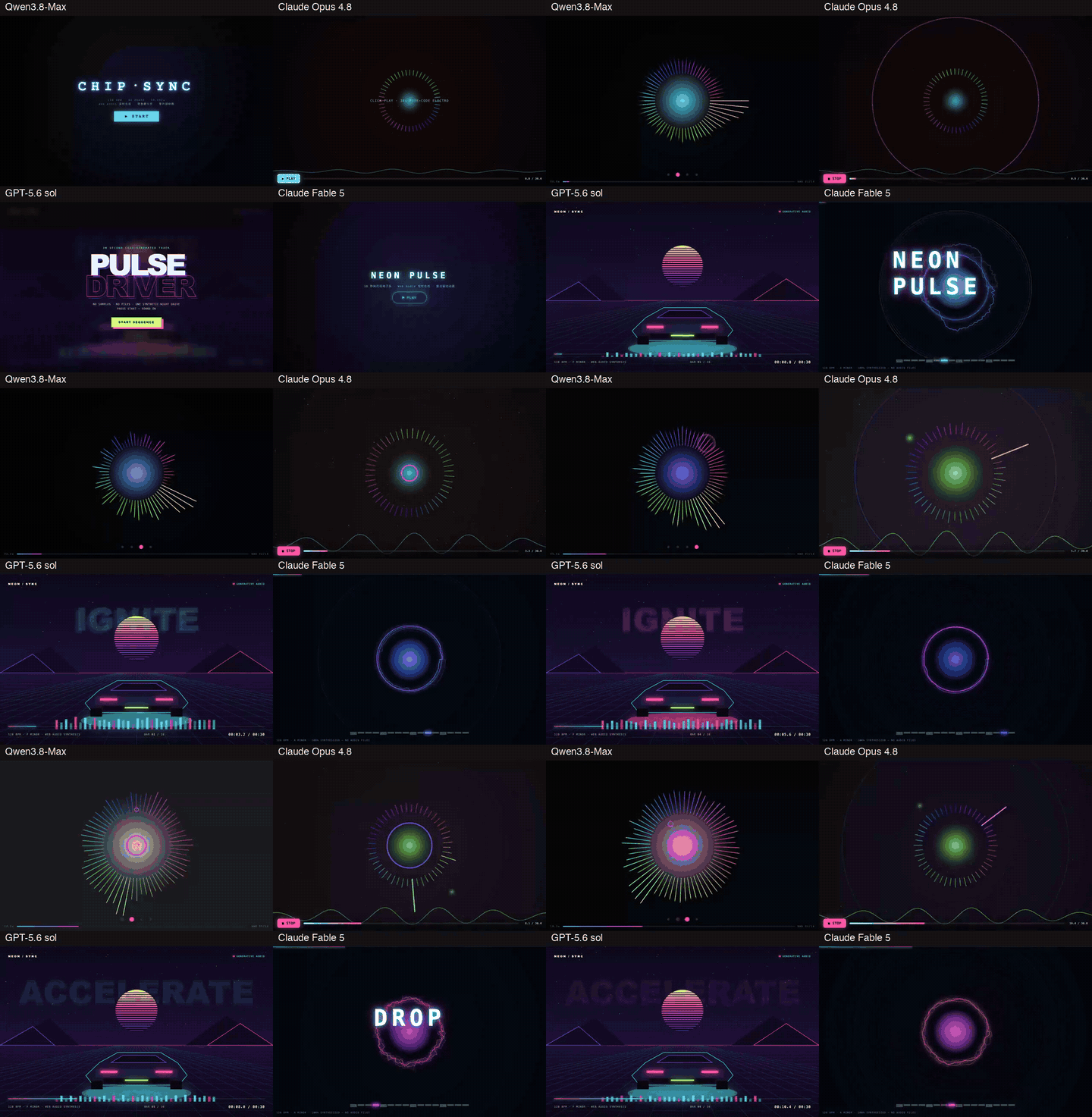
Figure 8: Chiptune visualizer, four models in playback
All four opened almost identically — a Start button as the centerpiece, with the real content revealed only on click. Once playing, they split in four clear directions. Qwen3.8-Max built an abstract visual around a blue core and radiating spectrum rings. Claude Opus 4.8 was the only one with full playback controls. GPT-5.6 Sol built out a complete sunset-highway scene, with a footer counter that pulses to the beat. Claude Fable 5 surfaced section titles that shift with the music's turns.
The challenge here isn't producing a report that looks complete — it's whether every conclusion can be traced back to the raw data and specific evidence.
The prompt: Run an end-to-end analysis on the frozen OpenAlex AI Landscape v1 dataset. The data spans 2020–2025 and covers 60 "country–year" units across 10 countries, 1,198 deduplicated papers, and 290 pages of PDFs for 17 CC BY papers, along with paginated text and page images. Without modifying the inputs or touching the external network, deliver conclusions, evidence, scripts, charts, a dashboard, and validation records.
The four models reached broadly the same conclusions, none of them obviously wrong. What actually separated them was evidence traceability — whether each conclusion mapped cleanly to a specific table, paper, and page. On that basis, Qwen3.8-Max scored 100, Claude Fable 5 94, Claude Opus 4.8 89, and GPT-5.6 Sol 87.
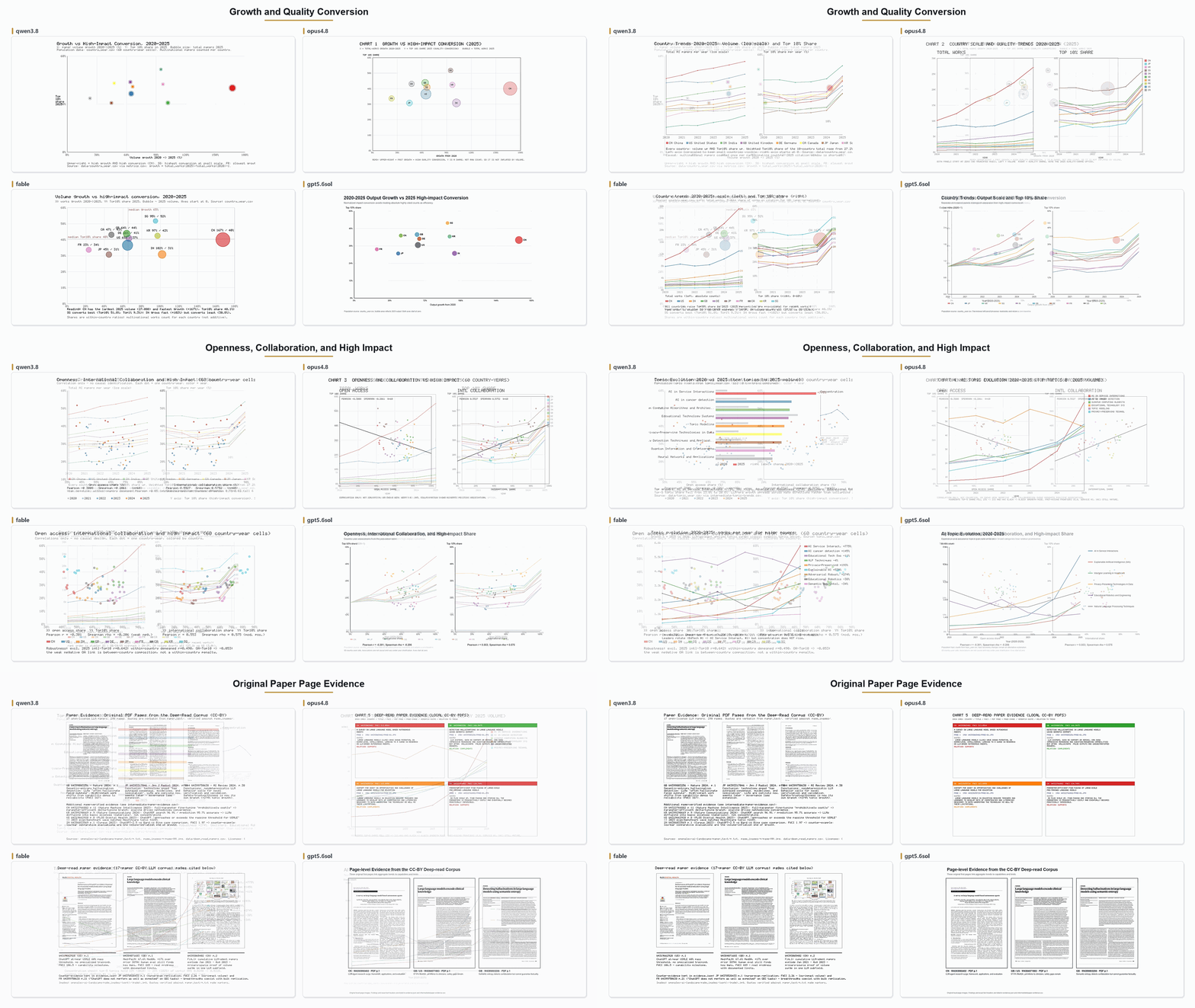
Figure 9: "Topic evolution" chart, four models compared
All four produced the same type of chart, one of which required page-level evidence.
Qwen3.8-Max embedded the PDF pages directly into the chart, annotating each with its paper ID, page number, and a quote from the source, and attached five more pieces of evidence that passed page verification — six evidence chains in all. Claude Opus 4.8 used four cards for paper ID, FWCI, citations, and its relationship call, with the page images parked elsewhere on the dashboard, for three page-level items total. Claude Fable 5 and GPT-5.6 Sol supplied five and three, respectively.
Qwen3.8-Max was also the most careful about data boundaries. It drew a clear line between the aggregate statistics in country_year.csv and the stratified sample of 1,198 papers in works.csv — never extrapolating the sample into global rankings, never treating the sample's topic frequencies as overall shares. Across collaboration, open access, and high impact, it stuck to "correlation" rather than "causation," and added three robustness checks: within-country demeaning, year-by-year correlation, and dropping 2025. In the end, all 44 automated checks passed. GPT-5.6 Sol, by comparison, ran two robustness checks.
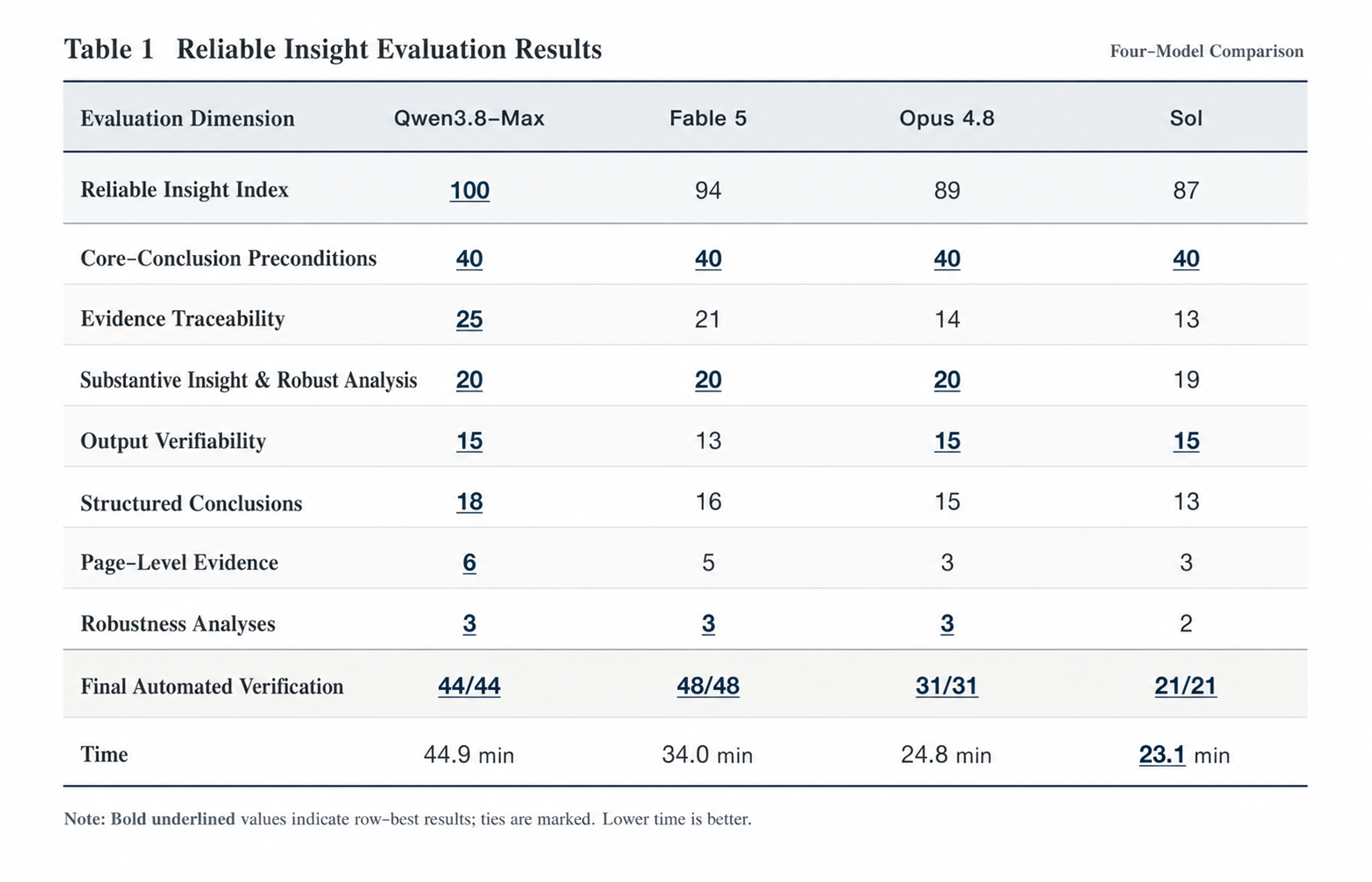
Figure 10: Trustworthy-insight scoring summary
The trustworthy-insight index gives an at-a-glance read on the head-to-head. On this task, Qwen3.8-Max had the best evidence traceability and the most complete delivery — but also the longest run time.
All four models finished the task through Qoder CLI, and every 92-second animation played cleanly start to finish. Scored across five dimensions — story coverage, visual composition, camerawork, runtime reliability, and engineering usability — Claude Fable 5 took 90, Qwen3.8-Max 89, Claude Opus 4.8 84, and GPT-5.6 Sol 68.
Claude Fable 5 had the most polished visuals. Its underground-tunnel segment fully rendered wooden supports, warm lighting, a treasure chest, and drifting motes of light, where the other three were nearly pitch black at the same moment. Its weak points: the 3D engine loaded over the network and wouldn't run offline, and the night scenes in the back half ran dark.
Qwen3.8-Max trailed by a single point, but topped three dimensions — story coverage, runtime reliability, and engineering delivery. It was the only entry to bundle the 3D engine locally for offline playback, and it shipped a local server, a check script, and validation screenshots too. It was also the only one of the four to clearly show the beat of "the news spreading through the village." Its downsides: the underground scene was too dark, and an opening close-up blocked much of the frame.
Claude Opus 4.8 was the most well-rounded and had the most complex scene, roughly 33,000 triangles. GPT-5.6 Sol built a full timeline in just 139 lines of code, but its characters and environment were mostly spheres and cubes, so the visuals came out fairly bare.
Going in, the question we cared about was simple: given a single prompt, can these models run a multi-hour engineering task to the finish on their own? They can. Across all five tasks, every model ran the whole way through, and none went off the rails.
The more interesting question is what happens in the gap where no one has defined what "good" looks like — where a model has nothing but its own standard to decide how far to take something before calling it done. What this generation of model-plus-harness is really competing on is no longer whether it can clear the bar, but what it asks of itself when no one is asking.
One boundary applies to everything above: each task was a single run, and small score gaps aren't a basis for ranking. All of it ran on one harness, Qoder CLI, so strictly speaking we're measuring the model-and-tool combination. We're open-sourcing every prompt, deliverable, and evaluation script from this round.
Everything from this evaluation is open source: the full prompts for all five tasks, the input data, the final deliverables and source code, the evaluation scripts, and per-task technical reports.
Repository: https://github.com/QoderAI/qodercli-bench-qwen3.8
The Better Harness Evaluation Model Used by 100,000 Users Is Now Open Source
Introducing Qoderian: Bring Qoder CLI into Your Obsidian Vault

1,596 posts | 525 followers
FollowAlibaba Cloud Community - August 3, 2026
Alibaba Cloud Community - October 15, 2026
Alibaba Cloud Community - November 3, 2026
Alibaba Cloud Community - August 3, 2026
Alibaba Cloud Community - September 17, 2026
Hosung Kim - October 25, 2026
1,596 posts | 525 followers
Follow Qoder
From Assisted to Autonomous — Adapting to Every Programming Need
Learn More Token Plan
Build more, spend less. One plan, every modality.
Learn More QwenWork
 is dedicated to helping employees strengthen their professional competitiveness in the AI era and to enabling enterprises to improve organizational effectiveness.
Learn More Qwen
Full-range, open-source, multimodal, and multi-functional
Learn MoreMore Posts by Alibaba Cloud Community

