Recently, we built Better Harness into Qoder Desktop. Since its launch, many users have asked: will this feature be open source?
The answer is yes!
Today, we’re officially open-sourcing Better Harness. Find the project at: https://github.com/QoderAI/better-harness
Better Harness is an open-source toolkit for analyzing and continuously improving coding agent workflows. It connects the engineering practices, evaluation models, and runtime capabilities of Harness Engineering and Loop Engineering, with support for Claude Code, Codex, Qoder, and Cursor.
All four platforms share the same evaluation model, but they do not yet offer full parity in session analysis, evidence coverage, or output capabilities. The Qoder integration has been repeatedly validated in real development workflows and is currently the most complete reference implementation.
| Host | Installation or Loading Method | Default Output |
|---|---|---|
| Claude Code | Add the repository as a marketplace, then install the plugin | HTML + Markdown |
| Codex | Install through Git Marketplace | HTML + Markdown |
| Qoder Desktop | Built in; no installation required | Canvas |
| Cursor Agent | Currently loaded from source | HTML / Markdown |
Once you have installed or loaded it on your platform, run the following command in the project you want to analyze:
/better-harnessYou can start it now and review the report as you continue reading. If a type of evidence is unavailable, Better Harness explicitly preserves that limitation in its results rather than substituting configuration counts or data from another platform.
Suppose an agent changes a module, runs a test command, and declares the task complete. The real question is not whether the repository “has tests,” but whether that test is relevant to the change, covers the main risks, and produces results that justify handing over the work.
That is why Better Harness does not treat the presence of AGENTS.md, Rules, Skills, MCP, Hooks, Memory, tests, or CI as proof that they actually contributed to the task. Every proposed improvement—a Finding—must include traceable evidence, a concrete impact on the user, the smallest necessary fix scope, and a way to verify the fix.
Here is a snapshot of Better Harness analyzing its own project in Codex:
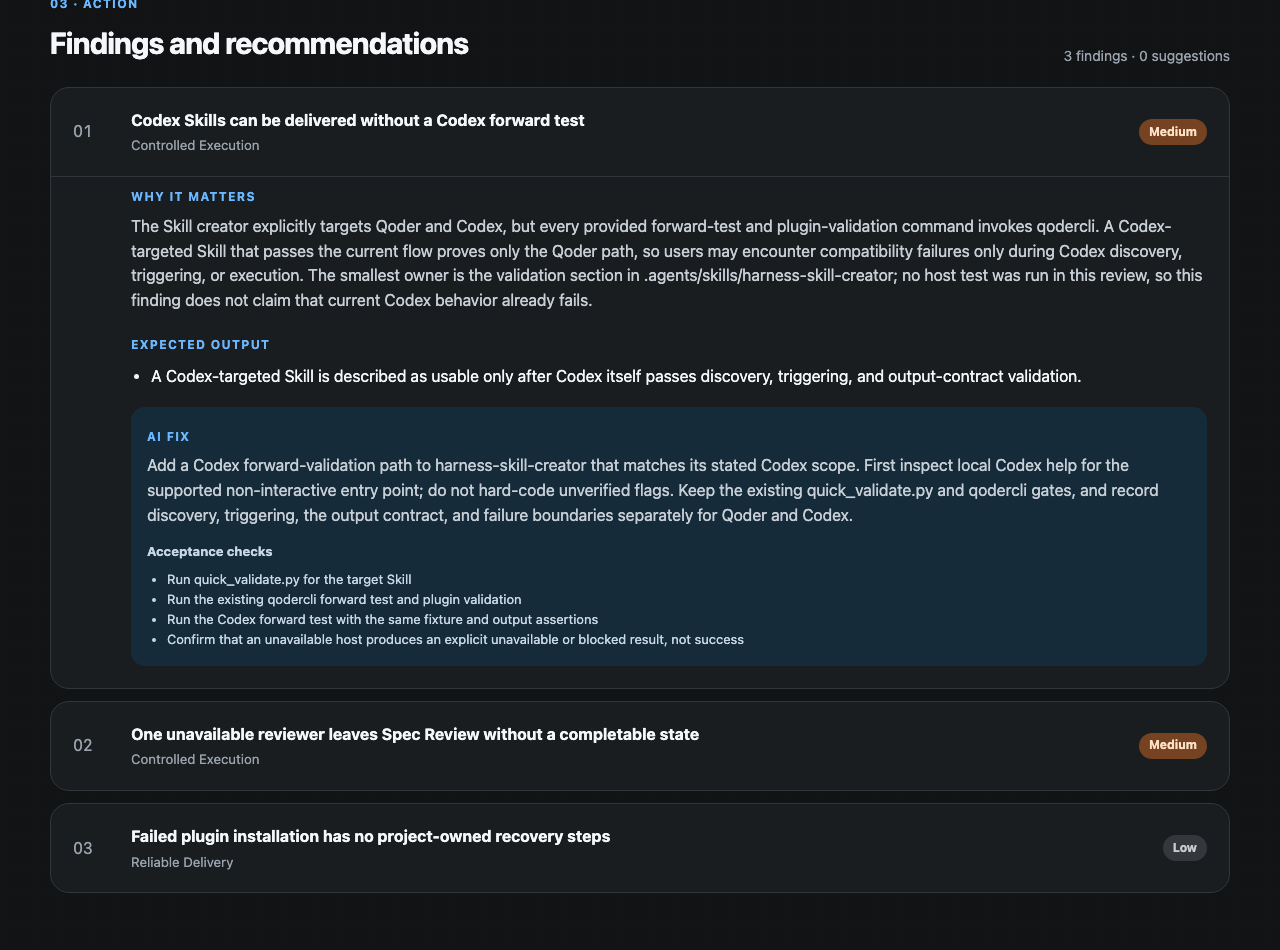
The report does not equate “missing Codex host tests” with “Codex has failed.” Instead, it preserves the distinction between tests that have not been run and evidence of failure. Scores only help locate issues; what matters is the conclusion, its impact, the smallest necessary fix scope, and how to verify the fix.
This is what separates Better Harness from a configuration checklist. A checklist tells you what a project has; Better Harness examines whether those capabilities actually helped the agent complete a task with trustworthy results.
And if the report’s judgments are to be inspected, revised, and verified again, open source has to mean more than a runnable entry point.
Simply publishing the prompt behind /better-harness on GitHub would certainly qualify as open source.
But for a coding agent, the outcome is never determined by a single line in a prompt. It depends on the entire way of working behind that prompt: what is worth checking, what counts as evidence, how judgments are formed, and how those judgments are continuously applied and refined in real projects.
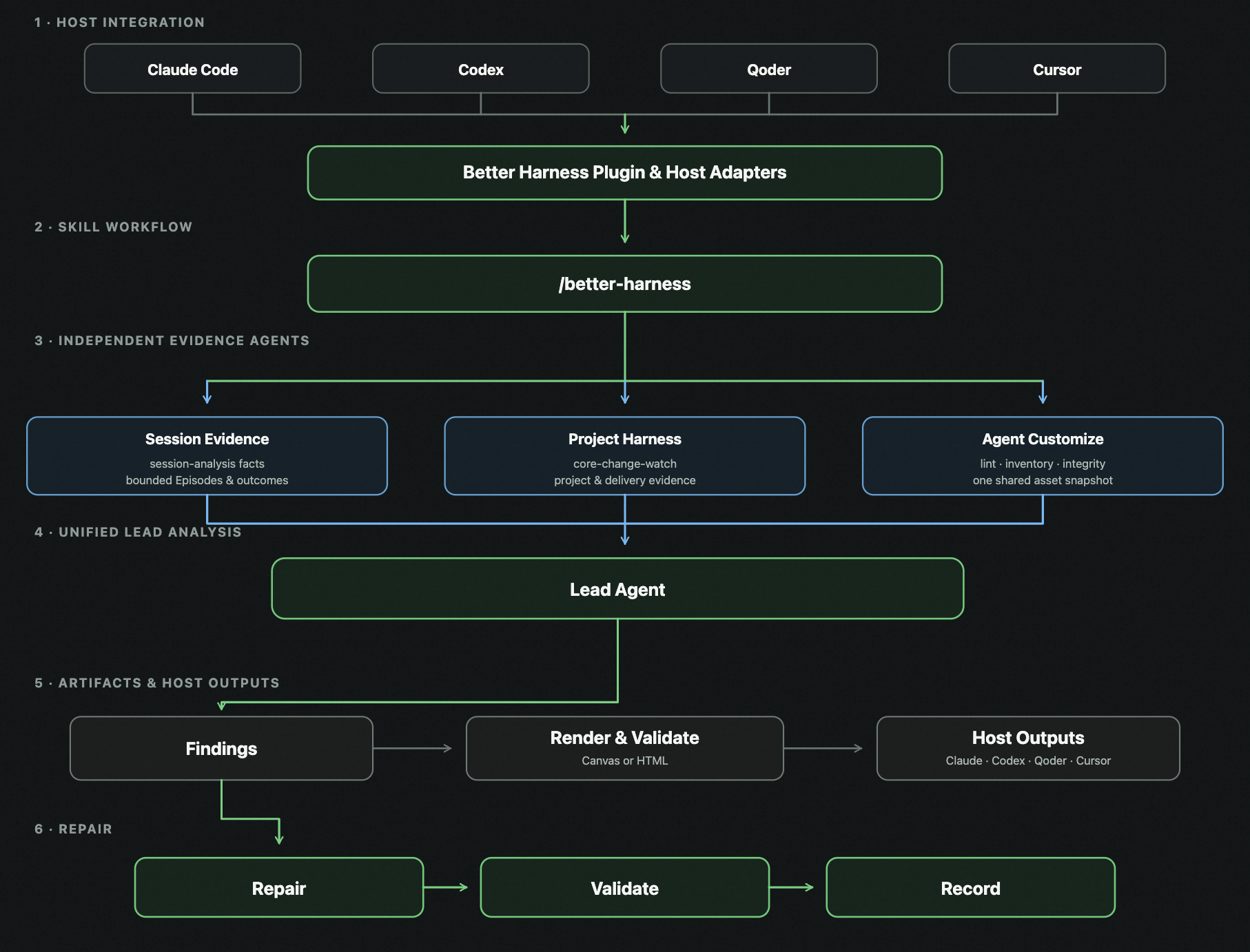
That is why this release opens up three interconnected layers of Better Harness.
This layer answers a fundamental question: when examining sessions, CLI tools, observability, Rules, Skills, MCP, Memory, Hooks, and automation, what should we check—and which conclusions cannot be drawn merely from the presence of configuration?
This knowledge is organized by problem domain in references:
| Domain | Question It Answers | Key Areas Examined |
|---|---|---|
| Session Evidence | How did the agent actually complete the task? | Sessions, task episodes, tool calls, retries after failures, usage, and evidence of outcomes |
| Project Harness | Does the project provide reliable paths for execution, verification, and delivery? | CLI tools, observability, design contracts, tests, Git Hooks, sensitive code, and recovery mechanisms |
| Agent Customize | Are agent assets discoverable, applicable, and actually effective? | Rules, Skills, MCP, Memory, Hooks, Custom Agents, and platform configuration |
| Loop Engineering | Which mechanism should handle proven recurring work over the long term? | Skill, Hook, Script, Automation, Rule, Custom Agent, MCP, and other mechanisms |
Rather than loading an ever-growing master prompt on every run, Better Harness consults the relevant domain guidance for the issues it finds. A diagnostic problem leads to observability practices; a Skill issue leads to Skill Review. When a recurring workflow is identified, it determines whether a Skill, Hook, Script, or Automation should handle that work on an ongoing basis.
This layer turns engineering practices into questions that can be checked individually and governs the relationship between evidence, scores, and conclusions. The current model and definitions of evidence states are published in Agent Work Loop.
Because the standards are still evolving, we avoided letting a single model subjectively define a “good harness.” For the first round of internal evaluation, we selected 30 real GitHub projects. Four types of models evaluated them independently using OpenAI’s Harness Engineering article, producing 120 standardized reports. We then compared results across models and applied human calibration to clarify evidence requirements, the limits of valid conclusions, and differences between project types, before reassessing every project under the updated criteria.
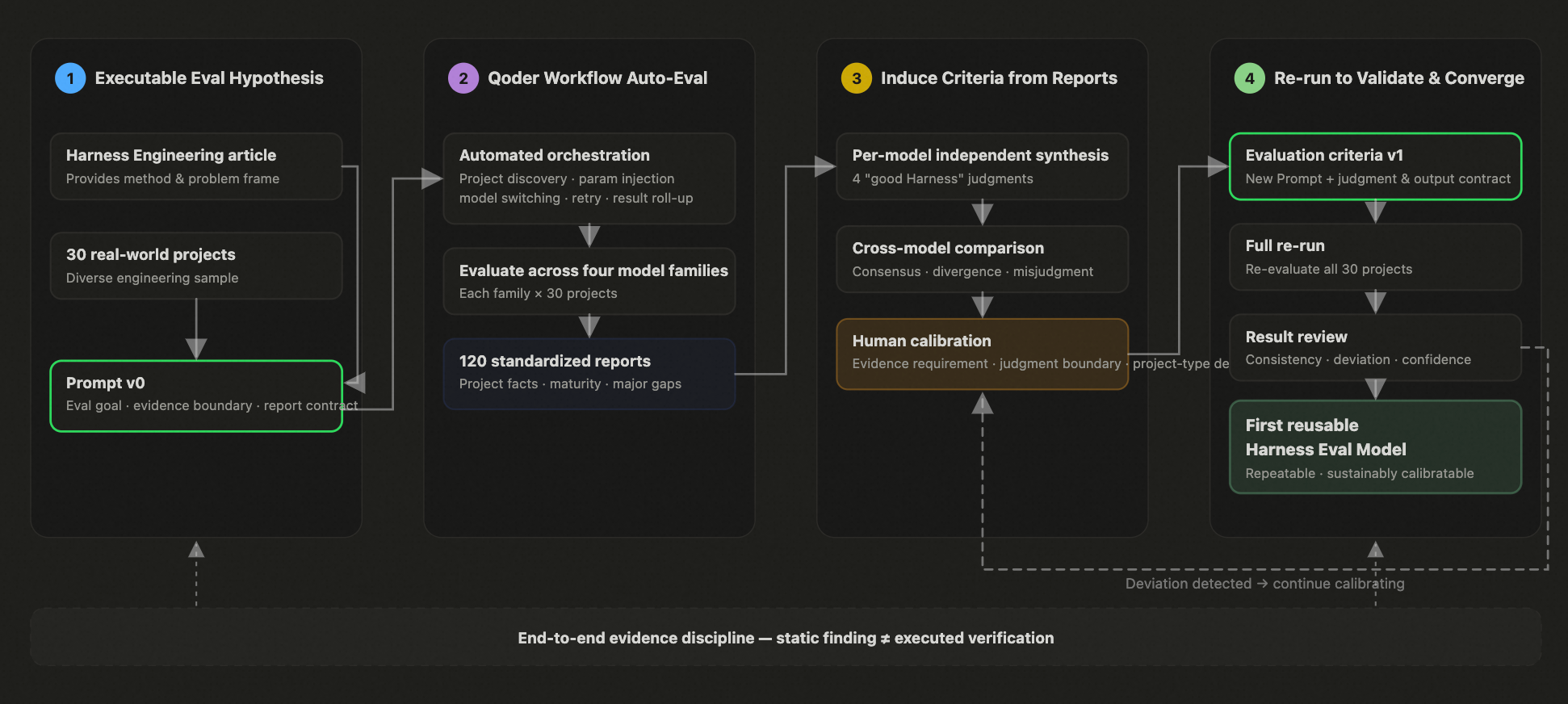
This loop—automated evaluation, automated synthesis, human calibration, and automated reruns—gave us our first reproducible Harness Engineering evaluation model, one that could be continuously refined.
The first version was still closer to a traditional software engineering maturity assessment, checking whether projects had documentation, tests, CI, and security mechanisms. But we soon realized that static assets cannot prove an agent has actually completed a task.
To track changes in both the model and project capabilities over time, we adopted a spec-driven approach to building Better Harness. As we accumulated more than 200 specs, the model gradually shifted from asking “What is in the repository?” to judging “What actually happened during the task?”
The unit of evaluation narrowed from a repository or session to a specific task. A session was no longer the object being evaluated, but simply a container for evidence. The model also converged on five dimensions: task understanding, controlled execution, change verification, reliable delivery, and retained learning. The existence of a file, a configuration count, events occurring close together in time, or even a successful command could no longer be treated as direct proof that a capability had actually been effective.
Ultimately, Agent Work Loop became more than a static scorecard: it became a reproducible system for making judgments about real tasks, with continuous calibration.
This layer brings the first two beyond documents and models, making them repeatable in real projects. Better Harness starts an analysis through a plugin or CLI—the JavaScript code in the project’s scripts directory—first fixing the task scope, then collecting three types of evidence separately:
These three evidence streams remain independent during collection and analysis. Only at the end does the Lead combine them with the guidance in References and the Agent Work Loop evaluation model to reach an overall judgment. “The project has a capability” and “the agent actually used it in the task” are, and always will be, two different facts.
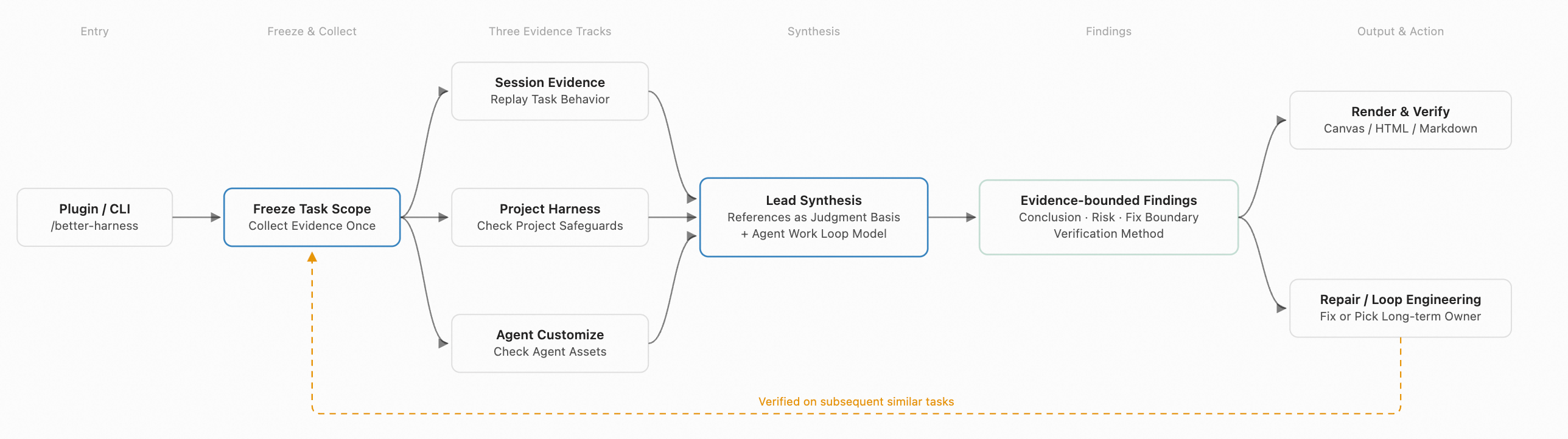
The final output is not just a score, but a set of Findings that specify the limits of the evidence, user impact, fix scope, and verification method. Once the report has been rendered and validated, the process can move on to remediation. If stable, recurring work is identified, Loop Engineering determines whether a Skill, Hook, Script, Automation, or another mechanism should handle it over the long term.
Completing a fix does not, by itself, mean the workflow has improved. The improvement loop is only complete when better results are observed again in subsequent tasks of the same kind.
Better Harness is built into Qoder Desktop. Update to the latest version, open the Quest window, and select Better Harness (Beta), or simply run /better-harness. It is also available directly in Qoder CLI and the JetBrains plugin on machines where Qoder Desktop has been installed.
Visit the Better Harness GitHub repository, follow the README to install it, and run/better-harnessfor the first time. For example, Claude Code users can run these commands in order:
/plugin marketplace add QoderAI/better-harness
/plugin install better-harness@better-harness
Then run:
/better-harness Analyze my project’s harness and generate an HTML reportOn your first run, you do not need to build a complete engineering framework for agents or aim for a perfect score. A more practical starting point is one issue with clear evidence, a concrete impact, and a fix you can verify quickly.
It might be a check command the agent cannot discover, an error log that offers no next step for diagnosis, or an existing Skill that has never been included in task routing.
Fix one issue, rerun the checks, and observe whether subsequent tasks of a similar kind change. Harness Engineering is not a one-off configuration exercise. It is the ongoing work of making a project easier for agents to understand, execute, and verify.

Better Harness has been run and calibrated repeatedly in Qoder’s real development workflows. Even so, the current model is primarily shaped by the project types and task scenarios we know best.
It may still have blind spots across different technology stacks, project scales, team constraints, and coding agents. More real-world evidence is needed to keep refining it.
If you would like to get involved, here are a few ways to contribute:
references/. No coding required.models/ or scripts/, complete with fixtures and tests.case-studies/.If you disagree with a Finding in a report, we warmly welcome an issue. To us, a counterexample from a real project is far more useful than a star—though a star is always appreciated, too.
Built at Qoder. Shared with the community. Helping every coding agent build on proven engineering practices.
QwenWork Unveiled E-Commerce Tool To Help Merchants in China Boost Efficiency

1,561 posts | 524 followers
FollowHosung Kim - August 17, 2026
Alibaba Cloud Community - May 21, 2026
Alibaba Cloud Community - August 3, 2026
Alibaba Cloud Community - September 25, 2026
Alibaba Cloud Native Community - March 25, 2026
Alibaba Cloud Community - August 24, 2026
1,561 posts | 524 followers
Follow Qoder
Qoder
From Assisted to Autonomous — Adapting to Every Programming Need
Learn More AgentCore
AgentCore unifies agent construction, governance, and execution capabilities so enterprises can deploy diverse agents with confidence.
Learn More Managed Service for Prometheus
Multi-source metrics are aggregated to monitor the status of your business and services in real time.
Learn MoreMore Posts by Alibaba Cloud Community

