Summary: The information humans and agents need is often scattered across large numbers of local files, making it difficult to locate accurately and efficiently. zg (zvec-grep) is local-first search infrastructure for humans and agents. Built on the vector search and BM25 capabilities of Zvec and combined with ripgrep (rg), it extracts and organizes information from local content such as code and documentation. This reduces search iterations and context consumption, helping humans and agents find and pinpoint the information they need more efficiently. zg is now open source—give it a try, and let us know what you think. Contributions are welcome!
With its outstanding performance and exhaustive matching, rg has become a foundational tool for developers and agents searching local content. When the target is explicit—a function name, configuration name, error message, or exact passage from a document—rg delivers fast, precise, and verifiable results.
As agents take on more complex tasks such as code comprehension, incident diagnosis, knowledge Q&A, and research analysis, retrieval inputs are shifting from explicit symbols and text toward natural-language descriptions of system behavior, implementation intent, and domain concepts.
These queries often have little lexical overlap with the wording used in code or documents. For example, the implementation behind “restore theme preferences” might be named hydratePreferences, while a user asking about the “access request process” may need a document that describes “account authorization and approval.” Without the right keywords, text matching alone can miss relevant content; broadening the search, however, can produce a large volume of results with no relevance ranking.
To find the required information, an agent may have to formulate multiple queries, run repeated searches, read files, and assemble context from scattered text matches. This increases tool calls, response time, and context consumption—and can still leave the agent reasoning from incomplete evidence.
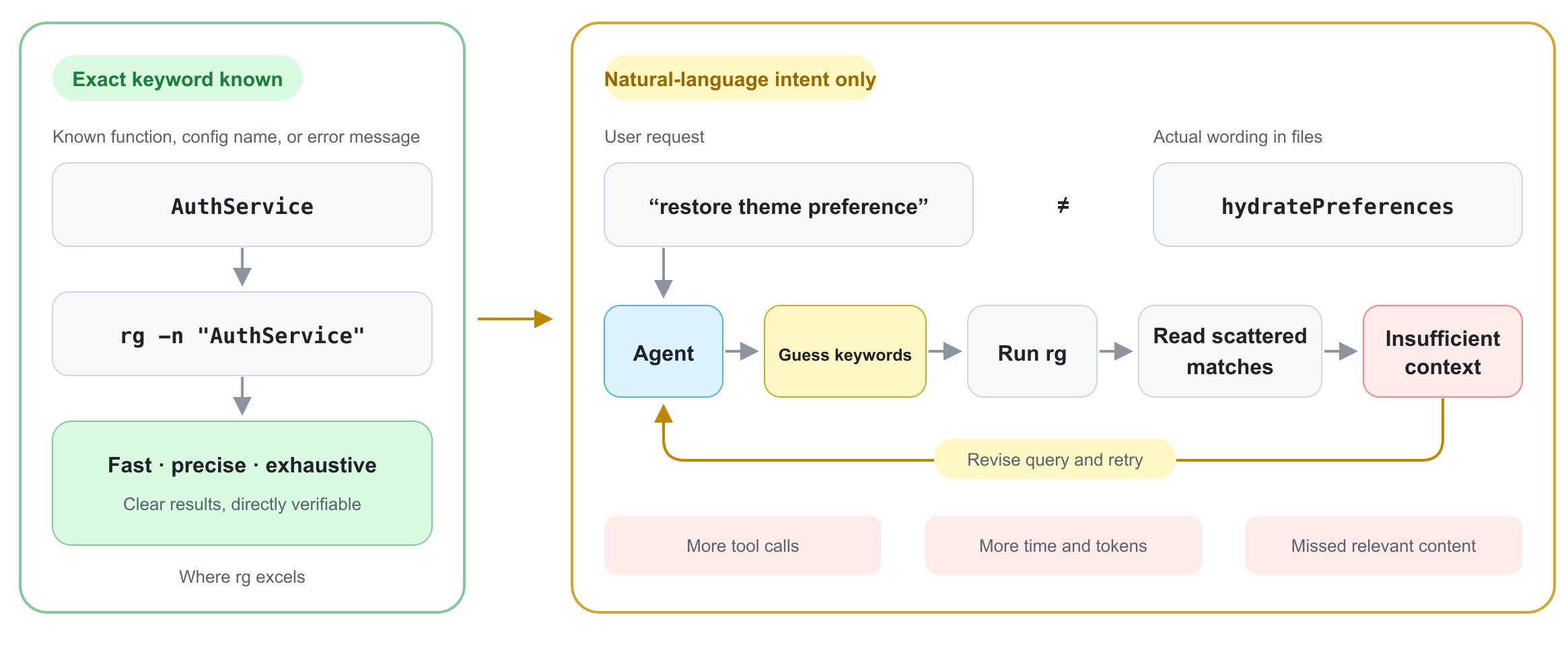
Local content retrieval therefore needs to preserve the precision, speed, and exhaustive matching of rg while adding semantic discovery, relevance ranking, and context organization. That is the problem zg is designed to solve.
To address this problem, we open-sourced zg (zvec-grep), local-first search infrastructure for humans and agents. zg extracts, organizes, and indexes local content such as code and documentation. Through its CLI and MCP integration, it provides semantic search, BM25, hybrid search, and exact matching with rg—extending local retrieval from keyword matching to intent discovery, relevance-ranked results, and precise verification.
zg's core design goal is to make information scattered across local files easy to discover and pinpoint. Its design principles are:
Based on these principles, zg's first open-source release starts with code and text content. It combines vector search, BM25, and rg; exposes both CLI and MCP interfaces on macOS, Linux, and Windows; and includes local embedding models, embedded indexes, and incremental updates. The following sections cover onboarding, retrieval and content coverage, task efficiency and cost, and local processing and data privacy.
zg supports macOS, Linux, and Windows, with a CLI for developers and MCP for agents. There is no service to deploy manually and no integration configuration to write: zg install automatically discovers Codex, Claude Code, Cursor, and OpenCode on the local machine and configures MCP for them.

Getting from installation to your first search takes three steps:
# 1. Install zg
npm install -g @zvec/zvec-grep
# Automatically discover installed agents and configure MCP;
# you can also specify a target, for example: zg install --target codex --yes
zg install

# 2. Build a local index for the current workspace
cd your-repository
# Uses the lightweight local model local/potion-code-16m-v2 by default
zg index

# 3. Start searching from the CLI or an agent
# Option 1: Search from the terminal with the CLI
zg query --human "theme preference persistence on startup"
# Option 2: Ask directly in a connected agent; the agent invokes zg through MCP as needed
# Example prompt: Find how theme preferences are restored on startup.
Connected agents can use the same local index directly through MCP, with no duplicate indexing or configuration.
Complex retrieval rarely ends with a single search. Starting from a task description, an agent gradually discovers relevant directions, keywords, and explicit targets. zg provides semantic search, BM25, hybrid search, and rg so each stage can use the retrieval capability best suited to it.
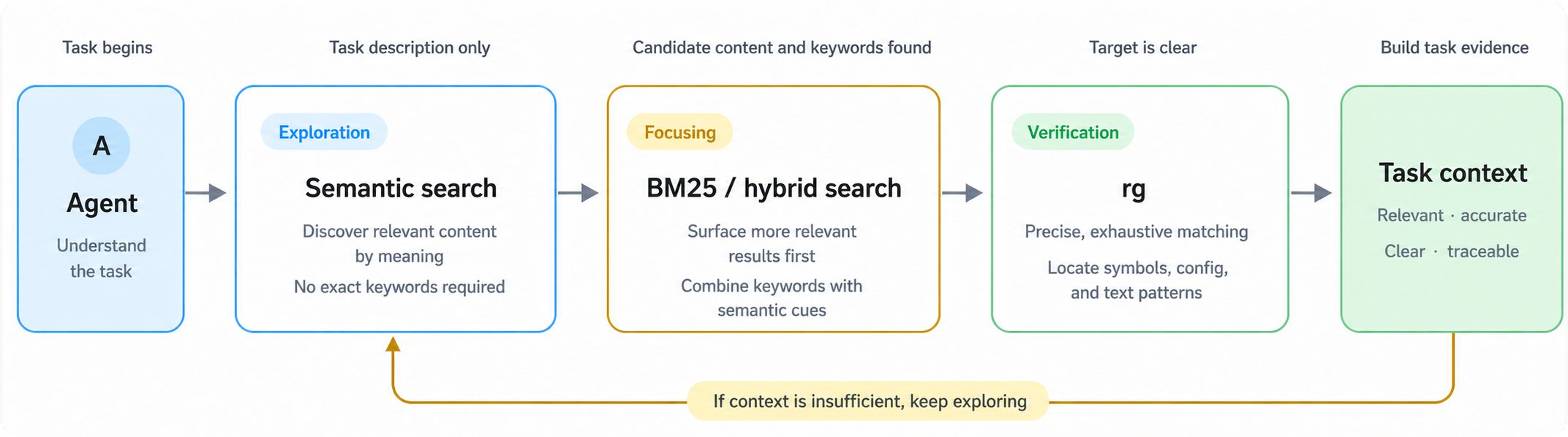
This is not a fixed pipeline that must always run from beginning to end. An agent can jump directly to the appropriate stage when it already has enough clues, or continue exploring when information is insufficient. CLI users can choose the same capabilities as needed, moving from a fuzzy intent toward discovering and precisely locating the required content.
zg is not limited to code. It applies an appropriate extraction and organization strategy to each type of content:
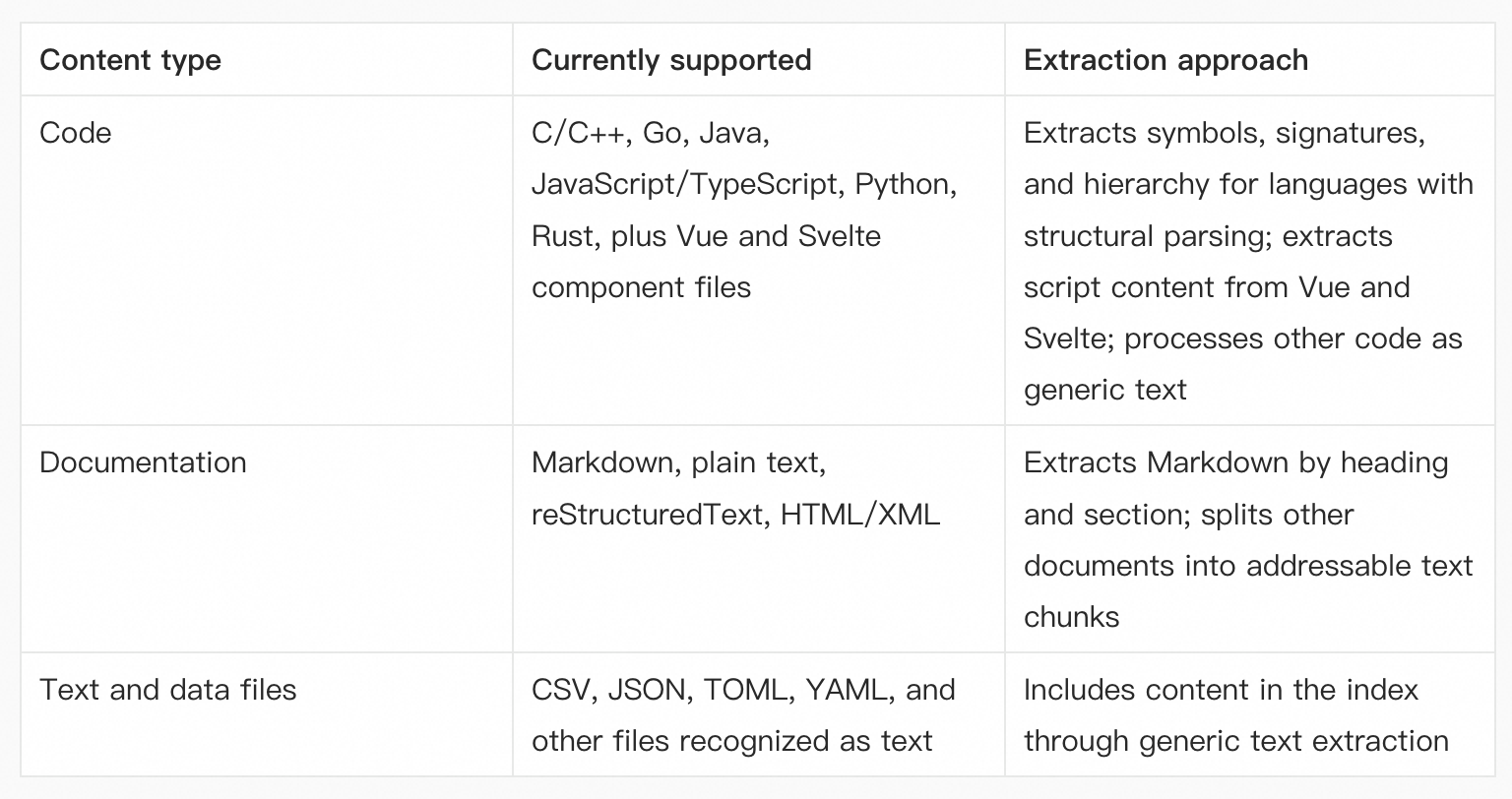
Code repositories, project documentation, research materials, and local knowledge bases can all become retrieval targets. Paths, globs, file types, and ignore rules can further constrain the scope, expanding content coverage without adding unnecessary result noise.
zg focuses not only on individual query latency, but also on the number of searches, tokens, and time an agent needs to complete an entire task. To reduce the cost of repeated keyword guesses, irrelevant file reads, and manual context assembly, zg optimizes the full retrieval path:
These optimizations need to demonstrate value across complete tasks—not merely make an individual query look faster. We therefore ran paired A/B evaluations on the code-repository Q&A benchmark SWE-QA-Bench and the deep-research benchmark BrowseComp-Plus. SWE-QA-Bench contains 20 questions from real code repositories that require agents to locate implementations across files and perform multi-step reasoning. BrowseComp-Plus contains 80 deep-research questions that require agents to retrieve and synthesize evidence from multiple documents in a large, fixed corpus.
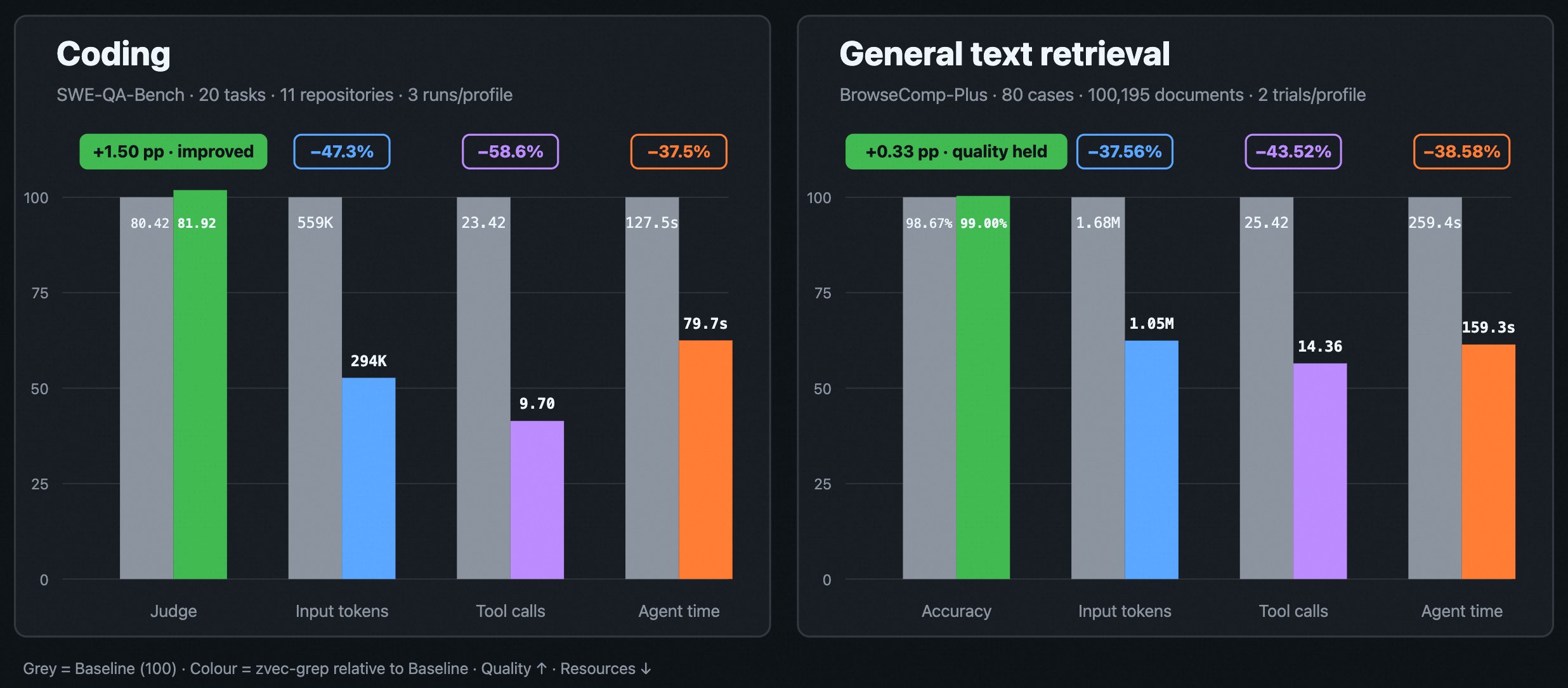
Evaluation notes: Each paired experiment used the same agent, model, prompt, runtime environment, and task constraints. The baseline used the agent's native tools; the zg condition added only a prebuilt index, MCP tools, and usage guidance. Prebuilding an index incurs a one-time time and compute cost, while remote embedding requests also incur token-based API fees. Because indexes can be reused across queries and agent tasks, with only changed content processed incrementally, this cost is typically negligible once amortized over continued use and is therefore excluded from the table above.
In our SWE-QA-Bench sample, zg reduced tool calls by more than half and input tokens by nearly half, while increasing the Judge score by 1.50 points. In our BrowseComp-Plus sample, accuracy rose from 98.67% to 99.00%, while input tokens decreased by 37.56%, tool calls by 43.52%, and agent time by 38.58%.
Local content such as source code and internal documentation often contains sensitive or unreleased information, making data flow during retrieval critically important. zg therefore makes local processing the default: file scanning, content extraction, local embedding generation, indexing, and retrieval all happen on-device, with no requirement to upload content or depend on an external service.
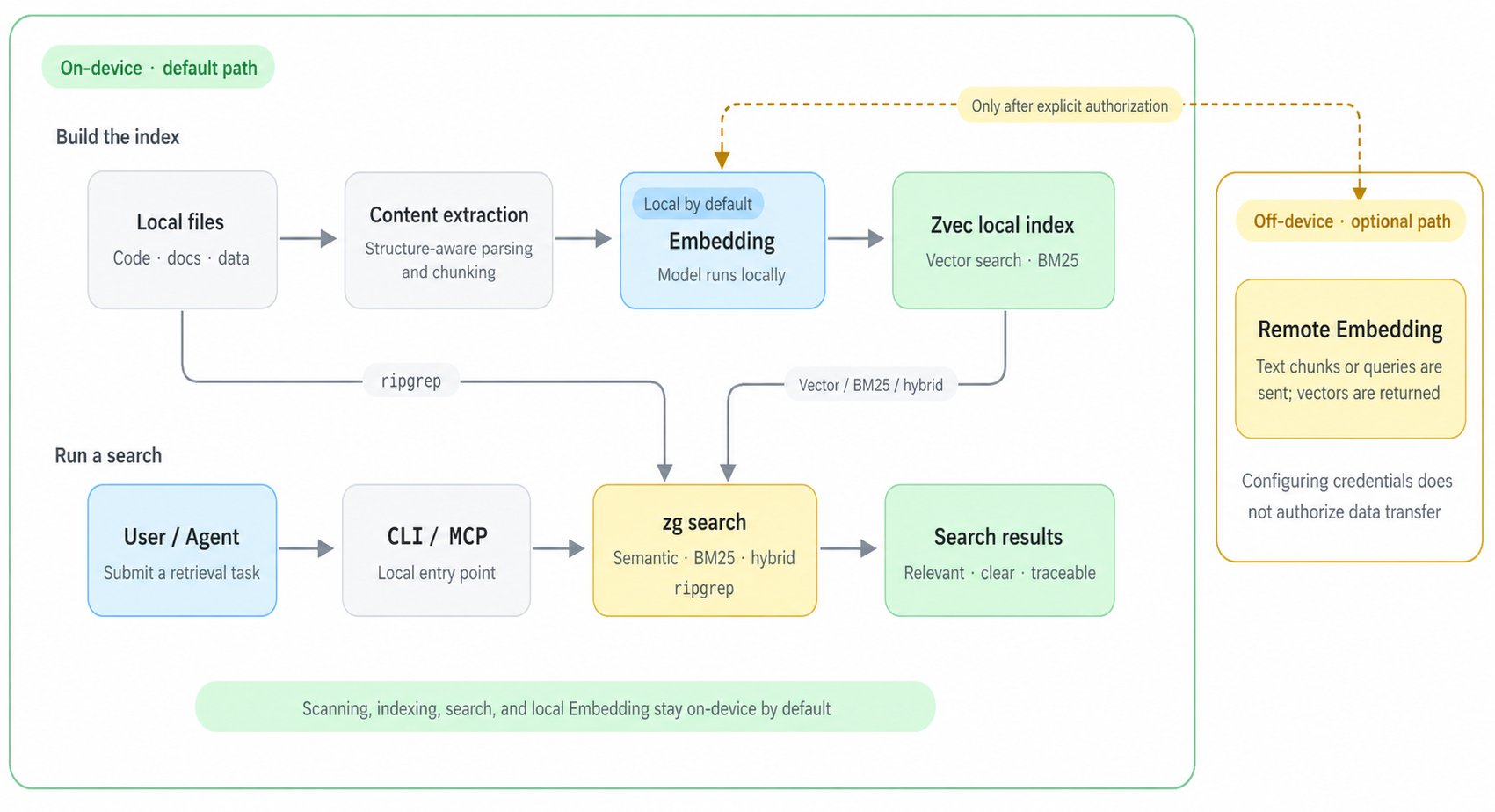
This local path is powered by on-device models and embedded indexes:
Beyond the default local path, zg preserves flexibility in model choice. When local models cannot meet retrieval-quality, multilingual-coverage, or device-resource requirements, users can opt into remote embeddings. Remote capabilities are never enabled automatically: relevant text or queries leave the device only after explicit authorization, balancing extensibility with data privacy.
zg provides the local-first retrieval foundations available today. Its next focus is expanding retrieval intelligence and document-processing coverage. Planned items indicate product direction and are not currently available.
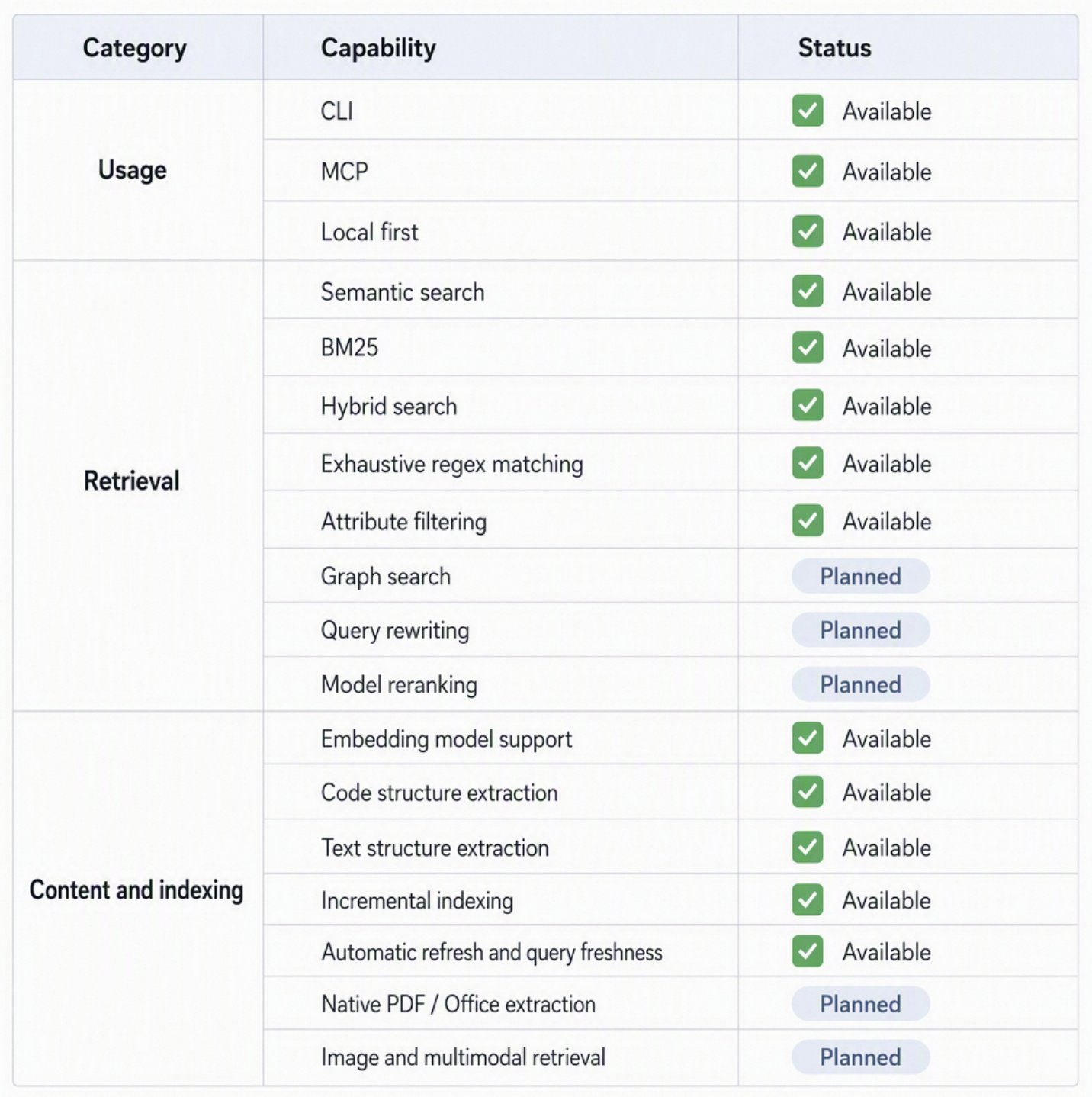
Available = supported today · Planned = product direction, not currently available.
To build more complete retrieval infrastructure, zg will focus on four areas:
At the same time, we will continue refining installation, upgrades, uninstallation, incremental indexing, concurrent access, service self-recovery, runtime diagnostics, and index compatibility to provide a smooth and consistent foundation for these capabilities.
zg is open source under the Apache 2.0 License. The project is still at an early stage, and we especially welcome feedback and contributions in these areas:
Project:
By Qwen developer
Source
Alibaba Supports Malaysia's AI untuk Rakyat Programme with MuleRun and WonderClip
Alibaba's QwenWork Hits 30 Million Users in First Month as Enterprise Adoption Surges

1,568 posts | 525 followers
FollowAlibaba Clouder - December 11, 2017
Alibaba Clouder - August 16, 2019
Alibaba Cloud Native Community - May 8, 2026
Alibaba Clouder - May 21, 2019
Alibaba-Cloud-GTS - August 25, 2021
Alibaba Clouder - December 21, 2020
1,568 posts | 525 followers
Follow Token Plan
Build more, spend less. One plan, every modality.
Learn More QwenWork
 is dedicated to helping employees strengthen their professional competitiveness in the AI era and to enabling enterprises to improve organizational effectiveness.
Learn More
Alibaba Cloud Model Studio
A one-stop generative AI platform to build intelligent applications that understand your business, based on Qwen model series such as Qwen-Max and other popular models
Learn More Qwen
Full-range, open-source, multimodal, and multi-functional
Learn MoreMore Posts by Alibaba Cloud Community

