
Alibaba DAMO Academy has unveiled a new AI model designed for the early detection of esophageal cancer (EC) in Nature Medicine, named DAMO EAGLE (Esophageal AI-Guided malignant Lesion Evaluation). Joining previous models for pancreatic, gastric, colorectal, and liver malignancies, this marks DAMO’s latest AI model for major cancer detection, while models for breast and lung cancers are currently in development. Together, these innovations target the top seven leading causes of cancer-related deaths in China, underscoring DAMO’s relentless commitment to tackling critical global health challenges through advanced technology.
Additionally, it unveiled DAMO RADAR, a generalist medical imaging AI model published in the prestigious international journal Science. Designed for contrast-enhanced abdominal CT diagnosis, the model can identify more than 146 conditions in a single scan. Matching the level of specialist radiologists, the model has now been officially open-sourced.
According to the research paper, The EAGLE model achieves a milestone inidentifying esophageal cancer, including early-stage and malignant precancerous lesions, using standard non-contrast chest computed tomography (CT) scans, without requiring contrast agents, while helping identify patients who may benefit from further endoscopic evaluation. The model has been validated using a robust anonymous dataset of over 80,000 patients across 12 medical centers in three countries—China, the Czech Republic, and Australia.
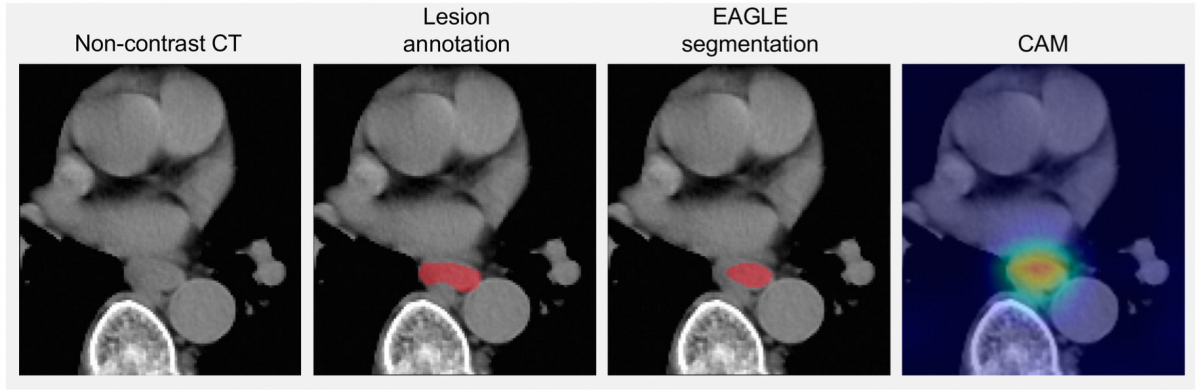
The lack of accurate, non-invasive, and scalable screening tools has long made the early detection of esophageal cancer a major hurdle in global healthcare. The issue is especially pressing in China, which accounts for roughly half of the world’s esophageal cancer cases and mortalities. Because symptoms rarely appear early on, many patients are diagnosed at advanced stages, missing the critical window for effective treatment. While non-contrast CT scans are widely accessible, using them to screen the esophagus has historically been a major challenge. The esophagus is a hollow, tubular structure prone to physiological collapse and motion artifacts, making small, early-stage malignant lesions nearly indistinguishable from normal tissue.
The EAGLE model presents a critical breakthrough in overcoming these limitations through an innovative training methodology. DAMO’s research team precisely paired accurate lesion locations derived from endoscopy reports and contrast-enhanced CT images with their corresponding non-contrast CT scans. This successfully trained the AI to recognize early esophageal cancer signatures that are virtually imperceptible to the human eye.
According to the study, in opportunistic screening scenarios, the DAMO EAGLE model achieves a 90% sensitivity rate for esophageal cancer and maintains a sensitivity of 52.5% even for precancerous lesions. In large-scale real-world clinical validation across 35,402 patients, an upgraded version of the framework (EAGLE-Plus) demonstrated an exceptional specificity rate of 99.2%, drastically minimizing false positives. Remarkably, the model successfully flagged malignant lesions up to 9 to 21 months before standard clinical pathways managed to diagnose them. Furthermore, it achieved similar performance on low-dose CT (LDCT) scans, allowing it to be integrated into existing routine health check-ups and lung cancer screening programs without requiring additional radiation exposure.
A comprehensive reader study highlighted EAGLE’s power as a clinical decision-support tool. When doctors evaluated cases with EAGLE’s assistance, their sensitivity for detecting difficult early-stage lesions improved by up to 22.7%, and their specificity improved by approximately 12.1%, enabling general residents to approach the diagnostic accuracy of specialized esophageal specialists. By serving as a rapid, non-invasive pre-endoscopy risk-stratification tool within population-based screening programs, clinical simulations revealed that triaging patients with EAGLE could help prioritize higher-risk individuals and increase endoscopic detection rate approximately threefold. This reduces healthcare costs by 37.5% to 64.5% across major medical systems.
In collaboration with institutions including the First Affiliated Hospital of Zhejiang University School of Medicine, DAMO Academy has introduced DAMO RADAR (Rapid Abdominal Diagnosis with AI and Radiology), a generalist medical imaging AI model published in _Science_. Designed for contrast-enhanced abdominal CT interpretation, the model can identify over 146 conditions from a single scan. Demonstrating both broad diagnostic coverage and high clinical accuracy, DAMO RADAR substantially improves radiologists’ diagnostic sensitivity when used as an assistive tool.
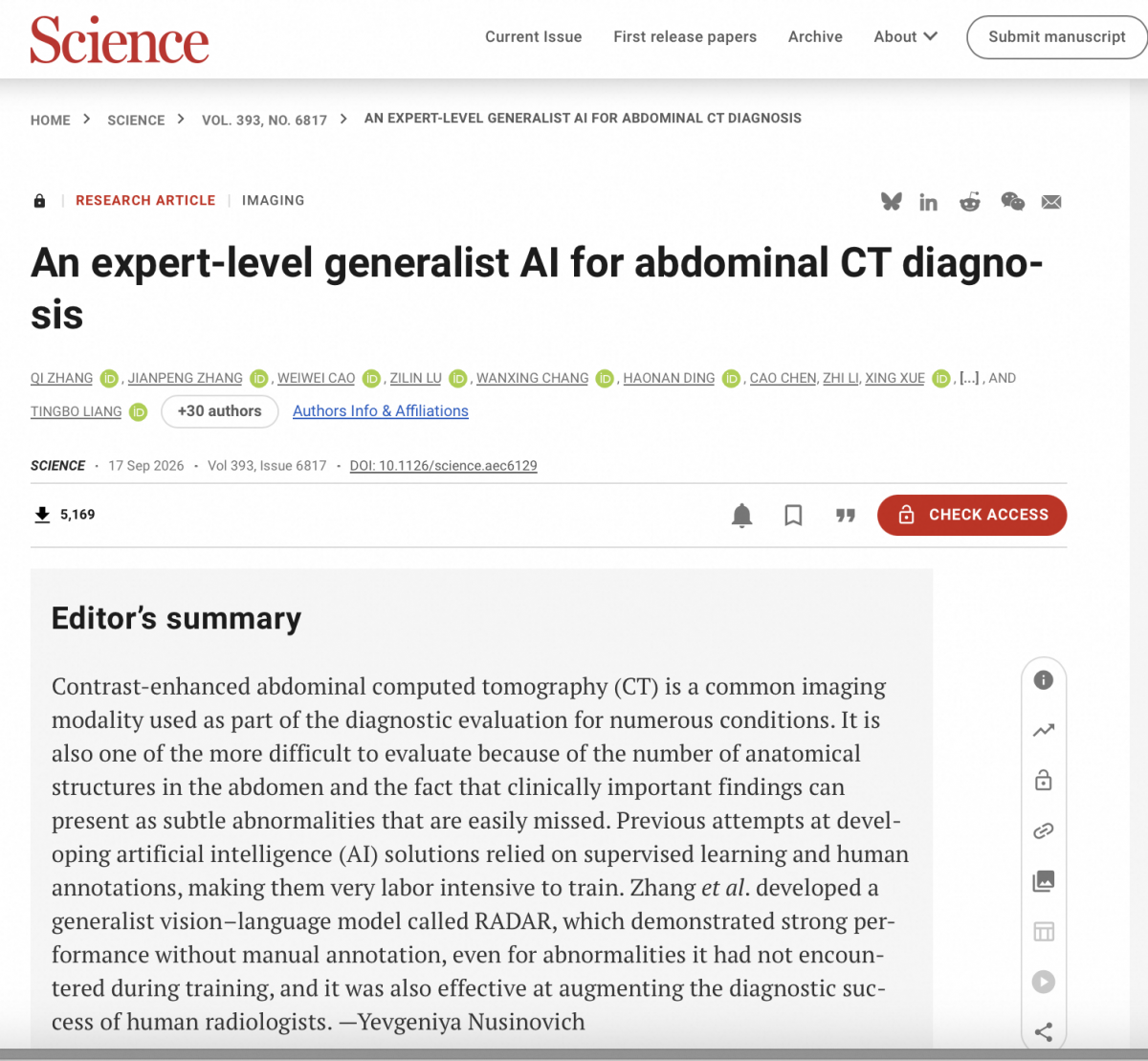
To enable multi-disease detection from a single CT scan—a capability that significantly cuts healthcare costs and turnaround times—DAMO leveraged a vision-language learning framework. The model was trained directly on the intrinsic associations between medical scans and their corresponding radiology reports. Pioneering an “organ-level fine-grained alignment” strategy, the system reconstructs CT scans into 3D representations and decomposes them into distinct anatomical units, ensuring precise alignment between image features and textual findings at the organ and tissue levels. Paired with an adaptive contrastive learning mechanism, the framework delivers scalable, versatile, and interpretable diagnoses without relying on manual pixel-level annotation.
DAMO RADAR represents the first milestone where high-accuracy, multi-organ, multi-disease abdominal detection has been realized. In the study, the research team evaluated 146 conditions across 18 organs using nearly 40,000 real-world clinical scans. The model achieved an Area Under the Curve (AUC) of 0.913, making it as the first generalist imaging AI to reach expert-level diagnostic capability. When assisted by the model, radiologists improved their diagnostic sensitivity by 10% and cut reading times by over 30%, effectively closing the performance gap between junior radiologists and senior specialists.
Through long-term commitment to advancing healthcare AI, DAMO Academy has successfully established a multi-disease “non-contrast CT + AI” technical pathway. From a single routine scan, the technology can now screen for pancreatic, gastric, colorectal, liver and esophageal cancers, as well as acute conditions like aortic dissection. Recognized in distinguished academic publications, DAMO aims to enable the comprehensive screening of all seven leading causes of cancer-related deaths in China through a single, non-contrast CT examination.
This article was originally published on Alizila written by Crystal Liu.
Alibaba Group Honored by Fortune's 2026 Change the World List for Bringing AI to Those in Need

1,548 posts | 520 followers
FollowAlibaba Cloud Community - April 29, 2026
Alibaba Cloud Community - March 13, 2026
Alibaba Cloud Community - May 31, 2024
Alibaba Cloud Community - November 20, 2025
Alibaba Cloud Community - September 1, 2026
Alibaba Cloud Community - July 24, 2025
1,548 posts | 520 followers
Follow QwenWork
QwenWork is dedicated to helping employees strengthen their professional competitiveness in the AI era and to enabling enterprises to improve organizational effectiveness.
Learn More Token Plan
Build more, spend less. One plan, every modality.
Learn More
Alibaba Cloud Model Studio
A one-stop generative AI platform to build intelligent applications that understand your business, based on Qwen model series such as Qwen-Max and other popular models
Learn More Alibaba Cloud Academy
Alibaba Cloud provides beginners and programmers with online course about cloud computing and big data certification including machine learning, Devops, big data analysis and networking.
Learn MoreMore Posts by Alibaba Cloud Community

