On Friday afternoon, you add a new Skill to your Agent. All five trial runs go well, so you confidently click Publish.
By Monday morning, the group chat is in uproar: some answers are correct, but reviewing the execution traces reveals that the Agent never checked the data; some responses say “the report has been generated,” but the file does not exist; and several previously reliable scenarios have inexplicably deteriorated.
Anyone who has put an Agent into production will probably recognize this scene. Consider these moments, too:
Many decisions to release an Agent rest on little more than “it seems fine” after a few trial runs.
“It seems fine” is a high-risk phrase in Agent engineering—because you do not know when it will fail.
Traditional software is deterministic: the same input always produces the same output, so running a unit test and checking a few performance metrics is enough.
An Agent is different. What it delivers is not just an answer, but a complete package of answer + process + artifacts + behavioral boundaries:
On top of that, model outputs are inherently probabilistic—being right this time does not mean being right next time.
Without a baseline comparison, an “impression” formed from a few trial runs proves neither that the Agent is stable nor that your changes have improved it.
What an Agent needs, then, is not a one-off acceptance test, but an ongoing evaluation system.
| Concept | Meaning |
|---|---|
| Evaluation case | An evaluation task comprising inputs, attachments, and success criteria |
| Agent under evaluation | A complete Agent configuration and its resources |
| Execution environment | The setting in which the Agent executes its tasks |
| Execution trace | Message events, tool calls, and tool results during execution |
| Response and artifacts | The final response, generated files, and changes to the environment |
| Evaluator | Logic that assesses a particular dimension |
| Baseline | Results before a change, used for comparison in regression testing |
If you think of an Agent as an exam candidate preparing to take on a job, every role in a reliable evaluation system has a counterpart:
The goal of evaluation is not a one-off score, but a continuously running evaluation loop: identify issues → improve → validate through regression testing → identify more issues.
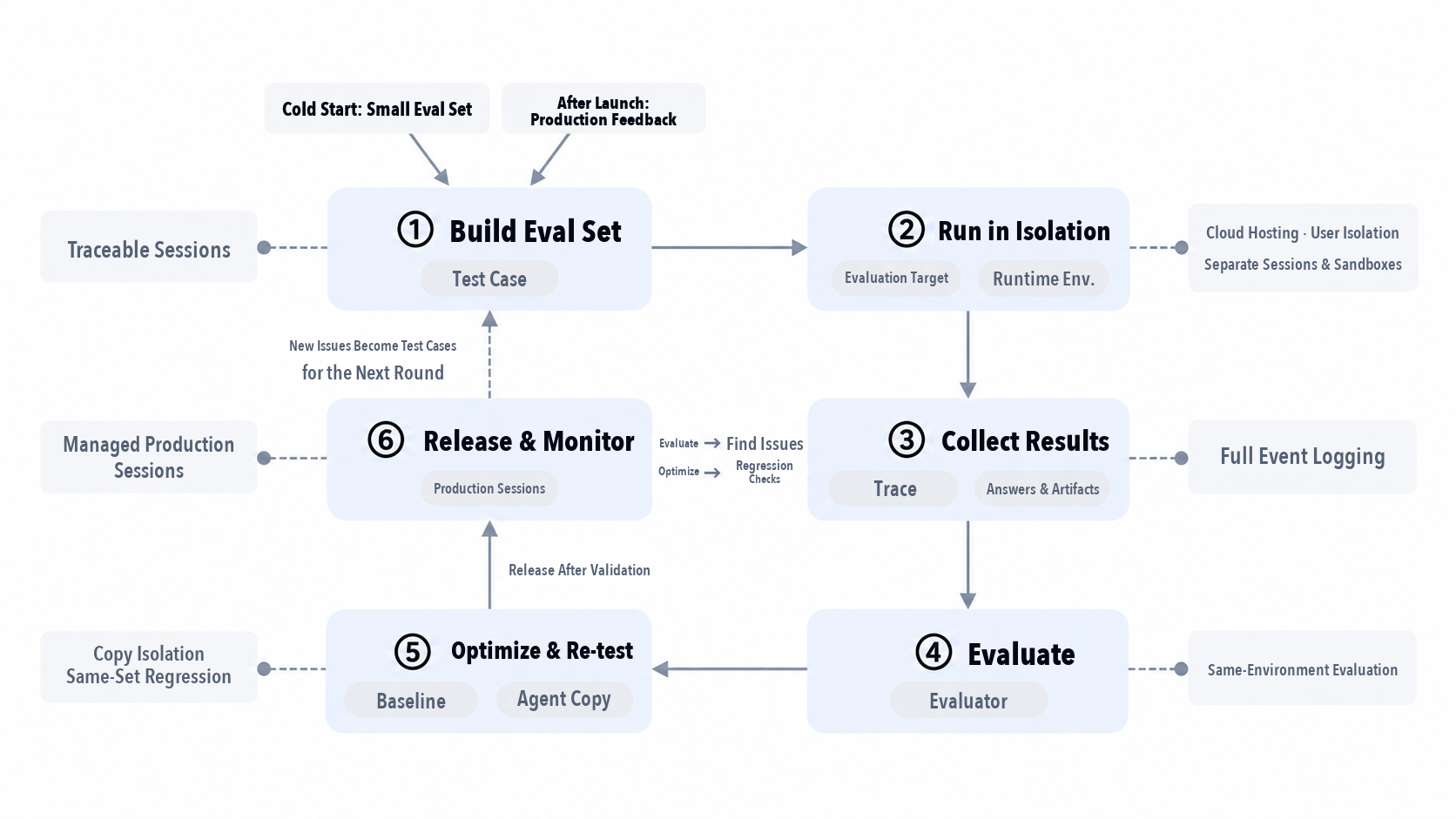
Qoder Cloud Agents provides the conditions needed to put an ongoing evaluation loop into practice:
Evaluation data usually comes from two sources: business evaluation datasets and open-source benchmarks. They differ in how they are organized and in the purposes they serve.
Business evaluation datasets come from the business itself.
An open-source benchmark generally comprises an end-to-end workflow that includes an evaluation dataset, not just data alone. Each benchmark has its own tasks and scoring scripts; some also require specific tools, Skills, or execution environments. Evaluating with open-source benchmarks is an appropriate approach when comparing the capabilities of general-purpose Agent harnesses or comparing results against public leaderboards.
For a user's cloud-hosted business Agent, an evaluation dataset built from the business itself is even more important. Its evaluation cases come from real tasks and issues, reflecting the Agent's performance in the business. It compares different versions of the same Agent across different business stages to determine whether the Agent has genuinely improved. This evaluation dataset grows with the business, gradually becoming the business owner's own data asset.
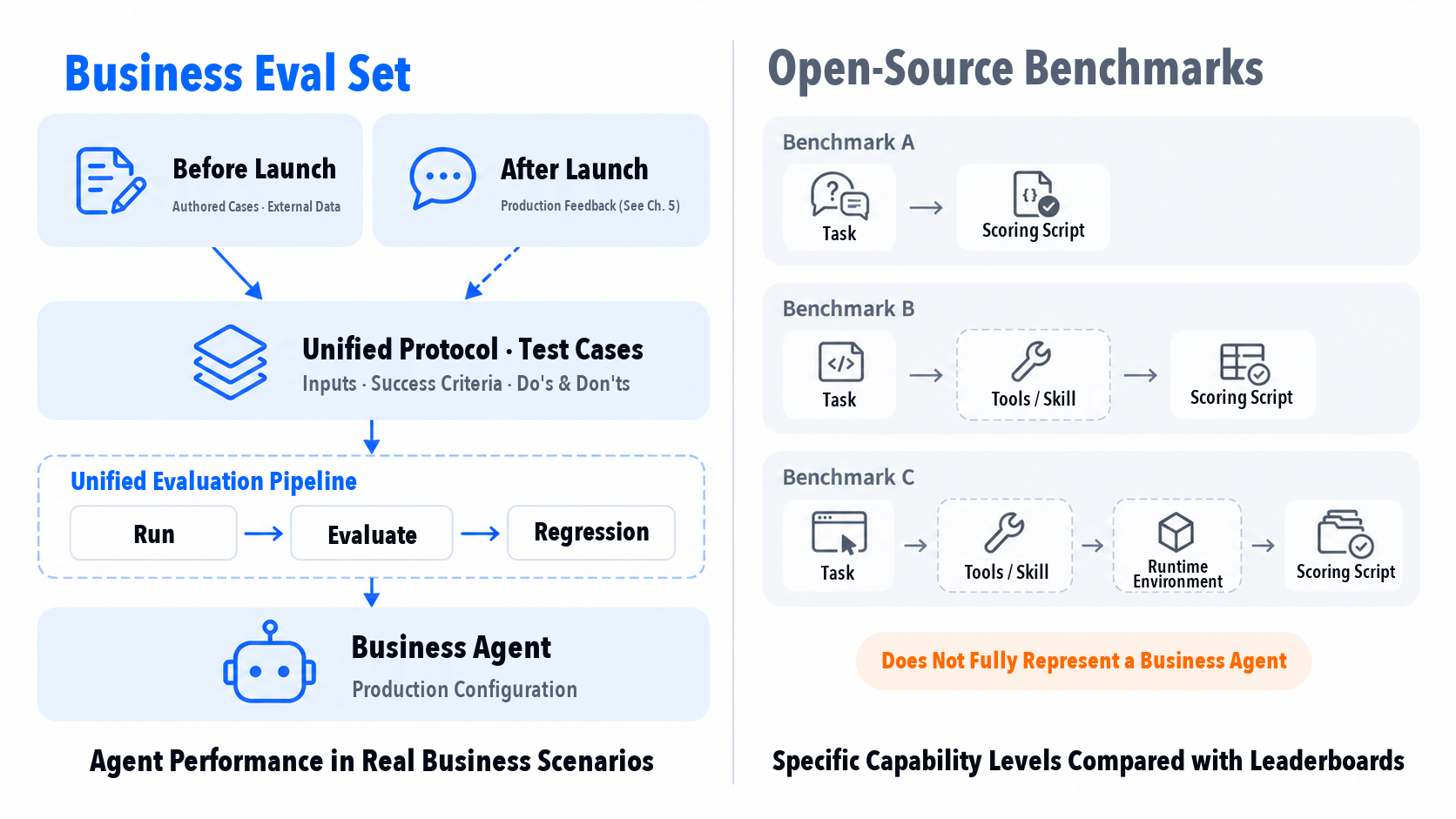
Business evaluation datasets compare the same Agent across different versions and business stages, answering the simplest question: did this change actually make it better?
More importantly, this question bank grows with the business—it ultimately becomes the business owner's own data asset. Models and frameworks can change, but others cannot simply copy a question bank rooted in your own business.
These three situations are common in Agent evaluation:
A standardized, isolated exam environment is a prerequisite for trustworthy scores.
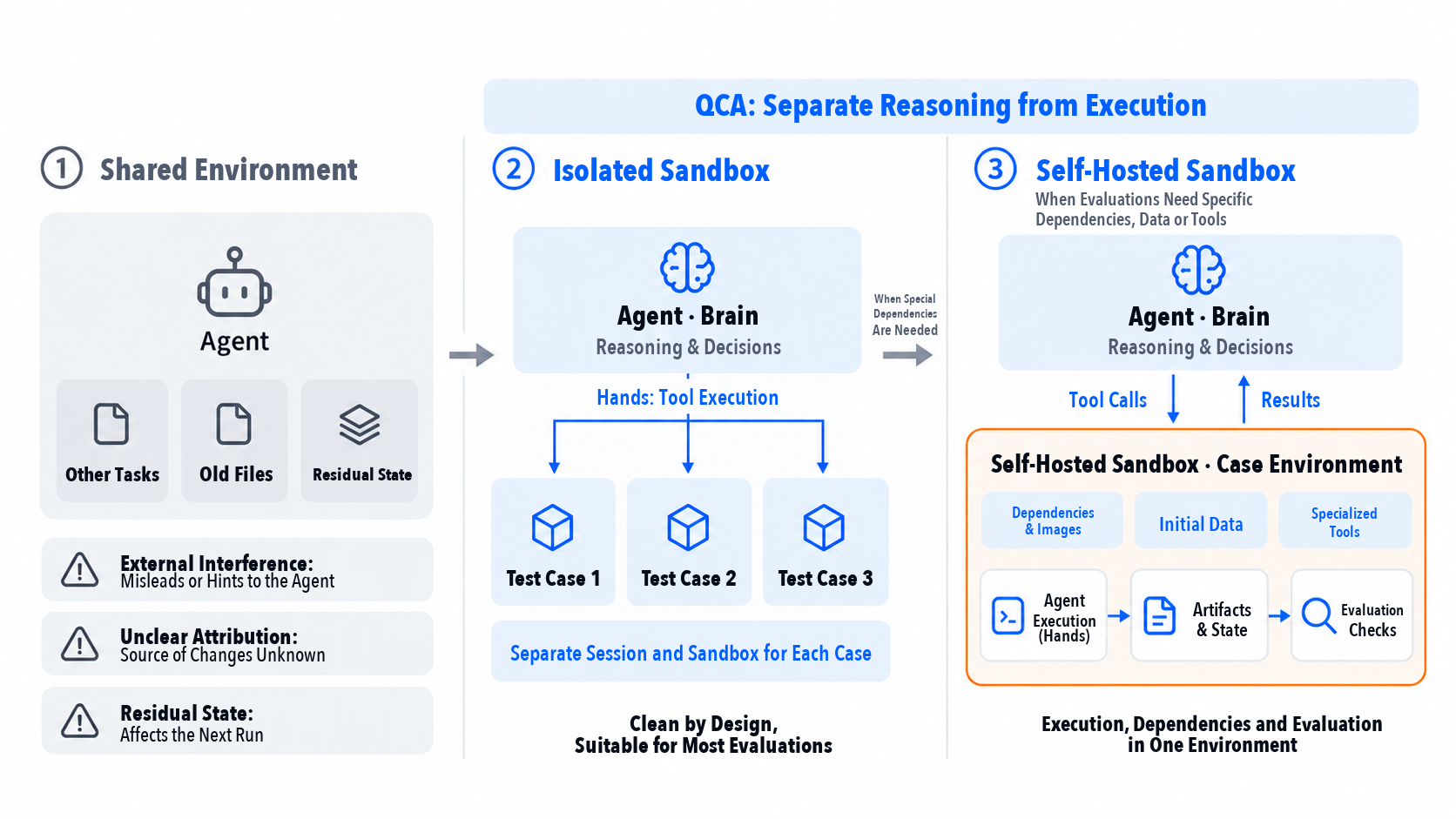
An independent test environment for every evaluation case. QCA uses an architecture with “decoupled reasoning and execution”, separating the Agent's reasoning and decision-making from tool execution in the sandbox and creating an isolated sandbox for each session. During evaluation, each evaluation case uses a separate session and is inherently isolated.
Set up specialized evaluation environments yourself. When evaluation requires specific dependencies, data, or tools, it also needs a separately prepared environment. Keeping that environment separate from QCA's default environment prevents effective validation. With QCA's self-hosted sandbox mode, the prepared evaluation environment can serve as the execution environment, bringing execution, dependencies, and evaluation together in the same environment.
A grader who looks only at the final answer can easily be misled:
That is why QCA evaluation insists on three checks:
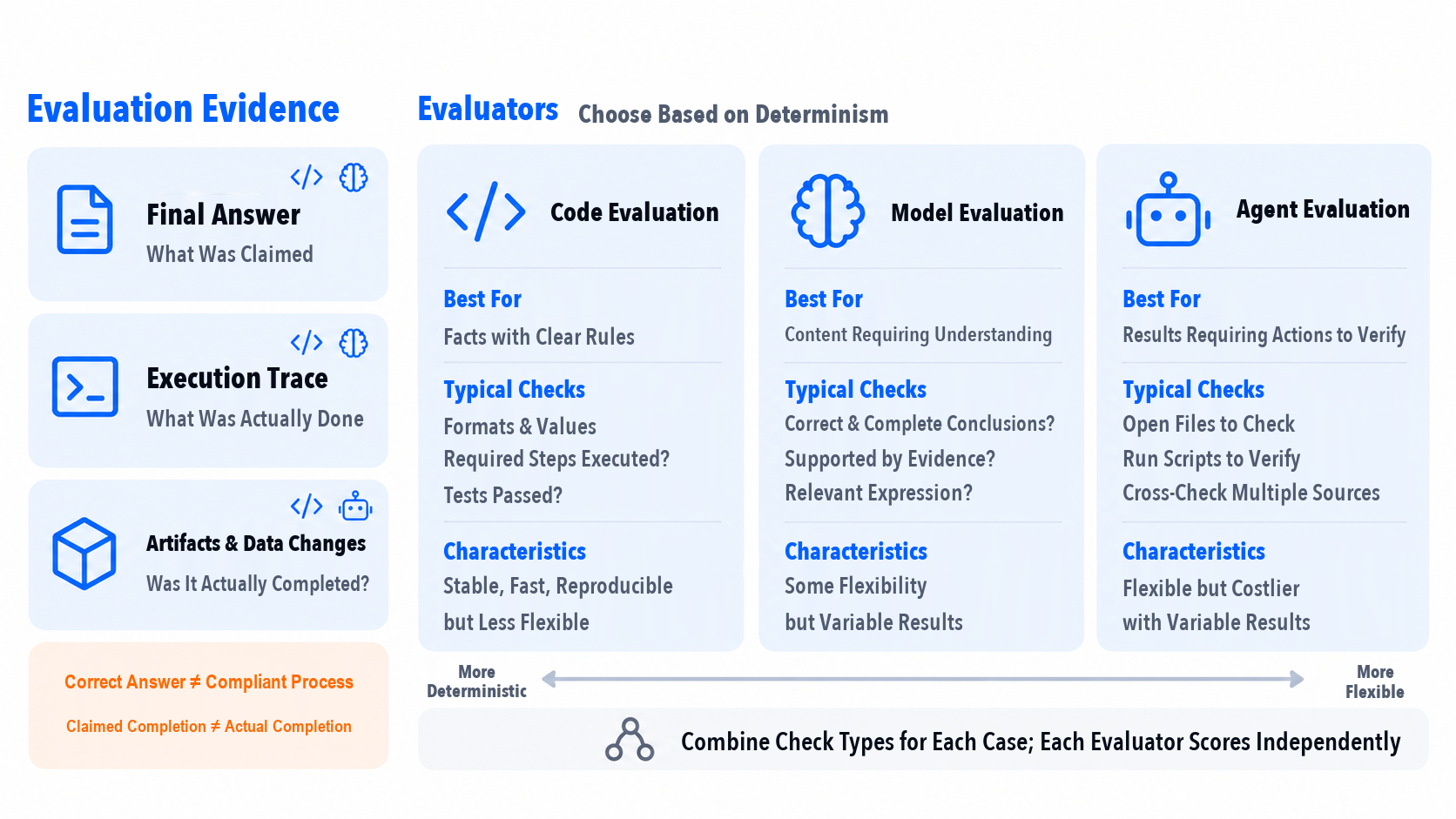
Different types of questions go to different evaluators. There is just one principle—start with deterministic checks:
An evaluation case typically combines several types of checks, with each evaluator scoring independently. Grading itself must also follow strict rules:
The results of one evaluation are the starting point for the next round of optimization.
But one fact is often overlooked: most optimizations you make to an Agent happen at the semantic level—changing prompts, adding Skills, or refining tool descriptions. Model outputs are inherently probabilistic: a change does not guarantee the Agent will follow it, and following it does not guarantee consistent behavior.
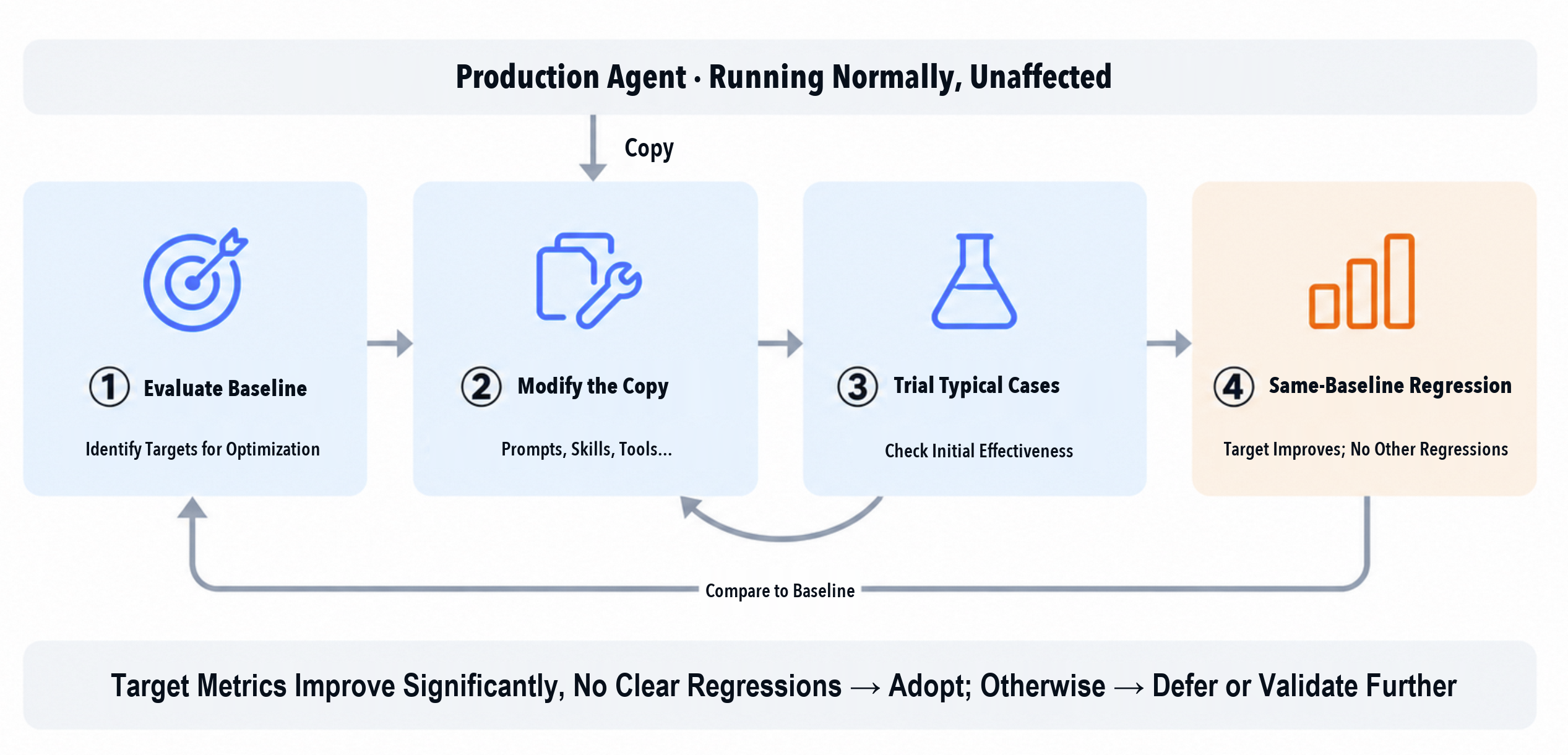
Every optimization therefore requires regression validation against the baseline. At its core, this means minimizing the uncertainty introduced by “changes”.
QCA's managed architecture makes this lightweight: quickly clone an identical copy of the Agent, then iterate on that copy to create different test versions while the production business Agent continues running as usual, unaffected.
The acceptance criteria must also be clear:
Fixing failed cases alone is not progress; overall performance must not regress.
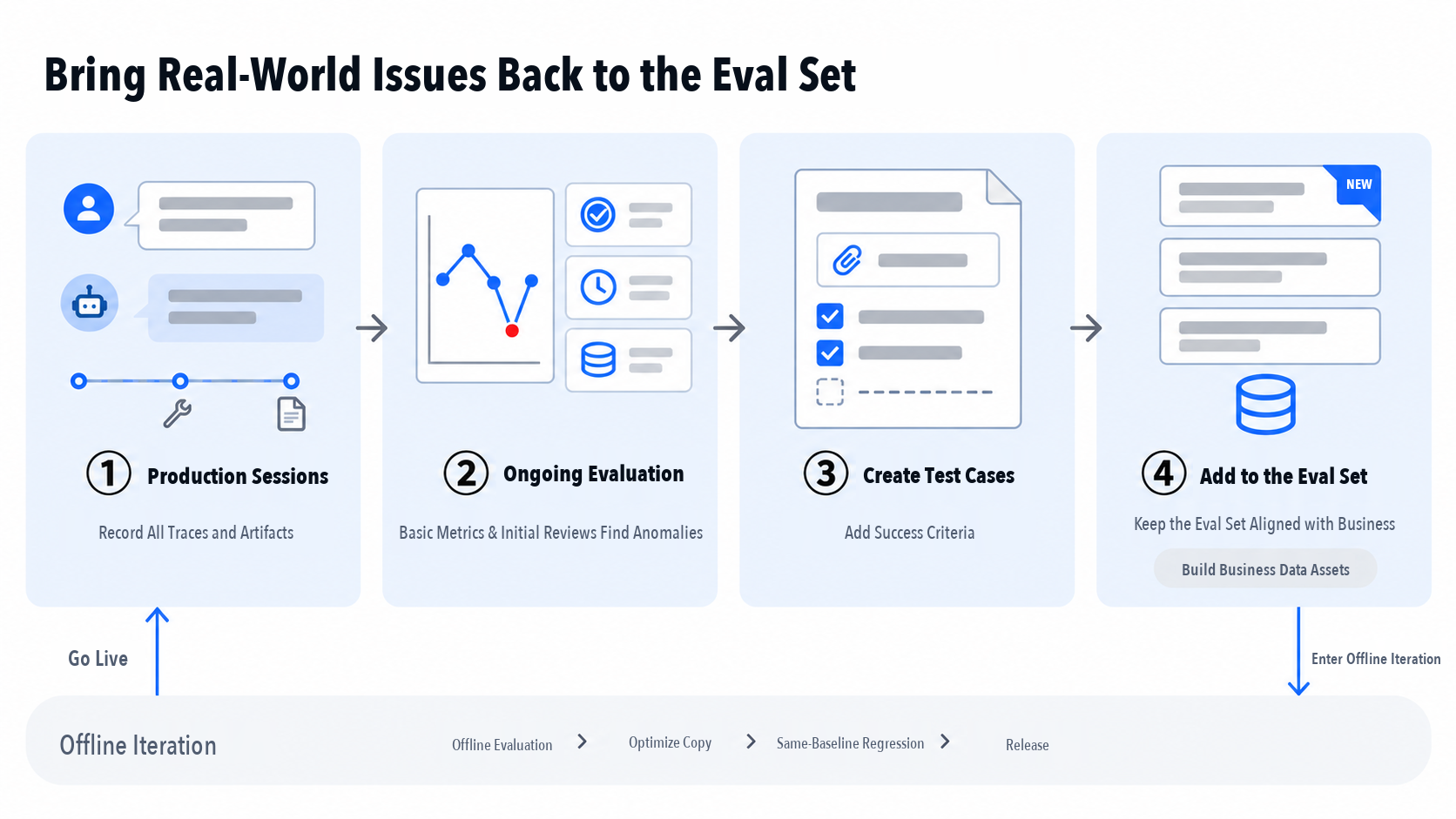
Offline evaluation datasets cover previously known issues and scenarios.
For issues that actually arise in production, you can conduct proactive, continuous assessment: turn valuable scenarios and issues into evaluation cases and add them to the evaluation dataset, building business data assets for future iteration and optimization.
Note that online assessment and offline evaluation are not the same:
Online assessment therefore requires business-specific observational metrics, such as trace efficiency, tool-call accuracy, and temporal accuracy. These metrics are signals to detect issues, not performance scores.
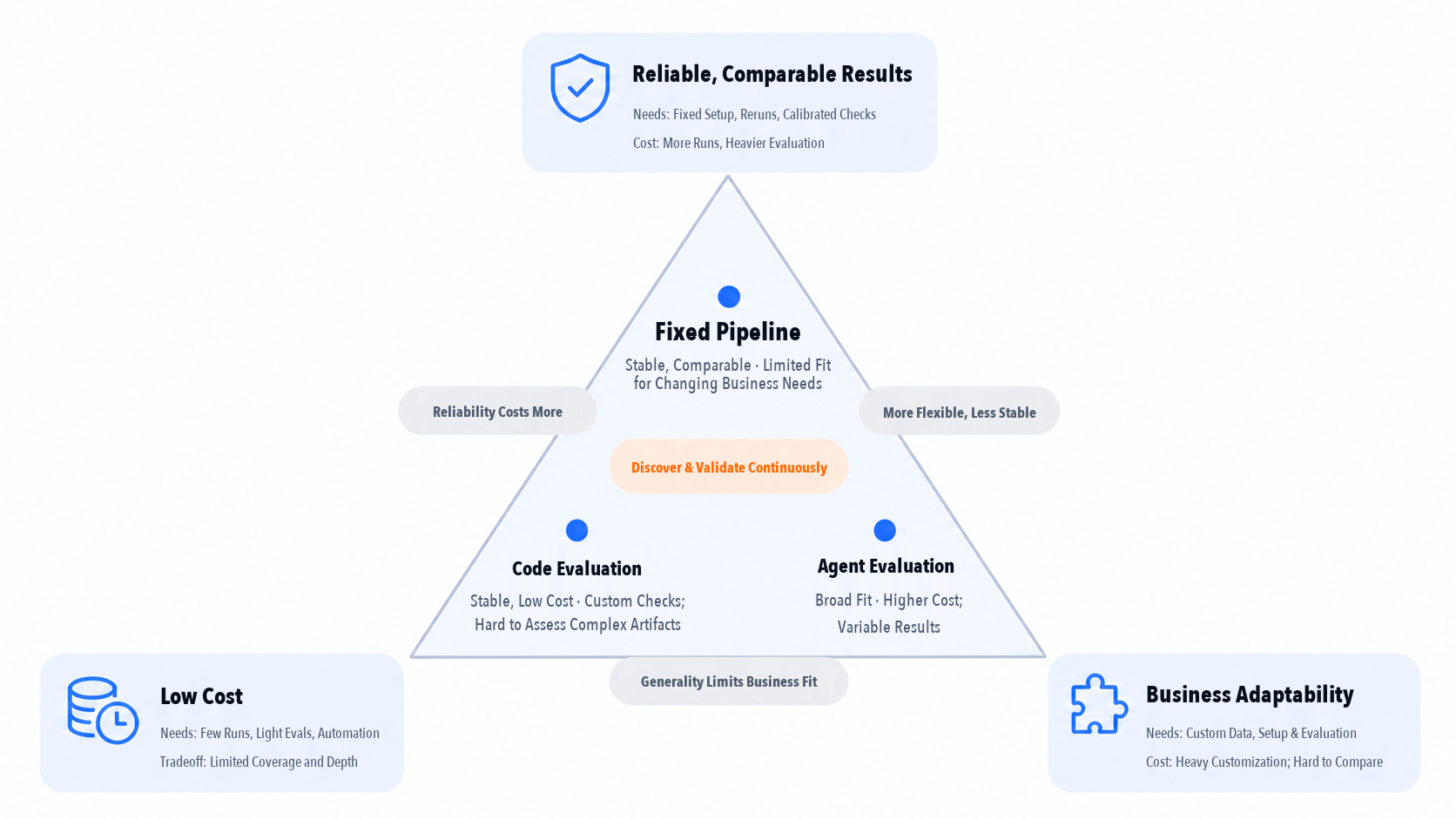
Agent evaluation always aims to achieve three things at once: trustworthy, comparable findings; flexibility to fit business needs; and controlled costs. In practice, it is hard to maximize all three simultaneously. Different businesses can make trade-offs and set priorities according to their needs—and that is precisely the flexibility a good evaluation framework should provide.
Evaluation is not a strict examiner expected to deliver a perfectly accurate score in a single sitting. It is more like an ongoing advisor, proactively uncovering issues in each round. Even without covering every issue, it delivers its core value as long as the issues it identifies are addressed and the improvements are validated.
So, you do not need perfect data or a perfect end-to-end workflow to start evaluating.
Choose a few representative failure cases already exposed in your business, build a small evaluation dataset, and start running it. As the Agent evolves, gradually add cases, refine evaluation, and expand coverage. Evaluation and the Agent grow alongside the business.
Only Agents that can be continuously evaluated can keep improving; only Agents that keep improving can earn a business's long-term trust.
Give your Agent its first evaluation today: https://qoder.com/cloud/quickstart (More evaluation capabilities are rolling out.)

1,594 posts | 525 followers
FollowAlibaba Cloud Community - October 15, 2026
Alibaba Cloud Community - July 29, 2026
Alibaba Cloud Community - August 3, 2026
Alibaba Cloud Community - October 14, 2026
Alibaba Cloud Community - July 28, 2026
Alibaba Cloud Community - August 11, 2026
1,594 posts | 525 followers
Follow Qoder
From Assisted to Autonomous — Adapting to Every Programming Need
Learn More QwenWork
 is dedicated to helping employees strengthen their professional competitiveness in the AI era and to enabling enterprises to improve organizational effectiveness.
Learn More Token Plan
Build more, spend less. One plan, every modality.
Learn More DeepSeek
-V4.1-Flash is the lightweight flagship of DeepSeek's new architecture family, packing 552B total MoE parameters to deliver flagship-surpassing intelligence across key benchmarks.
Learn MoreMore Posts by Alibaba Cloud Community

