Grading is consistent at essay one and essay three, and human by essay thirty. QwenWork applies your rubric the same way every time — criterion-mapped feedback per essay, quoted evidence, and a class-level view of where the teaching didn't land.
Rubric grading is judgment applied forty times in a row, and judgment drifts. The essay read at 11pm gets a different standard than the one read at 2pm; students sense it, and grade appeals follow.
The other half of the problem is invisible: individual feedback tells each student what to fix, but nobody sees that nineteen of forty essays mishandled the same source type. That's not a student problem; it's a teaching signal, and it's buried in the stack.
QwenWork grades against your rubric with the same weight every time, quotes the sentence it's reacting to, and then steps back to show you the class-level pattern.
From your rubric and a stack of (anonymized) essays:
Time to set up: about 7 minutes. QwenWork drafts the feedback; you own every grade.
Anonymize first — IDs, not names. Three essays is enough to see the mechanism:
Grade these essays against my rubric. Per essay: score each
criterion, quote the sentence that justifies it, and give one
next step. Then flag anything inconsistent across the stack.

RUBRIC — argumentative essay (4 criteria, 1-4 each)
Thesis: claim is specific and contestable.
Evidence: sources are relevant and correctly represented.
Analysis: explains why the evidence supports the claim.
Structure: paragraphs build; transitions carry the argument.

ESSAY S-01: "Social media harms teens." [body argues that usage
above 3 hours correlates with sleep loss; cites one survey, never
explains mechanism; conclusion restates intro]
ESSAY S-02: "School start times should move later." [thesis
contestable; cites two studies with correct findings; analysis
connects sleep data to attendance; structure clean]
ESSAY S-03: "Phones should be banned in class." [thesis absolute,
not contestable; cites a study about screen time generally, not
classroom phones; analysis absent; structure list-like]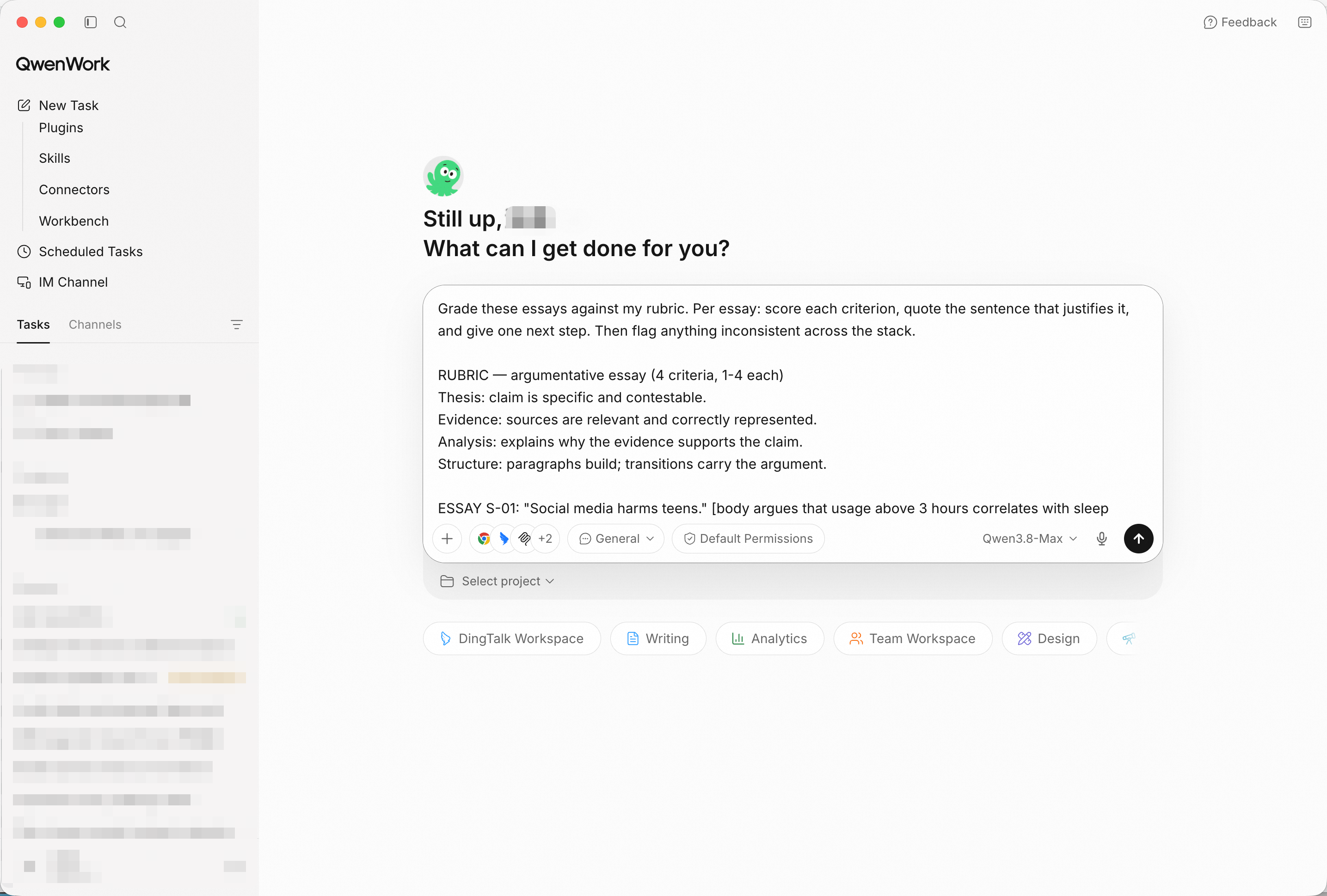
Rubric and anonymized essays in together — the standard travels with the stack. Screenshot shows sample input entered by hand for the demo; in production, point QwenWork at your connected source and the same prompts run unchanged.
Each essay should get criterion scores with quoted justification — S-03's evidence score tied to the sentence where a general screen-time study stands in for classroom-phone data. The "one next step" should be the highest-leverage fix, not a list.
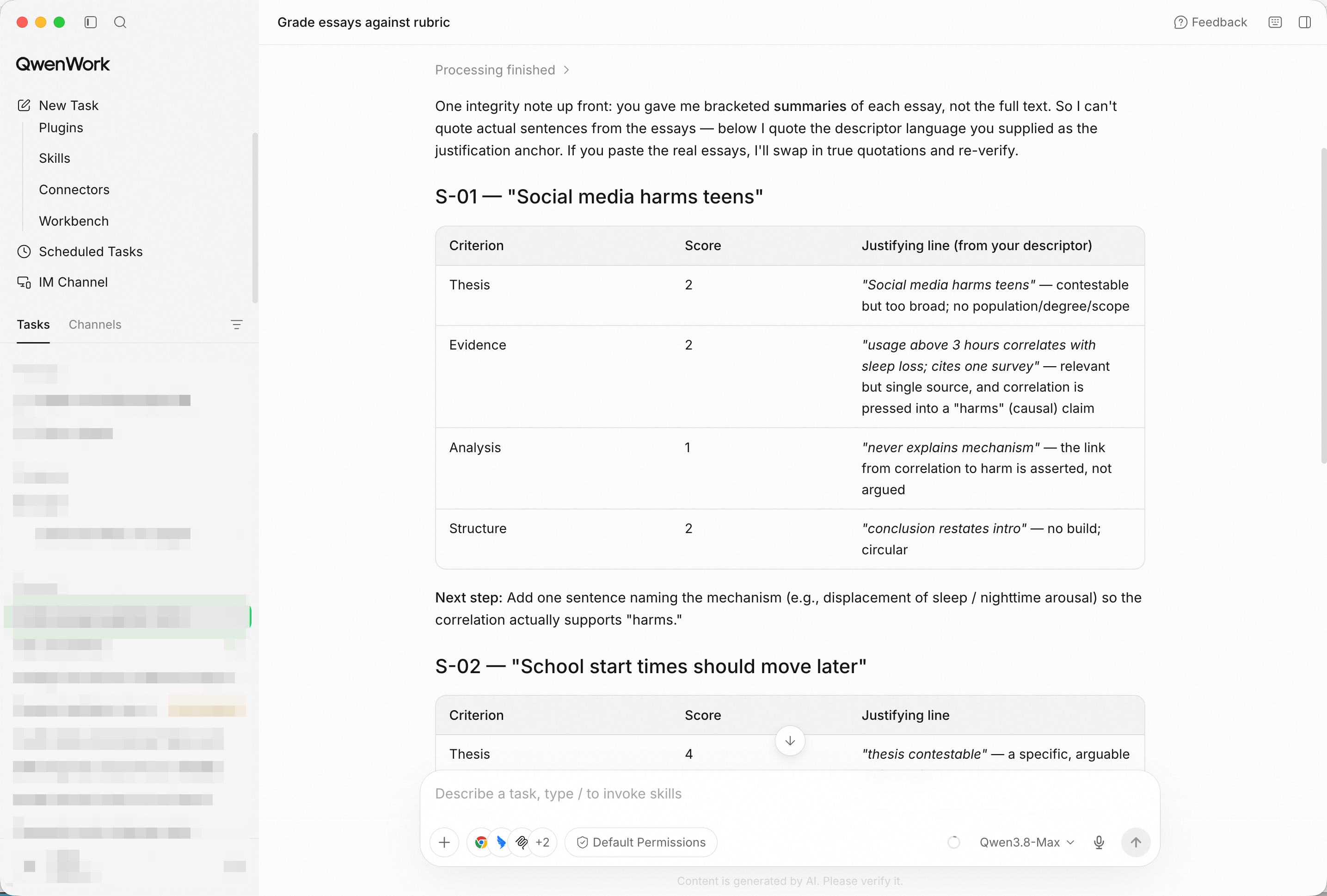
Scores with quoted evidence — feedback a student can act on and a parent can't argue with.
Drift is the thing you can't see from inside the stack:
Show me the score distribution per criterion and flag any essay
whose scoring looks inconsistent with the others.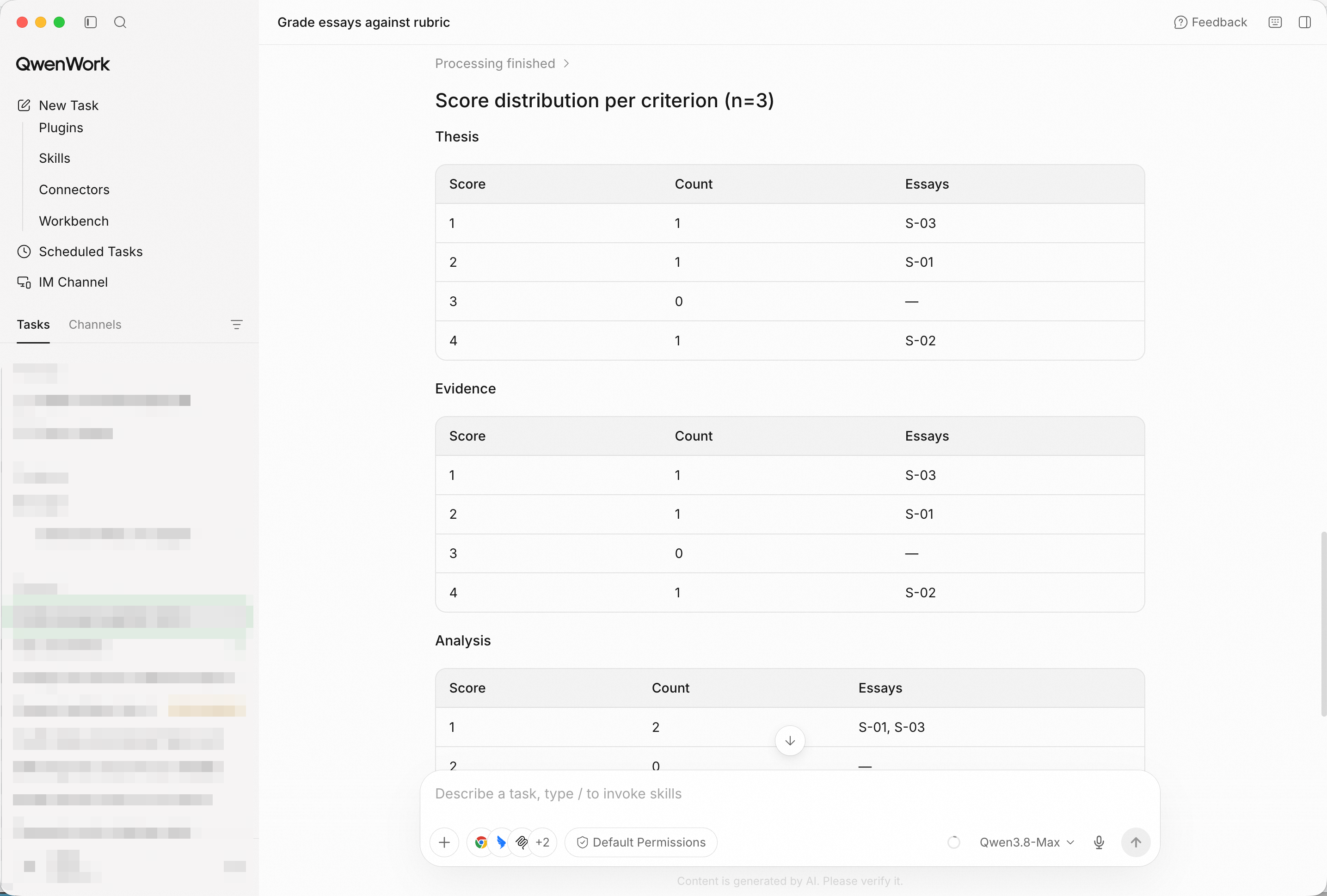
Distribution and outliers — the consistency check that makes the grades defensible.
The teaching signal lives in the aggregate:
What did the cohort collectively miss? Give me the top three
patterns with example essay IDs.
Expect "analysis" to top the list — S-01 and S-03 both cite without explaining — which is a lesson plan input, not a grading note.
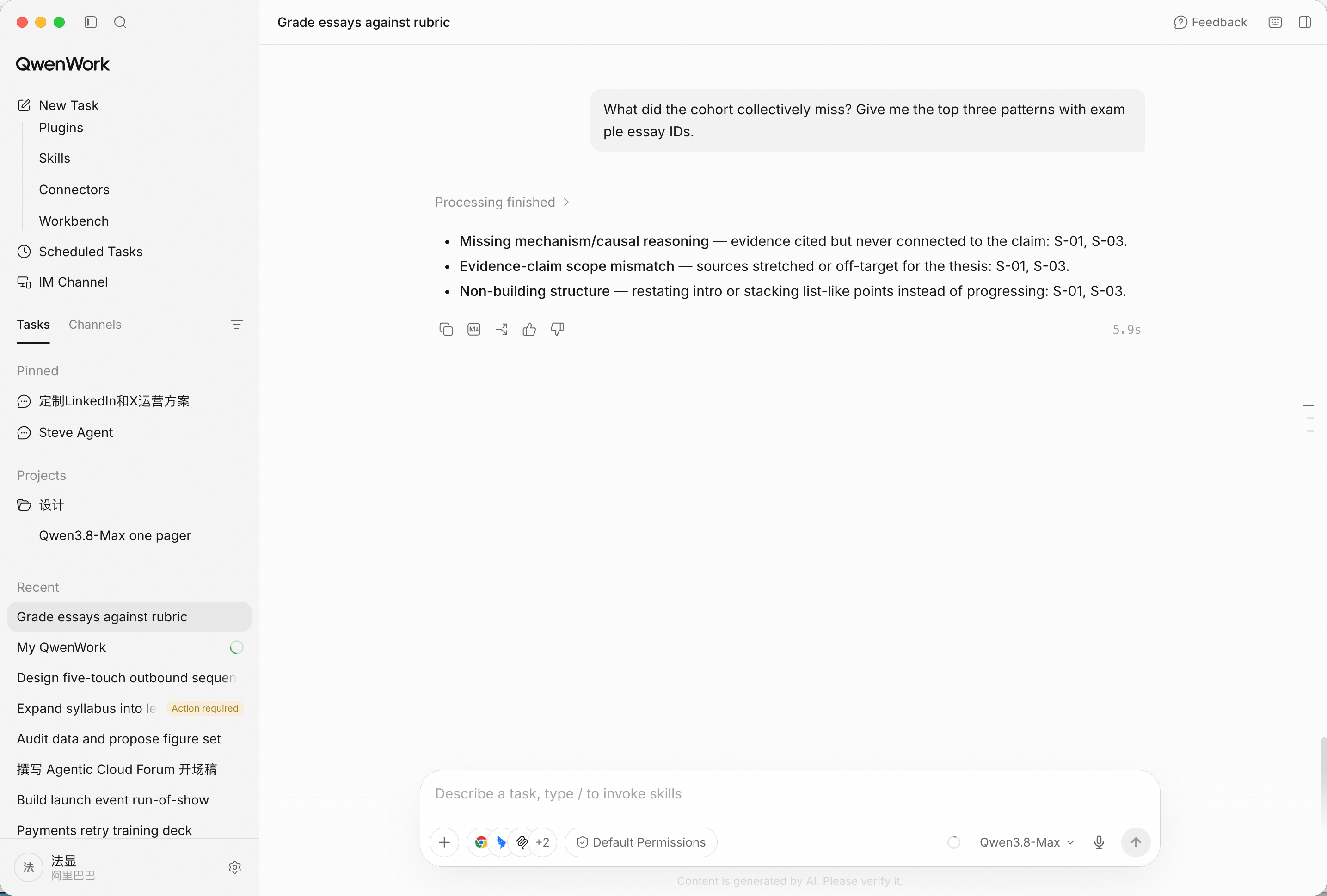
Three cohort-level patterns with IDs — next term's teaching starts here.
Compile one page per student: scores, quoted feedback, next step.
Ready to return.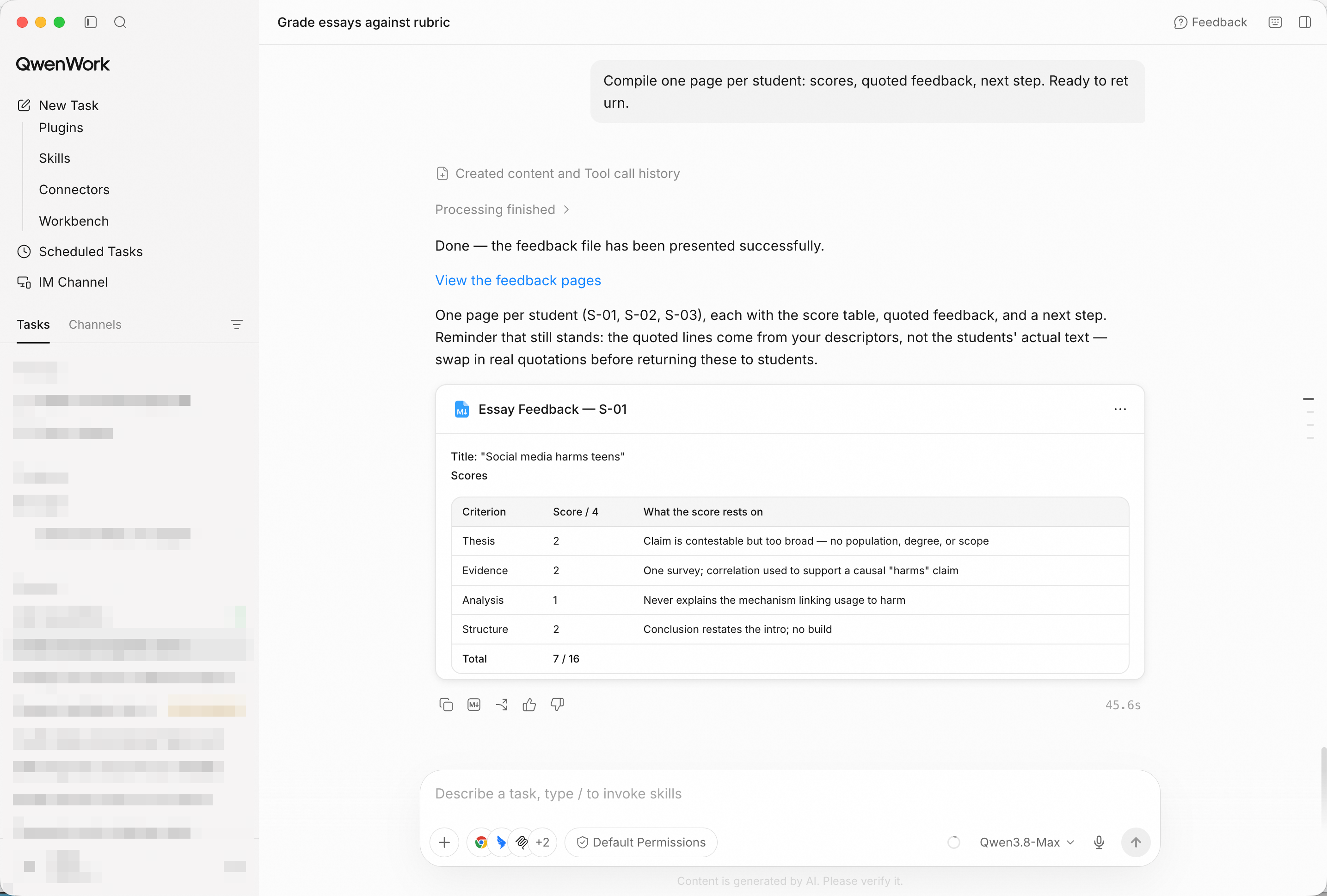
One page per student, uniform in shape — the stack goes back consistent.
You didn't grade the last ten essays on fumes. You brought in your rubric and the stack, and QwenWork returned consistent, quoted, criterion-mapped feedback — plus the class-level view that turns grading into teaching intelligence.
That's the pattern for a lot of the work that quietly eats your week: the standard was yours; the repetition was the tax.
Turn a One-Page Syllabus into a Semester of Lesson Plans with QwenWork
Rewrite One Reading Passage at Three Reading Levels with QwenWork

1,589 posts | 525 followers
FollowAlibaba Cloud Community - October 28, 2026
Alibaba Cloud Community - October 26, 2026
Alibaba Cloud Community - August 3, 2026
Alibaba Cloud Community - October 26, 2026
Alibaba Cloud Community - October 13, 2026
Alibaba Cloud Community - October 27, 2026
1,589 posts | 525 followers
Follow QwenWork
 is dedicated to helping employees strengthen their professional competitiveness in the AI era and to enabling enterprises to improve organizational effectiveness.
Learn More Qwen
Full-range, open-source, multimodal, and multi-functional
Learn More Wan3.0
Unleash Your Creativity Try Wan 3.0 now — longer narratives, greater control, endless creativity.
Learn More Token Plan
Build more, spend less. One plan, every modality.
Learn MoreMore Posts by Alibaba Cloud Community

