
Steatotic Liver Disease (SLD), commonly known as fatty liver disease, has emerged as a global health crisis, currently affecting an estimated 30% of the world’s population. Left unchecked, this figure is projected to surge to 55.7% by 2040. Despite its prevalence, SLD is often termed a “silent killer” due to its asymptomatic nature, as patients often feel no pain, no itch. Yet, without early intervention, this condition can progress to more serious liver damage like fibrosis and cirrhosis and even cancer.
However, traditional diagnostic methods, such as ultrasound and serum markers, often lack the sensitivity to catch early-stage risks, while specialized tests like elastography remain costly and inaccessible for many. As a result, high-risk patients are frequently missed until it is too late.
To bridge this critical gap, Alibaba DAMO Academy, in collaboration with medical institutes in China including Shengjing Hospital of China Medical University and Nanjing Drum Tower Hospital, has developed MAOSS (Multi-modal AI for Opportunistic hepatic Steatosis Screening) for identifying and predicting SLD progression.
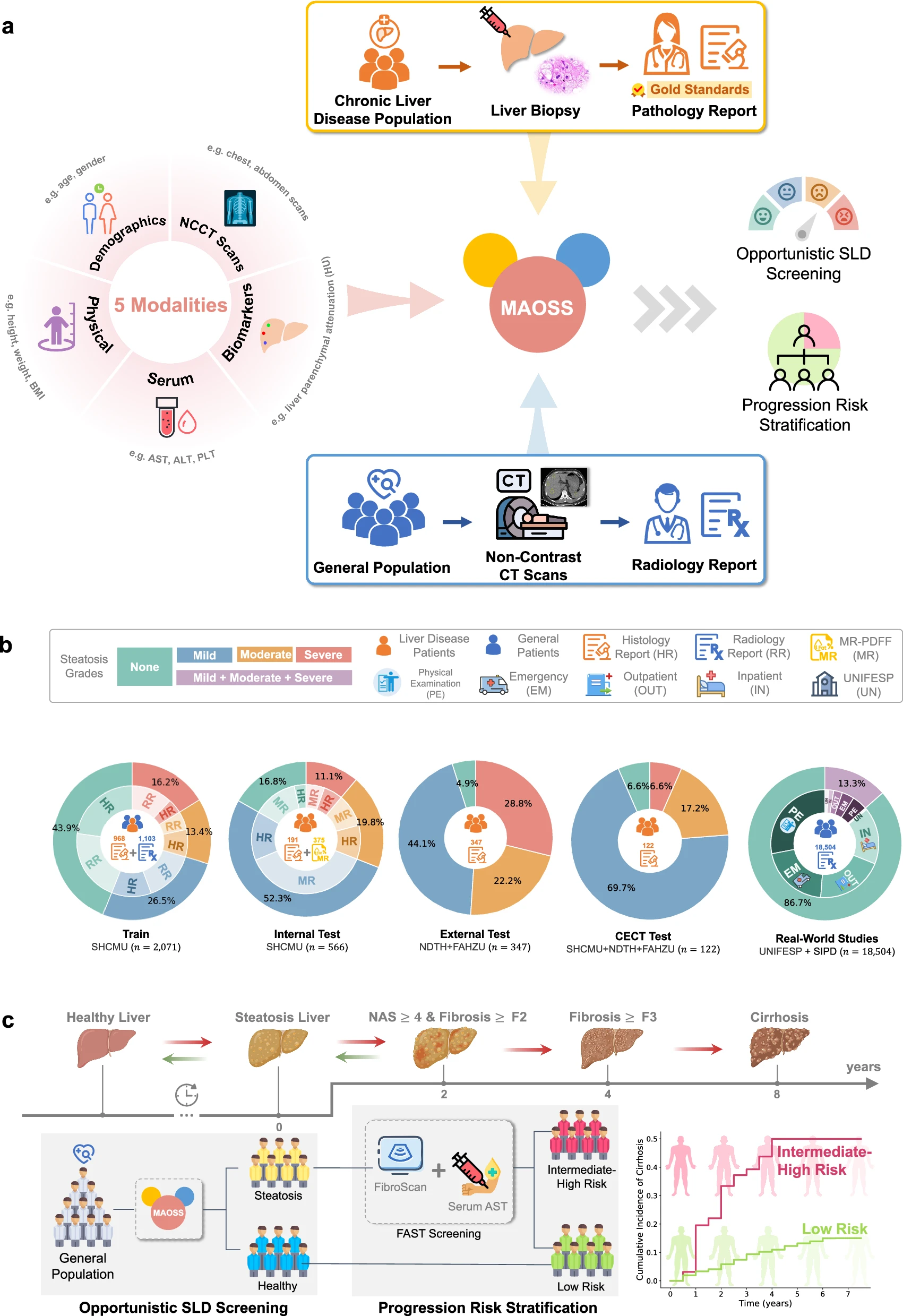
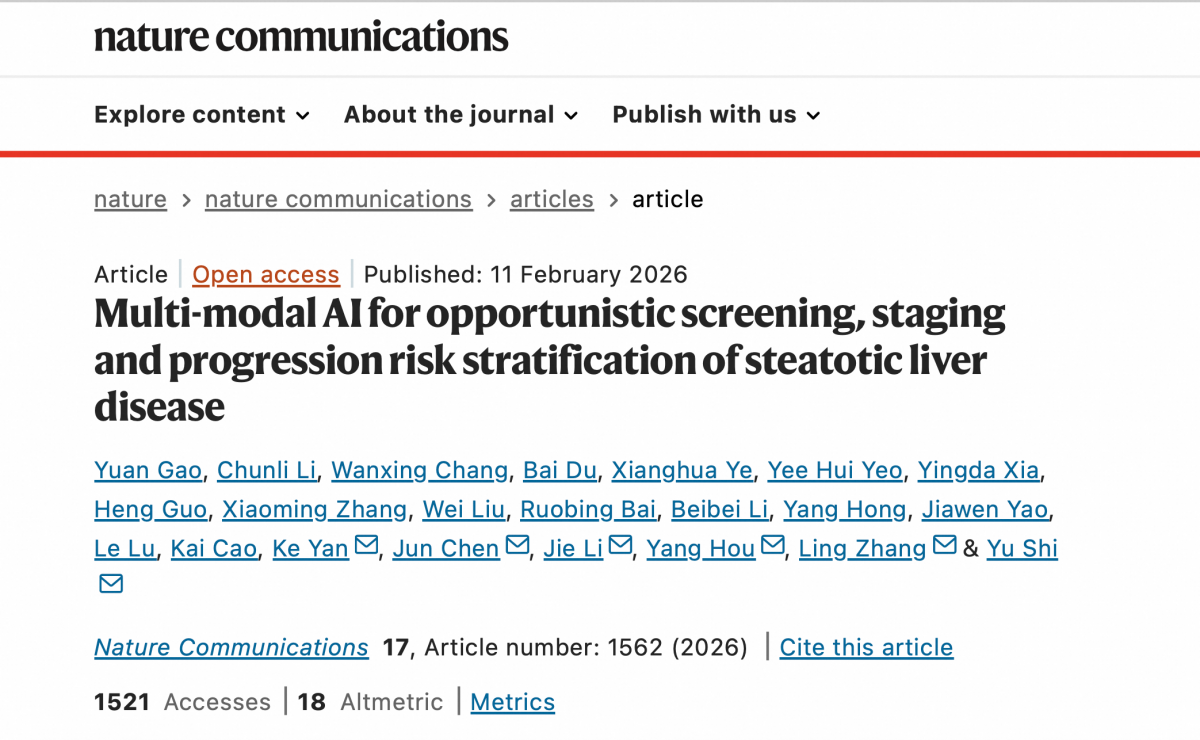
Published in Nature Communications, this novel AI model leverages easily available non-contrast CT scans and serum biomarkers to grade hepatic steatosis and assess fibrosis progression. By harnessing DAMO’s years of expertise in using AI to analyzing non-contrast CT scans, MAOSS automatically extracts subtle features from liver texture, density, and morphology, turning routine scans into powerful diagnostic tools. Trained on a large-scale anonymous SLD dataset and integrating multimodal inputs – including serological markers and non-contrast CT scans, MAOSS is capable of assessing both hepatic steatosis and fibrosis staging.
This is essential in helping reduce missed diagnoses of high-risk SLD cases and provide early warning signals for timely intervention in a cost-effective way. In retrospective validations involving 1,192 patients, MAOSS enhanced the detection rate of high-risk cases from 16.6% (via conventional clinical pathways) to 52.4% — a more than three-fold improvement; The model also effectively flags patients who have reached clinically significant fibrosis – a crucial window for intervention to prevent progression to liver cirrhosis.
Additionally, in multi-center external validations, MAOSS achieved an AUC (Area Under the Curve) of 0.904–0.917 across different stages of steatosis (from none to severe), significantly outperforming the average radiologist’s AUC score of 0.709. When deployed as an assistive tool, MAOSS boosted radiologists’ diagnostic accuracy to 0.798, with remarkable gains in identifying easily overlooked cases of mild SLD.
The launch of MAOSS underscores DAMO Academy’s unwavering commitment to revolutionizing preventive healthcare through innovative AI. Additionally, by forging strategic alliances with local partners, the Academy aims to deliver medical AI solutions that are not only more reliable but also cost-effective and accessible to communities worldwide.
In February, DAMO Academy announced an initiative to introduce its AI-powered multi-cancer screening technology to Pakistan. Through partnerships with Khwaja Muhammad Safdar Medical College and cloud services provider Sky47, this collaboration will deploy advanced AI systems locally to accelerate early cancer detection and drive digital health adoption.
Since its inception, this technology has garnered sustained international acclaim, notably being selected for the ITU’s “AI for Good: Innovate for Impact” Report. Furthermore, the World Health Organization’s Collaborating Centre for Digital Health has partnered with DAMO Academy to facilitate the deployment of these tools in developing regions.
To date, DAMO Academy has delivered AI-assisted medical screening to over 50 million people across ten countries and regions. By enabling the detection of major cancers, acute conditions, and chronic diseases through a single standard non-contrast CT scan, Alibaba is advancing medical AI and making life-saving diagnostics more reliable, affordable, and universally accessible.
This article was originally published on Alizila written by Crystal Liu.
Alibaba Cloud Unveils New Datacenter and AI Services in Japan to Support Growing Demand
Alibaba Cloud Accelerates Worldwide AI Innovation and Adoption Across Industries

1,549 posts | 520 followers
FollowAlibaba Cloud Community - June 30, 2026
Alibaba Cloud Community - September 1, 2026
Alibaba Cloud Community - September 29, 2026
Alibaba Cloud Community - July 24, 2025
Alibaba Clouder - August 22, 2019
Alibaba Cloud Community - September 8, 2025
1,549 posts | 520 followers
Follow QwenWork
QwenWork is dedicated to helping employees strengthen their professional competitiveness in the AI era and to enabling enterprises to improve organizational effectiveness.
Learn More Token Plan
Build more, spend less. One plan, every modality.
Learn More
Alibaba Cloud Model Studio
A one-stop generative AI platform to build intelligent applications that understand your business, based on Qwen model series such as Qwen-Max and other popular models
Learn More Qwen
Qwen
Full-range, open-source, multimodal, and multi-functional
Learn MoreMore Posts by Alibaba Cloud Community

