Over the past year, enterprises have been wiring agents into their business — writing code, running operations, driving analysis. At Apsara Conference we put it this way: the model decides how smart AI is; the database decides how far AI can go.
But there's something even easier to overlook than the data itself: the security posture that comes with putting agents into production.
Let's start with one number. Over the past year, new Alibaba Cloud ApsaraDB RDS for PostgreSQL instances grew by more than 400%, and roughly 80% of them were created by agents. Agent-driven access traffic is already approaching half of the total. The primary user of the database is shifting from human to agent.
At the time, that looked like an efficiency story. Today, it's first and foremost a security story.
If your agents are already in production, Alibaba Cloud's AI-powered database security solution lays out the control set end to end — agent behavior security, governed data access, and database protection. What follows walks the same ground from the database side, and shows where each product fits.
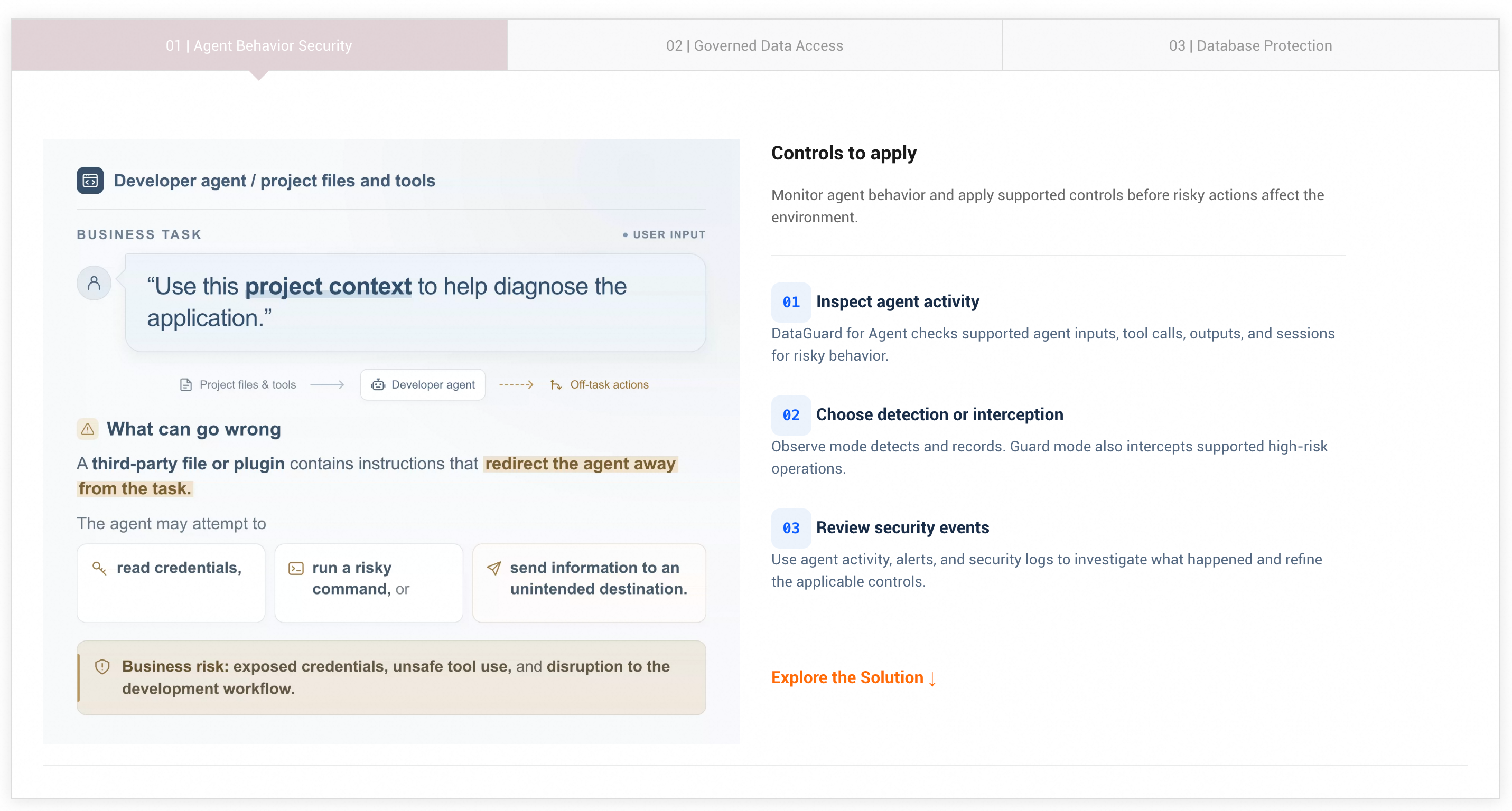
Database security used to be about people. The DBA had an account, the application had an account, permissions were granted to identities, and audits traced back to identities.
Once agents become the primary user, three blind spots open up.
First — whose account is the agent using? How were its permissions issued? If something goes wrong, can we trace it back to that specific agent?
Second — what is the agent doing to the database day in and day out? Is anyone watching, and is any of it recorded?
Third — the database's attack surface has changed. Credentials are scattered across code, configuration files, and the agent's own memory.
For the agent era, Alibaba Cloud database services cover four boundaries: identity on every connection, limits on every action, risks that can be surfaced, and defenses at the data layer.
When an agent connects to a database, its identity has to be transparent first. The Agent Data Gateway sits between the agent and the database: each agent gets its own identity and token, and its permissions are scoped down to database, table, column, and row level. Database credentials stay inside the gateway rather than in the agent's hands. Because the gateway sits on the access path, its audit log attributes each operation to the agent that made it.
"Action" splits into two, and the two are governed by different products.
The first is what the agent itself does — which tools it calls, what it sends out, whether a prompt injection has taken hold. That is DataGuard for Agent, free of charge for public preview, which inspects agent inputs, tool calls, outputs, and sessions and can intercept high-risk operations rather than only logging them.
The second is what happens once the request reaches the database. At that layer the engine sees a database user and a source IP — it cannot tell a person from an agent. Security audit is what makes that traffic reconstructible: every access is recorded, and an anomaly can be traced back along the record.
Routine inspection and diagnosis can also be handed off in part to database AI assistants. PolarDB, ApsaraDB RDS, AnalyticDB, Tair, and Lindorm all ship with AI assistants, so DBAs no longer have to trawl through raw logs to chase down every issue.
Latent issues in a database don't always turn into incidents immediately. More often, an anomaly has already appeared, but nobody is watching it continuously or reporting it proactively. DAS Agent periodically summarizes anomalies, latent risks, and optimization recommendations. It offers a daily free trial with a free quota of 5,000 characters per day, and each successful check-in grants an additional 700 characters. Keeping risk continuously visible gives you the evidence base for what to do next.
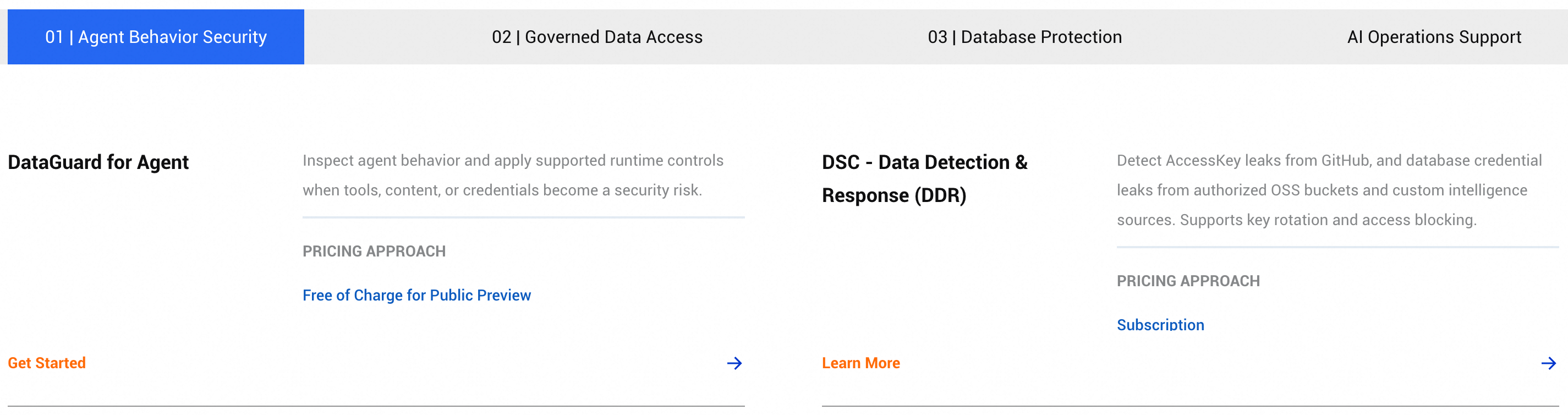
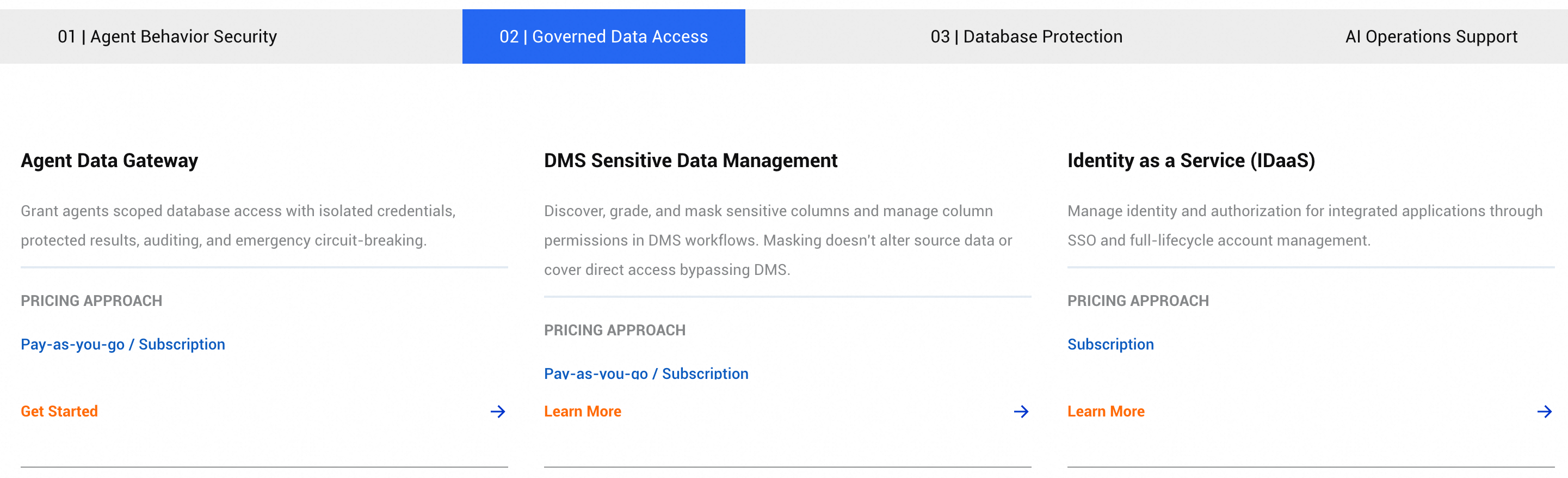
Data-layer security is still the foundation. Encryption, access control, and backup/recovery reduce the risk of bad data being produced or propagating inside the engine. Data encryption, access control, backup and recovery, and compliance assurances all need to be checked off item by item at selection time and during routine inspection. The relevant capabilities for ApsaraDB RDS, PolarDB, Tair, AnalyticDB, and Lindorm are documented on each product page, and the solution page collects the common ones into a single list with links to the documentation for each.
The capabilities above mainly address security inside the database, but database products alone don't cover the full chain. Credentials can be scattered across code, configuration, and agent memory; once data leaves the database, it keeps moving through applications, networks, and cloud resources. So identity and credentials outside the database, data exfiltration, and cloud-side configuration also need coordinated coverage from database and security products.
First, tighten identity and credential management. IDaaS's ITDR and PAM handle accounts and permissions; KMS Secrets Manager handles keys and credentials. Centralized management keeps credentials out of source code and rotates them on policy, so agents connecting to the database always have a defined, enforceable credential path.
Second, strengthen detection of data leakage and exfiltration. Data Security Center (DSC) continuously identifies anomalous reads of sensitive data. Cloud Firewall's Agentic NDR watches data-egress channels and surfaces alerts before bulk exfiltration happens, buying time to respond.
Third, close the gap on cloud-side configuration and permissions. Cloud Security Center's CSPM and CIEM surface misconfigurations and permission mismatches; agentless detection and threat detection add runtime coverage. Common issues — misconfiguration, over-provisioned permissions — get continuous scanning.
From the moment an agent connects to the database all the way to where the data finally lands, every door has a product guarding it.
The products and combined solutions described above are available on the Alibaba Cloud website. The solution page brings them together in one place, with the capability list, the product combinations covered in section 2, and the entry point to each product — organized so different roles can jump straight to what they need.
AI applications are landing across every industry. The capabilities above are not agent-specific — they cover the data path whether the request comes from an agent, an application, or a person at a console.
Go directly to the solution page: https://www.alibabacloud.com/en/solutions/ai-powered-database-security
Alibaba Cloud Launches First Public Cloud Region in the Netherlands

1,592 posts | 525 followers
Followdigoal - April 26, 2021
Alibaba Clouder - February 15, 2018
OpenAnolis - July 24, 2026
Bryan, Zhang - October 7, 2026
Alibaba Cloud Community - February 19, 2024
PM - C2C_Yuan - September 3, 2026
1,592 posts | 525 followers
Follow PolarDB for PostgreSQL
Alibaba Cloud PolarDB for PostgreSQL is an in-house relational database service 100% compatible with PostgreSQL and highly compatible with the Oracle syntax.
Learn More Security Center
A unified security management system that identifies, analyzes, and notifies you of security threats in real time
Learn More Database Security Solutions
Protect, backup, and restore your data assets on the cloud with Alibaba Cloud database services.
Learn More Database for FinTech Solution
Leverage cloud-native database solutions dedicated for FinTech.
Learn MoreMore Posts by Alibaba Cloud Community

