One text, three readers: the student who finishes early, the one who's still decoding, and the one in between. QwenWork rewrites the same passage at three readability levels — content intact, comprehension checks matched — so differentiation stops meaning three separate prep sessions.
Differentiated reading is the honest answer to a mixed classroom and the impossible one for a teacher's evening: same concepts, three vocabulary bands, three sentence rhythms, three sets of comprehension questions that test the same understanding at different depths.
Simplified texts usually fail by deletion — the ideas get smaller along with the words, and the struggling reader learns less on purpose. Good leveling keeps the concept and changes the load.
QwenWork levels by construction: same content map across all three versions, with each version's comprehension check targeting the same understanding at its own reading level.
From one passage:
Time to set up: about 6 minutes. You pick the passage and the levels; QwenWork does the rewriting.
Rewrite this passage at three reading levels: grade 4, grade 7,
and original (grade 10). Keep the same concepts and examples in
all three — change vocabulary and sentence structure, not content.

PASSAGE — Why the sky is blue (grade 10)
Sunlight reaches Earth's atmosphere and is scattered in all
directions by the gases and particles in the air. Blue light is
scattered more than other colors because it travels as shorter,
smaller waves — a phenomenon called Rayleigh scattering. This is
why we see a blue sky most of the time: the scattered blue light
reaches our eyes from every direction. At sunset, light passes
through more atmosphere, the blue is scattered away entirely,
and the longer wavelengths — reds and oranges — dominate.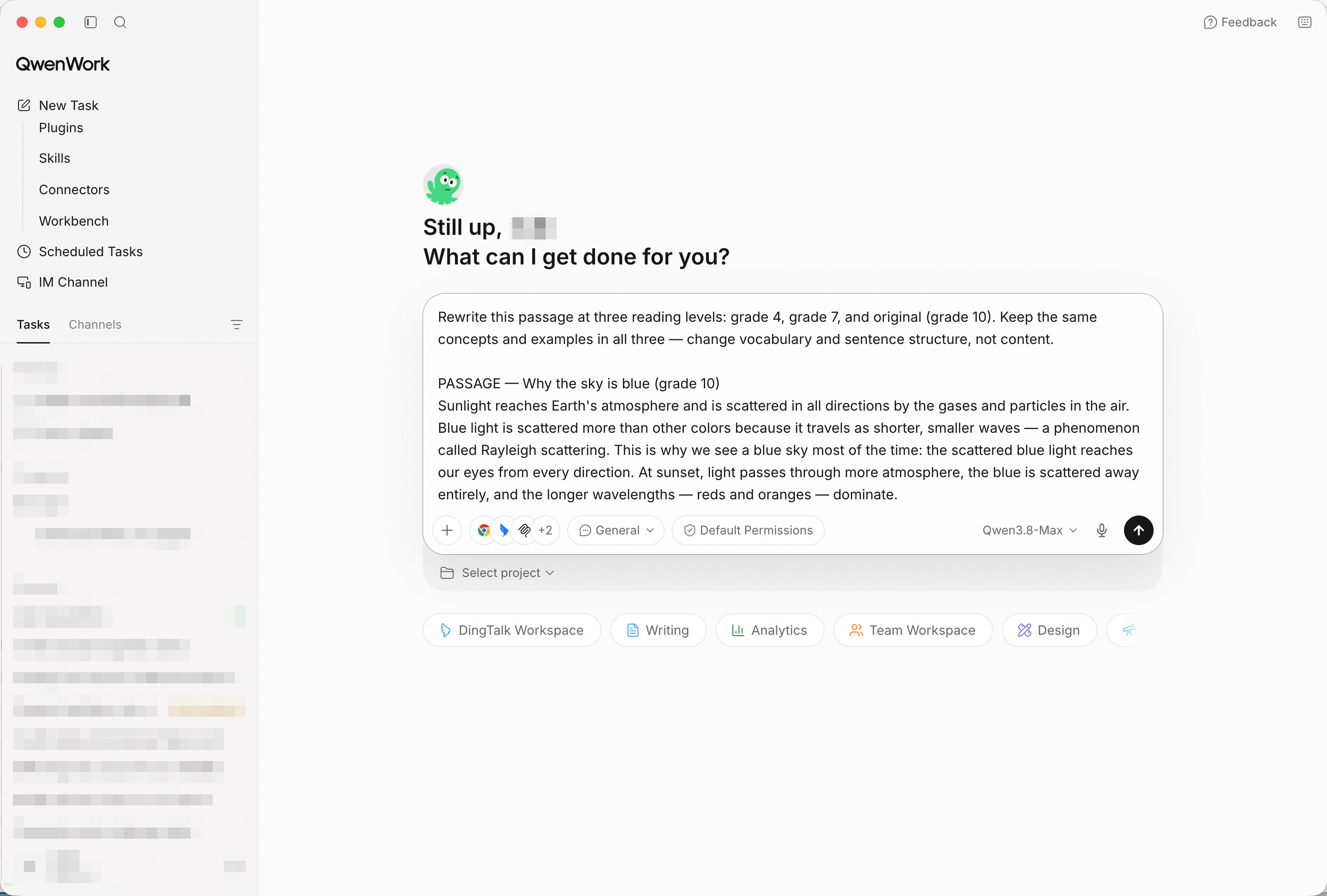
One passage, three target levels, one rule: content constant. Screenshot shows sample input entered by hand for the demo; in production, point QwenWork at your connected source and the same prompts run unchanged.
The failure mode is deletion, so check for it explicitly:
Show me the content map: which concepts and examples appear in
each version. Flag anything that was dropped rather than
simplified.
Rayleigh scattering can become "the way light bounces off air" at grade 4 — but it must still be there.
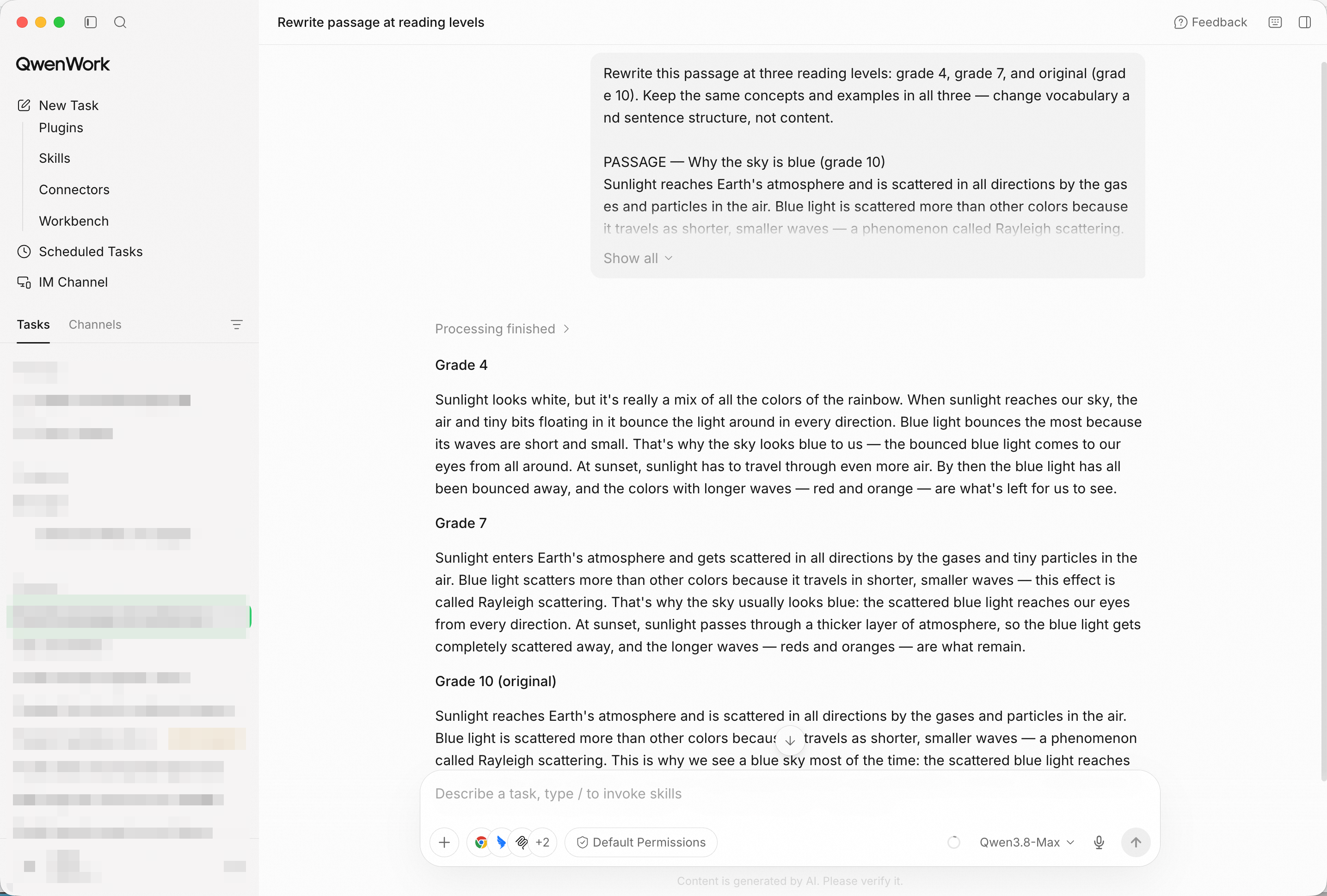
The content map across all three versions — simplification, not deletion.
Claims about grade level are cheap; measurements aren't:
Give me a readability estimate per version and confirm each lands
near its target band.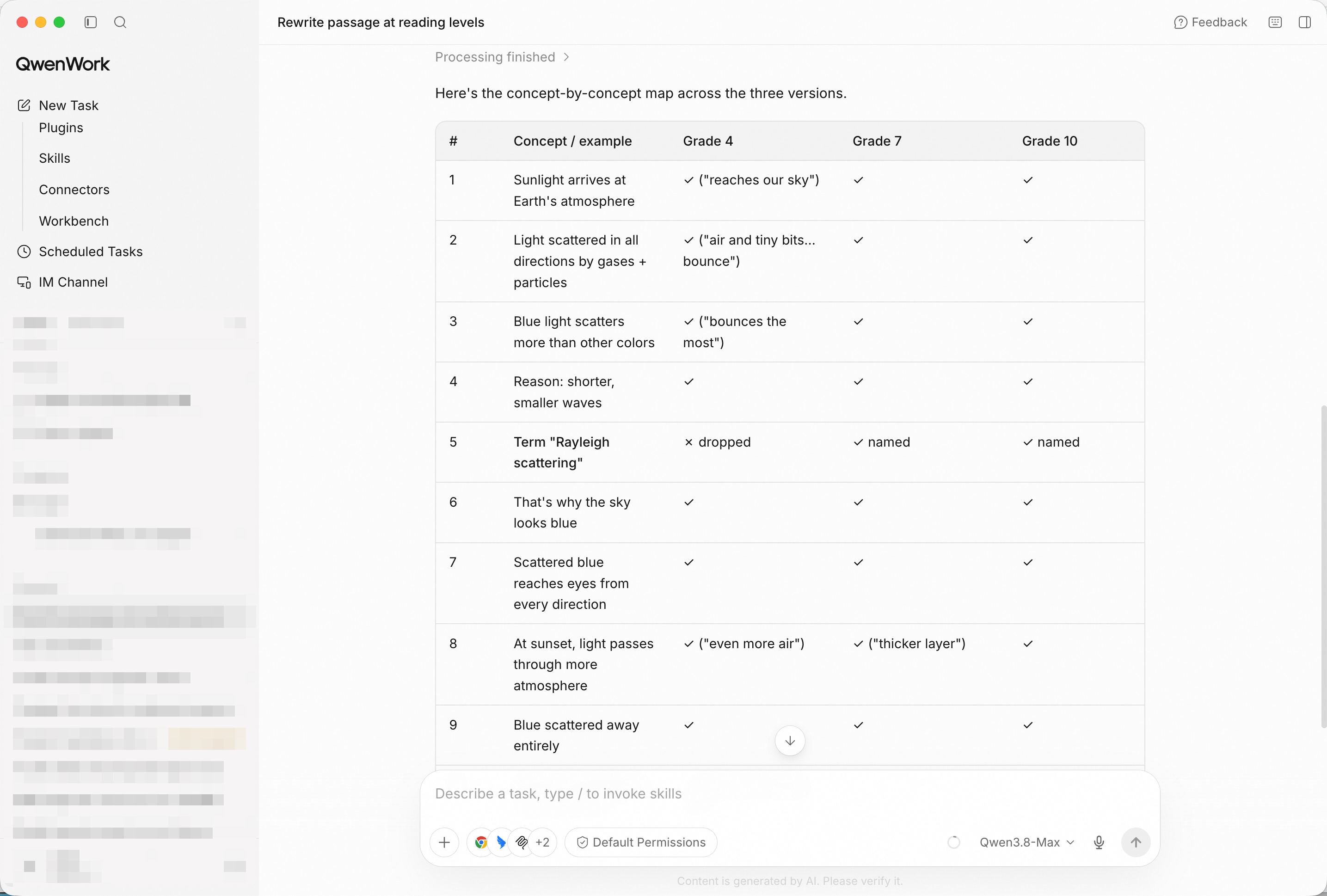
Three estimates against three targets — the leveling is checked, not assumed.
Same concepts, matched depth — this is where leveling either works or doesn't:
Write a four-question comprehension check per level. Same concepts
in all three; question complexity matched to the reading level.
A grade-4 question asks what color the sky usually is and why, in plain terms; the grade-10 question asks why sunsets shift to red — same causal chain, different linguistic load.
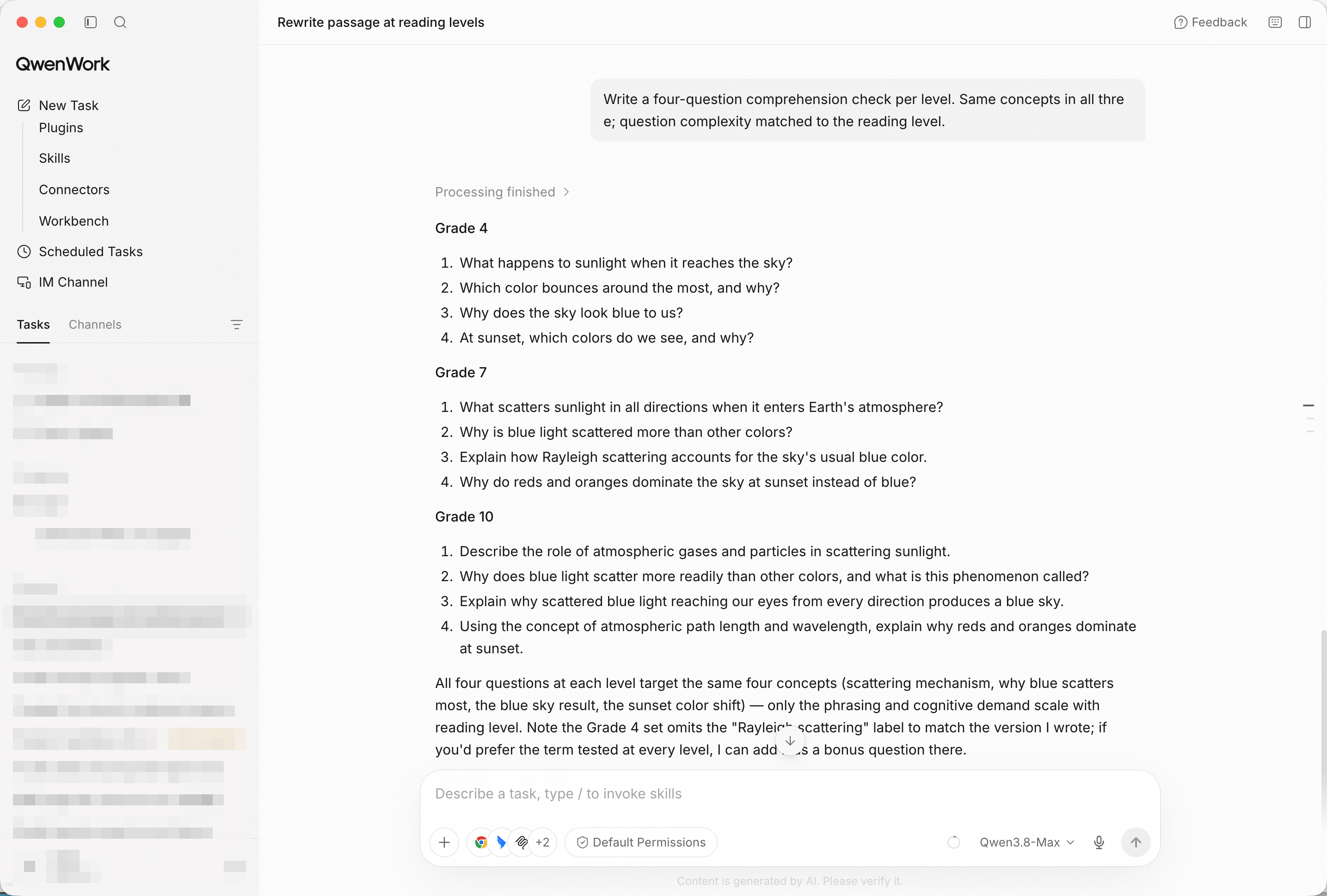
Twelve questions, one concept map — each reader is tested on what they actually read.
Compile the pack: three passages, three checks, answer keys, and
a note on which concepts to discuss together as a whole class.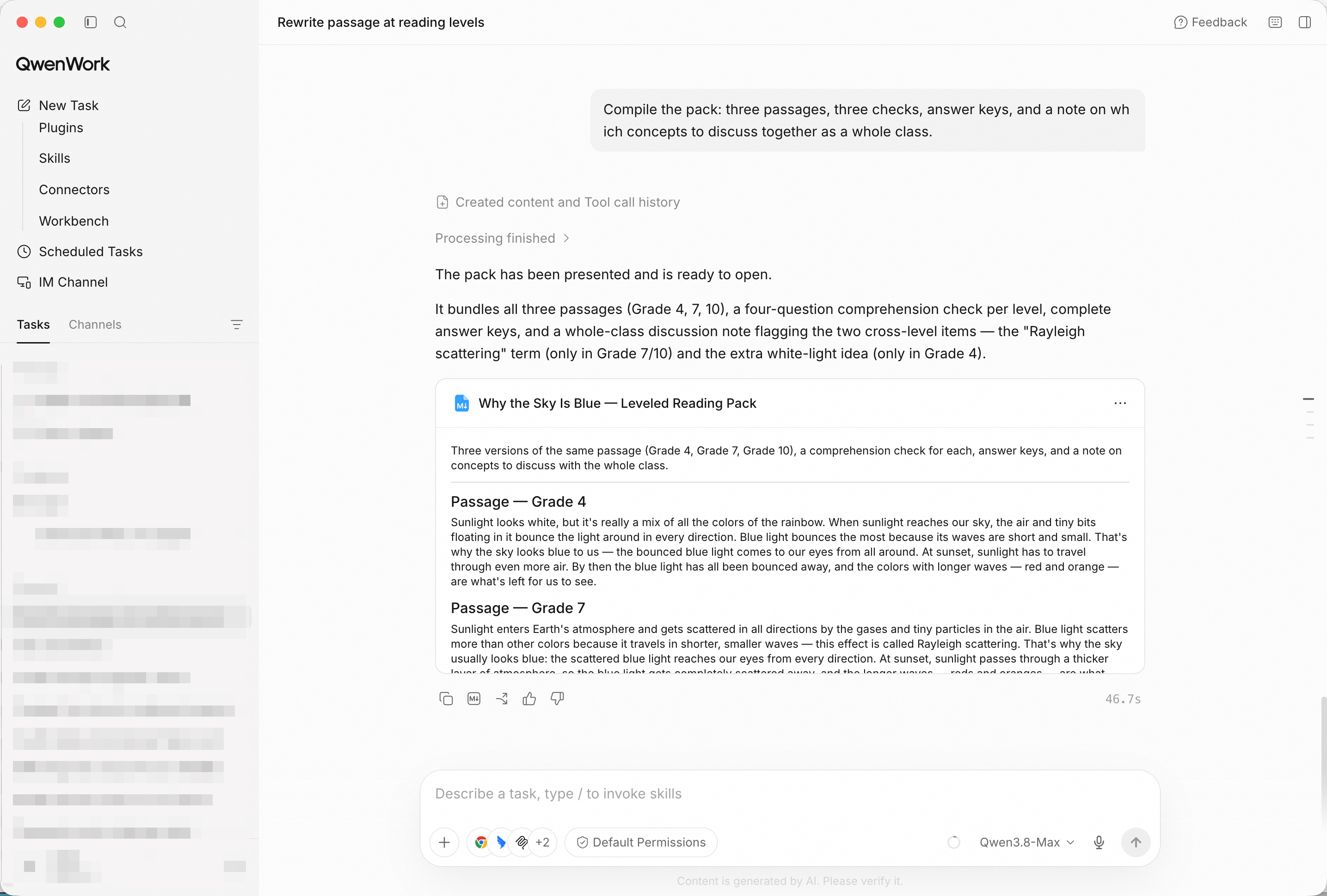
The pack ready for the unit — including the whole-class discussion note that ties the three rooms back together.
You didn't write three versions of everything at midnight. You brought in one passage, and QwenWork returned three leveled texts with the content held constant, matched comprehension checks, and a pack the whole unit can run from.
That's the pattern for a lot of the work that quietly eats your week: one text in, every reader served.
Grade a Stack of Essays Against Your Own Rubric with QwenWork

1,589 posts | 525 followers
FollowAlibaba Cloud Community - October 23, 2026
Alibaba Cloud Native Community - May 28, 2026
Alibaba Cloud Community - October 28, 2026
Alibaba Cloud Community - October 28, 2026
Alibaba Cloud Community - October 27, 2026
Alibaba Cloud Community - October 23, 2026
1,589 posts | 525 followers
Follow QwenWork
 is dedicated to helping employees strengthen their professional competitiveness in the AI era and to enabling enterprises to improve organizational effectiveness.
Learn More Token Plan
Build more, spend less. One plan, every modality.
Learn More Qwen
Full-range, open-source, multimodal, and multi-functional
Learn More
Alibaba Cloud Model Studio
A one-stop generative AI platform to build intelligent applications that understand your business, based on Qwen model series such as Qwen-Max and other popular models
Learn MoreMore Posts by Alibaba Cloud Community

