• The original Baguan model with 50% higher accurancy used to guide citizens to safety in Zhejiang
• Innovation in Green Datacenter, Healthcare and Education also exemplified in Alibaba AI for Good Report

Alibaba unveiled Baguan-Seasonal, a new AI model capable of forecasting long-range climate conditions from several months to a full 12 months ahead, at the United Nation’s climate conference in Belém, Brazil (also known as COP30).
This marks a notable milestone in the application of artificial intelligence for climate prediction. The model was built on its predecessor, Baguan, released last November by Alibaba’s DAMO Academy, which revolutionized short-term weather prediction by delivering accurate forecasts from one hour to ten days in advance with hourly resolution.
Accurate climate forecasting is critical for informed decision-making in agriculture, energy management, and disaster preparedness, especially as extreme weather events have intensified under a changing climate. Yet, reliably modeling climate uncertainty remains a formidable challenge, due to the Earth system’s inherent complexity and dynamics. Most existing AI models still struggle to capture the probabilistic nuances.
To overcome this, Baguan-Seasonal is designed specifically for probabilistic climate forecasting. It introduces a novel tokenization strategy and a mixed-scale conditioning mechanism that effectively handles high-dimensional climate data (such as global atmospheric data) across spatial and temporal scales. Baguan-Seasonal enables AI to understand the complex interactions between Earth’s atmosphere and oceans, and gradually extends the prediction horizon to 12 months. It can also detect long-term meteorological signals, providing early warnings for natural disasters such as floods, droughts, and cold waves.
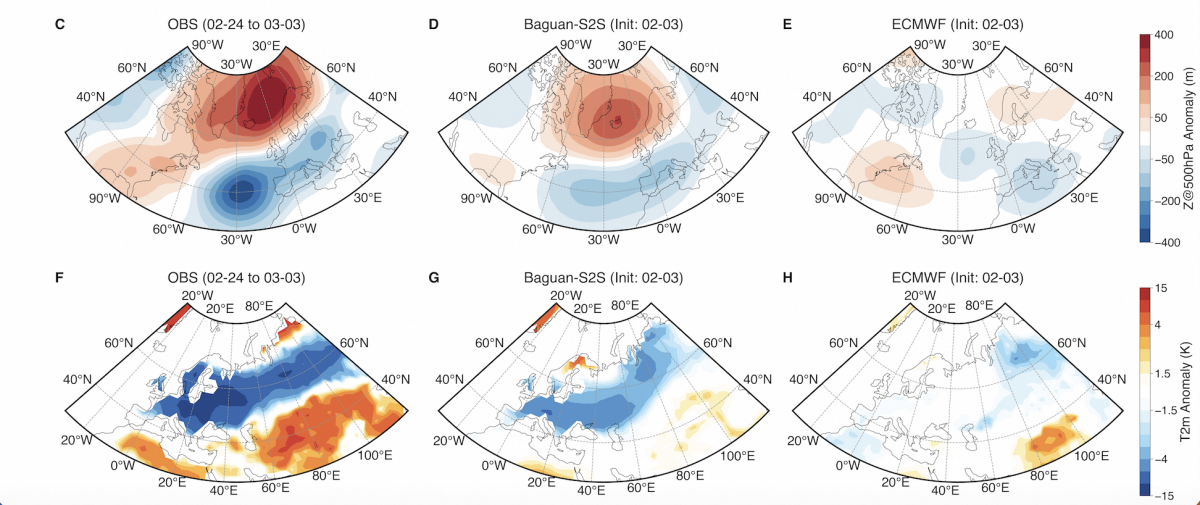
Alibaba also introduced Baguan-S2S, an AI model designed for sub seasonal weather prediction, forecasting weather conditions from 14 to 42 days ahead. In research, Baguan-S2S was found capable of capturing the early signal of the North Atlantic Oscillation (NAO)— a key atmospheric pattern influencing weather across the North Atlantic, Europe, and North America— four weeks in advance, predicting a pronounced cold anomaly of approximately 6°C in Europe. The prediction closely matched the actual observations and it even extended the forecast lead time of NAO for approximately one week earlier than the European Centre for Medium-Range Weather Forecasts (ECMWF).
AI in weather forecasting has been playing a key role in disaster prevention and energy planning. Over the past year, Baguan has been deployed across multiple real-world applications. In collaboration with the Zhejiang Meteorological Observatory, a customized model based on Baguan was developed to predict the path and intensity of tropical cyclones in 2025, enabling earlier and more effective disaster preparedness. For example, when Co-May, a severe tropical cyclone landed in east China in late July 2025, the model achieved 50% higher accuracy in predicting the cyclone’s intensity compared to other AI models, according to the Zhejiang Meteorological Observatory. This makes Baguan a useful tool for the Observatory in guiding the evacuation of about 97,000 citizens from coastal and low-lying areas in Zhejiang as Co-May made its first landfill.
Additionally, Baguan is now operational in several cities in China including cities in Shandong, Zhejiang, and Beijing to enhance renewable energy forecasting accuracy, supporting days-ahead grid planning under complex and volatile weather conditions.
Alibaba’s commitment to harnessing AI for social good—spanning the environment, healthcare, and education—was exemplified in Alibaba AI for Good Report 2025, which debuted at COP30. Key innovations highlighted in the report include the following:
In datacenter, Alibaba Cloud has introduced its comprehensive “5 Greens” strategy—encompassing Green Energy, Green Products, Green Architecture, Green Operations, and Green Services. Through cutting-edge technological innovation and advanced operational management—including computing-power synergy, intelligent job scheduling, an AI-enhanced digital twin system, and next-generation cooling and power infrastructure—Alibaba Cloud is building an industry-leading, green, low-carbon computing foundation. In fiscal year 2025 alone, Alibaba Cloud’s green cloud computing solutions enabled enterprise customers to avoid 11.19 million metric tons of CO₂ emissions, underscoring its commitment to sustainable digital transformation.
In physical health, Alibaba DAMO Academy has pioneered the “Non-Contrast CT + AI” approach, which aims to aid large-scale early screening for critical diseases including pancreatic cancer and Acute Aortic Syndrome (AAS). As of July 2025, the “Non-Contrast CT + AI” technology has been used over 50 million times in hospitals, health checkup centers, and other scenarios. Moving forward, DAMO Academy will promote the application of non-contrast CT+ AI in county-level hospitals and medically underserved regions, helping reduce medical costs and making cancer early screening accessible to a wider population.
In mental health, Alibaba joined hands with partners to launch the “GreenNet Program” in 2020, aiming to offer accessible support to users facing mental health challenges online. In January 2025, the program was integrated with Tongyi Xingchen Mental Health Companion Robot, which leverages Alibaba’s Qwen AI model and was built on professional mental health knowledge. Since the upgraded program launched, over 247,000 users have conversed with the agent, greatly enhancing the immediacy and accessibility of mental health services.
In youth education, Alibaba’s Cloud for Youth Program has further integrated AI to aid rural education. Leveraging the Qwen model and educational data, it has developed specialized educational models to help rural schools establish intelligent educational ecosystems. So far, the Cloud for Youth Program has covered 353 remote rural schools across 25 provinces in China, benefiting 310,000 teachers and students and generating 610,000 AI interaction records.
This article was originally published on Alizila written by Crystal Liu.

1,550 posts | 522 followers
FollowAlibaba Cloud Community - January 14, 2026
Alibaba Cloud Community - December 18, 2023
Alibaba Cloud Community - November 20, 2024
Alibaba Cloud Community - May 20, 2026
Alibaba Cloud Community - July 25, 2025
Alibaba Cloud Community - August 7, 2026
1,550 posts | 522 followers
Follow QwenWork
QwenWork is dedicated to helping employees strengthen their professional competitiveness in the AI era and to enabling enterprises to improve organizational effectiveness.
Learn More Token Plan
Build more, spend less. One plan, every modality.
Learn More
Alibaba Cloud Model Studio
A one-stop generative AI platform to build intelligent applications that understand your business, based on Qwen model series such as Qwen-Max and other popular models
Learn More Qwen
Qwen
Full-range, open-source, multimodal, and multi-functional
Learn MoreMore Posts by Alibaba Cloud Community

