The incident is over; the writing isn't. QwenWork turns the raw timeline — chat fragments, alert timestamps, fix commits — into a blameless postmortem with root-cause hypotheses and tracked action items, in the time it takes to cool down.
Postmortems fail two ways. Written in a hurry, they're a timeline with no analysis. Written a week later, they're a reconstruction — and reconstructions quietly become narratives that protect whoever writes them.
The good version needs three things at once: an accurate timeline, honest root-cause hypotheses (plural, ranked), and action items with owners. Assembling those from Slack threads and alert history is the part nobody wants.
QwenWork assembles them. You bring the raw log; it returns the document — structured, blameless by construction, and explicit about what's still unknown.
From one raw incident log:
Time to set up: about 6 minutes. Blameless by construction: the output names systems and decisions, never people.
Chat fragments, timestamps, half-sentences — all valid input:
Turn this incident log into a blameless postmortem: timeline with
durations, ranked root-cause hypotheses with evidence for and
against, and action items with suggested owners.

RAW LOG — incident #412, checkout latency
14:02 alert: p99 checkout latency 4.1s (threshold 1.5s)
14:05 on-call checks dashboards; DB connections at pool max
14:07 hypothesis in chat: "did the promo email go out at 14:00?"
14:09 marketing confirms email sent 14:00 to 400k list
14:12 attempt: raise DB pool size — no effect
14:18 notice: connection wait time high but query time normal
14:22 hypothesis: pool exhaustion from slow external payment call
   holding connections open
14:26 confirm: payment vendor latency spiked 14:00-14:30
14:31 mitigation: add circuit breaker + timeout on payment call
14:38 deploying
14:44 p99 back under threshold; incident closed 14:50
note: same vendor spike caused incident #398 last month, no action
taken then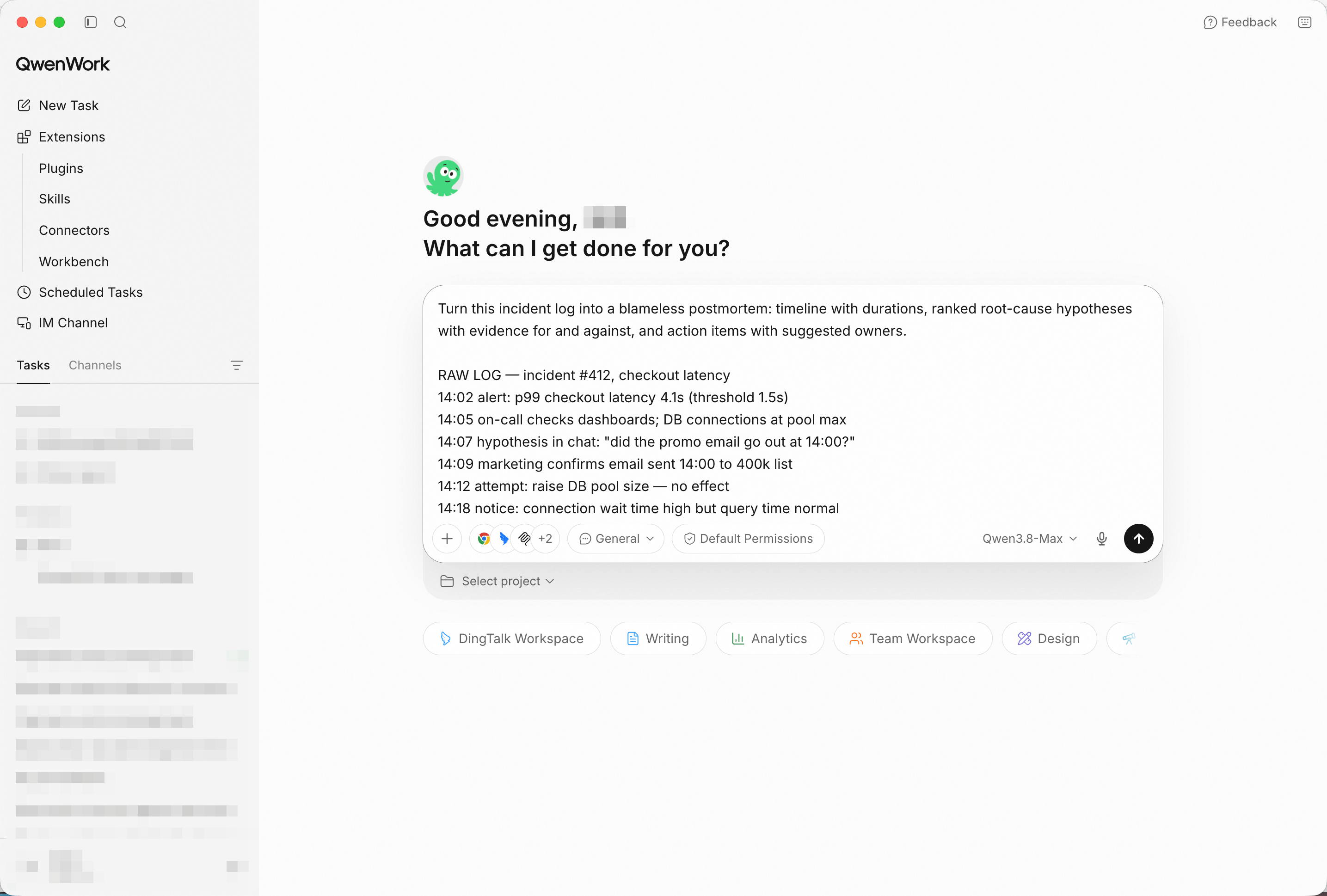
The raw log goes in unedited — gaps and all. Screenshot shows sample input entered by hand for the demo; in production, point QwenWork at your connected source and the same prompts run unchanged.
Durations matter more than timestamps: 20 minutes from first alert to correct hypothesis, 8 from mitigation to recovery. The timeline should also surface the load pattern — promo email at 14:00 as the trigger, vendor latency as the amplifier.
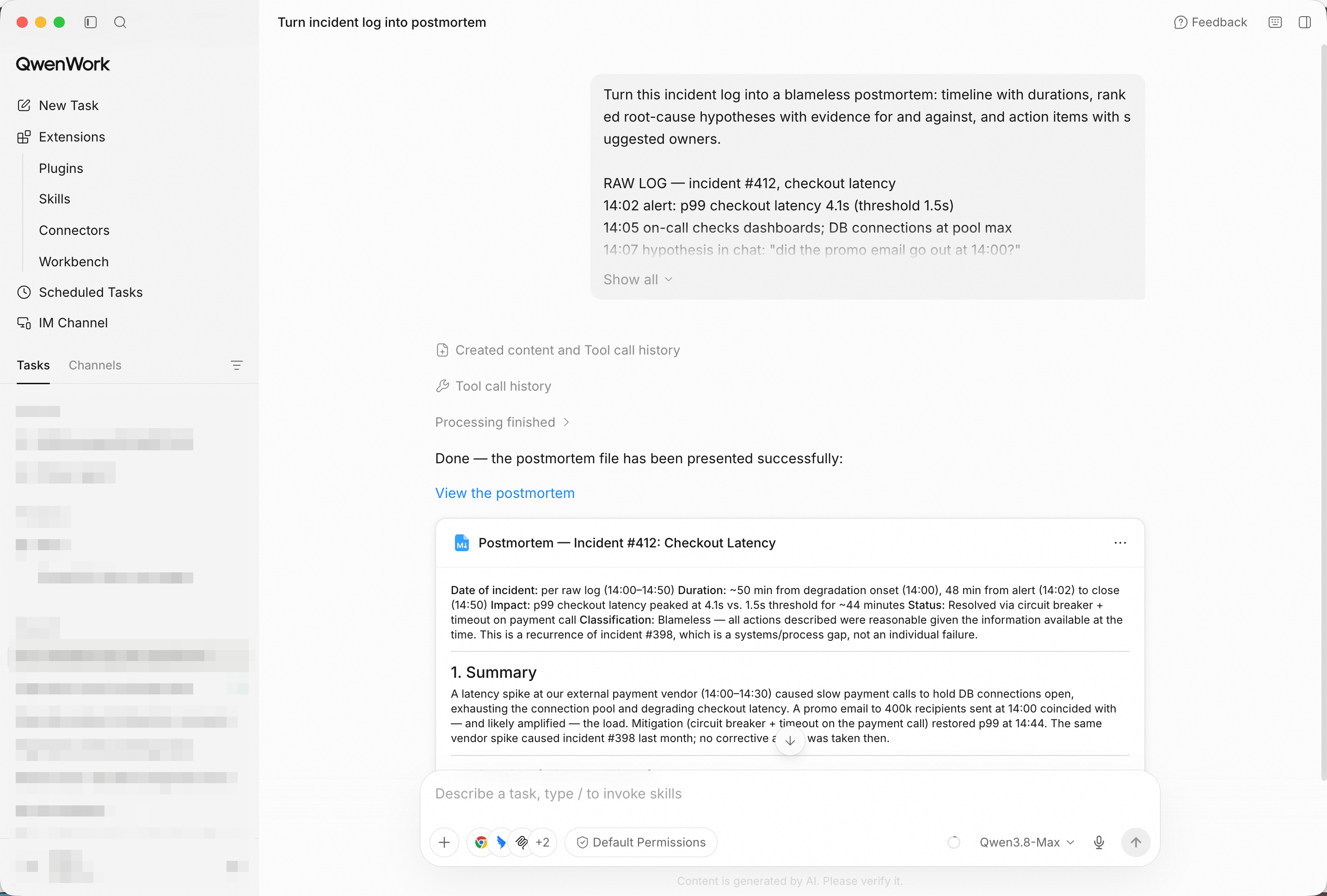
Timeline with durations and the trigger/amplifier distinction made explicit.
The interesting output is the ranking with evidence: pool exhaustion from the unbounded payment call (confirmed), pure traffic spike (contradicted — query times stayed normal), and the uncomfortable one: a known repeat, since #398 flagged the same vendor last month.
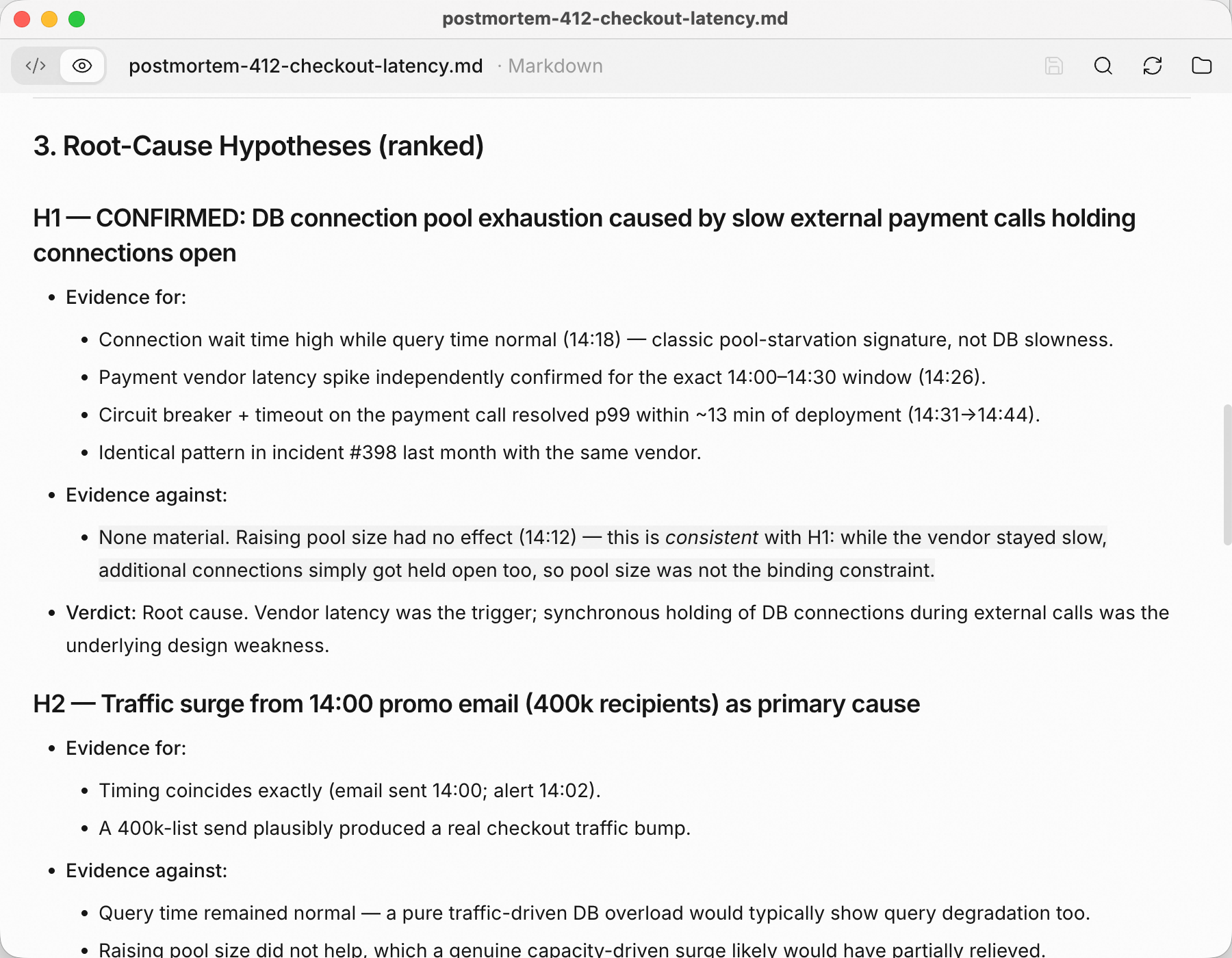
Hypotheses ranked with for/against evidence — including the one about the missed prior action.
Draft the action items: what, why, suggested owner role, and
priority. Include one for the missed follow-up from incident #398.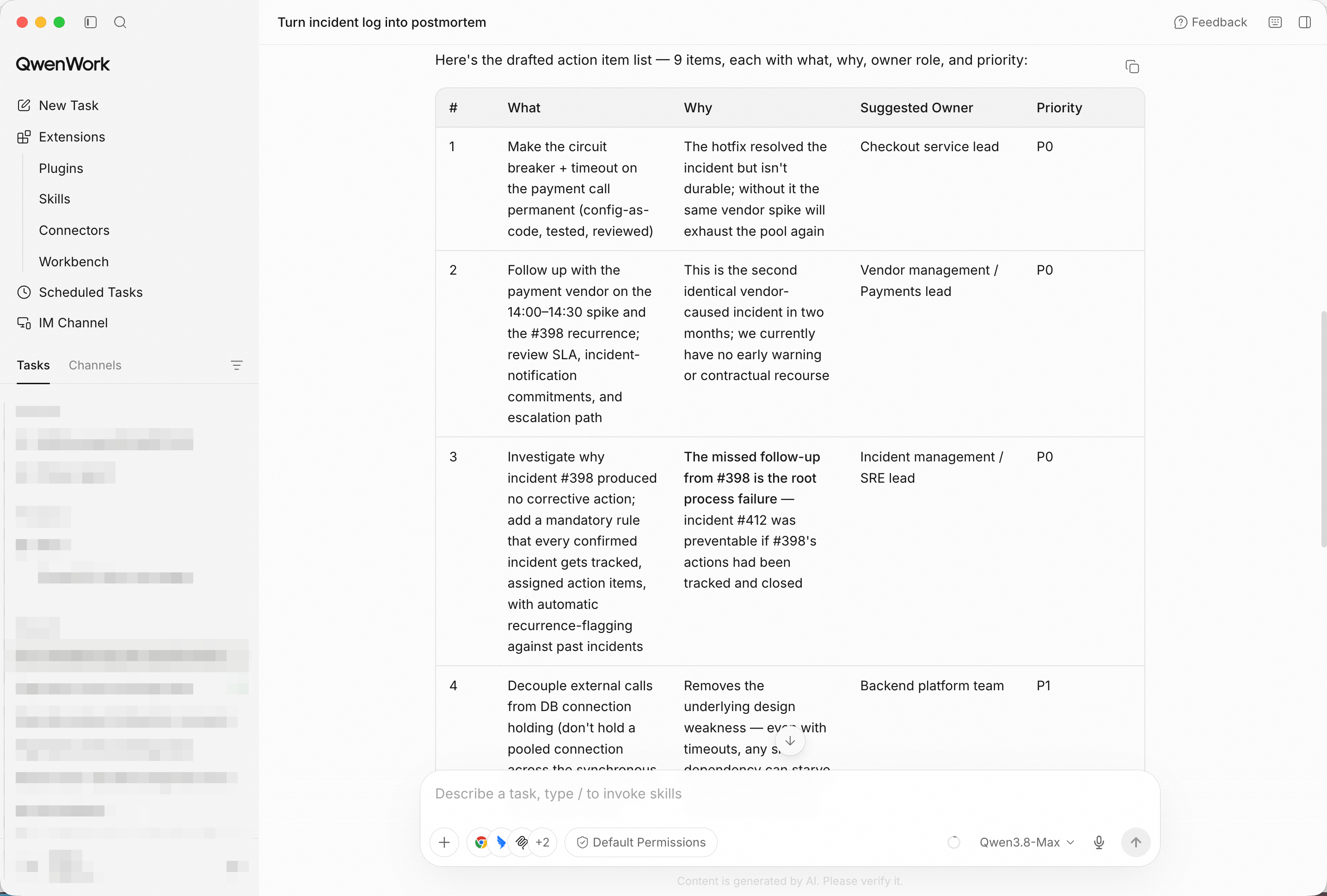
Action items with owners and priority — the repeat-offender item included, not buried.
Engineering needs the detail; the business needs three sentences:
Write a three-sentence stakeholder summary: what happened, what we
did, what changes so it doesn't recur.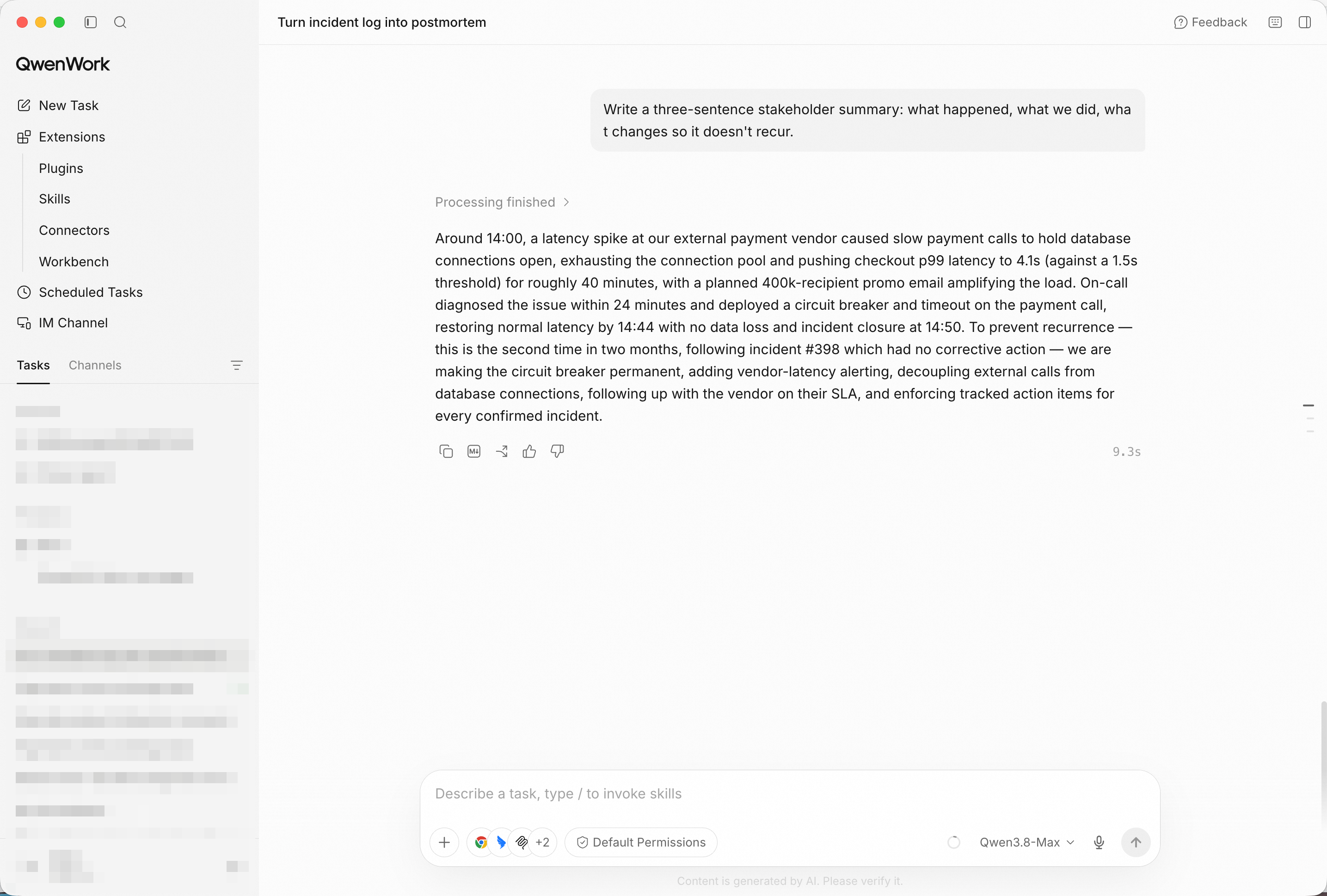
Three sentences for the business — the postmortem reaches both audiences from one source.
You didn't reconstruct the incident from memory a week later. You brought the raw log while it was fresh, and QwenWork returned a timeline, ranked hypotheses, owned action items, and a stakeholder summary — blameless by construction.
That's the pattern for a lot of the work that quietly eats your week: the learning is in the log; the document is the tax.
Rewrite a Flat Product Listing into One That Converts with QwenWork
Plan a Month of Social Content from One Product Brief with QwenWork

1,590 posts | 525 followers
FollowAlibaba Cloud Community - October 28, 2026
Alibaba Cloud Community - October 23, 2026
Alibaba Cloud Community - October 23, 2026
Alibaba Cloud Community - October 28, 2026
Alibaba Cloud Community - October 23, 2026
Alibaba Cloud Community - October 27, 2026
1,590 posts | 525 followers
Follow QwenWork
 is dedicated to helping employees strengthen their professional competitiveness in the AI era and to enabling enterprises to improve organizational effectiveness.
Learn More Token Plan
Build more, spend less. One plan, every modality.
Learn More Qwen
Full-range, open-source, multimodal, and multi-functional
Learn More Qoder
From Assisted to Autonomous — Adapting to Every Programming Need
Learn MoreMore Posts by Alibaba Cloud Community

