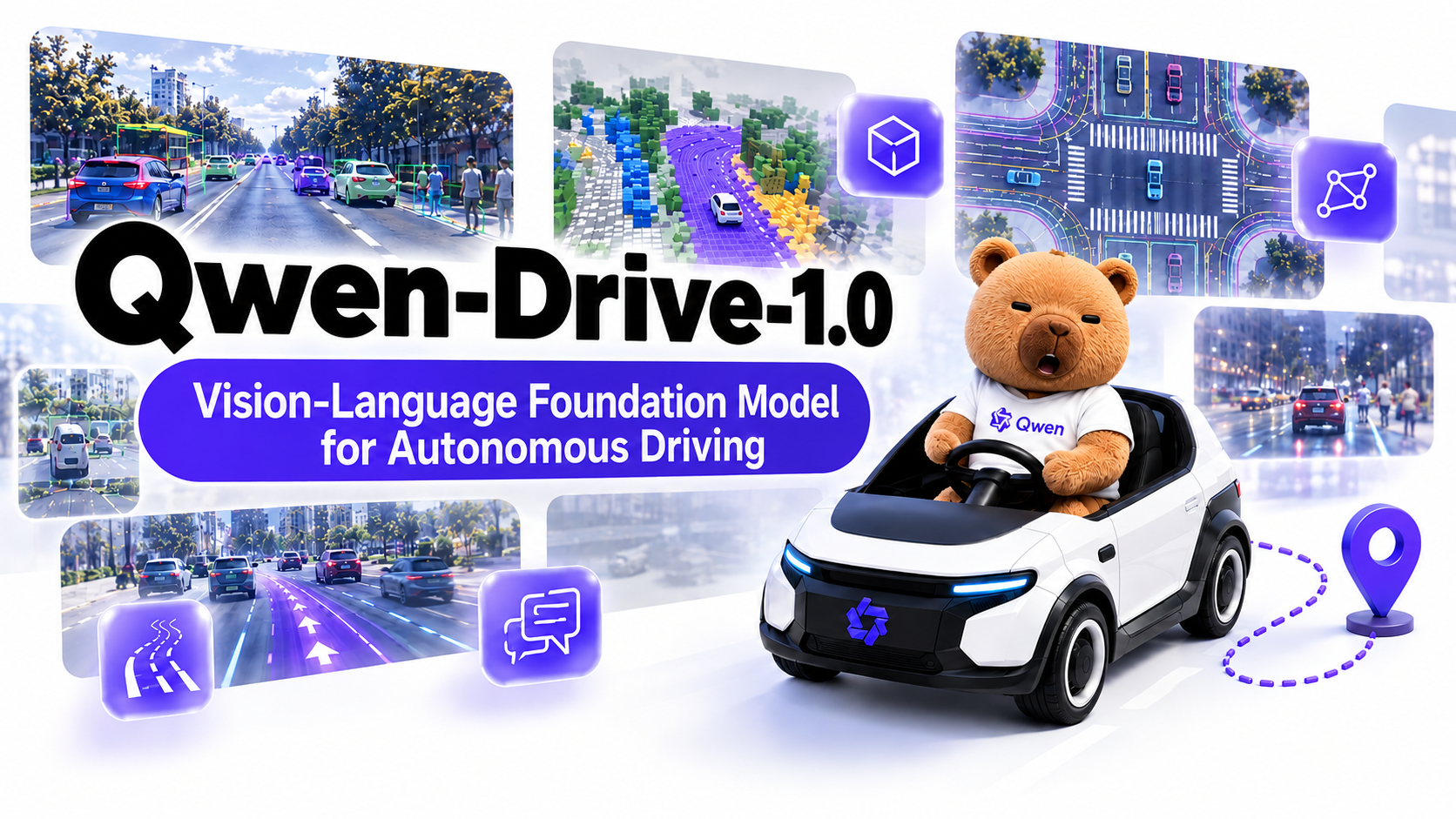
We introduce Qwen-Drive-1.0, the first vision-language foundation model for autonomous driving that unifies 3D perception and visual question answering at the pretraining stage and further extends to motion planning, while keeping the pretrained VLM architecture entirely untouched. Built on the natively multimodal Qwen3.5-4B, it attaches two external modules. A BEV perception head serves as an explicit, inspectable 3D probe, jointly performing 3D object detection, semantic occupancy prediction, and BEV map segmentation, and a Planning Expert generates future ego trajectories through flow matching. Through staged training, we substantially boost the autonomous driving capability of a general-purpose VLM and validate it on 3D perception, driving visual question answering, and motion planning tasks, forming a unified driving vision-language model that offers a new-generation VLM base for driving-scenario adaptation.
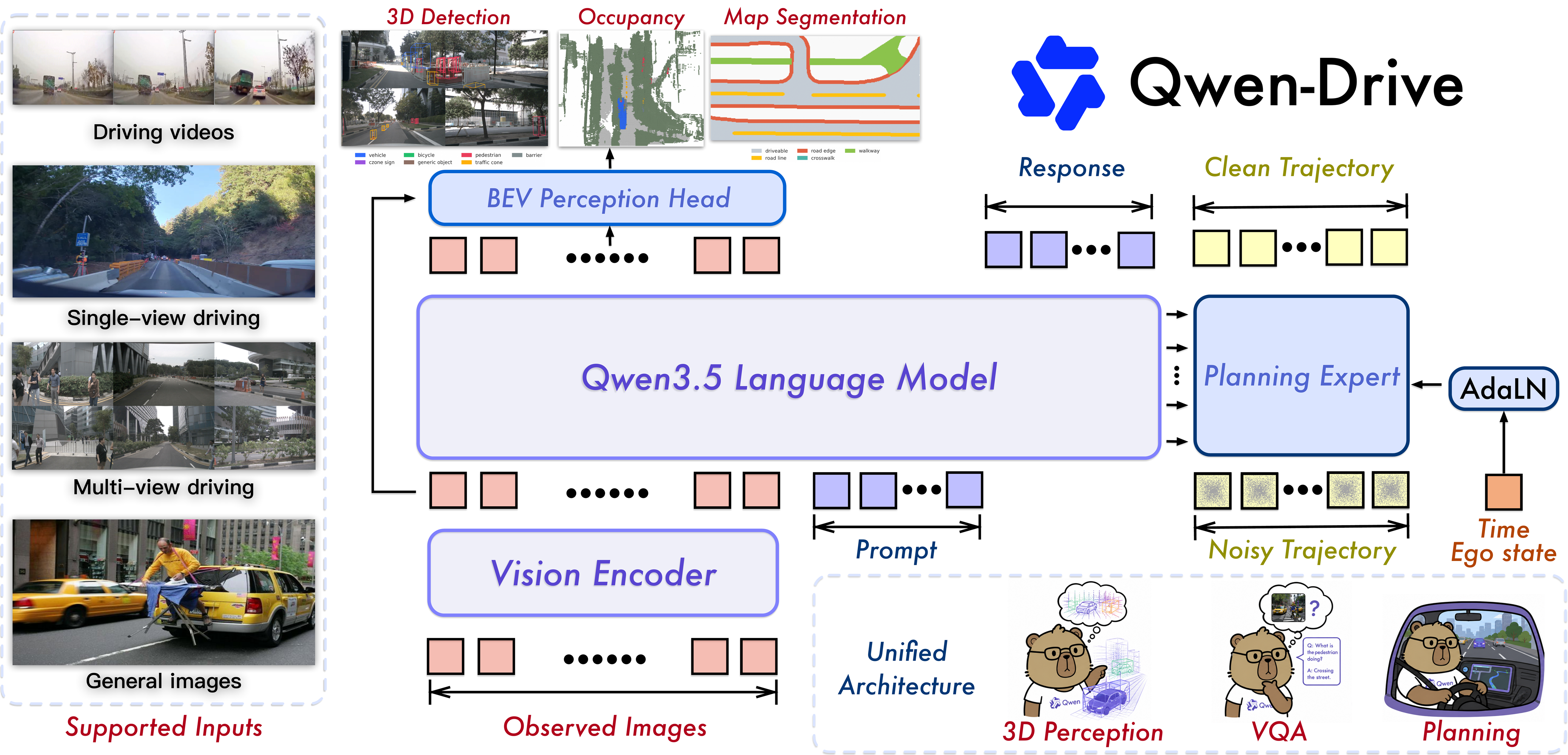
Qwen-Drive-1.0 builds on the natively multimodal Qwen3.5-4B. A shared vision encoder and VLM process single-view and multi-view driving images, temporal image sequences, and general images. Without changing the pretrained architecture, two external modules read from this shared pathway. The BEV perception head builds a BEV representation from multi-view single-frame inputs and jointly performs 3D object detection, semantic occupancy prediction, and BEV map segmentation. It acts as an explicit, inspectable 3D probe, and its losses provide an additional gradient path into the shared visual pathway during joint training. The Planning Expert is a diffusion transformer tailored to VLM representations. It generates 5-second ego trajectories through flow matching, with an optional textual planning reason as condition. Perception, question answering, and planning thus reside in one pretrained VLM.
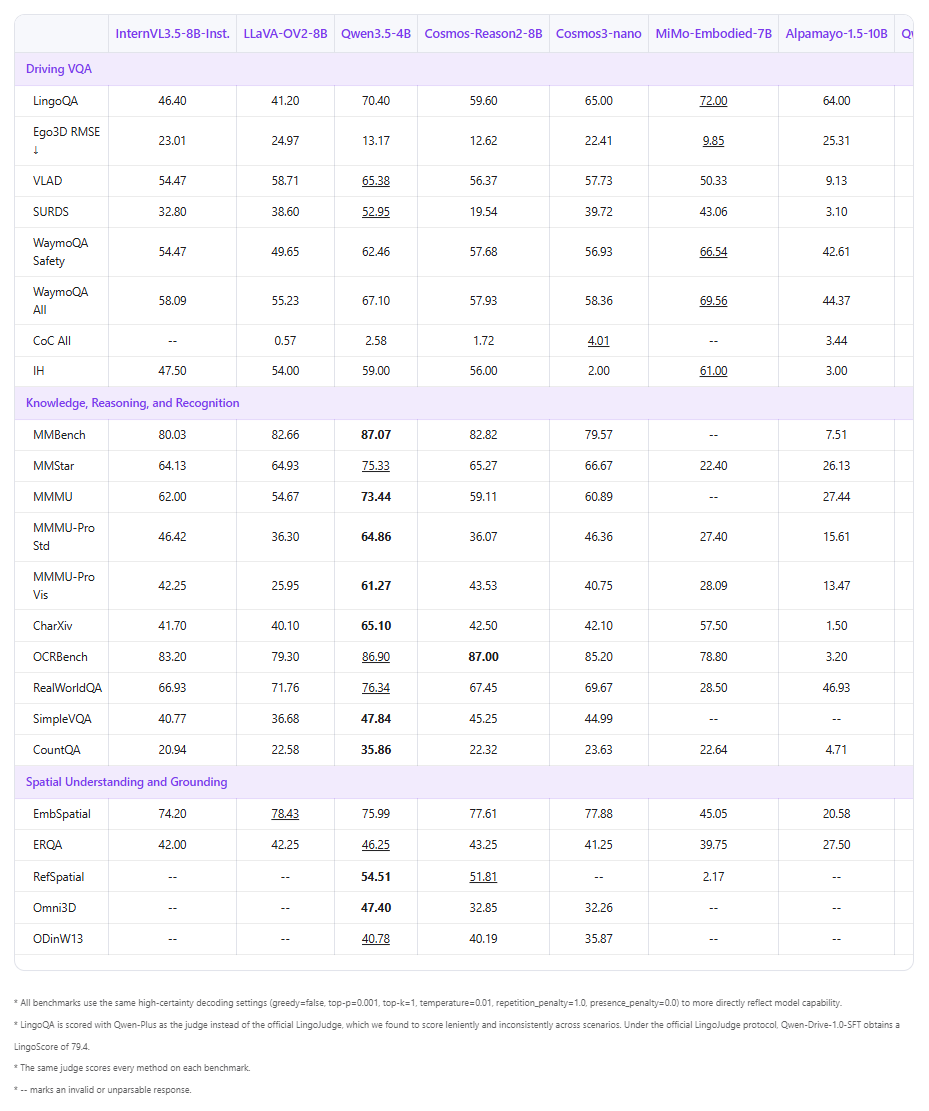
Qwen-Drive-1.0-SFT reaches a driving QA average of 69.43, leading both general-purpose VLMs and driving or embodied specialists, and demonstrating its strong driving scene understanding capability.
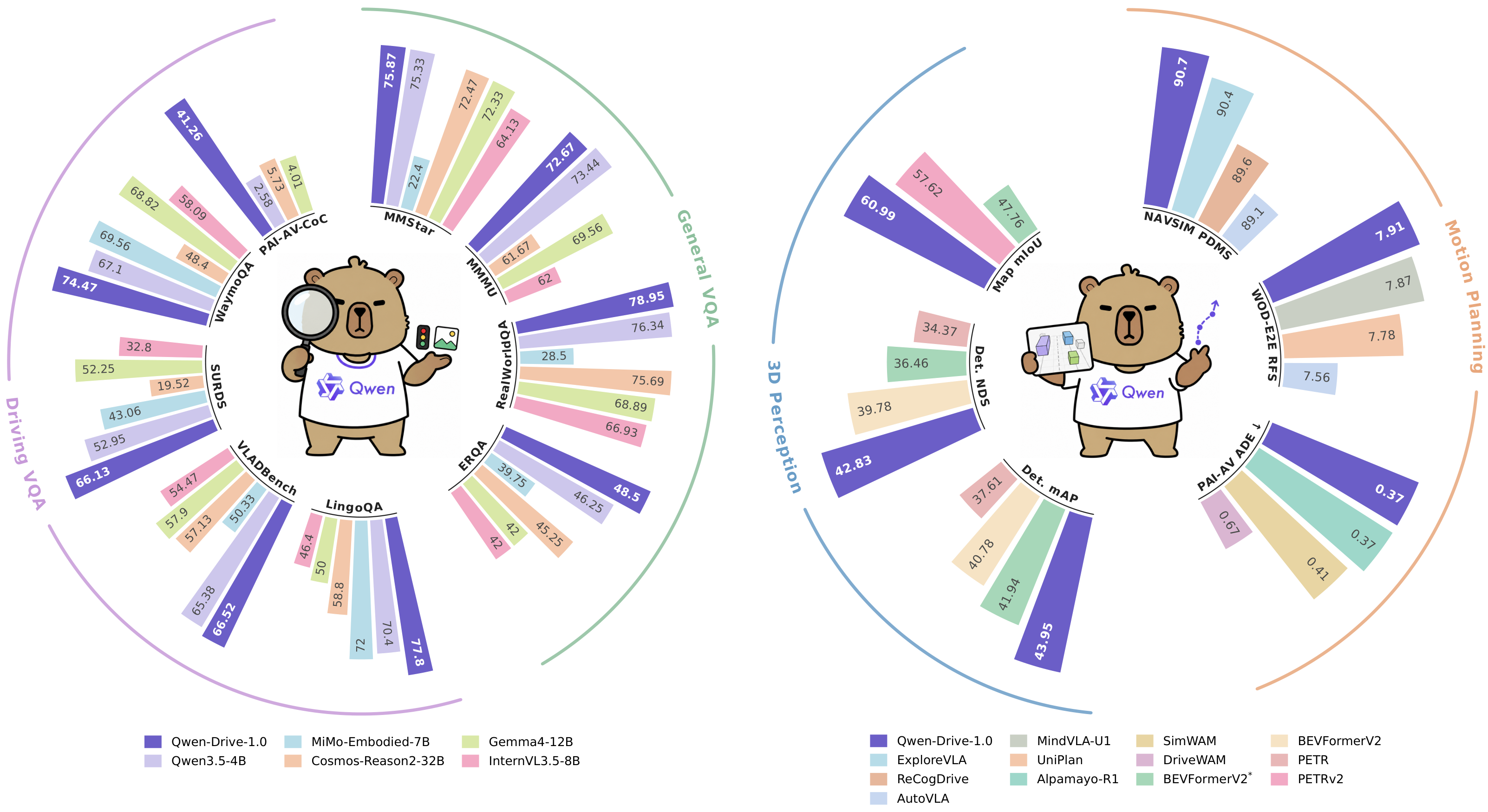
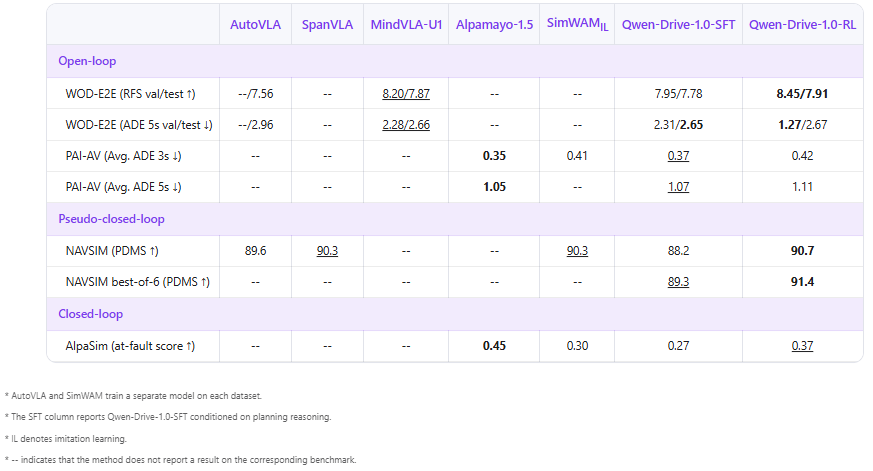
Qwen-Drive-1.0 demonstrates outstanding performance in motion planning, both in open-loop and closed-loop settings. The training is entirely based on publicly available data, comprising a total of 2.83 million samples. Due to differences in annotation styles across various datasets, we unified the trajectory format to achieve stable 5-second trajectory predictions at 10 Hz.
We consider Qwen-Drive-1.0 an initial step towards a vision-language foundation model for autonomous driving. Specifically, we introduce a BEV perception head as an explicit, inspectable 3D probe and a Planning Expert that generates future ego trajectories through flow matching. Through staged training, we substantially boost the autonomous driving capability of a general-purpose VLM and validate this route on 3D perception, driving visual question answering, and motion planning, forming a unified driving vision-language model that offers a new-generation VLM base for driving-scenario adaptation. Still, the consistency between textual reasoning and the generated trajectory remains to be strengthened, which we leave as a focus of future work.
@misc{zhou2026qwendrive10initialstepvisionlanguage,
      title={Qwen-Drive-1.0: An Initial Step towards a Vision-Language Foundation Model for Autonomous Driving},
      author={Xin Zhou and Zongchuang Zhao and Zhibo Yang and Mingsheng Li and Humen Zhong and Shuai Bai and Du Chu and Ruizhe Chen and Zhaohai Li and Jun Tang and Qiuyue Wang and Mingkun Yang and Jiazhao Zhang and Dayiheng Liu and Dingkang Liang and Xiang Bai},
      year={2026},
      eprint={2609.00111},
      archivePrefix={arXiv},
      primaryClass={cs.CV},
      url={https://arxiv.org/abs/2609.00111},
}Prudential Launches Brand New AI Underwriter Powered by Alibaba Cloud

1,573 posts | 525 followers
FollowAlibaba Cloud Community - June 17, 2026
Alibaba Cloud Community - June 8, 2026
Alibaba Cloud Community - June 3, 2026
Alibaba Cloud Community - August 3, 2026
Alibaba Cloud Community - June 17, 2026
Alibaba Cloud New Products - March 10, 2021
1,573 posts | 525 followers
Follow Token Plan
Build more, spend less. One plan, every modality.
Learn More QwenWork
QwenWork is dedicated to helping employees strengthen their professional competitiveness in the AI era and to enabling enterprises to improve organizational effectiveness.
Learn More
Alibaba Cloud Model Studio
A one-stop generative AI platform to build intelligent applications that understand your business, based on Qwen model series such as Qwen-Max and other popular models
Learn More Qwen
Qwen
Full-range, open-source, multimodal, and multi-functional
Learn MoreMore Posts by Alibaba Cloud Community

