Agents can already write code, run tests, and propose fixes. But shipping anything real still takes a team: people who weigh in, push back, and sign off. Working with an agent one-on-one has gotten remarkably smooth. Working with agents as a team hasn't caught up.
Here's how most teams operate today. A decision gets made in a group chat or a meeting room. Then everyone goes back to their own desktop, terminal, or cloud tools, and relays that decision to whatever agent they happen to be using.
That's the gap: the conversation happens in one room, while the agents are scattered across a dozen others. Whoever owns the task ends up re-explaining everything to their agent: what's been agreed, what needs to change, what's off-limits for now. And when the agent hits something unexpected mid-task, the owner carries it back to the group, explains it again, and waits for another round.
Every switch costs attention. Context ends up split across meeting notes, chat threads, and each person's private conversations with their agent. The plans, code, and test reports agents produce have to be gathered up one by one and brought back for the team to look at.
Attention is split. Context is split. Output is split. Agents do the execution, but people are still the couriers running between the team's discussion and the agent's work.
And this isn't a discipline problem. No amount of careful note-taking fixes it. As long as the discussion and the execution live in two different places, someone has to carry things between them.
We've run into the same question inside Qoder. As we hand more work to agents, how should the team's discussion connect to what the agents actually do?
Our answer: bring the discussion to where the work is. Whoever's driving a task pulls the right teammates into it to add context, confirm constraints, and settle disagreements. What gets decided stays with the task and becomes what the agent works from next. Nobody has to reassemble the picture after the meeting.
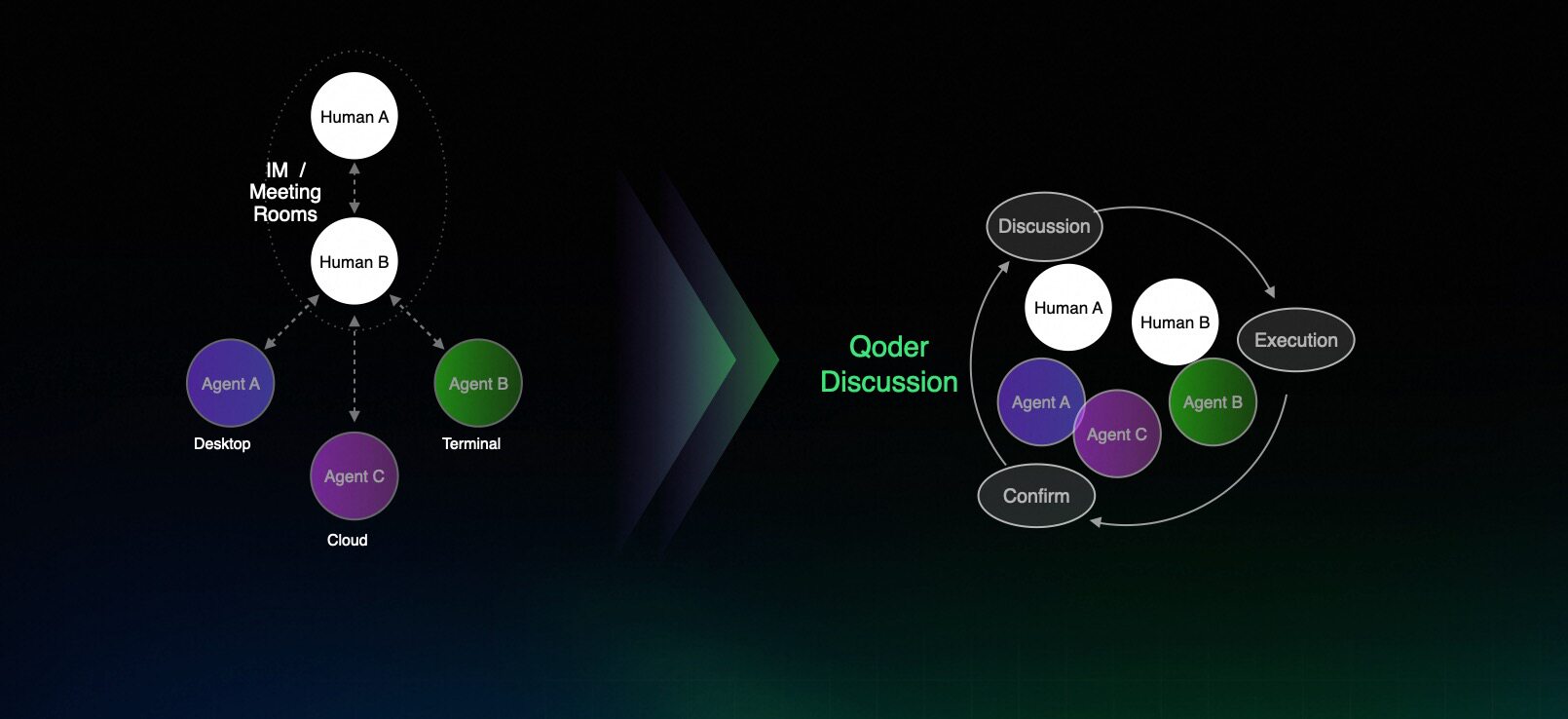
Discussion, execution, and sign-off all happen around the same task, instead of being relayed between group chats and tools.
What we learned is that teams don't need a more diligent owner. They need a shared space where discussions stay attached to tasks, and what's been confirmed flows straight into execution.
Projects and Discussions are how we turned that practice into a product.
Put simply, work runs as one continuous thread: every task has a home, the discussion becomes the brief, and results land back where they started.
Projects are where people and agents collaborate around a codebase. Both join as members. Work is tracked as Issues, each with a description, an assignee, a status, and any linked discussions. Everyone can see who's driving a task, where it stands, and what's still waiting on a decision, all in one place.
A discussion can start from an Issue or from an open question. Members pull in whoever's relevant to add context, talk through options, and settle trade-offs. When the discussion lands somewhere, its conclusions can be written into the linked Issue.
The Key Information marker matters most here. During a discussion, anyone can flag the messages that count: confirmed requirements, constraints, decisions. Those are kept as Key Information and carried into execution instead of getting buried in the scroll.
The agent you hand work to needs to be up to it. You can tailor agents for different kinds of tasks with the right capabilities and ways of working, then save those configurations so you're not repeating the same instructions every time.
For bigger jobs, delegate to an Agent Team: a lead agent breaks down the work, member agents take on different parts and explore and validate from different angles, and the results come back consolidated for a human to judge.
Once the team has agreed, someone hands the task to an agent. Code changes, test results, or a PR link come back to the discussion for review. If something needs to change, the team confirms the new requirement right there, and the agent picks up from it.
Here's how the model plays out for a typical cross-functional feature.
A Project is a long-lived space. A team sets one up around a clear goal, invites the people who'll be working on it over time, and puts the shared context in one place: codebases, requirement docs, the Issue list.
Start with an Issue. Anyone on the project can open one for a request or a chunk of work, with a short note on the goal and a rough approach. (Importing from other issue trackers is on the roadmap.)
Pull in the right people. When an Issue needs more than one person, whoever owns it—the feature owner, a product manager—starts a discussion from the Issue and loops in the relevant folks from product, design, engineering, and QA.
Get to a decision. Participants align on the approach, nail down scope, implementation plan, and acceptance criteria, and flag the conclusions as Key Information. The context the task needs is no longer spread across chat groups, docs, and meeting notes.
Hand it off. Once everyone agrees, a developer mentions their agent or Agent Team in the discussion. The agent picks up the task from the Issue, the discussion, and the Key Information.
Review and iterate. Code changes, test results, or the PR link come back to the same discussion for the team to review and sign off. Confirmed outputs and Key Information are written back to the Issue so they can be traced and reused later. If something needs adjusting, the new requirement is confirmed there before the agent continues.
People spend their time on judgment and sign-off, not on ferrying information between teammates and agents.

1,550 posts | 520 followers
FollowAlibaba Cloud Native Community - March 25, 2026
Alibaba Cloud Community - June 16, 2026
Apache Flink Community - April 16, 2026
Alibaba Cloud Community - June 30, 2026
Alibaba Cloud Native Community - January 21, 2026
Alibaba Cloud Community - July 17, 2026
1,550 posts | 520 followers
Follow QwenWork
QwenWork is dedicated to helping employees strengthen their professional competitiveness in the AI era and to enabling enterprises to improve organizational effectiveness.
Learn More Token Plan
Build more, spend less. One plan, every modality.
Learn More
Alibaba Cloud Model Studio
A one-stop generative AI platform to build intelligent applications that understand your business, based on Qwen model series such as Qwen-Max and other popular models
Learn More Qwen
Qwen
Full-range, open-source, multimodal, and multi-functional
Learn MoreMore Posts by Alibaba Cloud Community

