By Steve Wang, Developer Relations Lead, Alibaba Cloud International
For the past twenty years, developer platforms were built on one assumption: a person would be on the other end. That person is still there. But now there is a second user — one that does not read tooltips, does not lose patience, and does not browse. It just calls, observes, and moves on. Platforms today must serve both, and that coexistence is the new design problem.
Cloudflare's latest data shows that 57.4% of all HTTP requests on the internet are now automated. Agents and bots have grown into the majority of traffic, though humans still drive the decisions, the creativity, and the intent behind most of that automation.
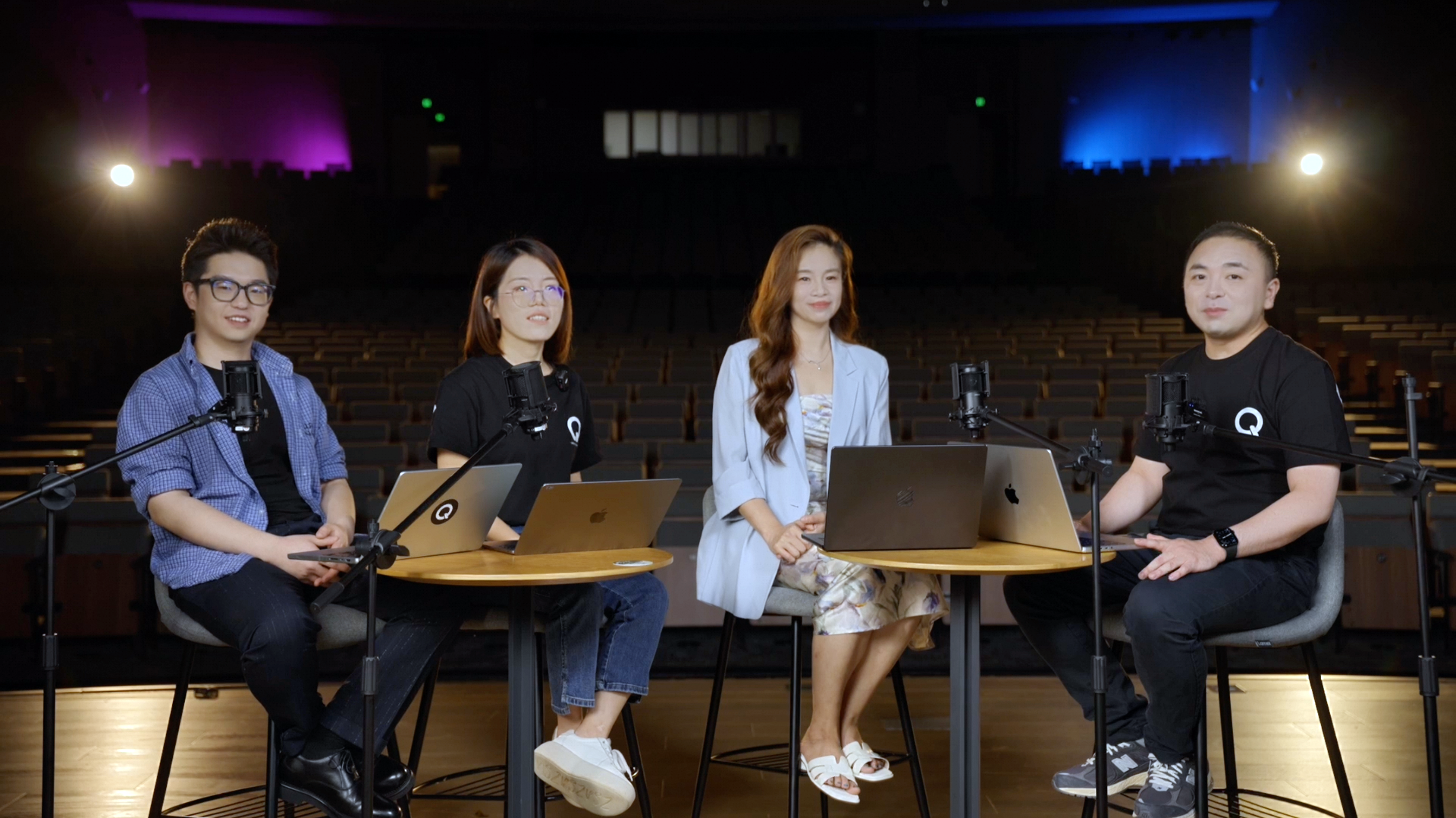
This was the context for the first episode of Qwen Live, a conversation series featuring the people building the Qwen ecosystem. I sat down with Linlin Kong, Head of Qwen Cloud, and product managers PanGu and XiJue — three people designing Qwen Cloud, a platform that works for both human developers and the agents they deploy. The conversation was not a product pitch. It was a design discussion about complexity itself.
Models are getting smarter, faster, cheaper. But intelligence alone does not close the gap between what a model can do and what actually ships. Linlin Kong put it plainly: "If the platform cannot talk to the agent directly, you will always need a person stuck in the middle." She described watching developers open twenty-something browser tabs to test one small change — copying, pasting, losing their place, starting over. The distance between "I have an idea" and "it's live" is what kills good ideas, not the model's IQ.
The challenge is that humans and agents need different things from the same platform. A developer still wants clear pages, good visual hierarchy, fast navigation. An agent needs none of that — it needs clear semantics, stable interfaces, structured output, parseable errors, verifiable results. When a platform only serves one side well, the other side suffers. If everything is organized around visual flows, agents cannot parse it. If it is stripped down to raw machine interfaces, humans lose their way. The interface layer — how both humans and agents discover, call, and verify capabilities — has become a central design constraint.
PanGu put it more sharply: "Agents are not afraid of complexity. They are afraid of chaos." Complex systems overwhelm humans because there are too many concepts, too many docs, too many steps. People do not want to memorize all of that. But if the same complexity is properly described, tool-callable, and result-verifiable, an agent turns it into executable context. The agent reads the manual so the developer does not have to. The human sets direction; the agent handles the structured, repeatable execution. The point is division of labor, not replacement.
Skills — structured instruction sets written for agents, not humans — make this concrete. When you write for a person, you can leave gaps. People fill them with experience and intuition. When you write for an agent, every judgment must be explicit. If you do not specify that a model does not support image inputs, the agent will try, fail, and retry the same wrong path indefinitely.
A good Skill works like a coach: it provides not a feature list, but a task strategy. When to use a capability. When not to. What to check first. How to know if it worked. The human developer still decides the goal. The Skill just makes sure the agent can get there without getting lost.
The difference between an assistant and an agent is clear. An assistant answers questions. An agent reasons, acts, observes, and self-corrects in a loop. The platform's job is to make that loop reliable — not by dumbing things down, but by organizing capabilities into a structure both humans and agents can navigate from their own entry points.
If agents fear chaos rather than complexity, then the job of every platform is to create order. Not fewer features, not simpler interfaces, but structured, discoverable, verifiable capability — accessible to humans through good UX, and to agents through good semantics.
This applies beyond interface design. Cost is the same story. "Token Anxiety" follows every developer running agents overnight, and XiJue offered a surprising take: "Cost anxiety is not a pricing problem. It is an information and sense-of-control problem." A developer spending three dollars a month can feel just as anxious as one spending three thousand, if the bill is unclear. Qwen Cloud's answer to this is Token Plan — exposing cost as a first-class metric, making spend visible, predictable, and programmatically controllable, so the anxiety disappears whether you spend three dollars or three thousand. The pattern holds for both human and agent experiences: what blocks adoption is not complexity itself, but the lack of structure around it.
This may be the defining product challenge of the next several years — designing platforms where humans and agents coexist productively, each doing what they do best.
Every major platform shift follows the same pattern. Flash dominated interactive web content for two decades, then mobile arrived and the entire paradigm had to move to HTML5. The winners were not the ones who tried to port Flash to a touchscreen — they were the ones who redesigned from the ground up. The agent era is following a similar path. As agent traffic grows, every platform faces challenges it was never built for: agent trust and permissions, cost visibility across autonomous loops, structured verification of results, multi-agent coordination. These are not small problems.
But the same challenges create openings. Incumbents built their platforms around human UX. Adding agent support on top is like wrapping Flash in a mobile skin — it technically runs, but it was never built for the new environment. Platforms that take the agent era seriously from the start have a chance to set the standard before the market settles. There will be many ways to do this — Qwen Cloud is one approach, offering a web experience for developers, Skills for agents, and a CLI for terminal workflows. Early internet, mobile, cloud — each shift rewarded the teams that moved while the architecture was still being defined. The agent era is in that same phase.
The full conversation is in the first episode of Qwen Live. Agents are here. The question is whether you are ready to build for them. If you are, Qwen Cloud is designed for both sides of this shift.
Alibaba Positions for Accelerated AI Growth in Second Half of 2026

1,550 posts | 520 followers
FollowJustin See - March 13, 2026
Alibaba Cloud Native Community - May 18, 2026
Alibaba Cloud Native Community - May 9, 2026
Alibaba Cloud Native Community - September 3, 2025
Kalpesh Parmar - October 10, 2025
Alibaba Cloud Native Community - March 5, 2026
1,550 posts | 520 followers
Follow Token Plan
Build more, spend less. One plan, every modality.
Learn More QwenWork
QwenWork is dedicated to helping employees strengthen their professional competitiveness in the AI era and to enabling enterprises to improve organizational effectiveness.
Learn More Qwen
Qwen
Full-range, open-source, multimodal, and multi-functional
Learn More
Alibaba Cloud Model Studio
A one-stop generative AI platform to build intelligent applications that understand your business, based on Qwen model series such as Qwen-Max and other popular models
Learn MoreMore Posts by Alibaba Cloud Community

