In the early stage of digital transformation, the Quick BI Advanced Edition served as a reliable partner, addressing the fundamental need of “data visualization.” However, as business scenarios evolve, deeper challenges begin to emerge.
Have you noticed that static dashboards can no longer support modern decision-making?
Today, we need more than just “displaying data”:
● How can real-time data drive agile decisions?
● How can we extract deeper insights from well-designed dashboards?
● How can we break down data silos and enable true business collaboration?
These are not abstract questions—they represent real pain points in day-to-day operations:
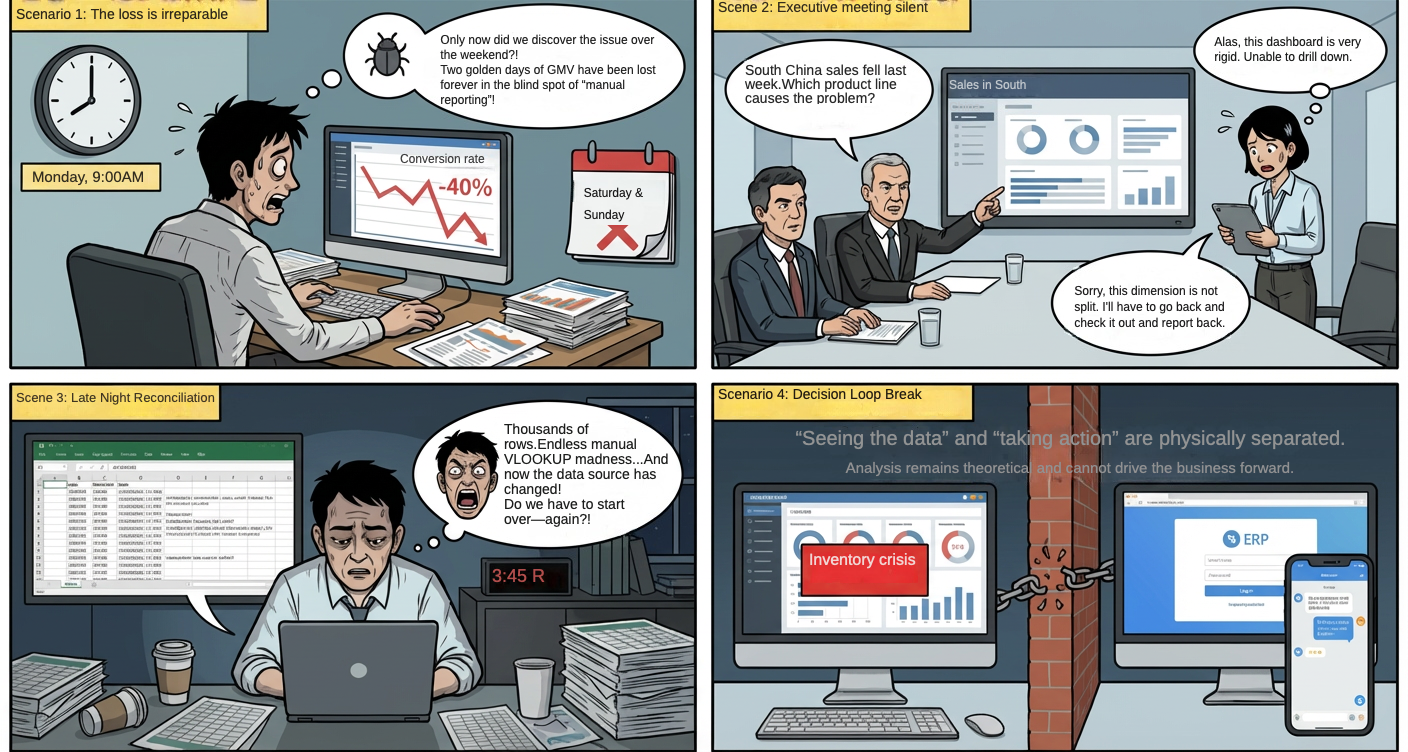
During a Monday morning review, you discover that the conversion rate of a core product dropped by 40% on Saturday due to a system bug. Two full days of valuable GMV were lost within the blind spot of manual reporting—and by the time the issue was identified, it was already too late.
In a reporting session, an executive points to the dashboard and asks:“Sales in South China declined last week— which product line underperformed?”Because the report dimensions are fixed, you can only respond:“Sorry, this breakdown is not available. I’ll follow up later.”The moment for decision-making is lost while waiting for answers.
Standard dashboards cannot support complex financial logic. You are forced to export data to Excel, perform VLOOKUPs across thousands of rows, and manually adjust formats. By the time you finish, the underlying data has already been updated—and the process must start over.
You identify an inventory risk in a report, but must leave the system to create a ticket in ERP, then switch to DingTalk for approval. “Insight” and “execution” are disconnected. Valuable analytical insights remain unacted upon, breaking the decision-making loop.
If the Advanced Edition connects the basic steps of “data connection, modeling, and visualization,” more complex business challenges require a more powerful, intelligent solution.
This is exactly what the Quick BI Enterprise Standard Version delivers.
Through four key capabilities, it helps you move beyond passive analysis and into a new stage of proactive insight and closed-loop decision-making.
— Solving the challenge of delayed response caused by manual monitoring
In advanced editions, anomalies are often buried deep within complex reports. Managers must log in daily and manually refresh dashboards just to check data. This reactive approach means a sudden drop in GMV may only be discovered hours later, or best-selling products may run out of stock before replenishment actions can be taken. By the time risks are identified, losses are often already irreversible.
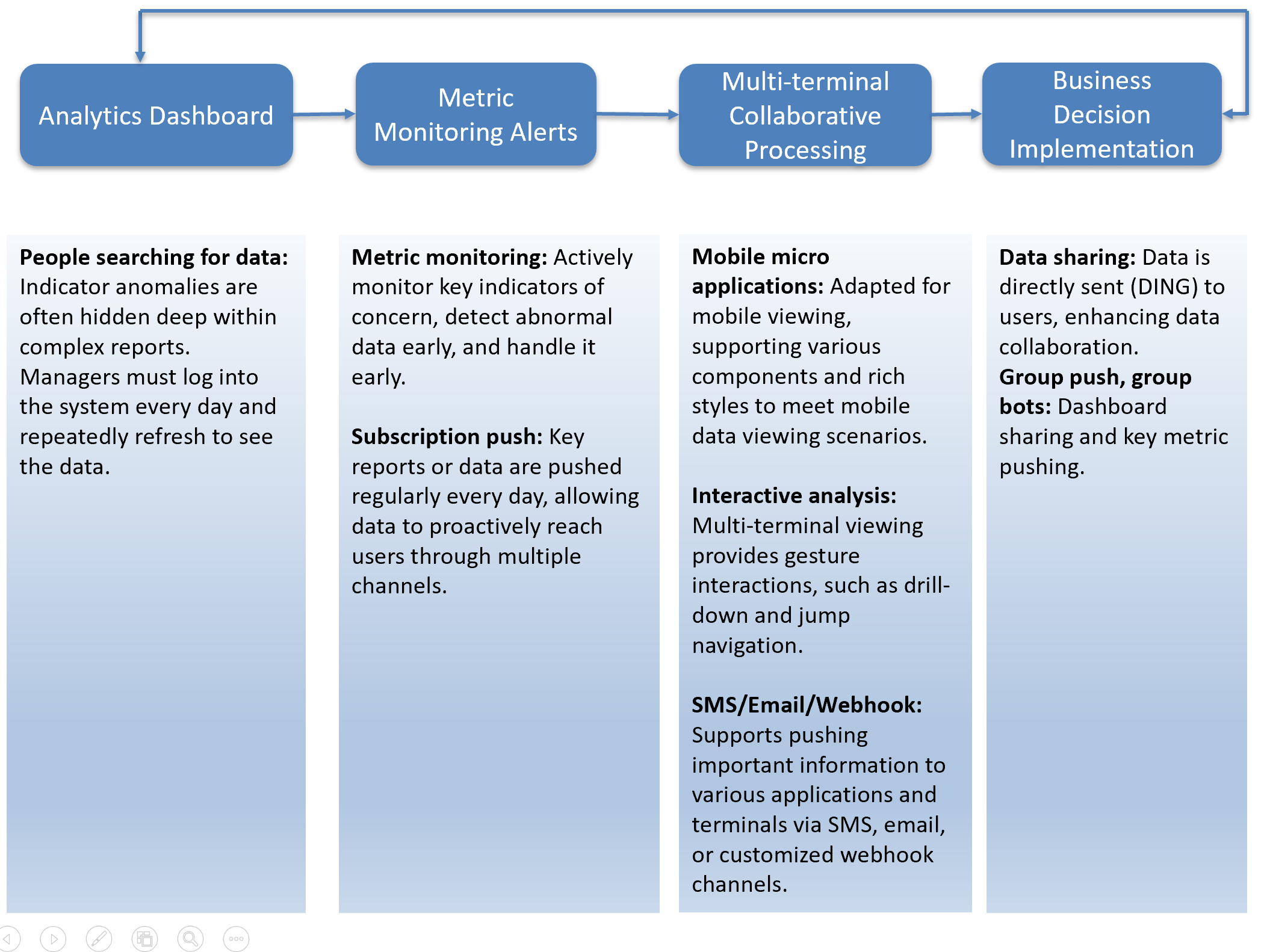
The Enterprise Standard Version shifts from manual monitoring to proactive alerting. Built-in monitoring capabilities automatically detect anomalies and notify stakeholders in real time, significantly shortening the path from issue detection to action.
● Monitoring & alerting: No need for constant manual checks. Configure minute-level monitoring for key KPIs such as payment success rates and inventory thresholds. Once a threshold is breached, alerts are triggered automatically.
● Real-time notifications: Alerts are delivered instantly via collaboration tools such as DingTalk, Feishu, Lark, and email—ensuring responsible stakeholders are notified immediately.
● Mobile mini-apps: Build a portable “digital cockpit” optimized for mobile use. Access key metrics anytime, anywhere—whether commuting or in meetings.
— Solving the bottleneck of static reports and slow analysis cycles
Reports in advanced editions are typically static. When new ideas arise or ad hoc questions are raised during meetings (e.g., analyzing the cause of declining sales in a specific city), users often find that the required dimensions are unavailable. They must submit requests to IT, wait for prioritization and modeling, and only then receive updated reports. These delays erode business intuition and cause valuable insights to miss their critical validation window.
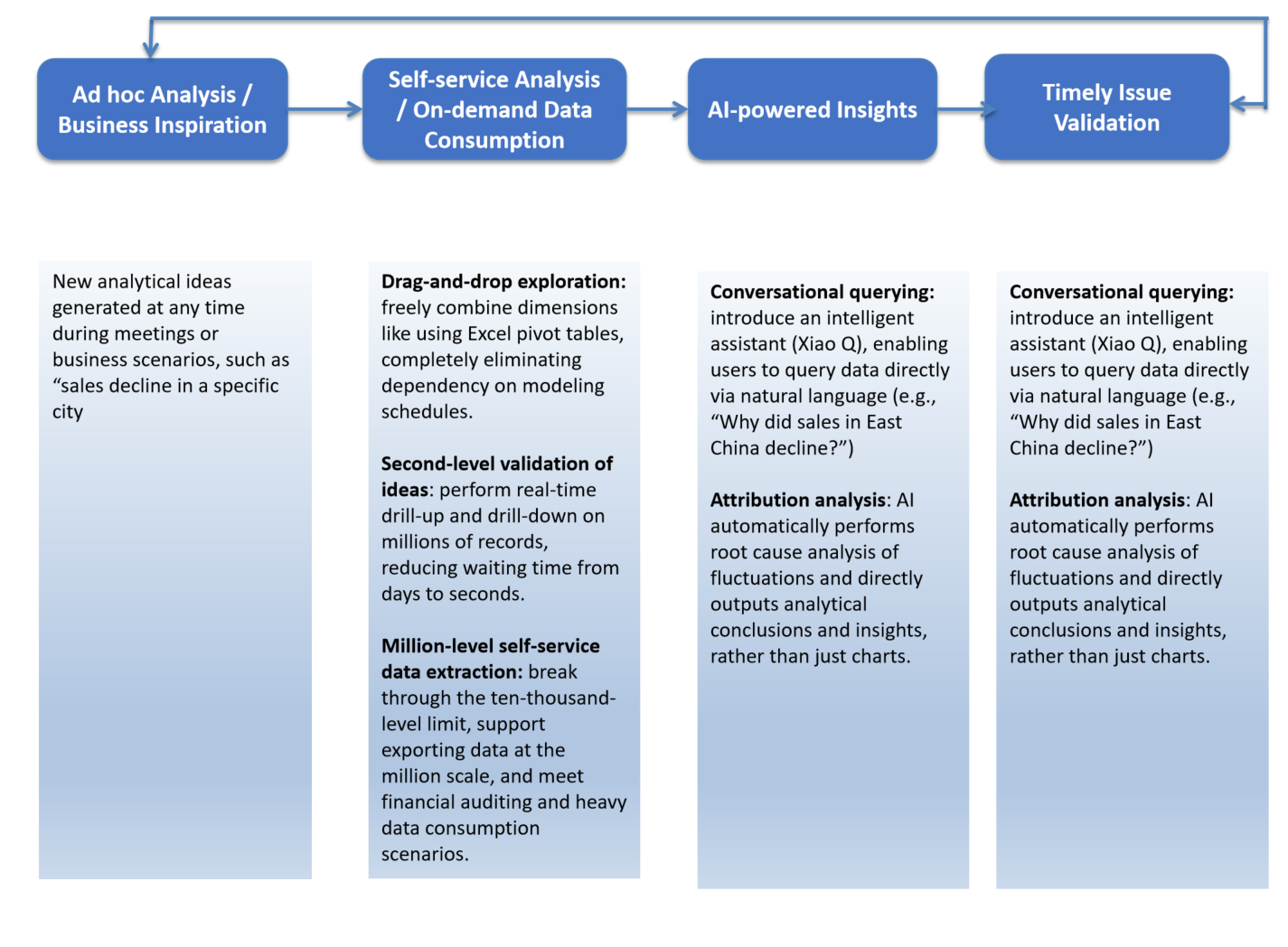
The Enterprise Standard Version empowers business users with flexible, self-service analytics. Instead of waiting for IT, users can explore data freely and validate insights in real time.
● Ad hoc analysis: Drag-and-drop analysis similar to pivot tables. Combine dimensions across large datasets and perform drill-downs, roll-ups, and validations within seconds—no IT support required.
● Smart Q: Introduces conversational BI. Simply ask questions like “Why did sales decline in East China this week?” The system automatically performs root-cause analysis and generates actionable insights—not just charts.
● Large-scale data access: Supports exporting millions of rows for audits and deep analysis, removing traditional data limits and enabling heavy data workloads.
— Solving limitations in complex data processing and presentation
Standard dashboards struggle with complex reporting and high-end presentation needs:
● Excel dependency: Financial reconciliation and multi-level calculations are too complex for dashboards, forcing users back to offline Excel files and creating data inconsistency.
● Limited presentation quality: In executive meetings or control centers, basic dashboards lack visual impact and storytelling capability, reducing the effectiveness of data communication.
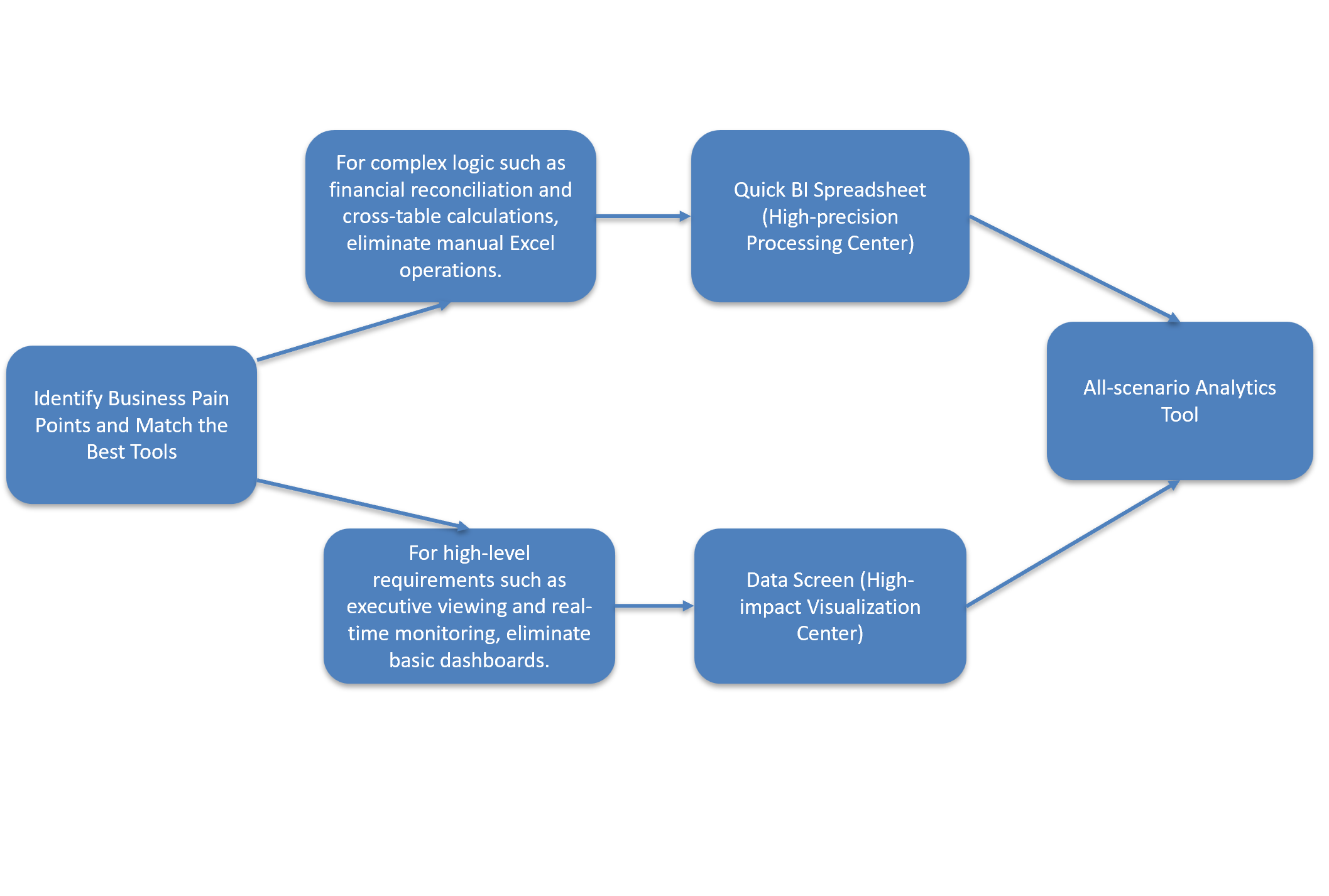
Use the right tools for different scenarios—workbooks for complex analysis, dashboards for strategic visualization.
● Workbook (for finance and professional analysts):
● Visualization screens (for executives and control centers):
— Solving disconnected workflows and incomplete decision cycles
Data analysis and execution are separated across different systems. After identifying issues in reports, users must switch tools to take action, resulting in fragmented workflows. Insights remain disconnected from execution, preventing real business impact.
Break down system barriers and turn insights into actions directly within Quick BI.
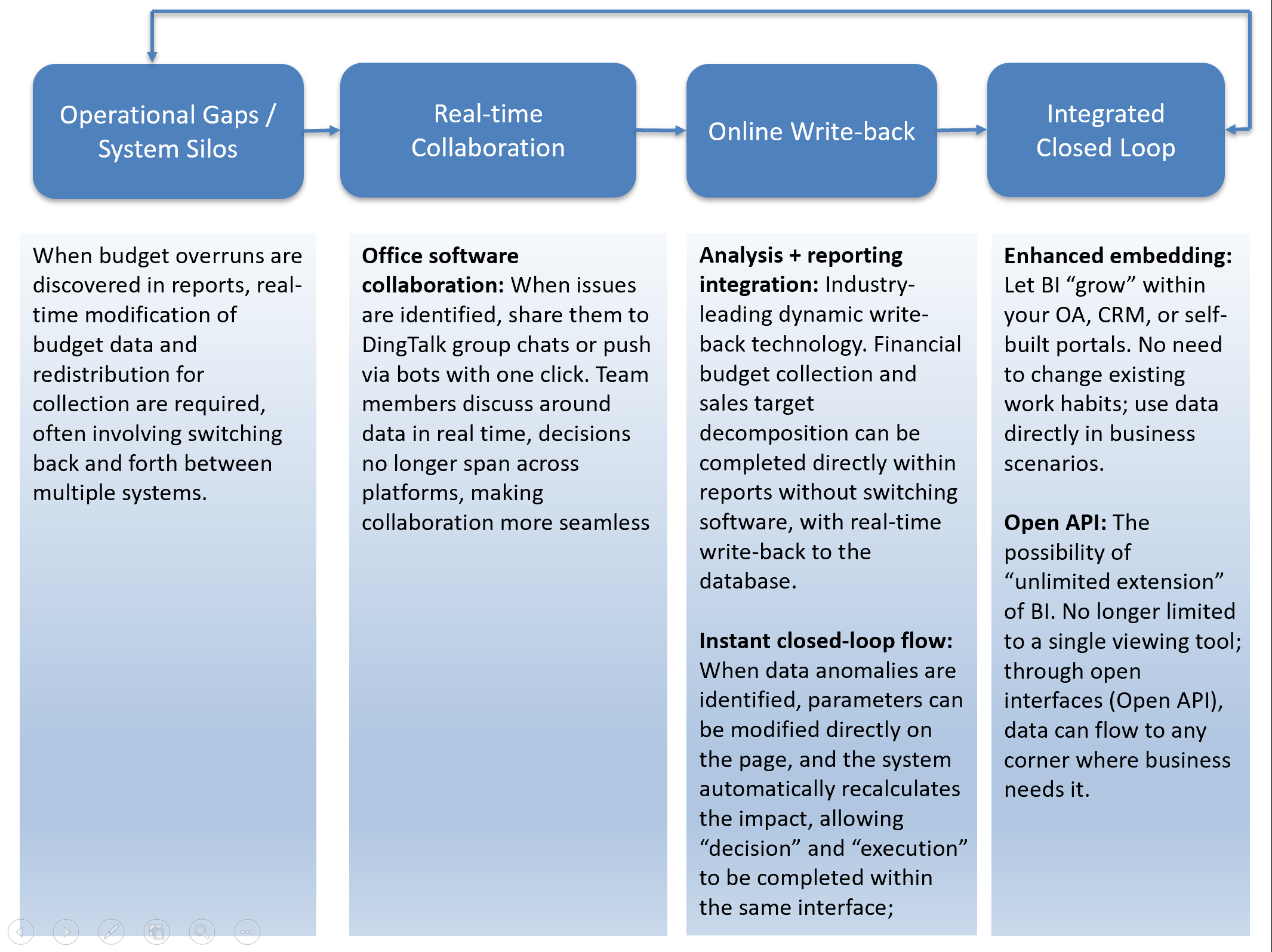
● Interactive forms (data write-back): Combine analytics with data input. Users can submit budgets or targets directly within reports, writing data back to underlying systems and enabling immediate action.
● Collaboration integration: Share insights directly to DingTalk or other collaboration platforms. Enable real-time discussion and faster decision-making across teams.
● Enhanced embedding & open APIs: Integrate BI capabilities into existing systems such as OA, CRM, or internal portals—bringing data directly into business workflows and eliminating context switching.
| Business Area | Advanced Edition | Enterprise Standard Version | Core Value |
|---|---|---|---|
| Data Monitoring | Manual inspection | Automated monitoring & alerts | Response time: hours → seconds |
| Analysis & Decision | Fixed dimensions, IT-dependent | Self-service & conversational analytics | Decision-making: technical → accessible |
| Full-Scenario Analysis | Single dashboard | Workbooks + visualization screens | From single view to full toolkit |
| Collaboration | Read-only, fragmented workflows | Integrated forms & embedding | Closed-loop execution |
The Quick BI Enterprise Standard Version is not just a feature upgrade—it represents a fundamental leap in decision-making speed and precision.
If you are facing challenges such as growing data complexity, evolving analytical needs, and slow business response cycles, this is the engine that powers your next stage of digital capability.
👉 If you are experiencing similar challenges or would like to explore upgrading to the Quick BI Enterprise Standard Version, feel free to reach out to us.
Alibaba Unveils Wan2.7 Redefining Personalized and Precision Image Creation

1,550 posts | 521 followers
FollowAlibaba Cloud Community - June 18, 2026
Alibaba Cloud Community - June 9, 2026
Bryan, Zhang - May 28, 2026
Bryan, Zhang - June 17, 2026
Iain Ferguson - December 17, 2021
5991570251130339 - January 31, 2023
1,550 posts | 521 followers
Follow Big Data Consulting for Data Technology Solution
Alibaba Cloud provides big data consulting services to help enterprises leverage advanced data technology.
Learn More Big Data Consulting Services for Retail Solution
Alibaba Cloud experts provide retailers with a lightweight and customized big data consulting service to help you assess your big data maturity and plan your big data journey.
Learn More Realtime Compute for Apache Flink
Realtime Compute for Apache Flink offers a highly integrated platform for real-time data processing, which optimizes the computing of Apache Flink.
Learn More
Hologres
A real-time data warehouse for serving and analytics which is compatible with PostgreSQL.
Learn MoreMore Posts by Alibaba Cloud Community

