| 4200+ | 1.9 Million+ | 95% |
|---|---|---|
| Data products | Data consumption Count | Employee coverage |
Founded in 1989, Hailiang Group focuses on three core sectors: education, non-ferrous materials manufacturing, and ecological agriculture. As a global enterprise group, it operates across 12 countries and regions, serving over 280,000 teachers and students, as well as tens of thousands of industrial workers and retail employees.
In October 2025, the Zhejiang Provincial Department of Economy and Information Technology released the Notification on Announcing the 2025 Zhejiang Province Enterprise Data Management National Standard (DCMM) Implementation Pilot Program. With its strong foundation and forward-looking practices in data management, Hailiang Co., Ltd. was successfully selected as a 2025 Zhejiang Province Enterprise Data Management National Standard (DCMM) Implementation Pilot Enterprise (Batch 3).

Digital transformation is a key component of Hailiang Group’s strategy and a core driver of its future high-quality growth. The integration of Hailiang Brain and Quick BI breaks down data silos and transforms data into an intelligent decision-making engine through a “See–Know–Act” closed loop. Looking ahead, Hailiang will continue to deepen data-driven operations and leverage AI to empower end-to-end upgrades across its three core industries.
— Digital Transformation Owner, Hailiang Group
Hailiang Brain × Quick BI has built three “See–Know–Act” closed loops. Leveraging core capabilities such as data knowledge processing, AI-driven analysis, and AI-integrated business processes—combined with Quick BI’s data visualization and self-service analytics—Hailiang unlocks data value from “visible” to “proactive” and ultimately to “actionable.”
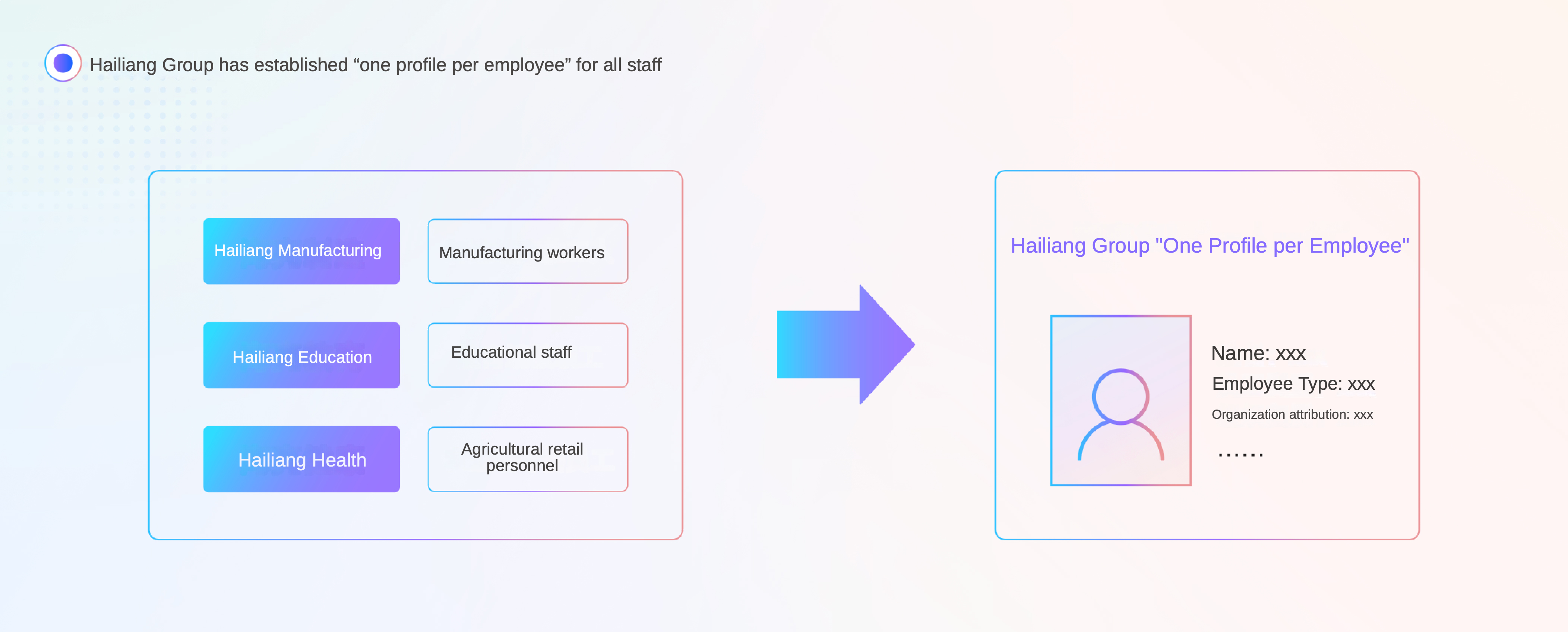
At Hailiang Group, HR management spans multiple workforce types, including industrial workers in manufacturing, teaching staff in education, and retail employees in agriculture. Previously, employee data was scattered across more than 10 systems, with inconsistent standards for fields such as employee type and organizational affiliation. Data duplication and missing rates reached 25%, and cross-regional transfers and staffing decisions relied heavily on manual experience.
Hailiang collaborated with Lingyang to build Hailiang Brain, enabling the “See–Know–Act” closed loop:
1. See: Integrate data from over 10 systems to build an enterprise-level “single employee profile,” covering more than 20 dimensions such as basic information, certifications, and performance history. Data accuracy improved from 75% to 98%.
2. Know: Quick BI powers an HR analytics dashboard that automatically links business data such as profit and cost, clarifying relationships like “HR efficiency vs. profit” and “skills vs. roles.” For example, it establishes correlation models between workforce load and production capacity in manufacturing.
3. Act: AI automatically analyzes HR efficiency and skill matching, generating real-time transfer recommendations. For instance, the education sector optimizes teacher allocation based on data-driven matching, increasing student satisfaction by 15%, while cross-factory workforce dispatch efficiency in manufacturing improves by 70%.
As a result, Hailiang Group increased its person-role matching rate by 20% and improved HR evaluation efficiency by 40%, enabling effective talent allocation across more than 220 global locations.
Previously, the marketing team needed to analyze data such as promotion ROI and customer segmentation. IT teams had to extract data from CRM and retail systems and manually consolidate it, a process that typically took two days—significantly delaying campaign reviews.
Hailiang Brain and Lingyang Quick BI established a “self-service data consumption” model, enabling the second “See–Know–Act” closed loop:
1. See: Connect to CRM, retail, and other systems to synchronize data such as promotion orders and customer behavior in real time, and visualize it through Quick BI dashboards.
2. Know: Use built-in ROI analysis models to automatically calculate key metrics such as return on investment and customer repurchase rate, while supporting drag-and-drop self-service analysis.
3. Act: Business users eliminate reliance on IT and complete data analysis instantly. For example, a marketing team in the agriculture sector used real-time insights to quickly adjust campaign strategies, increasing ROI for a single campaign by 25%.
To date, Hailiang Group has recorded over 1.9 million data consumption interactions. The barrier to data usage has been reduced by 80%, and marketing decision efficiency has improved by 90%.
In the manufacturing sector, warehouse management has long relied on manual inventory checks. Data reflects only surface-level quantities, making it difficult to identify slow-moving stock or stockout risks, resulting in high inventory costs.
Through the combined power of data governance and AI-driven analytics in Hailiang Brain, the third “See–Know–Act” closed loop was established:
1. See: Establish unified material master data standards (coding rules and required fields), cleanse over 200,000 historical records, and integrate 11 operational systems to enable “single entry, system-wide synchronization.”
2. Know: Use Quick BI and AI algorithms to automatically analyze metrics such as inventory turnover and aging stock cycles, and build correlation models between replenishment and sales.
3. Act: AI provides real-time recommendations for replenishment quantities and inventory strategies. For example, a copper foil factory reduced the proportion of slow-moving inventory from 12% to 5%, lowering inventory costs by 18%.
According to Hailiang’s data, after implementing this solution, inventory turnover increased by 25%, and the standardization rate of warehouse and logistics management reached 90%.
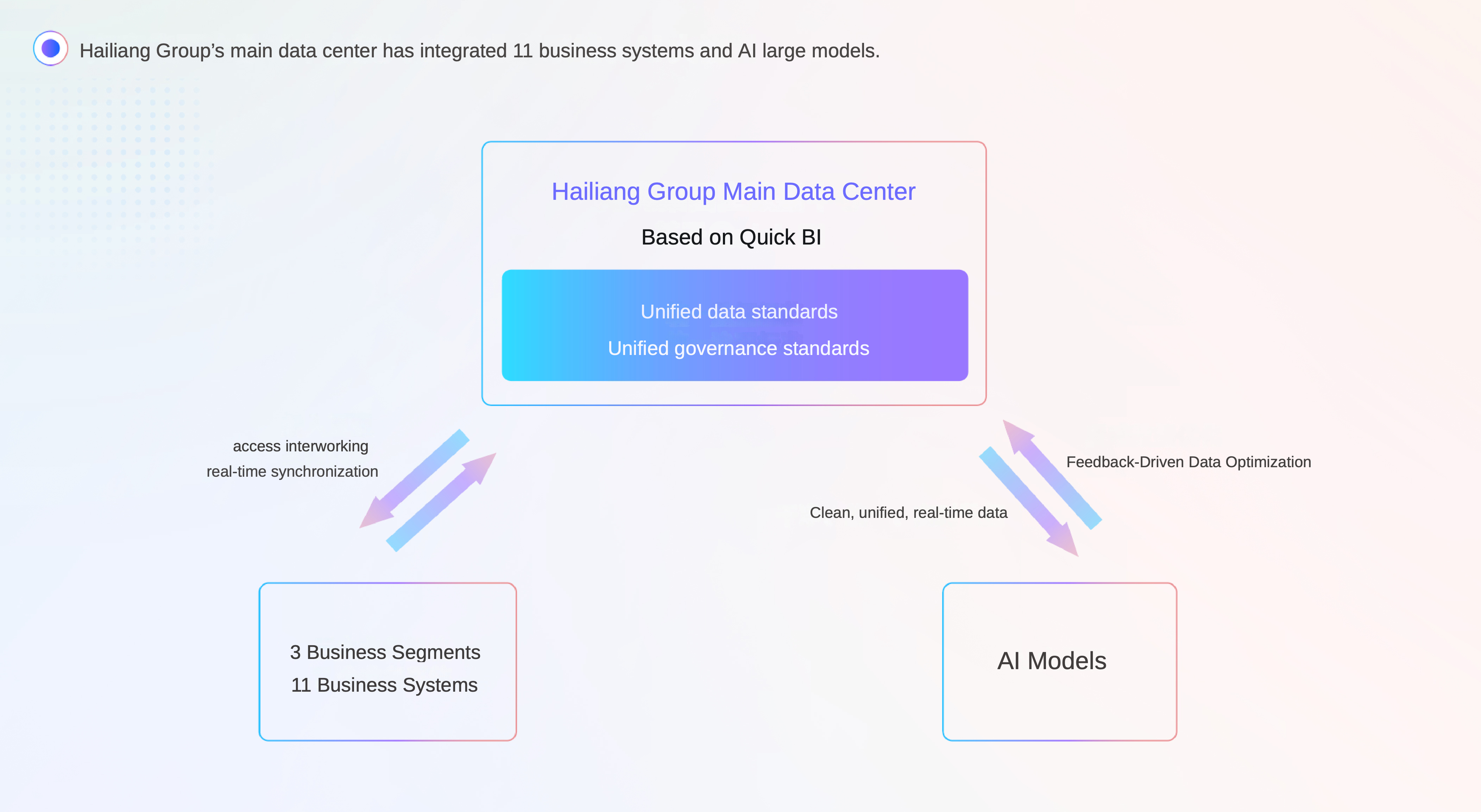
From HR management and workforce optimization to marketing analytics and inventory control, Hailiang Group has deeply integrated Hailiang Brain with Quick BI, creating a virtuous cycle of "data consumption → asset development → business transformation."
Looking ahead, Hailiang will further evolve into an intelligent decision-making hub, expanding into areas such as financial operations analysis and AI-driven IT workflow integration—shifting digital transformation from a supporting function to a driver of innovation.
| Before | After |
|---|---|
| • Over 239 systems across education, manufacturing, and agriculture, with fragmented data and no unified view • Business teams waited more than 24 hours to access key metrics such as workforce efficiency and inventory • Inefficiencies such as workforce underutilization and excess inventory frequently occurred |
• Data integrated across more than 10 systems, improving accuracy from 75% to 98% • Business users completed 1.9 million real-time data interactions without IT dependency • Inventory turnover increased by 25%, and warehouse management standardization reached 90% |

1,550 posts | 521 followers
FollowPM - C2C_Yuan - August 1, 2023
Alibaba Cloud Community - April 30, 2026
Alibaba Cloud Community - June 24, 2025
Alibaba Cloud Community - June 18, 2026
Alibaba Cloud Community - July 3, 2026
Alibaba Cloud Community - August 17, 2026
1,550 posts | 521 followers
Follow Big Data Consulting for Data Technology Solution
Alibaba Cloud provides big data consulting services to help enterprises leverage advanced data technology.
Learn More Big Data Consulting Services for Retail Solution
Alibaba Cloud experts provide retailers with a lightweight and customized big data consulting service to help you assess your big data maturity and plan your big data journey.
Learn More Realtime Compute for Apache Flink
Realtime Compute for Apache Flink offers a highly integrated platform for real-time data processing, which optimizes the computing of Apache Flink.
Learn More
Hologres
A real-time data warehouse for serving and analytics which is compatible with PostgreSQL.
Learn MoreMore Posts by Alibaba Cloud Community

