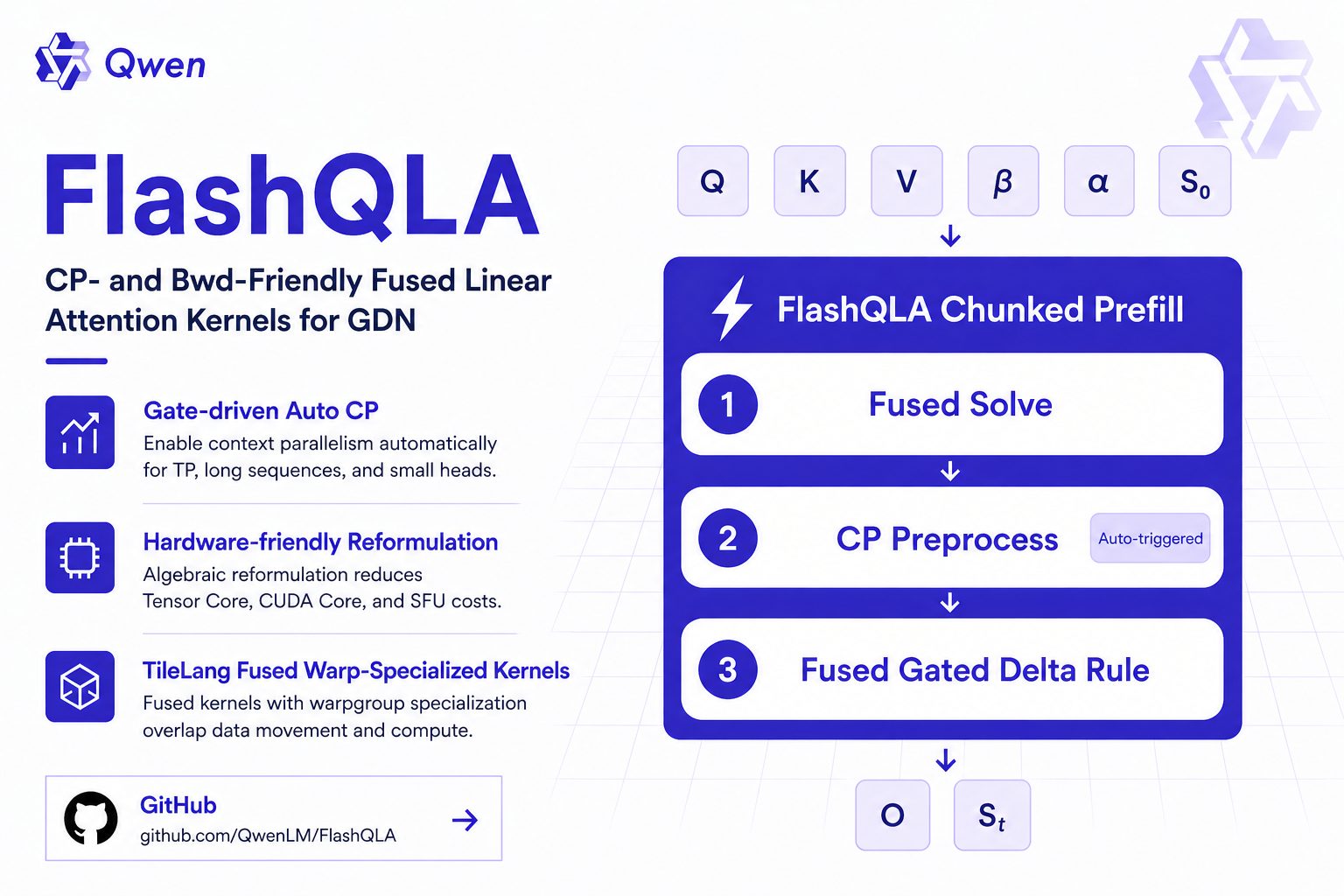
Following the release of Qwen3-Next, Gated Delta Network (GDN) has become the workhorse attention layer across the Qwen family — from Qwen3-Next-80B-A3B all the way to the subsequent Qwen3.5 / Qwen3.6 series. As models scale to 397A17B / 122A10B / 35B / 27B and context windows stretch beyond 256K, the overhead of the GDN block in end-to-end training and inference has become non-negligible.
Today we officially open-source FlashQLA: a high-performance linear attention kernel library built on TileLang. FlashQLA applies reasonable operator fusion and performance optimization to the forward and backward passes of GDN Chunked Prefill, achieving 2-3× forward speedup and 2× backward speedup over the FLA Triton kernel across multiple scenarios on NVIDIA Hopper. The efficiency gains are particularly pronounced in pretraining scenarios and edge-side agentic inference.
FlashQLA code and benchmarks are open-sourced at github.com/QwenLM/FlashQLA.
Let us first review the forward computation flow of GDN Chunked Prefill, taking chunk index i as an example:
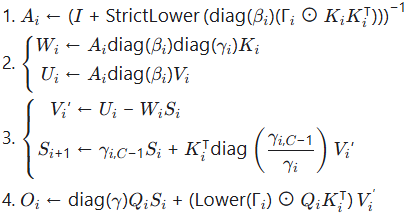
Ignoring gate preprocessing and CP, each step of this flow corresponds to one kernel in FLA. This flow has two main efficiency problems:
chunk_gated_delta_rule_fwd_kernel can only launch batch_size * num_heads thread blocks simultaneously, resulting in low GPU utilization in small-model, small-batch, or TP scenarios.The solutions to these two problems are contradictory. For the first problem, the most intuitive solution is to write a fully-fused kernel, where all data is accessed only once and all intermediate variables are kept on-chip. When batch_size * num_heads is large enough, this is certainly optimal. However, such a solution obviously runs into the second problem: for edge-side inference with small models and batch_size=1, or for large-model online deployments with TP where long-sequence inputs from coding agents etc. cannot launch a large enough batch for chunked prefill, the speedup of a fully-fused kernel over the original FLA implementation is limited.
The earliest solution to the second problem comes from how DeltaNet does context parallelism, which splits a long sequence into multiple sub-sequences, uses S0 = 0 to parallelize the recurrence, and then computes an additional M matrix to correct the recurrent results. This scheme was later optimized to insert a step before the recurrence kernel to compute the S0 of each sub-sequence, and has now been merged into the FLA repository. For CP rank j, the specific preprocessing flow is:
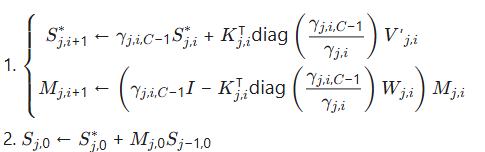
However, this CP scheme also has its drawbacks: first, it introduces significant extra computation, with the time complexity of recurrently computing the M matrix even exceeding that of the S matrix; second, it does not work well with fully-fused kernels, because matrix inversion and other steps must be performed before the S0 of each sub-sequence can be computed.
Based on the two problems above, a compromise solution can be derived: split the GDN Chunked Prefill forward computation into two fused kernels, inserting CP-related preprocessing steps between them. After some transformations and simplifications, the following computation flow is obtained:
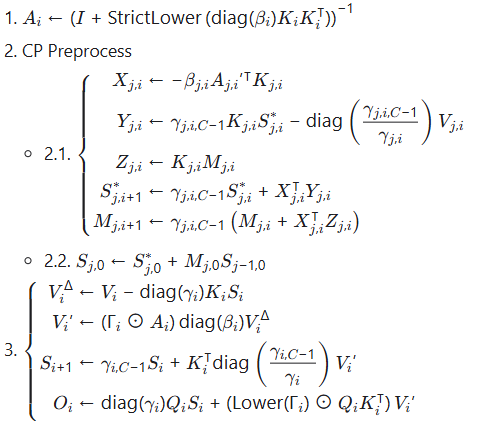
We also designed a simple mathematical model to automatically determine the degree of parallelism. Let N be the number of chunks in a sequence and L be the number of chunks per CP rank. It is easy to see that the runtime of steps 2.1 and 3 is proportional to L, while the runtime of step 2.2 is proportional to  ; therefore we can choose
  to minimize total time, where λ is a coefficient composed of
 batch_size, num_heads, and other hyperparameters.
In production, intra-card CP is not always needed. Following the original FLA implementation, step 3 can also increase parallelism by 2-4× via splitting v_head_dim, at the cost of redundant memory access to Q and K. Based on measured data, we enable CP only when batch_size * num_heads <= 40 or batch_size * num_heads <= 56 && seq_len >= 8192.
Revisiting the GDN recurrence:

For αi ∈(0,1), the influence of each Si on subsequent states decays exponentially, giving it a sliding-window property. For a sufficiently long window size of W, starting computation from Si−W = 0 can obtain the accurate Si, without the need to start from S0. We refer to this process as warmup. On real data, we find that αi is not constantly 1 on 60–80% of linear attention heads, and 6–8 chunks of warmup are sufficient to drive the Si error below the noise floor.
Therefore, for linear attention heads with the sliding-window property, we can design a lighter CP preprocessing flow that discards the computation of the correction term M and directly obtains an equally accurate sub-sequence S0 through warmup:
|
C0 |
C1 |
C2 |
C3 |
C4 |
C5 |
C6 |
C7 |
C8 |
C9 |
C10 |
C11 |
C12 |
|
|
R1 |
O |
O |
O |
O |
O |
||||||||
|
R2 |
X |
X |
O |
O |
O |
O |
|||||||
|
R3 |
X |
X |
O |
O |
O |
O |
X denotes warming up with a zero initial state until the gate has decayed sufficiently, then writing out the S0 of that CP rank; O denotes subsequent normal recurrent computation. The warmup length for each rank is determined by an independent kernel that collects gate statistics, and the cost of this step is negligible.
We implement FlashQLA in TileLang using a warpgroup-specialization pattern: one producer warpgroup and three consumer warpgroups reside in the same SM, exchange data through shared memory, and synchronize via mbarriers.
In the forward pass, the three consumer warp groups compute V', S, and O respectively, overlapping computation and memory traffic through a ping-pong structure.
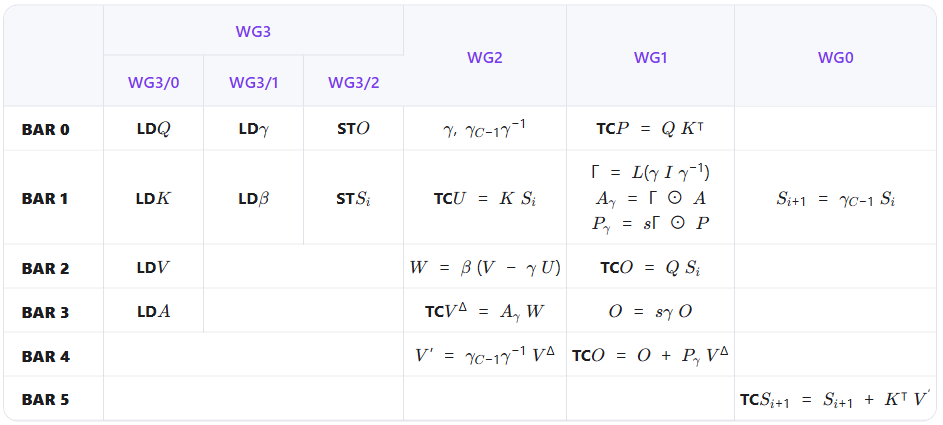
Notes:
As mentioned earlier, the CP preprocessing splits into two cases: the original approach (computing both M and S) and the sliding-window approach (computing only S). We designed a single fused kernel that handles both:
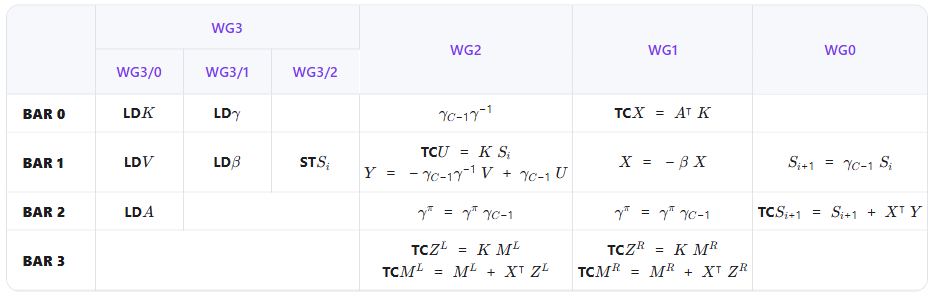
Notes:
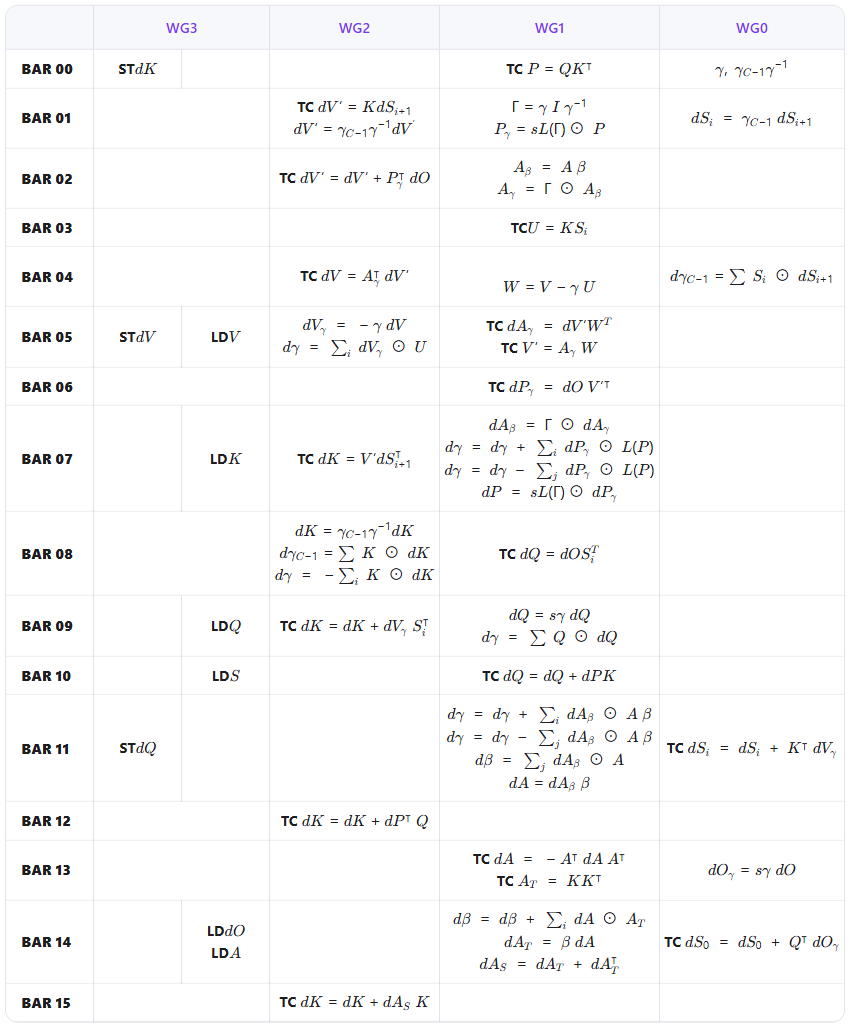
In the backward pass, we reuse the CP preprocessing kernel from the previous section to recompute the S matrix, then fuse bwd_dv, bwd_dhu, bwd_dqkwg, bwd_wy into a single kernel with corresponding algebraic optimizations. Because of on-chip resource constraints, the backward kernel does not use multi-stage pipelining; instead it relies on the long compute chain to hide memory traffic. The full schedule is available in the FlashQLA repo.
We benchmarked FlashQLA against the FLA Triton and FlashInfer baseline (FLA 0.5.0, Triton 3.5.1, FlashInfer 0.6.9, TileLang 0.1.8) on the head configurations used by the Qwen3.5 / Qwen3.6 family — hv ∈64,48,32,24,16,8, corresponding to TP1 through TP8.
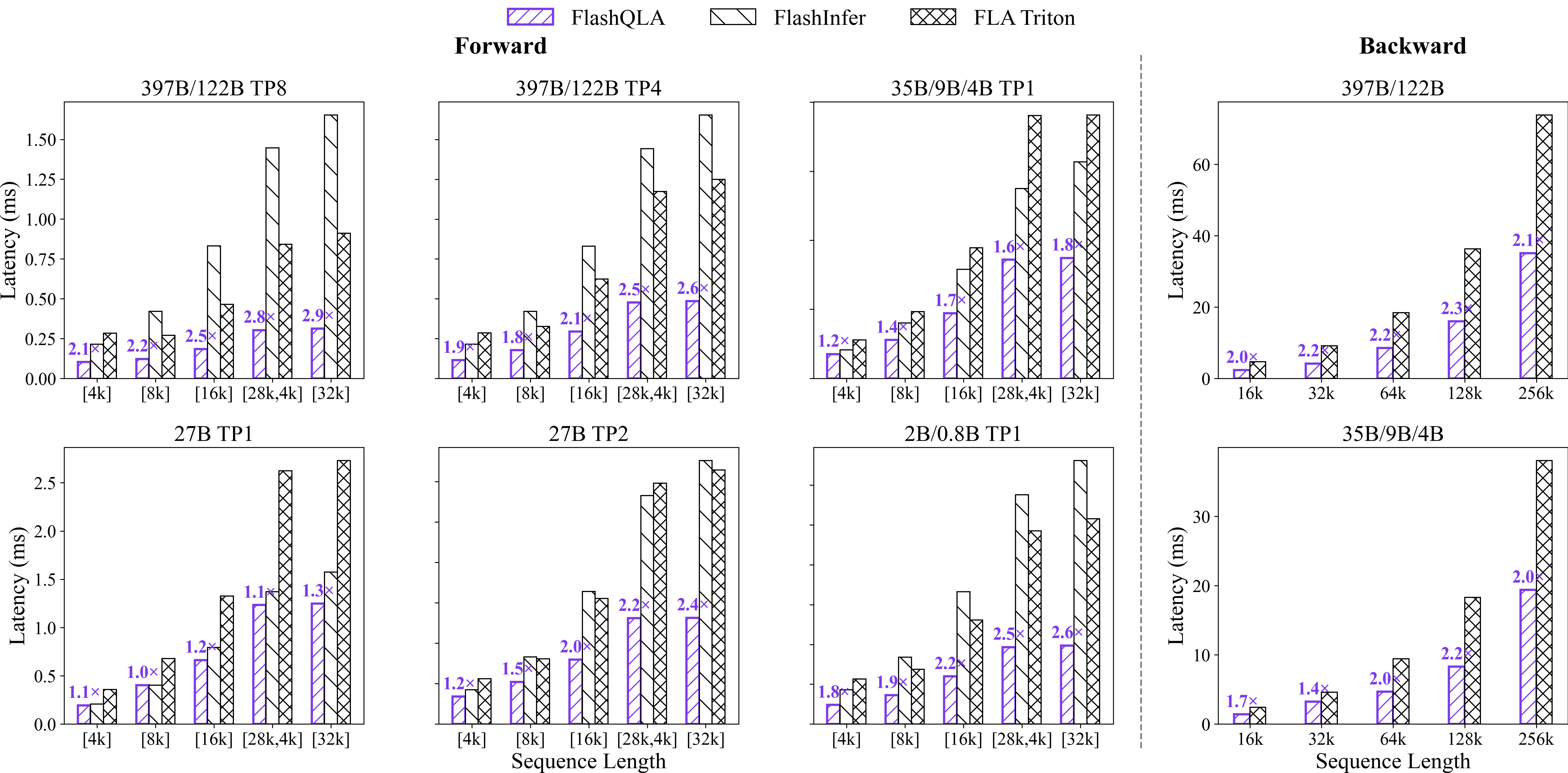
Specifically, the forward (FWD) benchmarks measure single-kernel latency for different models and TP settings under varying batch lengths, while the backward (BWD) benchmarks examine the relationship between total token count within a batch and latency during a single update step.
Selected H200 single-layer forward results:
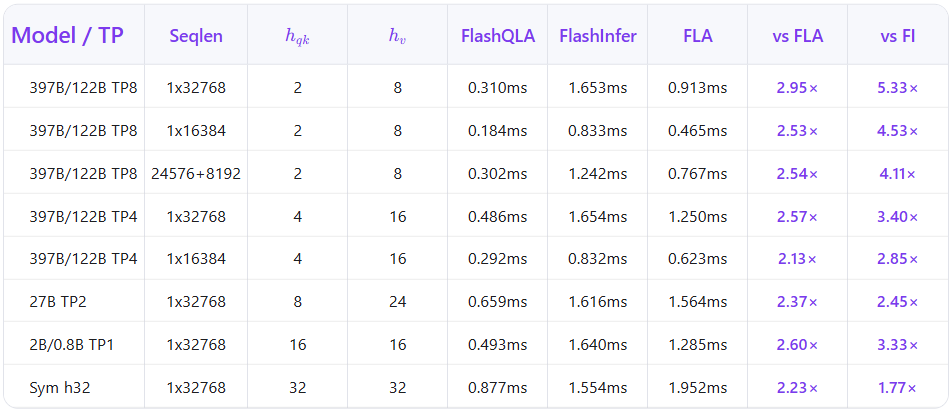
The speedup grows with TP degree because FlashQLA improves SM utilization via intra-card AutoCP in the exact regimes — TP sharding and small head number — where the baseline leaves SMs idle.
FlashQLA exposes both a high-level API matching FLA’s signature and low-level fwd/bwd entry points:
import torch
from qla import chunk_gated_delta_rule

o, final_state = chunk_gated_delta_rule(
    q=q,                            # [B, T, H_q, K]
    k=k,                            # [B, T, H_q, K]
    v=v,                            # [B, T, H_v, V]
    g=g,                            # [B, T, H_v]
    beta=beta,                      # [B, T, H_v]
    scale=scale,
    initial_state=initial_state,    # optional, [B, H_v, K, V]
    output_final_state=True,
    cu_seqlens=cu_seqlens,          # optional, varlen support
)
Requirements: SM90, CUDA 12.8+, PyTorch 2.8+. Install:
git clone https://github.com/QwenLM/FlashQLA.git
cd FlashQLA && pip install -v .FlashQLA is inspired by Flash Linear Attention, FlashInfer and TileLang. We thank these communities for the reference implementations.
If FlashQLA is useful for your research, please cite:
@misc{flashqla2026,
    title  = {FlashQLA: Flash Qwen Linear Attention},
    author = {Zhang, Chengruidong and Lin, Xi and Jiang, Huiqiang and Wang, Zekun and
              Li, Xiao and Cao, Yizhong and Zhuang, Bohan and Men, Rui and Zhang, Jianwei and
              Zheng, Bo and Lin, Junyang and Liu, Dayiheng and Zhou, Jingren},
    year   = {2026},
    publisher = {GitHub},
    howpublished = {\url{https://github.com/QwenLM/FlashQLA}}
}Alibaba Clinches Back-to-Back Spot on TIME100 Most Influential Companies List

1,540 posts | 516 followers
FollowAlibaba Cloud Community - August 27, 2026
Farruh - September 9, 2026
ApsaraDB - May 29, 2025
Alibaba Cloud ECS - June 4, 2020
ApsaraDB - February 4, 2026
Alibaba F(x) Team - June 20, 2022
1,540 posts | 516 followers
Follow QwenWork
QwenWork is dedicated to helping employees strengthen their professional competitiveness in the AI era and to enabling enterprises to improve organizational effectiveness.
Learn More Token Plan
Build more, spend less. One plan, every modality.
Learn More
Alibaba Cloud Model Studio
A one-stop generative AI platform to build intelligent applications that understand your business, based on Qwen model series such as Qwen-Max and other popular models
Learn More Qwen
Qwen
Full-range, open-source, multimodal, and multi-functional
Learn MoreMore Posts by Alibaba Cloud Community

