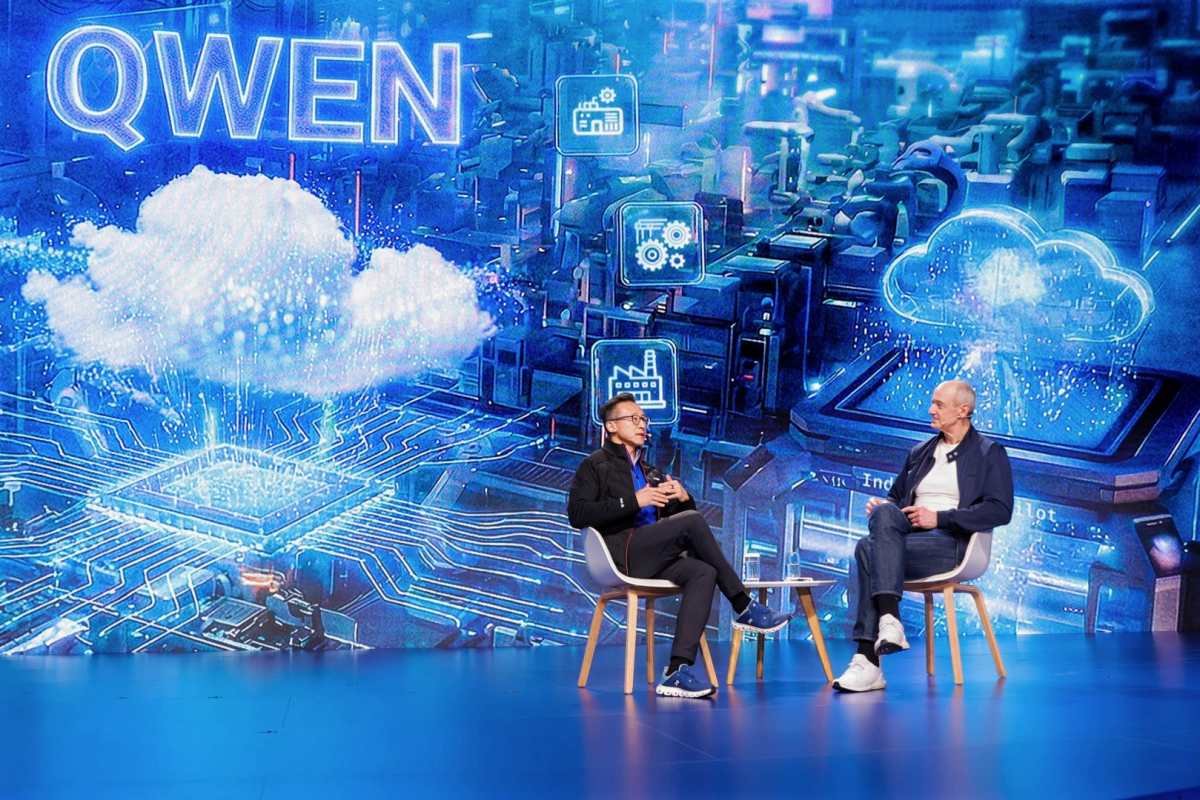
As the agentic era takes hold, Alibaba has rebuilt itself to unlock the vast opportunity for intelligence that executes action. Alibaba Group co-founder and Chairman Joe Tsai outlined the scale of this multi-trillion-dollar market potential at the Siemens RXD Summit in Beijing on Monday.
“Agents are ‘virtual knowledge workers’ that can perform many tasks people do today. When you consider the global economy is $110 trillion, with nearly $50 trillion tied to white-collar knowledge workers, you begin to see the scale of market potential: agents can disrupt or enhance a total addressable market (TAM) bigger than all other industries combined,” Tsai noted.
"Agents can disrupt or enhance a total addressable market (TAM) bigger than all other industries combined"
– Joe Tsai Alibaba Group co-founder and Chairman
At the core of the agentic acceleration is the value metric transition from compute resources to tokens – that is, the unit economics of generated and actioned intelligence. Acting on this conviction, the company recently established the Alibaba Token Hub (ATH) Business Group, structured around a three-layer framework aligned with its core mission of creating, distributing, and applying tokens.
At the application layer, Alibaba deploys tokens in real-world settings to power Wukong, its newly launched enterprise-grade AI-native agent platform. Wukong allows businesses to deploy digital partners able to execute daily workflows, moving AI from ‘thinking partners’ in the form of chatbots, to ‘doing partners’ in the form of agents. On the consumer front, Alibaba’s flagship Qwen App is becoming China’s first all-in-one personal AI assistant for life, work, and learning, with 300 million monthly active users as of February.
Underlying this, Alibaba is also elevating Model-as-a-Service (MaaS) as an organizational priority. As Alibaba Group CEO Eddie Wu noted during the December quarter 2025 earnings call, MaaS is projected to become the largest revenue product within Alibaba’s Cloud Intelligence Group.
As Alibaba turns translates intelligence into action, it is building an AI flywheel in which superior models attract more applications to its MaaS platform, which, in turn, generates data that further strengthens those models.
“The power and quality of these models will attract more customers to our platform,” Joe reiterated Alibaba’s long-term commitment to investing massively to maintain its leadership in foundational models.
The effects of this self-reinforcing flywheel is then implemented by the new ATH business group across Alibaba’s enterprise and consumer ecosystem.
The strong and accelerating momentum is evident in Alibaba Cloud’s performance, which has recorded over RMB100 billion in revenue from external customers in 11 months (through February FY2026). In five years, Alibaba targets to surpass USD 100 billion in this revenue metric, including MaaS.
Alibaba’s success in pairing intelligence with real-world applicability and execution was acknowledged in a recent Citi Research, which stated “the shift from selling resources to selling intelligent capabilities creates ample room for non-linear revenue growth and profitability improvement,” highlighting Alibaba as “one of the best plays for China AI exposure.”
This article was originally published on Alizila written by Alizila Staff.
Friend or Foe? AI: The New Cybersecurity Threat and Solutions

1,546 posts | 518 followers
FollowIain Ferguson - January 21, 2022
Alibaba Cloud Community - June 22, 2026
Alibaba Cloud Community - May 14, 2026
Alibaba Cloud Community - June 26, 2026
Alibaba Cloud Community - April 22, 2026
Alibaba Clouder - July 19, 2019
1,546 posts | 518 followers
Follow Alibaba Cloud Model Studio
A one-stop generative AI platform to build intelligent applications that understand your business, based on Qwen model series such as Qwen-Max and other popular models
Learn More QwenWork
QwenWork is dedicated to helping employees strengthen their professional competitiveness in the AI era and to enabling enterprises to improve organizational effectiveness.
Learn More
Token Plan
Build more, spend less. One plan, every modality.
Learn More Alibaba Cloud for Generative AI
Accelerate innovation with generative AI to create new business success
Learn MoreMore Posts by Alibaba Cloud Community

