As industries accelerate digital transformation, artificial intelligence is rapidly becoming a key driver of innovation across engineering, manufacturing, and product development. According to IDC, global spending on AI solutions is expected to exceed $600 billion by 2028, reflecting strong demand for AI-powered software, infrastructure, and services. At the same time, PwC estimates that AI could contribute up to $15.7 trillion to the global economy by 2030, with industrial sectors expected to benefit significantly from AI-enabled design, simulation, and engineering processes.
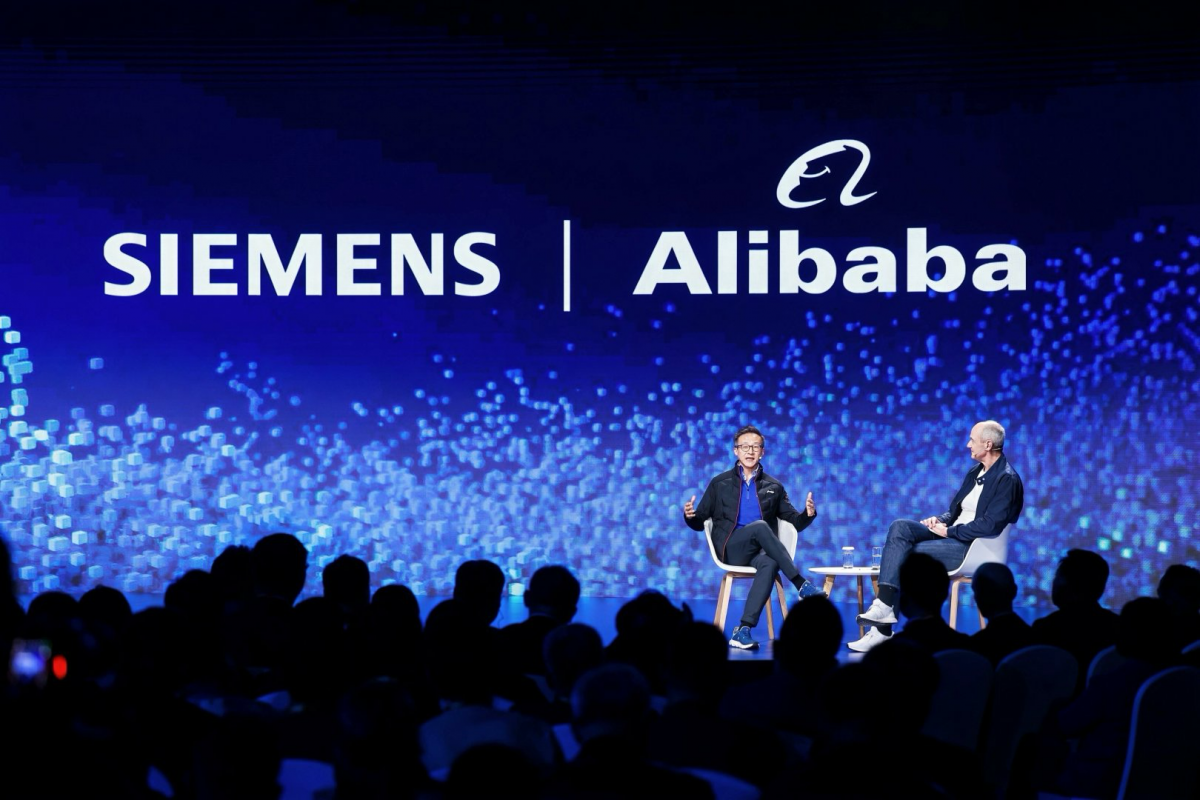
Speaking at the Siemens RXD Summit in Beijing, Joe Tsai, Chairman of Alibaba Group highlighted the rapid evolution of AI and the growing role of cloud infrastructure in enabling enterprise adoption. He noted that advances in large language models and AI agents are transforming how knowledge work is performed, with AI systems increasingly able to plan tasks, reason, and interact with enterprise data. Describing agents as “virtual knowledge workers,” Tsai pointed out that in a global economy of roughly 110 trillion, nearly 50 trillion is tied to white‑collar knowledge work—highlighting the enormous market potential for AI agents to enhance or transform knowledge‑driven industries.
As part of its efforts to make advanced engineering and AI capabilities more accessible, Siemens and Alibaba Cloud announced an expansion of their partnership. Together, the companies are working to provide computer-aided engineering (CAE) capabilities as Infrastructure-as-a-Service (IaaS) for customers in China by combining Siemens’ simulation portfolio with Alibaba Cloud’s advanced computing and trusted cloud infrastructure.
Through this collaboration, Siemens plans to validate and deploy its cloud-enabled CAE solutions on Alibaba Cloud, enabling customers to access scalable simulation environments, including virtual simulation appliances and high-performance computing clusters, delivered through the cloud. This will help engineering teams run complex simulations more efficiently while benefiting from the elasticity and scalability of the Alibaba Cloud infrastructure.
The collaboration also explores how Alibaba’s Qwen large language models could support AI-driven capabilities in Siemens’ product lifecycle management software, opening new possibilities for AI-assisted engineering workflows and intelligent product development.
At the same time, Siemens technologies are helping power the infrastructure behind the AI economy, including large-scale data centers such as Alibaba Clous’s Zhangbei Data Center. To support these critical environments, Siemens introduced new technologies designed for the next generation of AI infrastructure.
This article was originally published on Alizila written by Gabbie Fu.
Alibaba Bets Big on Agentic AI: A Multi-Trillion Dollar Market Opportunity

1,546 posts | 518 followers
FollowAlibaba Clouder - August 7, 2019
Alibaba Clouder - September 21, 2018
Alibaba Cloud Community - September 18, 2024
Alibaba Cloud Community - March 27, 2025
Alibaba Cloud Community - July 12, 2022
Alibaba Clouder - September 28, 2018
1,546 posts | 518 followers
Follow Alibaba Cloud Model Studio
A one-stop generative AI platform to build intelligent applications that understand your business, based on Qwen model series such as Qwen-Max and other popular models
Learn More Qwen
Qwen
Full-range, open-source, multimodal, and multi-functional
Learn More QwenWork
QwenWork is dedicated to helping employees strengthen their professional competitiveness in the AI era and to enabling enterprises to improve organizational effectiveness.
Learn More
Token Plan
Build more, spend less. One plan, every modality.
Learn MoreMore Posts by Alibaba Cloud Community

