Creates an ApsaraDB RDS instance.
Operation description
Applicable engines
RDS MySQL
RDS PostgreSQL
RDS SQL Server
RDS MariaDB
Related feature documentation
Try it now
 Test
Test
RAM authorization
|
Action |
Access level |
Resource type |
Condition key |
Dependent action |
|
rds:CreateDBInstance |
create |
*All Resource
|
|
None |
Request parameters
|
Parameter |
Type |
Required |
Description |
Example |
| RegionId |
string |
Yes |
The region ID. You can call DescribeRegions to query available regions. |
cn-hangzhou |
| Engine |
string |
Yes |
The database engine type. Valid values:
|
MySQL |
| EngineVersion |
string |
Yes |
The database engine version. Valid values:
Note
|
8.0 |
| DBInstanceClass |
string |
Yes |
The instance type. You can specify a standard or YiTian instance type. For more information, see Primary instance types. To create a Serverless instance, use one of the following values:
|
mysql.n2.medium.2c |
| DBInstanceStorage |
integer |
Yes |
Instance storage capacity of the instance, in GB. Instance storage capacity increases in increments of 5 GB. For the valid values, see Instance specifications. |
100 |
| SystemDBCharset |
string |
No |
Deprecated parameter. You do not need to configure this parameter. |
gbk |
| DBInstanceNetType |
string |
Yes |
The network connectivity type of the instance. The value is fixed as Intranet, which indicates an internal network connection. |
Intranet |
| DBInstanceDescription |
string |
No |
The instance name. The name must be 2 to 255 characters in length. It must start with a Chinese character or an English letter, and can contain digits, Chinese characters, English letters, and hyphens (-). Note
The name cannot start with http:// or https://. |
testInstance |
| SecurityIPList |
string |
Yes |
The IP whitelist of the instance. Separate multiple entries with commas (,). Duplicate entries are not allowed. You can add up to 1,000 IP addresses or CIDR blocks per instance. The following formats are supported:
|
10.10.XX.XX/24 |
| ClientToken |
string |
No |
The client token that is used to ensure the idempotence of the request. You can use the client to generate the token, but you must make sure that the token is unique among different requests. The token can contain only ASCII characters and cannot exceed 64 characters in length. |
ETnLKlblzczshOTUbOCz**** |
| PayType |
string |
Yes |
The billing method of the instance. Valid values:
Note
The system automatically generates an order and completes the payment. No manual payment confirmation is required. |
Postpaid |
| ZoneId |
string |
No |
The zone ID of the primary node.
|
cn-hangzhou-b |
| ZoneIdSlave1 |
string |
No |
The zone ID of the secondary node.
|
cn-hangzhou-c |
| ZoneIdSlave2 |
string |
No |
ApsaraDB RDS for MySQL Cluster Edition instances support creating one or two secondary nodes when you create an instance. If you have this requirement, use this parameter to specify the zone of the second secondary node. |
cn-hangzhou-d |
| InstanceNetworkType |
string |
No |
The network type of the instance. Valid values:
Note
|
VPC |
| ConnectionMode |
string |
No |
The access mode of the instance. Valid values:
Default value: assigned by the RDS system. Note
SQL Server 2012, 2016, and 2017 support only the standard access mode. |
Standard |
| VPCId |
string |
No |
The VPC ID. Note
This parameter takes effect only when InstanceNetworkType is set to VPC. |
vpc-**** |
| VSwitchId |
string |
No |
The vSwitch ID.
|
vsw-**** |
| PrivateIpAddress |
string |
No |
The internal IP address of the instance. The IP address must be within the IP address range of the specified vSwitch. The system automatically assigns an internal IP address based on the values of VPCId and vSwitchId by default. |
172.16.XX.XX |
| UsedTime |
string |
No |
The subscription duration. Valid values:
Note
This parameter is required if the billing method is Prepaid. |
2 |
| Period |
string |
No |
Specifies whether the subscription instance is billed on a yearly or monthly basis. Valid values:
Note
This parameter is required if the billing method is Prepaid. |
Year |
| ResourceGroupId |
string |
No |
The resource group ID. |
rg-acfmy**** |
| DBInstanceStorageType |
string |
No |
The storage type of the instance. Valid values:
The default value of this parameter is automatically determined based on the instance type code specified in the DBInstanceClass parameter:
Note
Serverless ApsaraDB RDS instances support only PL1 ESSDs and Premium ESSDs. |
general_essd |
| BusinessInfo |
string |
No |
The business extension parameter. |
121436975448952 |
| EncryptionKey |
string |
No |
The ID of the key used for cloud disk encryption in the same region. Specifying this parameter enables cloud disk encryption (which cannot be disabled after it is enabled) and requires you to also specify RoleARN. You can view the key ID in the Key Management Service console, or create a new key. For more information, see Create a key. Note
|
0d24*****-da7b-4786-b981-9a164dxxxxxx |
| RoleARN |
string |
No |
The Alibaba Resource Name (ARN) of the RAM role that grants the RDS service account access to KMS. You can call the CheckCloudResourceAuthorized operation to retrieve the ARN. Important When you enable cloud disk encryption, you must specify RoleARN. |
acs:ram::1406****:role/aliyunrdsinstanceencryptiondefaultrole |
| AutoRenew |
string |
No |
Specifies whether to enable auto-renewal for the instance. This parameter is valid only when you create a subscription instance. Valid values:
Note
|
true |
| Category |
string |
No |
The instance edition. Valid values:
|
HighAvailability |
| DedicatedHostGroupId |
string |
No |
The ID of the dedicated cluster host group. Required when creating an RDS instance in a dedicated cluster.
|
dhg-4n**** |
| TargetDedicatedHostIdForMaster |
string |
No |
The host ID for the primary instance in a dedicated cluster. Required when creating an RDS instance in a dedicated cluster. If you do not specify this parameter, the system automatically assigns a host.
|
i-bp**** |
| TargetDedicatedHostIdForSlave |
string |
No |
The host ID of the secondary instance in the dedicated cluster. Required when you create an RDS High Availability Edition or RDS Enterprise Edition instance in a dedicated cluster. If you do not specify this parameter, the system automatically assigns a host.
|
i-bp**** |
| TargetDedicatedHostIdForLog |
string |
No |
The ID of the host for the log instance in the dedicated cluster. This parameter is required when you create an RDS Enterprise Edition instance in a dedicated cluster. If you do not specify this parameter, the system automatically assigns a host.
|
i-bp**** |
| DBParamGroupId |
string |
No |
The ID of the parameter template. You can call DescribeParameterGroups to query the parameter template ID. Note
Only MySQL and PostgreSQL support this parameter. If you do not configure this parameter, the system default parameter template is used. You can also create a custom parameter template and specify it here. |
rpg-sys-**** |
| DBTimeZone |
string |
No |
The time zone of the instance. This parameter takes effect only when Engine is set to MySQL or PostgreSQL.
Note
|
+08:00 |
| DBIsIgnoreCase |
string |
No |
Specifies whether table names are case-insensitive. Valid values:
|
true |
| TargetMinorVersion |
string |
No |
The minor engine version of the RDS instance to create. This parameter is required only when you create a MySQL or PostgreSQL instance. Format:
|
rds_20200229 |
| StorageAutoScale |
string |
No |
Specifies whether to enable automatic storage expansion. Only MySQL and PostgreSQL support this parameter. Valid values:
Note
You can also call ModifyDasInstanceConfig to adjust this setting after the instance is created. For more information, see Configure automatic storage expansion. |
Disable |
| StorageThreshold |
integer |
No |
The threshold (percentage) that triggers automatic storage expansion. Valid values:
Note
This parameter is required when StorageAutoScale is set to Enable. |
50 |
| StorageUpperBound |
integer |
No |
The maximum total storage capacity for automatic storage expansion. Automatic storage expansion does not cause the total storage capacity of the instance to exceed this value. Unit: GB. Note
|
2000 |
| DryRun |
boolean |
No |
Specifies whether to perform a dry run for this operation. Valid values:
|
false |
| UserBackupId |
string |
No |
The user backup ID. You can call the ListUserBackupFiles operation to query the ID. If you specify this parameter, an instance is created based on the user backup. If you specify this parameter, the following limits apply:
|
67798**** |
| Amount |
integer |
No |
The number of ApsaraDB RDS for MySQL instances to create. This parameter applies only to batch creation of ApsaraDB RDS for MySQL instances. Valid values: 1 to 20. Default value: 1. Note
|
2 |
| CreateStrategy |
string |
No |
The batch instance creation strategy. This parameter takes effect only when the Amount parameter is greater than 1. Valid values:
|
Atomicity |
| Tag |
array<object> |
No |
The tags. |
|
|
object |
No |
The details of the tags. |
||
| Key |
string |
No |
The tag key. Specifying this parameter binds a tag to the instance.
|
testkey1 |
| Value |
string |
No |
The tag value that corresponds to the tag key. Specify this parameter to attach a tag to the instance.
|
testvalue1 |
| DeletionProtection |
boolean |
No |
Specifies whether to enable the RDS deletion protection feature. This parameter is supported only for pay-as-you-go instances. Valid values:
|
true |
| BabelfishConfig |
string |
No |
The Babelfish for ApsaraDB RDS for PostgreSQL configuration. Configuration format: {"babelfishEnabled":"true","migrationMode":"xxxxxxx","masterUsername":"xxxxxxx","masterUserPassword":"xxxxxxxx"} Parameter description:
Note
This parameter applies only to ApsaraDB RDS for PostgreSQL instances. For more information about Babelfish for ApsaraDB RDS for PostgreSQL, see Introduction to Babelfish. |
{"babelfishEnabled":"true","migrationMode":"single-db","masterUsername":"babelfish_user","masterUserPassword":"Babelfish123!"} |
| ServerlessConfig |
object |
No |
The settings for a serverless ApsaraDB RDS instance. Required when creating a serverless instance. Note
MariaDB does not support serverless instances. |
|
| MaxCapacity |
number |
No |
The maximum value of the automatic scaling range for the instance's RCU (RDS Capacity Unit). Valid values:
Note
The value of this parameter must be greater than or equal to MinCapacity, and only integers are supported. |
8 |
| MinCapacity |
number |
No |
The minimum value of the automatic scaling range for instance RCUs. Valid values:
Note
The value of this parameter must be less than or equal to MaxCapacity. |
0.5 |
| AutoPause |
boolean |
No |
Specifies whether to enable intelligent pause and resume for the serverless instance. Valid values:
Note
This parameter applies only to serverless instances of MySQL and PostgreSQL. If no connections are established within 10 minutes, the instance enters the paused state. The instance automatically resumes when a new connection is initiated. |
true |
| SwitchForce |
boolean |
No |
Specifies whether to enable forced elastic scaling for a serverless instance. Valid values:
Note
|
false |
| ConnectionString |
string |
No |
The internal endpoint of the database. The endpoint format is |
rm-uf6wjk5****.mysql.rds.aliyuncs.com |
| Port |
string |
No |
Specifies the port to initialize when creating an RDS instance. Valid values:
|
3306 |
| BurstingEnabled |
boolean |
No |
Deprecated parameter. You do not need to configure this parameter. |
0 |
| AutoPay |
boolean |
No |
Specifies whether to enable the I/O performance burst feature for Premium ESSDs. Valid values:
Note
For more information about the I/O performance burst feature for Premium ESSDs, see What is a Premium ESSD. |
false |
| IoAccelerationEnabled |
string |
No |
Specifies whether to enable automatic payment. Valid values:
Note
Default value: true. If your payment method has insufficient balance, set AutoPay to false. This generates an unpaid order that you can pay for in the ApsaraDB RDS console. |
true |
| ColdDataEnabled |
boolean |
No |
Specifies whether to enable the Buffer Pool Extension (BPE) feature for Premium ESSDs. Valid values:
|
0 |
| WhitelistTemplateList |
string |
No |
Specifies whether to enable the data archiving feature for Premium ESSDs. Valid values:
|
false |
| AutoCreateProxy |
boolean |
No |
The whitelist. When you need to configure multiple IP addresses, separate them with commas. Do not add spaces before or after the commas. Example: |
192.168.0.1,172.16.213.9 |
| AutoUseCoupon |
boolean |
No |
Specifies whether to automatically create a proxy. Valid values:
|
false |
| PromotionCode |
string |
No |
Specifies whether to use a coupon. Valid values:
Note
If you use a coupon and then perform a downgrade, the amount deducted by the coupon will not be refunded. |
true |
| OptimizedWrites |
string |
No |
The coupon code. |
aliwood-1688-mobile-promotion |
| ExternalReplication |
boolean |
No |
The switch for the 16KB atomic write feature. Valid values:
|
optimized |
| CustomExtraInfo |
string |
No |
Specifies whether to enable RDS MySQL native replication. Valid values:
|
ON |
|
No |
Response elements
|
Element |
Type |
Description |
Example |
|
object |
The response parameters. |
||
| DryRunResult |
boolean |
Indicates whether the dry run for instance creation passed. Valid values:
Note
|
true |
| TagResult |
boolean |
Indicates whether the tag is successfully bound to the instance. Valid values:
Note
This parameter is not returned if no tag is bound to the instance. |
true |
| RequestId |
string |
The request ID. |
1E43AAE0-BEE8-43DA-860D-EAF2AA0724DC |
| ConnectionString |
string |
The internal endpoint of the instance. |
rm-uf6wjk5****.mysql.rds.aliyuncs.com |
| Message |
string |
The prompt information of the batch creation task. |
Batch Create DBInstance Task Is In Process. |
| DBInstanceId |
string |
The instance ID. If you set the Amount parameter to a value greater than 1, the number of instance IDs that corresponds to the value is returned, separated by commas. For example, if Amount is set to 3, three instance IDs are returned. Example:
|
rm-uf6wjk5**** |
| Port |
string |
The port number of the internal endpoint of the instance. |
3306 |
| TaskId |
string |
The task ID for batch creation.
|
s2365879-a9d0-55af-fgae-f2**** |
| DryRun |
boolean |
Indicates that a dry run is performed before the instance is created.
|
true |
| OrderId |
string |
The order ID. |
1007893702**** |
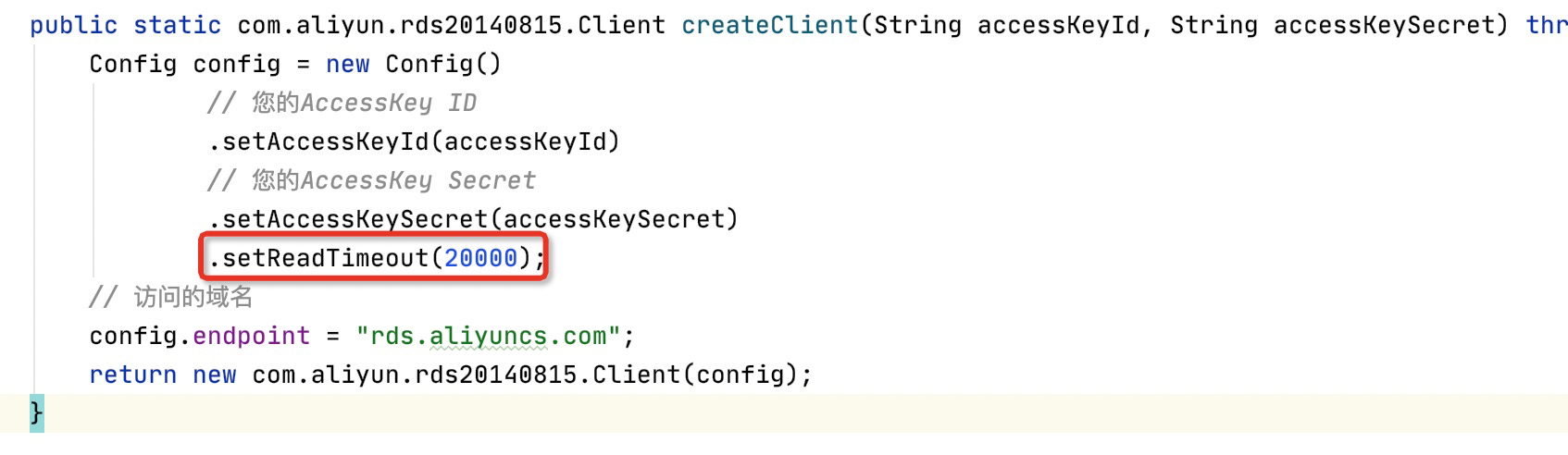
When you call this operation using the new SDK, a request timeout error may occur because the default client timeout in the SDK differs from the server-side timeout. The operation is actually called successfully in this case. To avoid this issue, set the ReadTimeout parameter to 20000 before making the call.
Examples
Success response
JSON format
{
  "DryRunResult": true,
  "TagResult": true,
  "RequestId": "1E43AAE0-BEE8-43DA-860D-EAF2AA0724DC",
  "ConnectionString": "rm-uf6wjk5****.mysql.rds.aliyuncs.com",
  "Message": "Batch Create DBInstance Task Is In Process.",
  "DBInstanceId": "rm-uf6wjk5****",
  "Port": "3306",
  "TaskId": "s2365879-a9d0-55af-fgae-f2****",
  "DryRun": true,
  "OrderId": "1007893702****"
}
Error codes
|
HTTP status code |
Error code |
Error message |
Description |
|---|---|---|---|
| 400 | Invalid.ParamGroupDBVersion | %s.%s | |
| 400 | InvalidInstanceLevel.DiskType | Specified instance level not support request disk type | The current instance type does not support the specified storage type. |
| 400 | RR309 | We have detected a security risk with your payment method. Please proceed with verification via the link in your email or console message and re-submit your order after verification. | A security risk was detected in the default payment method. Please verify your payment method before placing your order. A verification link will be sent to you via email and internal message. |
| 400 | InvalidZoneId.NotSupported | The Specified vpc Zone not supported. | VPC-hosted RDS instances cannot be created in the zone. Specify a different zone. |
| 400 | InvalidZone.NotSupportedForStorageType | The specified zone is closed or invalid for Specified DBInstanceStorageType. | The specified region is closed or invalid for the specified DBInstanceStorageType. |
| 400 | InvalidNetworkTypeClassicWhenCloudStorage | The Specified InstanceNetworkType value Classic is not valid when choose cloud storage type. | When selecting a cloud storage type, specifying a InstanceNetworkType value of Classic is not valid. |
| 400 | InvalidZone.NotSupported | The Specified Zone not supported. | The zone is invalid. |
| 400 | InvalidEssdStorageSize | invalid cloud essd storage size. | The storage size of cloud disks is invalid. Check the storage size. |
| 400 | InvalidParameter | Some Reuquest Parameters Is Invalid. Check or Try It Again Later. | |
| 400 | Pay.AmountLimitExceeded | Pay amount limit exceeded. | |
| 400 | IncompleteAccountInfo | Your information is incomplete. Complete your information before the operation. | The operation failed. Items that are marked with an asterisk (*) in the account information must be specified. Make sure that you specify these items on the Basic Information page in Account Center. |
| 400 | IncompleteTaxInfo | Your tax information is incomplete. Complete your information before the operation. | The operation failed. Your tax information is incomplete. Complete your tax information. |
| 400 | InvalidPaymentMethod.Incomplete | No payment method is specified for your account. We recommend that you add a payment method. | No valid payment method is specified for your Alibaba Cloud account. Add a valid payment method. |
| 400 | InvalidPaymentMethod.Missing | No payment method is specified for your account. We recommend that you add a payment method. | No valid payment method is specified for your Alibaba Cloud account. Add a valid payment method. |
| 400 | InsuffcientBalanceOrBankAccount | Add a payment method or add funds to the prepayment balance. Get started by creating an instance. | No valid payment method is specified within your Alibaba Cloud account. Add a valid payment method or add funds to your Alibaba Cloud account. |
| 400 | InvalidPaymentMethod.NoAccess | No payment method is specified for your account. We recommend that you add a payment method. | |
| 400 | InvalidPaymentMethod.InsufficientBalance | No payment method is specified for your account. We recommend that you add a payment method or add funds to the prepayment balance. | |
| 400 | Pay.LowFunds | The balance of the advance payment is insufficient or there is no balance of the advance payment. | |
| 400 | Pay.ChargeChannelNotFound | Failure to obtain the first external payment channel if the advance balance is insufficient. | |
| 400 | VswitchIpExhausted | Vswitch IP exhausted. | The operation failed. No vSwitch IP addresses are available. |
| 400 | InvalidPrivateIpAddress.AlreadyUsed | The specified IP is already used. | The IP address has been used. |
| 400 | InvalidEcsImage.NotFound | Sepcified ecs image does not exist | |
| 400 | InvalidMinorVersion.NotFound | Sepcified minor version does not exists. | |
| 400 | InvalidConcurrentOperate | Concurrent operation is detected. | Concurrent operations exist. Wait until the previous operation is complete and try again. |
| 400 | ZoneId.NotMatchWithCategory | The number of ZoneId specified does not match with category. | The number of zones is not supported for the database engine or the RDS edition of the RDS instance. Modify the zone settings. |
| 400 | InvalidSecurityIPList.Format | The specified parameter securityIPList is not valid. | The format of the IP address whitelist does not meet the requirements. Check the IP address whitelist. |
| 400 | InvalidDBParamGroupId.Format | The specified parameter dbParamGroupId is not valid. | |
| 400 | InvalidTargetMinorVersion.Format | The specified parameter targetMinorVersion is not valid. | |
| 400 | InvalidDedicatedHostGroupId.Format | The specified parameter dedicatedHostGroupId is not valid. | |
| 400 | InvalidDBInstanceClass.Malformed | The specified parameter DBInstanceClass is not valid. | |
| 400 | InvalidEngineVersion.Malformed | The specified parameter EngineVersion is not valid. | The database engine version is invalid. Check the database engine version and try again. |
| 400 | CreditPayInsufficientBalance | Insufficient credit pay limit. Please contact your channel partner to increase the limit. | The quota runs out. Contact your customer service representatives to increase the quota. |
| 400 | InvalidTagKey.Malformed | The Tag.N.Key parameter is empty. | The Tag.N.Key parameter is left unspecified. |
| 400 | InvalidTagValue.Malformed | The Tag.N.Value parameter is empty. | The Tag.N.Value parameter is left unspecified. |
| 400 | Duplicate.TagKey | The Tag.N.Key contains duplicate keys. | The values of two Tag.N.Key parameters are duplicate. |
| 400 | NumberExceed.Tags | The maximum number of Tags is exceeded. The maximum is 20. | The number of tags exceeds 20. |
| 400 | MissingParameter.ResourceIds | The parameter ResourceIds.N must not be null. | The ResourceIds.N parameter cannot be empty. |
| 400 | InvalidParameter.TagKey | The Tag.N.Key parameter is invalid. | The value of the Tag.N.Key parameter is invalid. |
| 400 | InvalidParameter.TagValue | The Tag.N.Value parameter is invalid. | The Tag.N.Value parameter is invalid. |
| 400 | NoPermission.SystemTag | You have no permission to use system tags. | You have no permission to use the system tag. |
| 400 | InvalidParam.Amount | Amount is allowed from 1 to 20. | Amount is allowed from 1 to 20. |
| 400 | InvalidParam.CreateStrategy | Only Atomicity and Partial are allowed. | Only the Atomicity and Partial parameters are supported. |
| 400 | InvalidParam.Engine | Only MySQL is allowed when Amount > 1. | |
| 400 | InvalidMultiZoneInfoList | The Specified Zone Info List is Invaild. | |
| 400 | InvalidKmsConfigStatus | The Kms Service Config is Invalid. | |
| 400 | InvalidConnectionString.Duplicate | Specified connection string already exists in the Aliyun RDS. | |
| 400 | InvalidPort.Malformed | Specified port is not valid. | The port number is invalid. |
| 400 | InvalidUsedTime | UsedTime can not Less than or equal to zero. | The value of the UsedTime parameter must be greater than 0. |
| 400 | Kms.Unauthorized | KMS has not been authorized. | KMS is not authorized. |
| 400 | InvalidDBInstanceClass.Offline | The specified instance type is no longer provided. Please specify another instance type. | The instance type that you select is no longer available. Select another instance type. |
| 400 | SystemParamGroupCode.Format | Specific DBParamGroupId is not valid. | The DBParamGroupId parameter specified for creation is invalid. |
| 400 | InvalidDBInstanceName.Duplicate | Specified DB instance name already exists in the Aliyun RDS. | The operation failed. The instance name already exists. Specify a different name and try again. |
| 400 | ServiceLinkedRole.NotExist | Service linked role for RDS PostgreSQL not exist. | Create the AliyunServiceRoleForRdsPgsqlOnEcs role for ApsaraDB RDS for PostgreSQL. |
| 400 | CommodityServiceCalling.Exception | Failed to call commodity service. | Failed to call commodity service return. |
| 400 | Commodity.InvalidComponent | The module you purchased is not legal, please buy it again. | The module you purchased is not legal, please buy it again. |
| 400 | Pay.InsufficientBalance | Insufficient available balance. | Insufficient available balance. |
| 400 | Price.CommoditySys | Commodity system call exception. | Commodity system call exception. |
| 400 | RegionEndTimeDissolvedAustralia | Cloud services in the Australia (Sydney) region will be discontinued. Set the validity date to September 30, 2024 or earlier than September 30, 2024. | Hello customer, this area has been abolished. |
| 400 | RegionEndTimeDissolvedIndia | Cloud services in the India (Mumbai) region will be discontinued. Set the validity date to July 15, 2024 or earlier than July 15, 2024. | Hello customer, this area has been abolished. |
| 400 | InvalidPrivateIpAddress.Format | The specified private IP address format is incorrect. | The specified IP address is not in the correct format. |
| 400 | InvalidPrivateIpAddress.Mismatch | Specified private IP address is not in the CIDR block of virtual switch. | The VPC endpoint is invalid. |
| 400 | TooManyWhitelistTemplateIds | create dbinstance can support attach to up to 10 whitelist templates. | Excessive number of incoming whitelist templates! You can associate up to 10 whitelist templates. |
| 400 | UnsupportExtendDisk.NotSupport | Specified DB instance is unsupport extend disk. | Disk expansion is not supported on the specified instance. |
| 400 | InvalidWhitelistTemplateId | the template id list is invalid. | The ID of the specified whitelist template is incorrect. Check the setting. |
| 400 | InvalidRequestId | The request is copy, check your token. | The request is copy, check your token. |
| 400 | InvalidParameter.MinCapacity | The specified parameter 'MinCapacity' is not valid. | The specified parameter 'MinCapacity' is not valid. |
| 400 | UnsupportedClassCode | The specified DB instance class stops selling. | The specified DB instance class stops selling. |
| 400 | InvalidParameter.NotSupportDBInstanceStorageType | Parameter DBInstanceStorageType is invalid. | Invalid DBInstanceStorageType parameter |
| 400 | InvalidParam.InstanceNetworkType | Creation of classic network instances is not supported. | Classic network offline, does not support the creation of classic network instances! |
| 400 | InvalidOrder.NotFound | Specified order does not exist in RDS. | The specified order does not exist in RDS. |
| 400 | InvalidVSwitchId.Format | The specified vswitch Id format is incorrect. | The specified vSwitch ID is in an incorrect format. |
| 400 | Order.ComboInstanceNotAllowOperate | A package instance is not allowed to operate independently. | A package instance is not allowed to operate independently. |
| 400 | Price.PricingPlanResultNotFound | Pricing plan price result not found. | Pricing plan price result not found. |
| 400 | Order.NoRealNameAuthentication | You have not passed the real-name authentication and do not meet the purchase conditions. Please log in to the user center for real-name authentication. | You have not passed the real-name authentication and do not meet the purchase conditions. Please log in to the cost and cost for real-name authentication. |
| 400 | InsufficientAvailableQuota | Your account quota limit is less than 0, please recharge before trying to purchase. | Your account available limit is less than 0, please recharge before trying to purchase. |
| 400 | RegionDissolvedEOM | Dear customer, Alibaba Cloud plans to optimize and adjust the current region. Cloud services in this region will cease operations. You are currently unable to operate new purchase orders. Thank you for your understanding and support. | Hello, Alibaba Cloud plans to optimize and adjust the current region. Cloud services in this region will stop operating. In order to ensure your business continuity and smooth transition of data migration, you are currently unable to operate new purchase orders. Thank you for your understanding and support. |
| 400 | Order.PeriodInvalid | There is a problem with the period you selected, please choose again. | There is a problem with the period you selected, please choose again. |
| 400 | pay.noCreditCard | Account not bound to credit card. | No credit card is available. |
| 400 | Order.InstHasUnpaidOrder | There is an unpaid order for the service you have purchased. Please pay or void it before placing the order. | There is an unpaid order for the service you have purchased. Please pay or void it before placing the order. |
| 400 | BasicInfoUncompleted | Your information is incomplete. Complete your information before the operation. | Your basic information is not complete, please complete your basic information before operation. |
| 400 | Risk.RiskControlRejection | Your account is abnormal, please contact customer service for details. | Your account is abnormal, please contact customer service for details. |
| 400 | Api.NotSupport | Specified api is not supported. | The current interface does not support. |
| 400 | ContainForbiddenLabelError | There is a label that prohibits placing orders. Please contact your distributor for assistance. | You cannot place the order because a tag indicates that order placement is prohibited. Contact your distributor. |
| 400 | InvalidDBInstanceId.NotFound | The DBInstanceId provided does not exist in records. | The DBInstanceId provided does not exist. |
| 400 | InvalidParam | Sepcified wal level Parameter is invalid. There are still logical slots in instance, so it can not be set as replica. | The specified wal_level parameter is invalid. There is still a copy slot in the instance, so it cannot be set to replica. |
| 400 | System.SaleValidateFailed | Sales expression validation system error. | A system error occurs when the sales expression is verified. |
| 400 | Abs.InvalidAccount.NotFound | account is not found. | The account does not exist. |
| 400 | SqlExecuteFailedOrTimeout | sql command execution failed or timed out:%s. | SQL command execution failed or timed out |
| 400 | ColdData.EngineVersionNotSupport | The current instance engine version not support coldDataEnabled. | The current instance engine version not support coldDataEnabled. |
| 400 | ColdData.MinorVersionNotSupport | The current instance minor version not support coldDataEnabled. | The current instance minor version not support coldDataEnabled. |
| 400 | IncorrectTargetClasscode | The current instance type does not support this operation. | This operation is not supported by the instance type. |
| 400 | RequiredParam.NotFound | Required input param is not found. | Required parameters are missing. |
| 400 | Parameters.Invalid | Parameter error, please check the parameters. | Parameter error, please check the parameters. |
| 400 | BackupPolicyNotSupport | Cold Data won't open with CrossBackup or Flash Backup, please check Backup Policy. | Cold Data won't open with CrossBackup or Flash Backup, please check Backup Policy. |
| 400 | InvalideStatus.Format | The instance status does not support this operation. | The instance status does not support this operation. |
| 400 | InvalidReleasedKeepPolicy.Format | Specified Released Keep Policy is not valid. | Specified Released Keep Policy is not valid. |
| 400 | InvalidDBInstanceEngineType.Format | the DB instance engine type does not support this operation. | This operation is not supported for the database engine of the instance. |
| 400 | Pay.NoCreditCard | No credit cards. | No credit cards. |
| 400 | VpcNetworkTypeNotSupport | The vpc network type instance does not support this operation. | The vpc network type instance does not support this operation. |
| 400 | MirrorInsExists | Specified DB instance mirror ins already existed. | Specified DB instance mirror ins already existed. |
| 400 | InvalidBackupSet | The specified database does not exist in the backup set. | The specified database does not exist in the backup set. |
| 400 | OrdTCommodityQueryError | Failed to query for product. | Failed to query product. |
| 400 | ProductInstanceReleased | The instance has been released. Please check before placing the order. | The instance has been released, please verify and place an order. |
| 400 | IncorrectTargetCategory | Current target category does not support this operation. | Current target category does not support this operation. |
| 400 | PurchaseDurationInsufficient | The purchase duration does not meet the requirements, please choose again. | The purchase duration does not meet the requirements, please select again. |
| 400 | NotFound.ParamGroupId | Current ParamGroupId not found. | The parameter template does not exist. |
| 400 | InvalidParamForXfs | Xfs instance must be single tenant standard instance. | Xfs instance must be single tenant standard instance. |
| 400 | UnsupportedColdData | Current coldDataEnabled parameter can not support. | The specified region does not support cold storage. |
| 400 | AtLeastThreeVSwitchAvailableIp | The primary vswitch requires at least three available IP addresses. | The master switch requires at least 3 available IPs. |
| 400 | AtLeastTwoVSwitchAvailableIp | The primary vswitch requires at least two available IP addresses. | The master switch requires at least 2 available IPs. |
| 400 | DuckDBOperationConflictBetweenPrimaryAndReadOnlyInstance | Current instance is already attached to another duckdb instance, operation is conflict. | The current instance is already associated with another DUCKDB instance, which conflicts with the current DUCKDB operation. |
| 400 | AtLeastTwoVSwitchParamExists | The specified params(Vswitchs) at least two. | At least two Vswitchs parameters must be specified. Each Vswitchs parameter specifies a vSwitch in a zone. |
| 400 | InvalidVPCId.NotFound | Specified virtual vpc is not found. | The VPC ID cannot be found. Check the VPC ID. |
| 400 | InvalidDefaultVSwitch.NotFound | InvalidDefaultVSwitch.NotFound | The operation failed. The vSwitch cannot be found in the VPC. |
| 400 | InvalidVSwitchId.Mismatch | Specified instance and virtual switch are not in the same zone. | The RDS instance and the vSwitch are not in the same zone. |
| 400 | InvalidVpcIdOrVswitchId.NotSupported | The specified vpcId or vSwitchId is not supported. | The VPC that is specified by the vpcId parameter or the vSwitch that is specified by the vSwitchId parameter is not supported. Check the values of these parameters. |
| 401 | CannotDecreaseEssdPerfLevel | cannot decrease cloud essd performance level. | |
| 500 | ExternalFailure | The request processing has failed due to external service failure. | The request processing has failed due to external service failure. |
| 500 | RequestMetaDataFailed | The service request failed. Please try again later or contact service personnel. | The service request failed. Please try again later or contact service personnel. |
| 500 | InvokeProxyFailure | The request processing has failed due to service failure of rds api. | The request failed to be processed due to an RDS API failure. |
| 403 | ByokRoleArnNotFound | The roleArn can not be null. | The roleArn can not be null. |
| 403 | RISK.RISK_CONTROL_REJECTION | Risk control rejection. | |
| 403 | AliCroup2CloudUserCannotBuyNotInnerCommodity | There is no group cloud commodity label, and users within the group are not allowed to purchase. | The product does not have the group cloud migration tag. Internal group users are not allowed to purchase this product. |
| 403 | GroupReplicationNotSupport.InvalidEngineVersion | Group Replication requires the instance engine version to be 8.0. | The instance database version is not MySQL 8.0. MySQL Group Replication is not supported. |
| 403 | GroupReplicationNotSupport.InvalidNodeClassCode | Group Replication requires the ClassCode of each node to be consistent. | The specifications of the instance nodes are inconsistent. MySQL Group Replication is not supported. |
| 403 | GroupReplicationNotSupport.InvalidNodeNum | Group Replication is not supported, the number of nodes must be an odd number greater than or equal to 3. | The number of instance nodes is not an odd number greater than or equal to 3. MySQL Group Replication is not supported. |
| 403 | GroupReplicationNotSupport.InvalidXengine | Group Replication is not supported because the instance has xengine tables. | The instance contains tables that use the X-Engine storage engine. MySQL Group Replication is not supported. |
| 403 | GroupReplicationNotSupport.MemoryTooSmall | Group Replication is not supported because the memory is too small. | The instance specification has insufficient memory. MySQL Group Replication is not supported. |
| 403 | IncorrectMinorVersion | Current engine minor version does not support operations. | This operation is not supported for the current minor engine version. |
| 403 | CloudDiskEncryptionNotSupport | The encryption key is not allowed for general-purpose instance. | Universal instances do not support cloud disk encryption. |
| 403 | CloudSSDNotSupport | Cloud ssd does not support this operation, please upgrade to essd. | SSD disks do not support this operation. Upgrade to ESSD. |
| 403 | InvalidVswitchId | Specified conn vswitch id is not valid. | The specified VSwitchId is in an incorrect format or is empty. |
| 403 | BasicCategoryNotSupport | The Basic category is not supported. | Basic series not supported |
| 403 | OrderStatus.UnPaid | The specified db instance has unpaid order. | The instance has an unpaid order. Please pay first and try again. |
| 403 | InvalidReduceDiskSize | The storage capacity after the scale-down must be larger than the used amount. | The scale-in target capacity cannot be less than the current storage space usage |
| 403 | InvalidUserOperatorPermission | The user permission does not support this operation. | The user is not authorized to perform this operation. |
| 403 | OperationDenied.ZoneResource | There is no available zone for inventory. | There is no available zone for inventory. |
| 403 | NotInFlowController | Sorry,no permission. | Sorry,no permission. |
| 403 | InvalidKmsKey | Kms key is disabled. | The KMS key is disabled. |
| 403 | InvalidInstanceLevel.Malformed | Current DB instance level does not support this operation. | The specified database instance type does not support this operation. |
| 403 | IncorrectCharacterType | Current DB instance character type does not support this operation. | This operation is not supported for the character type of the instance. |
| 403 | GuardDBInstanceExists | Current DB instance had guard instance. | The current database instance already has a disaster recovery instance. |
| 404 | InsufficientResourceCapacity | The target availability zone does not have sufficient resources. | The target Availability Zone does not have enough resources. |
| 404 | InvalidClusterKms | The current instance does not authorized to access the Key Management Service. | The instance does not have permissions to access Key Management Service (KMS). |
| 404 | Request.NotFound | The requested resource is not available. | The requested resources are unavailable. |
| 404 | HostInfo.NotFound | The specified host info is not found. | The specified host information does not exist. |
See Error Codes for a complete list.
Release notes
See Release Notes for a complete list.