PolarDB is a cloud-native relational database by Alibaba Cloud with a compute-storage decoupled architecture. PolarDB is 100% compatible with MySQL and PostgreSQL, highly compatible with Oracle syntax, and supports centralized and distributed deployments. Compared with self-managed databases, PolarDB delivers up to 6x transactional and 400x analytical performance of open source databases at 50% of the total cost of ownership (TCO).
Choose the PolarDB database engine that best suits your application while maintaining full ecosystem compatibility.
|
PolarDB database |
Ecosystem compatibility |
Service architecture |
Product form |
|
100% compatible with MySQL |
Shared storage, compute-storage decoupled |
Public cloud, Apsara Stack Enterprise, DBStack |
|
|
100% compatible with PostgreSQL, highly compatible with Oracle syntax |
|||
|
Shared-nothing, integrated centralized and distributed architecture |
Benefits
|
Ecosystem compatibility
|
High performance
|
High availability
|
|
Mass storage
|
Easy to scale
|
Security
|
Service architecture
PolarDB for MySQL
PolarDB for MySQL uses a cloud-native, compute-storage decoupled architecture that combines commercial-grade stability and performance with open source simplicity. It delivers second-level elasticity, high availability, and mass storage.
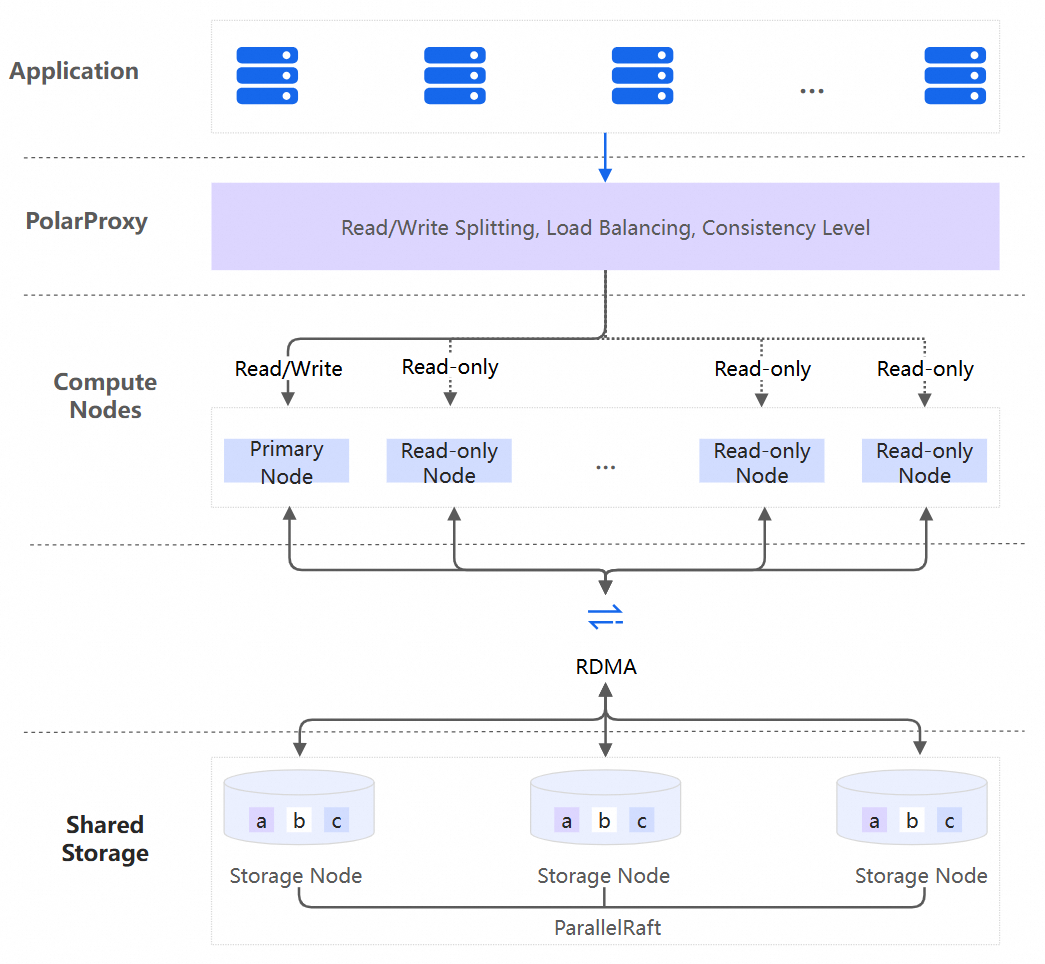
-
Database proxy (Proxy)
A network proxy between the database and your application that forwards all requests. Provides security authentication, automatic read/write splitting, load balancing, consistency levels, connection pooling, persistent connections, and overload protection.
-
Database compute nodes
-
PolarDB uses a multi-node cluster architecture. Cluster Edition provides one read/write node and multiple read-only nodes. Multi-master Clusters have multiple read/write nodes and multiple read-only nodes.
-
Active-active failover between read/write and read-only nodes ensures high availability.
-
Compute nodes host the SQL engine and come in General-purpose and Dedicated specifications.
-
-
Shared distributed storage
All compute nodes share a single data copy, reducing storage costs. Built on distributed block storage, capacity scales online up to hundreds of terabytes without single-server limits.
PolarDB for PostgreSQL
PolarDB for PostgreSQL clusters support both centralized and distributed forms:
-
Centralized
Uses a cloud-native, compute-storage decoupled architecture that combines commercial-grade stability and performance with open source simplicity. Delivers second-level elasticity, high availability, and mass storage.
-
Distributed
A distributed database built on centralized PolarDB for PostgreSQL. Uses a two-layer CN/DN architecture for distributed scalability with compute-storage decoupling. Retains all centralized cluster features for diverse enterprise workloads.
|
Centralized (Enterprise Edition and Standard Edition)
|
Distributed
|

PolarDB for Xscale
PolarDB for Xscale starts with centralized DNs fully compatible with standalone MySQL 5.7 and 8.0. When growth demands it, the architecture upgrades in-place to distributed mode — distributed components connect to existing DNs without data migration or application changes.
|
Centralized (Standard Edition)
|
Distributed (Enterprise Edition)
|


Videos
How to use PolarDB
Manage PolarDB clusters — create clusters, databases, and accounts — through:
Quick guide
|
PolarDB database |
Billing |
User Guide |
Whitepapers |