This topic provides an overview of the GanosBase spatio-temporal engine, including its feature framework and advantages.
Overview
GanosBase is a next-generation spatio-temporal database engine independently developed by Alibaba Cloud. It integrates spatio-temporal data processing capabilities into the cloud-native relational database PolarDB, providing integrated storage, querying, analysis, and rendering for new-generation multi-modal spatio-temporal data. GanosBase is named after the combination of Gaea (the goddess of earth) and Chronos (the god of time), representing the deep integration of space and time. It is pronounced as ['gænəs].
Spatial data and spatio-temporal data
Spatial data is used to represent the position, shape, distribution, and other spatial characteristics of objects in a defined space, as well as related information. It describes things and phenomena in the real world that have geographic significance. In a database context, a typical example is recording all schools in a city, with each school stored as a row. The spatial outline of each school (typically a polygon with spatial reference information) is stored in a Geometry column specific to spatio-temporal databases, while other columns record attributes such as the school name, area, and founding date. Spatial data can be further categorized into geometric spatial data, raster spatial data, and grid spatial data based on different modal structures, and the appropriate type should be selected based on the application scenario.
Spatio-temporal data extends spatial data by incorporating the temporal dimension, capturing how objects and phenomena change over time. Moving object data — such as trajectories of people, vehicles, ships, and aircraft — is the most typical spatio-temporal data. This type of data requires recording a series of spatio-temporal positions (longitude/latitude coordinates + time) traversed by a moving object, along with attribute or monitoring information associated with each position. For example, trip records for shared bicycles can be stored as rows, with each trip's trajectory stored in a Trajectory column, and monitoring metrics such as speed and direction recorded at each trajectory point.
In a broad sense, spatio-temporal data is a superset of spatial data. In this documentation, spatial data is collectively referred to as spatio-temporal data, and GanosBase is collectively named the spatio-temporal database engine.
Challenges in spatio-temporal data management

GanosBaseproblems solved by GanosBase
GanosBase provides integrated expression, storage, querying, analysis, and rendering capabilities for new-generation multi-modal spatio-temporal data, addressing the challenges of complex workflows, high entry barriers, and low application efficiency that have long plagued spatio-temporal big data. It is widely applicable to urban management, transportation and logistics, ride sharing, natural resources, aerospace, IoT, and other fields.
Pricing
Currently, PolarDB for PostgreSQL includes the GanosBase component free of charge.
Feature framework
GanosBase provides integrated expression, storage, querying, analysis, and rendering capabilities for new-generation multi-modal spatio-temporal data.
Core components
Geometry engine
The geometry engine provides storage and computation for vector data such as points, lines, planes, and volumes. It supports data ingestion from multiple geometric data source formats including SHP, GeoJSON, WKB, and WKT. The GanosBase geometry engine is fully compatible with PostGIS function interfaces and has unique advantages in spatial data caching, spatial indexing, and spatial parallel computation. Large-scale vector data query and analysis performance improves by more than 5 times.

Raster engine
The raster engine provides storage and computation for remote sensing images, digital elevation models (DEMs), and grid data. It supports multiple raster data source formats including Tiff, HDF4, HDF5, GRIB, and NetCDF. The GanosBase raster engine provides object-oriented storage, with a single row capable of storing objects larger than 1 TB. It also supports OSS-based raster data lake scaling and provides various fundamental operators including raster spatial relationship identification, raster pyramids, raster statistics, raster attributes, raster image processing, and raster algebra, as well as business algorithms such as color balancing, mosaic, DEM algorithms, and D8 catchment algorithms. It has clear advantages in large-scale raster data storage and computation scenarios.

Moving object engine
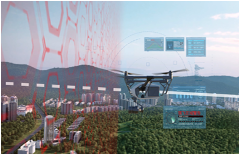
The moving object engine provides storage and computation for moving object data such as trajectories of people, vehicles, ships, and aircraft. The GanosBase moving object engine provides native storage, indexing, and segmentation optimization for 4D trajectories (2D/3D space + time). It supports adding custom attributes to each trajectory point, defining spatio-temporal events, efficient compression and resampling of tens of billions of trajectory points, and various database-native spatio-temporal operators including trajectory segmentation, stay-point detection, trajectory similarity, and spatio-temporal relationship identification.
GeomGrid engine
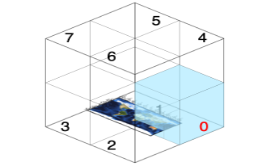
The GeomGrid engine provides spatial grid construction and coding/query capabilities for 2D and 3D spatial objects. The GanosBase GeomGrid engine supports multiple meshing rules including GeoSOT and H3, spatial object coding, bidirectional lookups between objects and codes, grid-based aggregation and analysis, and grid degeneration.
Surface model engine
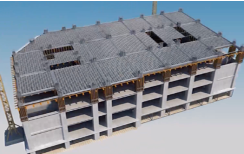
The surface model engine provides storage and computation for semantic 3D data described by surface meshes. The GanosBase surface model engine can process building information modeling (BIM) data, deconstruct and structure models based on semantics, support complex 3D spatial analysis and large-scale federated retrieval, and provide model simplification algorithms that interface with mainstream front-end 3D rendering engines.
Volume model engine
The volume model engine provides storage and computation for anisotropic data characterized by non-homogeneous volume meshes. The GanosBase volume model engine can process complex geological body data, supports grid truncation at sequence boundaries, business interpolation algorithms, complex spatial analysis, large-scale federated retrieval, and model simplification algorithms that interface with mainstream front-end 3D rendering engines.
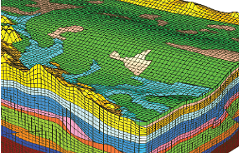
The volume model engine is currently in the invitational preview phase. To use it, Contact us.
Scene model engine
The scene model engine provides storage and computation for refined rendering models. The GanosBase scene model engine supports importing models in multiple formats including OSGB, glTF/GLB, and OBJ. It supports space clipping and merging algorithms, texture clipping and simplification algorithms, model simplification algorithms that interface with mainstream front-end 3D rendering engines, and in-database accurate visibility and shadow ratio analysis.

Point cloud engine
The point cloud engine provides storage and computation for massive point cloud data collected by LADAR systems. The GanosBase point cloud engine supports in-database block spatial indexing, point cloud compression, spatial querying and computation, and point cloud thinning and simplification that interfaces with mainstream front-end 3D rendering engines.

Path engine
The path engine provides storage and computation for topological graph data described by points and edges, such as pipe networks and road networks. The GanosBase path engine builds network topologies based on point and edge models and supports multiple pathfinding algorithms including TSP, K-shortest paths, turn restriction, and bidirectional Dijkstra's.
Quick display engine
The quick display engine provides fast rendering support for all spatial data types in GanosBase. For vector and raster data, the quick display engine performs hierarchical aggregation based on spatial characteristics and uses visibility culling algorithms to build fast display indexes without pre-tiling, with support for local index updates. For various 3D data types, it constructs rendering levels through model simplification, texture compression, and data stitching, and dynamically generates formats compatible with rendering engines. The quick display engine replaces the traditional pre-tiling approach, providing integrated visualization and computing capabilities that ensure data currency.

End-to-end capabilities
Atlas is a lightweight spatio-temporal data analysis and visualization product jointly developed by the GanosBase and Alibaba Cloud DataV teams. It helps Internet customers quickly discover the value of spatio-temporal data, supporting applications in business location decision-making, scientific research, and integration into user-specific spatio-temporal applications. Atlas is designed to quickly address large-scale spatio-temporal data analysis, visualization, and result sharing, providing the following core capabilities:
Graphical preview of large-scale spatio-temporal data.
SQL-based visualization and analysis of spatio-temporal data in GanosBase.
Diversified expression of spatio-temporal data through multiple primitives such as points, lines, surfaces, raster, and grids.
Atlas pushes all spatio-temporal computation down to GanosBase for maximum efficiency, and interfaces with the front end through GanosBase dynamic quick display technology to render various spatio-temporal data, truly achieving fast mapping from any SQL query. In addition to direct data preview, Atlas can also render business maps such as weather cloud maps, trajectory density maps, and grid aggregation maps, and share them as "works" to tell your "map stories".
Advantages
Unified management
Native support for rich multi-modal spatio-temporal data types
GanosBase natively supports various data types including geometry, raster, trajectories, and geographic grids, along with their storage structures and computation capabilities. It replaces the traditional "multiple data types, multiple storage methods" framework, providing unified management of all spatio-temporal data in a single database, reducing business complexity and O&M costs.
Strict compliance with OpenGIS standards and full compatibility with PostGIS syntax
GanosBase supports transparent migration of existing PostGIS geometry applications, 2D/3D/4D coordinate spaces, 2-D/n-D spatial indexing, planar and spherical computation, and configurable spatial computing accuracy. In common spatio-temporal query scenarios, GanosBase delivers more than 5 times the performance of PostGIS.
Powerful, flexible, and easy-to-use professional raster data management
GanosBase supports ingesting raster data from multiple formats including HDF4, HDF5, GRIB, and NC. It provides OSS-based transparent query processing, manages raster large objects exceeding 1 TB per row with more than 10 times performance improvement in parallel operations, and supports various fundamental raster operators as well as business algorithms including image mosaic, clipping, color balancing, and DEM processing.
Integrated storage, computation, and rendering for 3D data management
GanosBase supports importing common 3D model data types including IFC (BIM), glTF, GLB, OBJ, OSGB, and 3D geological models. After ingestion, it supports complex 3D spatial analysis and queries, provides non-pre-tiling rendering through the GanosBase quick display engine, and improves 3D data computation efficiency by more than 50 times compared to traditional GanosBase solutions.
Multi-source geographic grid coding and aggregation
GanosBase supports multiple grid meshing and coding methods including GeoSOT and H3. It can rapidly encode hundreds of millions of 2D and 3D spatial objects based on grids, perform real-time aggregation queries on grid codes, and interface with GanosBase dynamic MVT quick display technology for efficient rendering of aggregated attributes.
Massive moving object trajectory management and visualization
GanosBase supports trajectory management for moving objects such as people, vehicles, ships, and aircraft in a four-dimensional spatio-temporal environment. It supports composite storage of trajectories, events, and polymorphic attributes, as well as complex computations including compression, segmentation, similarity identification, and stay-point detection. The native trajectory model delivers nearly 50 to 100 times the performance of traditional point models in spatio-temporal analysis scenarios.
Polymorphic tiered storage for all spatial data
GanosBase supports PolarDB for PostgreSQL polymorphic tiered storage for all spatial data. The database supports not only block storage but also cheaper object storage (OSS) as a database storage medium. Users can place any partition of a partitioned table on OSS, or place spatio-temporal large object columns on OSS. OSS supports the same create, read, update, delete, and index operations, with multi-level caching ensuring performance and full transparency to users. Polymorphic tiered storage significantly reduces storage costs while meeting all data operation requirements.

Computation pushdown
Unlike traditional spatio-temporal middleware solutions, GanosBase pushes key business computations down to the database platform, bringing computation closer to the data. This fully leverages the database's processing capabilities for efficient local computation, reducing I/O latency from large intermediate data transfers across the network while simplifying business logic and significantly improving system performance.
Rich operators for various spatio-temporal analysis and processing
GanosBase supports a rich set of spatial analysis operators including import/export, data type conversion, attribute processing, spatial relationship identification, spatial computation, spatial processing, and business analysis. Users can build more complex business algorithms by composing these operators. Customer practice has shown that business algorithms built on GanosBase pushdown operators typically achieve order-of-magnitude efficiency improvements.
Elastic parallel spatio-temporal queries
GanosBase leverages the PolarDB elastic parallel query (ePQ) capability for spatio-temporal queries. ePQ supports cross-node parallelism, leveraging read-only nodes for complex analytical queries to improve query efficiency. Compared with single-node parallel queries, ePQ accelerates 19 of 22 query types by more than 10 times and 3 query types by more than 60 times, with performance scaling linearly as resources increase.

Hybrid transactional and analytical processing (HTAP)
GanosBase works with PolarDB for PostgreSQL and AnalyticDB for PostgreSQL to deliver HTAP capabilities for spatio-temporal data. GanosBase supports both database products directly, and also supports adding AnalyticDB for PostgreSQL analytical nodes to the transactional database PolarDB for PostgreSQL, enabling seamless synchronization and integration of spatio-temporal data across transactional and analytical nodes through HTAP.

Integrated visualization and computing
GanosBase provides a quick display engine for 2D and 3D non-pre-tiling access, enabling efficient retrieval and visualization of entities represented by spatio-temporal data from a single dataset. This replaces the traditional "file storage, database computation, tile viewing" stack, supporting spatial queries, spatio-temporal queries, scenario-oriented queries, and cross-modal fusion queries through integrated visualization and computing technology.
Quick display indexes
GanosBase builds sparse pyramid indexes using visibility culling algorithms, supporting visualization of hundreds of millions of polygon objects with sub-second access and parallel index updates across hundreds of millions of records completing in minutes.
MVT enhancement
GanosBase provides enhanced PostGIS MVT capabilities for visualizing any spatio-temporal query results, supporting acceleration algorithms such as global resampling to dynamically generate 2D/3D vector tiles at faster speeds and smaller sizes.
3D rendering without pre-tiling
GanosBase provides in-database model simplification, texture reorganization, data stitching, LOD construction, and other capabilities for 3D data, with support for dynamically generating 3D tile output that interfaces with rendering engines.
Contact us
If you have any questions, Contact us.