Hologres simplifies enterprise RAG by unifying OLAP, vector, and full-text search, enabling scalable hybrid retrieval, real-time updates, lower costs, and easier production deployment.
Getting a Retrieval-Augmented Generation (RAG) system from a cool prototype to a reliable production service is tough. You’ll hit walls with data scale, hybrid queries (mixing keywords and semantic search), real-time updates, and, of course, cost. In this post, we’ll break down how RAG architectures have evolved and why a unified approach—like the one offered by Alibaba Cloud Hologres—is the key to solving these enterprise-grade headaches. We’ll show you how its combo of OLAP, vector, and full-text search in one engine, tightly integrated with PAI-EAS for model serving, can help you build a RAG system that’s both powerful and cost-efficient.
Building a quick RAG demo is easy. But when you’re dealing with real-world, enterprise-scale demands, things get messy fast. Here are the four big problems you’ll run into:
To tackle these, you need to rethink your stack from the ground up.
The old way of building RAG was to glue separate systems together. It worked for demos, but it falls apart under real pressure.
This classic setup looks like this:
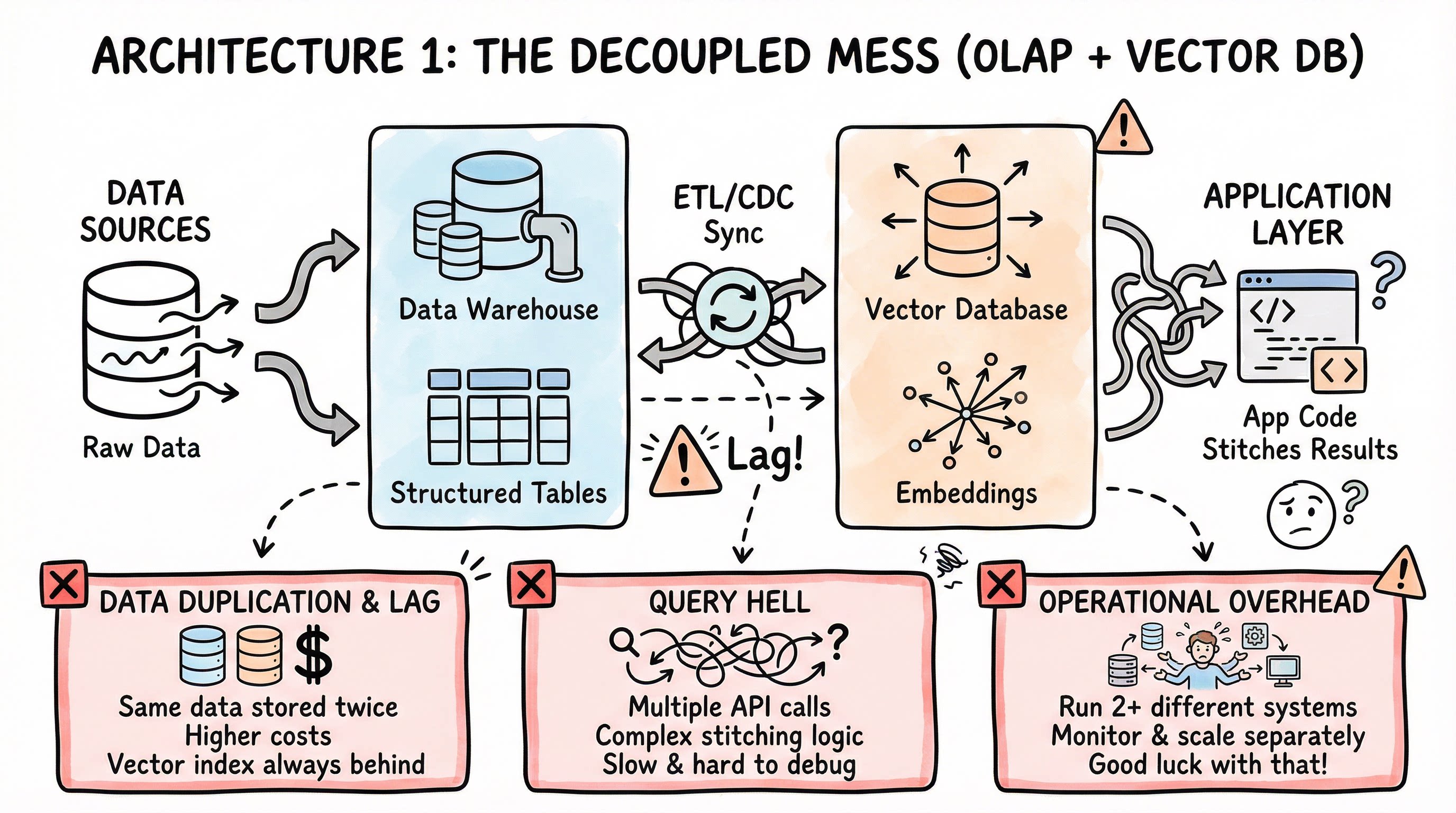
Why it sucks in production:
Hologres cuts through this complexity by baking a high-performance vector engine (HGraph) and full-text search right into its core OLAP engine. Everything lives in one place. This unified backend integrates seamlessly with PAI-EAS (Elastic Algorithm Service), which provides a one-click deployment experience for your RAG service, supporting popular open-source models like DeepSeek and LLaMA2.
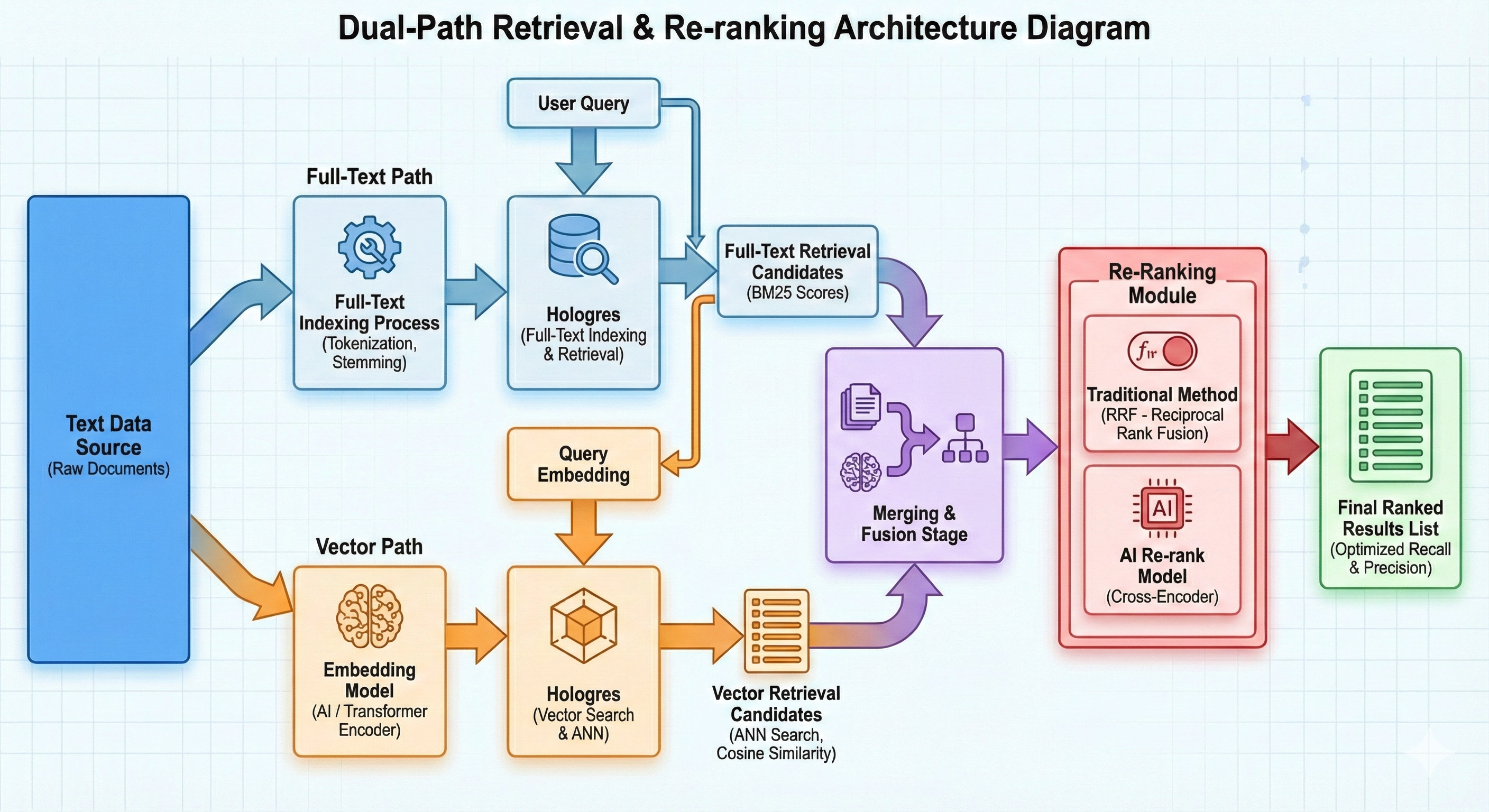
Why it’s better:
| Evaluation Dimension | Decoupled Architecture | Hologres Integrated |
|---|---|---|
| Data Consistency | Weak | Strong |
| Hybrid Query | App-layer fusion, complex | DB-layer fusion, simple |
| Operational Complexity | High | Low |
| Real-Time Capability | Weak | Strong |
| Total Cost | High | Low |
Let’s see how this unified model solves our four big problems.
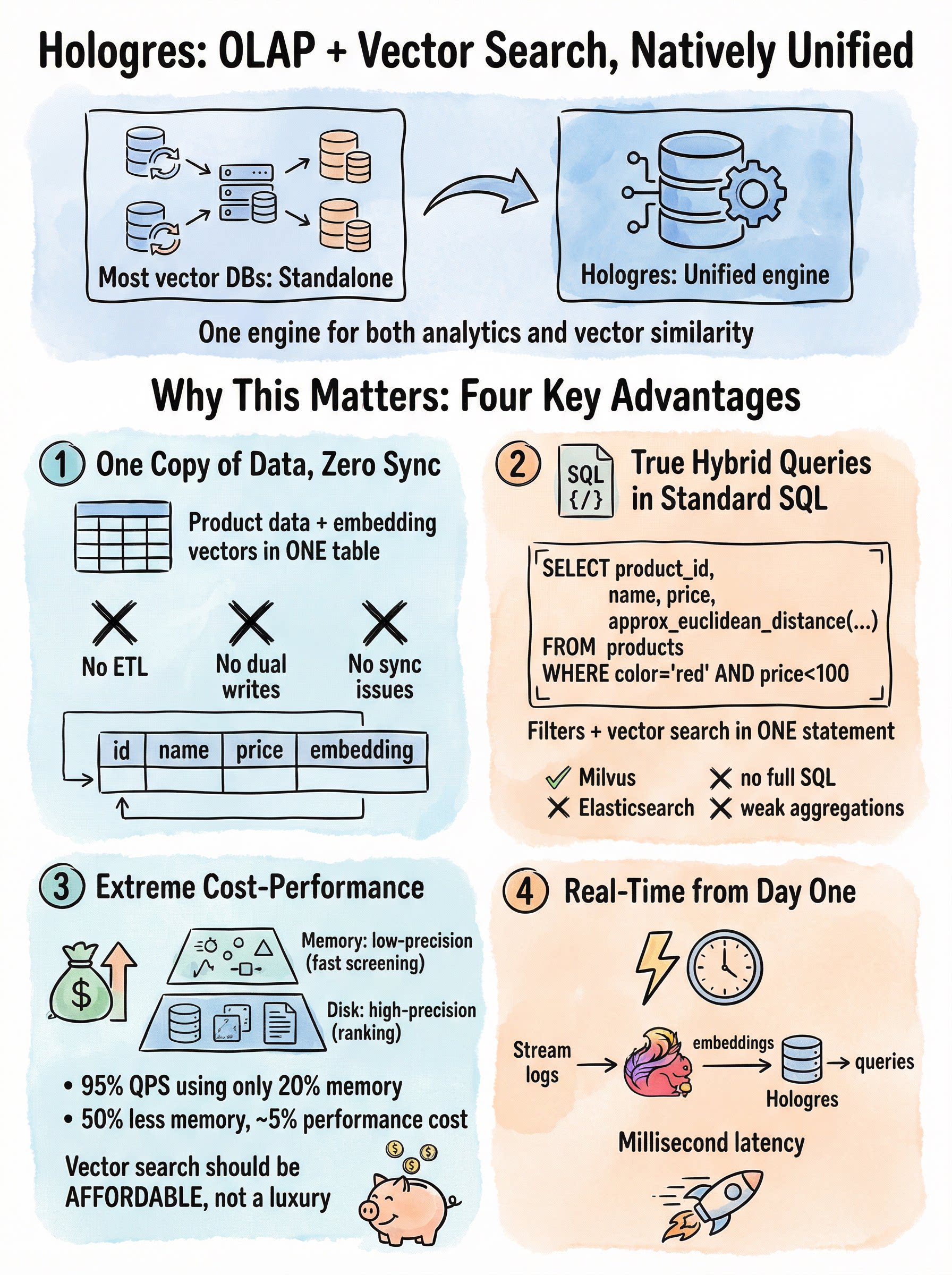
With Hologres, you can write a single SQL query that does it all: filter by user attributes, match keywords, and find semantic neighbors. Your application or PAI-EAS service connects to Hologres using a standard config (holo_config) containing the endpoint, port, database, and credentials, and then executes the query directly on the unified table.
WITH
-- Step 1: full text retrieval and scalar filter
fulltext_search AS (
    SELECT
        id,
        text_search (text_field, 'test5  test6 test7 test8 test9') AS score,
        ROW_NUMBER() OVER (ORDER BY text_search (text_field, 'test5  test6 test7 test8 test9') DESC) AS ft_rank
    FROM
        documents
    WHERE
        field1 > 2
        AND text_search (text_field, 'test5  test6 test7 test8 test9') > 0
    LIMIT 100
),
-- Step 2: vector retrieval and scalar filter
vector_search AS (
    SELECT
        id,
        approx_cosine_distance (vector1, '{2.8, 2.3, 2.4}') AS score,
        ROW_NUMBER() OVER (ORDER BY approx_cosine_distance (vector1, '{2.8, 2.3, 2.4}') DESC) AS vec_rank
    FROM
        documents
    WHERE
        field1 > 2
        AND approx_cosine_distance (vector1, '{2.8, 2.3, 2.4}') > 0
    ORDER BY
        approx_cosine_distance (vector1, '{2.8, 2.3, 2.4}') DESC
    LIMIT 100)
-- Step 3: RRF fusion search
SELECT
    COALESCE(ft.id, vec.id) AS doc_id,
    -- RRF_score = sum(1/(rrf_rank_constant + rank)), rrf_rank_constant is a constant 60
    (CASE WHEN ft.ft_rank IS NOT NULL THEN 1.0 / (60 + ft.ft_rank) ELSE 0 END)
    +
    (CASE WHEN vec.vec_rank IS NOT NULL THEN 1.0 / (60 + vec.vec_rank) ELSE 0 END)
    AS rrf_score,
    d.text_field,
    d.field1,
    d.field2
FROM
    fulltext_search ft
    FULL JOIN vector_search vec ON ft.id = vec.id
    LEFT JOIN documents d ON COALESCE(ft.id, vec.id) = d.id
-- Sort by RRF score in descending order
ORDER BY
    rrf_score DESC
LIMIT 10;
No more juggling multiple clients or writing custom fusion logic. It’s just SQL.
Pair Hologres with Apache Flink, and you’ve got a real-time pipeline. New data comes in via Kafka, Flink processes it, and it lands in Hologres where it’s instantly searchable—both as text and as a vector. End-to-end latency? Seconds.

Hologres is an MPP, columnar OLAP system designed for petabyte-scale analytics. That same engine can effortlessly handle billions of vectors and execute complex hybrid queries at high speed. Scale isn’t a problem you solve later; it’s built-in from day one.
By collapsing three systems (OLAP + Vector DB + Search Engine) into one, you dramatically cut your TCO. You save on licenses, compute, storage, and, most importantly, the engineering hours spent keeping the whole Rube Goldberg machine running. We’ve seen teams cut their RAG infrastructure costs by over 50%.
A major financial firm needed a chatbot that could answer highly specific, personalized questions from a massive knowledge base of 100k+ documents.
Their challenges were textbook:
Their solution with Hologres: They stored everything—user profiles, product specs, FAQ text, and vectors—in a single Hologres table. Their RAG app sent one SQL query that did all the filtering and searching at once.
The results spoke for themselves:
If you’re serious about moving RAG to production, the decoupled, multi-system approach is a dead end. It’s too complex, too slow, and too expensive.
The future is integrated. A platform like Hologres, which unifies OLAP, vector search, and full-text search, and integrates smoothly with PAI-EAS for model serving, gives you a simple, scalable, and cost-effective foundation for your enterprise RAG applications. It’s built for the real world, not just the demo.
Ready to build your own? Check out the official guides like "Build an Enterprise FAQ Knowledge Base with Hologres, PAI, and DeepSeek" to get started today.
👉 Try Hologres on Alibaba Cloud or talk to our solution architect and see how one engine can handle both your BI dashboards and your RAG pipeline.
The Complete Guide to Hybrid Search: The Perfect Blend of Full-Text and Vector Search
Using SQL to Call LLMs? Hologres + Model Studio Enables Data Developers to "Talk" Directly to AI

25 posts | 0 followers
FollowNeel_Shah - May 21, 2026
Farruh - July 18, 2024
OpenAnolis - January 26, 2026
Alibaba Cloud Community - November 5, 2024
Alibaba Cloud Big Data and AI - March 23, 2026
Muhamad Miftah - February 23, 2026
25 posts | 0 followers
Follow Hologres
A real-time data warehouse for serving and analytics which is compatible with PostgreSQL.
Learn More Big Data Consulting for Data Technology Solution
Alibaba Cloud provides big data consulting services to help enterprises leverage advanced data technology.
Learn More Big Data Consulting Services for Retail Solution
Alibaba Cloud experts provide retailers with a lightweight and customized big data consulting service to help you assess your big data maturity and plan your big data journey.
Learn More Financial Services Solutions
Alibaba Cloud equips financial services providers with professional solutions with high scalability and high availability features.
Learn MoreMore Posts by Alibaba Cloud Big Data and AI

