"Can I query data using natural
language?"
"Are there any risk clauses in this PDF contract?"
"Help me check if this shelf layout matches our plan."
As data developers, we're familiar with SQL, data warehouse layering, and ETL processes. But when faced with these requests, we often have to shake our heads helplessly—because they belong to the realm of "AI engineering" involving large models, multimodal processing, and vector retrieval. Building a RAG system? That means GPU clusters, LangChain, FastAPI, vector databases...a steep increase in tech stack complexity and soaring operational costs.
But today, I want to tell you: these scenarios can actually be solved with SQL.
Alibaba Cloud Hologres has deeply integrated with the Model Studio large model platform to introduce AI Function capabilities—no Python, no additional services needed. Using your familiar SQL, you can directly call large models to enable intelligent analysis across all modalities, from structured data to images, PDFs, and videos.
Traditional AI solutions suffer from three major pain points, which Hologres + Model Studio addresses precisely:
1.
AI and data are siloed: Data resides in
data warehouses while models run externally, requiring back-and-forth data
movement that's slow and poses security risks.
→ Hologres brings models
"into" the data, completing inference right next to where the
data lives, ensuring data never leaves the warehouse.
2.
High engineering costs: Self-hosted LLM
services require GPUs, API gateways, rate limiting, circuit breakers...making
them difficult for data teams to maintain.
→ Model Studio provides managed large
model services, which Hologres can call with a single function—zero
operations overhead.
3.
Mismatched tech stacks: SQL developers
don't know how to write LangChain, and algorithm engineers don't understand
data warehouse layering.
→ Use SQL to orchestrate AI logic,
empowering data teams to lead end-to-end AI applications.
What is Model Studio? What does it bring to data development?
Model Studio is Alibaba Cloud's one-stop large model development and application building platform, integrating mainstream models like Qwen, DeepSeek, and Kimi, supporting various capabilities including text generation, multimodal understanding (e.g., Qwen-VL), embedding, translation, and more.
For data developers, Model Studio's core value is: you only need to focus on "how to use it," not "how to run it."
● Model deployment, elastic scaling, monitoring, and alerting are all managed by the platform
● OpenAI API compatible, with low migration costs
● Supports VPC calls, meeting enterprise security and compliance requirements
● Pay-per-token pricing, ready-to-use with no wasted idle resources
How do Hologres and Model Studio work together?
Hologres integrates with Model Studio through API key-based direct calls, balancing agility with production-grade performanc
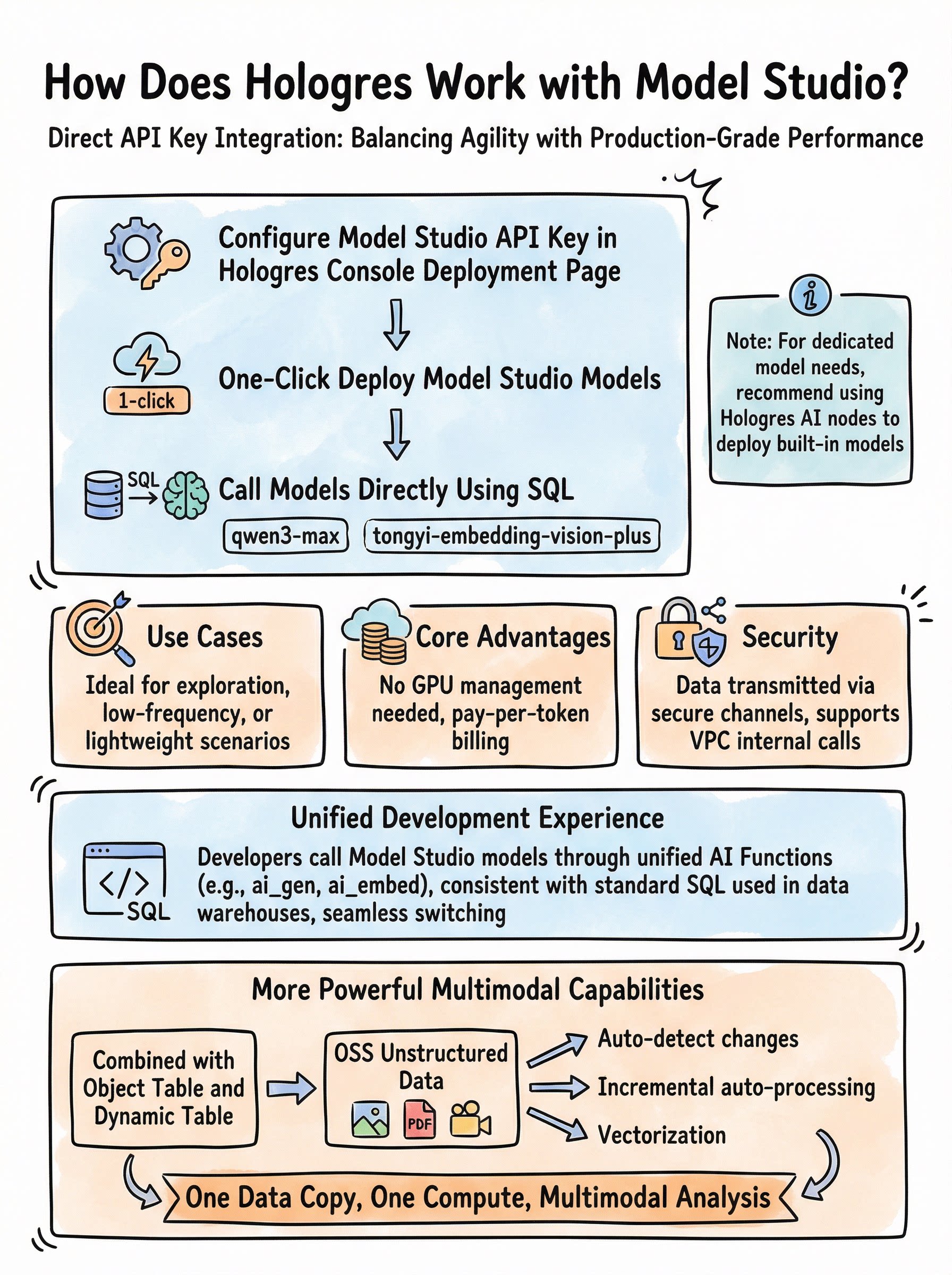
Figure: Hologres integrates with Model Studio through API key configuration, enabling direct model calls from SQL
Simply configure a Model Studio API Key in the Hologres console deployment page, then deploy Model Studio large models with one click. After that, you can directly call models on the Model Studio platform (such as qwen3-max, tongyi-embedding-vision-plus) using SQL.
Note: For dedicated model requirements, it's recommended to deploy built-in models using Hologres AI nodes
● Use cases: Ideal for exploration, low-frequency, or lightweight scenarios
● Key advantages: No GPU management required, pay-per-token pricing
● Security: Data transmitted through secure channels, supports VPC calls
Developers call Model Studio large models through unified AI Functions (such as ai_gen, ai_embed) using standard SQL consistent with data warehouse operations, enabling seamless switching.
More powerfully, combined with Object Table and Dynamic Table, Hologres can automatically detect changes in unstructured data (such as images, PDFs, videos) in OSS, enablg incremental automatic processing and vectorization—truly achieving "one data source, one computation, multi-modal analysis."
Hologres AI Function Deep
Dive: SQL as Your AI Orchestration Language
Hologres provides rich AI functions covering the entire pipeline from preprocessing to inference, all callable through standard SQL:
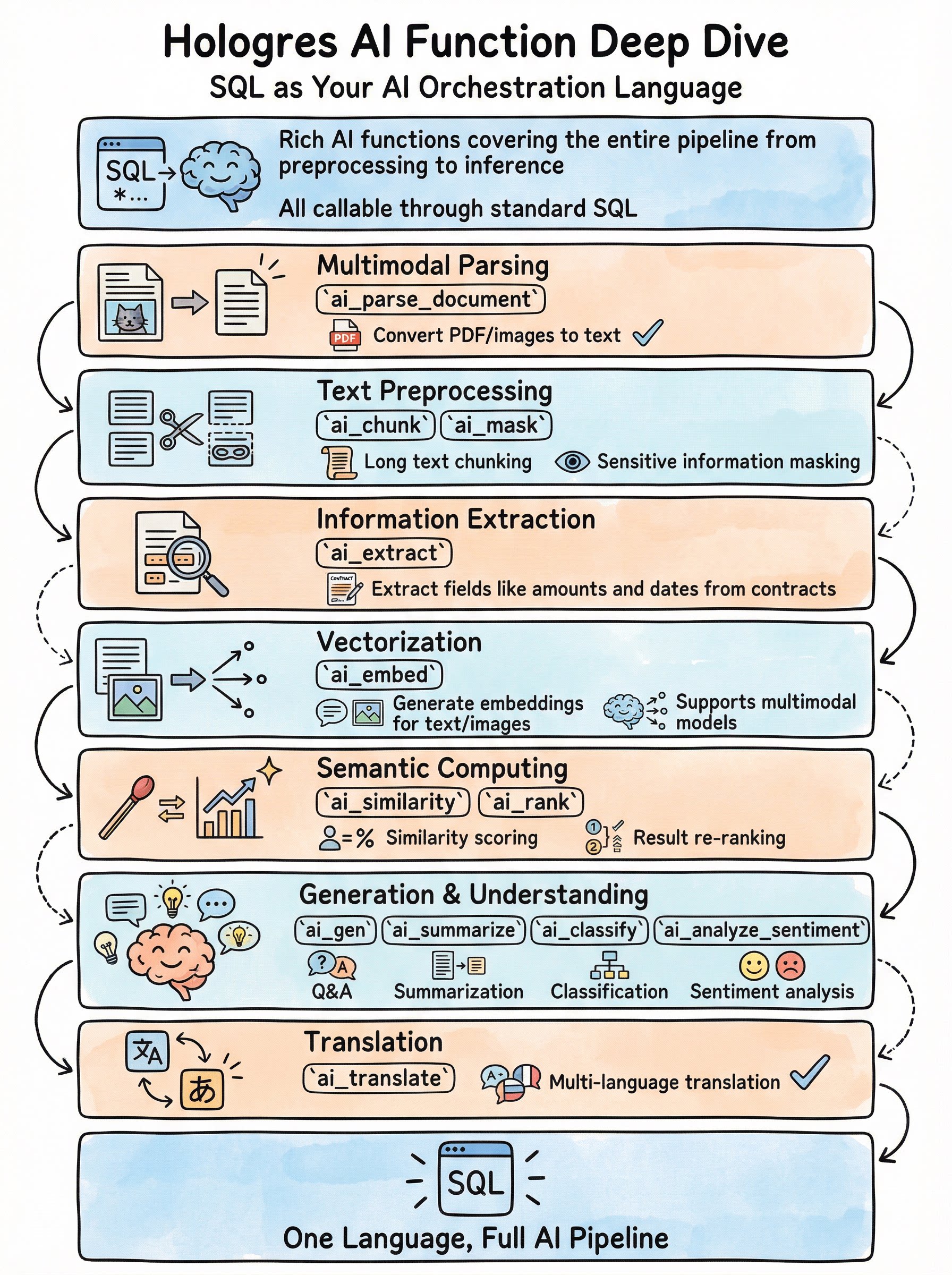
|
Function Category |
Function Examples |
Typical Use Cases |
|
Multimodal Parsing |
ai_parse_document |
Convert PDF/images to text |
|
Text Preprocessing |
ai_chunk, ai_mask |
Long text chunking, sensitive information masking |
|
Information Extraction |
ai_extract |
Extract fields like amounts and dates from contracts |
|
Vectorization |
ai_embed |
Generate embeddings for text/images, supports multimodal models |
|
Semantic Computing |
ai_similarity, ai_rank |
Similarity scoring, result re-ranking |
|
Generation & Understanding |
ai_gen, ai_summarize, ai_classify, ai_analyze_sentiment |
Q&A, summarization, classification, sentiment analysis |
|
Translation |
ai_translate |
Multi-language translation |
In the past, the core battlefield for data development was structured data—we modeled, aggregated, scheduled, and ultimately produced reports. But today, real business insights are often hidden in unstructured data like PDF contracts, store photos, and in-car videos. How can we make these "silent data" queryable with SQL? Hologres + Model Studio provides the answer.
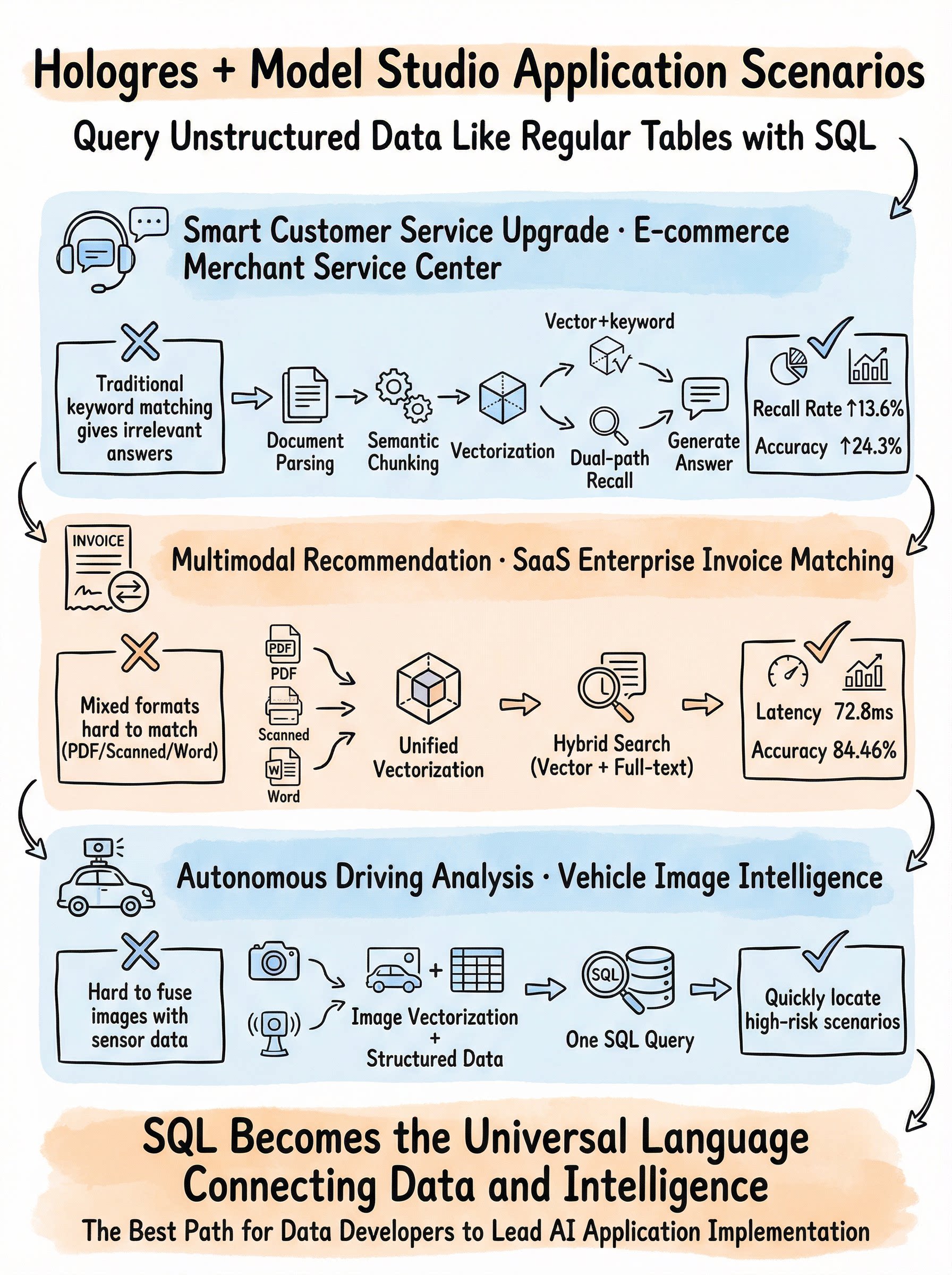
Figure: Hologres enables unified processing of structured and unstructured data through Object Table and Dynamic Table, with AI functions powered by Model Studio
Every day, millions of Taobao merchants inquire about platform rules, after-sales processes, or marketing policies. Traditional keyword-matching knowledge base systems often provide irrelevant answers. Alibaba's CCO (Customer Experience Operations) team wanted to build a truly semantic-understanding intelligent Q&A system: when a merchant asks "How to handle malicious buyer returns?", the system should accurately retrieve and generate relevant solutions.
With Hologres, they stored tens of thousands of help documents in OSS and automatically synchronized file metadata through Object Table. Using the declarative capabilities of Dynamic Table, the system automatically called ai_parse_document to parse content for new documents, then used ai_chunk to semantically segment paragraphs, and finally generated vectors using ai_embed with Model Studio's text-embedding-v4 model, persisting them to Hologres tables. When users asked questions, the system first vectorized the query using ai_embed, performed dual-path retrieval (vector + full-text) within Hologres, then used ai_rank to refine candidate results, and ultimately generated natural language responses using ai_gen (calling qwen3-max). The entire pipeline required no data export or external service orchestration—all driven by standard SQL. After launch, recall rate improved by 13.6% and accuracy by 24.3%, with significantly increased click-through rates, truly achieving "ask accurately, answer correctly."
A global top-tier SaaS company provides ERP systems, with customers uploading large volumes of invoices, contracts, and transaction documents daily, expecting the system to automatically recommend historically similar templates to reduce repetitive entry. However, these documents have mixed formats (PDF, scanned copies, Word), and traditional OCR plus rule-engine approaches had limited effectiveness and high maintenance costs.
The company unified all unstructured files into OSS, automatically captured metadata through Hologres' Object Table, and used Dynamic Table with incremental capabilities to call ai_parse_document to extract text content, then used ai_embed (based on Model Studio's tongyi-embedding-vision-plus multimodal model) to generate unified embeddings for each document. When querying, users upload a new invoice, the system automatically vectorizes it, and performs hybrid retrieval in Hologres—combining vector similarity with full-text keywords (such as customer name, amount, tax ID) for joint scoring and sorting. Thanks to Hologres' powerful hybrid indexing and high-performance vector engine, average latency was only 72.8ms at single concurrency, maintaining millisecond-level response even at 40 concurrent requests, with accuracy reaching 84.46%. More importantly, data didn't need synchronization to dedicated vector databases but was unified in Hologres, significantly reducing data redundancy, synchronization complexity, and total cost of ownership (TCO).
In the smart driving domain, an automotive manufacturer needed to identify high-risk scenarios from massive amounts of vehicle images and sensor signals, such as "pedestrians suddenly crossing the road." Traditional solutions required sending images to independent CV platforms for processing, then flowing inference results back to the data warehouse—not only creating long pipelines but also causing timestamp alignment difficulties and data inconsistency issues.
Now, they store raw images in OSS and stream structured signals (GPS coordinates, vehicle speed, brake pressure, etc.) in real-time to Hologres. Through Object Table, the system automatically associates images with corresponding structured events. Then, using Dynamic Table, it calls ai_embed (using Model Studio-deployed Qwen3-VL multimodal model) to generate visual embeddings for new images, combining them with structured fields into wide tables. Safety analysis teams simply need one SQL query:
SELECT image_url, ai_similarity(vision_emb,
ai_embed('pedestrian crossing')) AS risk_score
FROM driving_events
WHERE speed > 30 AND brake_pressure > 0.8
ORDER BY risk_score DESC;
This quickly identifies high-risk segments. This "multimodal fusion analysis" capability enables data teams to directly participate in driving strategy optimization and accident attribution, rather than just being log movers.
These cases collectively reveal a trend: AI is moving from algorithmic black boxes to becoming part of data infrastructure. Hologres + Model Studio makes unstructured data manageable, processable, and queryable like ordinary tables, with SQL becoming the universal language connecting data and intelligence—this is the optimal path for data developers to lead AI application implementation.
Hologres + Model Studio isn't "just another AI tool," but rather deeply integrates large model capabilities into data infrastructure. It enables data developers to build cutting-edge multimodal intelligent applications without needing to transform into AI engineers.
You no longer need to write glue code, apply for GPU clusters, or coordinate with algorithm teams—with SQL, you can unlock the value of large models.
Take action now:
● Configure a Model Studio API Key in Hologres
● Or deploy a model to AI nodes
● Then run this SQL:
SELECT ai_gen('Summarize the value of Hologres + Model Studio in one sentence');
The answer will be: Empowering data development to become the productivity engine of the AI era.
Want to see how Hologres lets you call
LLMs directly using standard SQL? 👉 Try Hologres on
Alibaba Cloud or talk
to our solution architect to explore how you can seamlessly integrate AI
capabilities into your real-time data workflows.
For more details, check out the official documentation:
Build a RAG Platform with Hologres and n8n: A Step-by-Step Guide

25 posts | 0 followers
FollowAlibaba Cloud Big Data and AI - April 13, 2026
Alibaba Cloud Big Data and AI - April 13, 2026
Neel_Shah - May 21, 2026
Alibaba Cloud Big Data and AI - June 3, 2026
Alibaba Cloud Big Data and AI - June 11, 2026
Alibaba Cloud Big Data and AI - February 26, 2026
25 posts | 0 followers
Follow Qwen
Qwen
Full-range, open-source, multimodal, and multi-functional
Learn More Big Data Consulting for Data Technology Solution
Alibaba Cloud provides big data consulting services to help enterprises leverage advanced data technology.
Learn More Big Data Consulting Services for Retail Solution
Alibaba Cloud experts provide retailers with a lightweight and customized big data consulting service to help you assess your big data maturity and plan your big data journey.
Learn More AI Acceleration Solution
Accelerate AI-driven business and AI model training and inference with Alibaba Cloud GPU technology
Learn MoreMore Posts by Alibaba Cloud Big Data and AI

