Let’s cut to the chase: if you’re building anything with LLMs—RAG apps, smart search, recommendation systems—you’ve probably hit a wall with traditional keyword search. It just doesn’t “get” meaning. That’s where vector databases come in.
But here’s the thing: while vector search is powerful, the way most teams are implementing it is creating more problems than it solves. You end up juggling two systems—one for your business data (like ClickHouse) and another just for vectors (like Pinecone or Milvus). It’s messy, expensive, and makes simple queries painfully complex.
In this post, we’ll break down what vector DBs actually do, why they matter for real-world AI apps, and how Hologreson Alibaba Cloud flips the script by baking vector search right into its OLAP engine—so you can ditch the duct tape architecture.
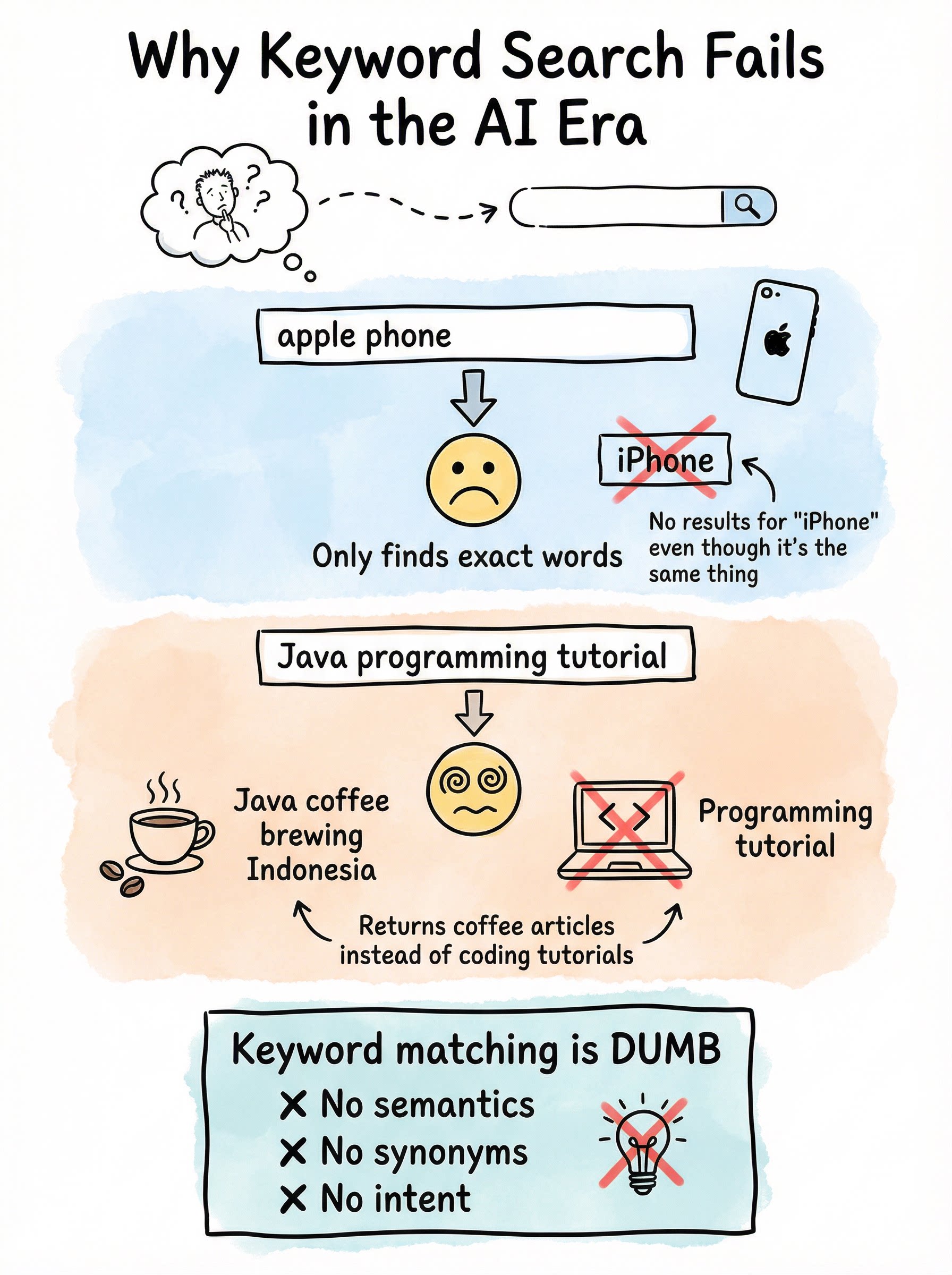
Think about a basic e-commerce search:
Or worse:
Keyword matching is dumb. It has no concept of semantics, synonyms, or intent. For AI apps that need to understand, not just match, this is a non-starter.
So what’s the alternative? Semantic search.
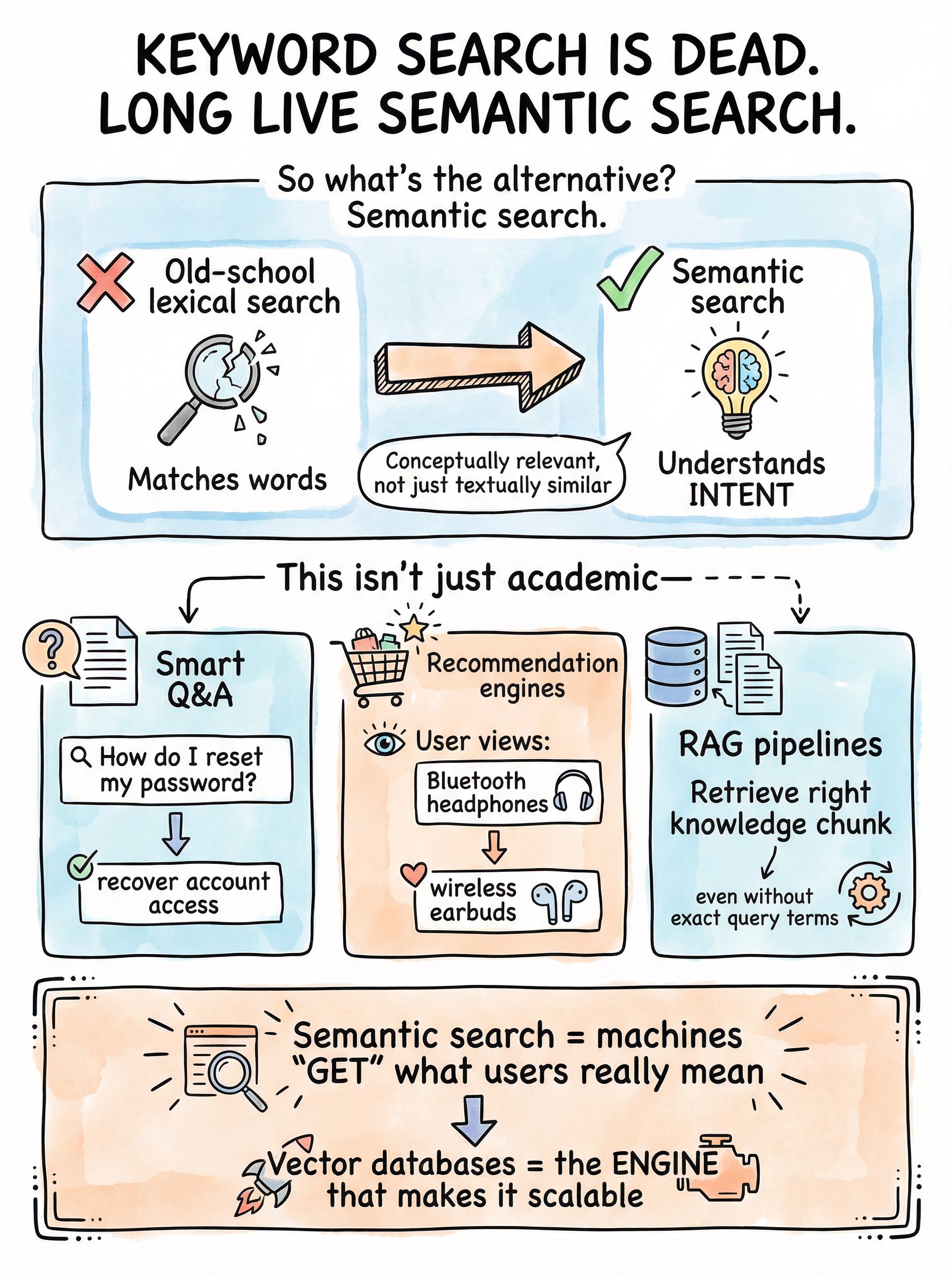
Unlike old-school lexical search (which just matches words), semantic search aims to understand the intent behind a query and return results that are conceptually relevant, not just textually similar.
This isn’t just academic—it’s the foundation of every modern AI application:
In short: semantic search is how machines start to “get” what users really mean. And vector databases are the engine that makes it scalable.
Using an embedding model, you convert text, images, or any unstructured data into a list of numbers—a vector—that captures its semantic meaning. The magic is this: similar things end up close together in vector space.
Now, instead of string matching, you do vector search: find the vectors closest to your query vector using cosine similarity or Euclidean distance. This is how you get “iPhone” when someone searches “apple phone.”
A vector database is just a system optimized to store billions of these vectors and run fast nearest-neighbor (ANN) searches at scale.

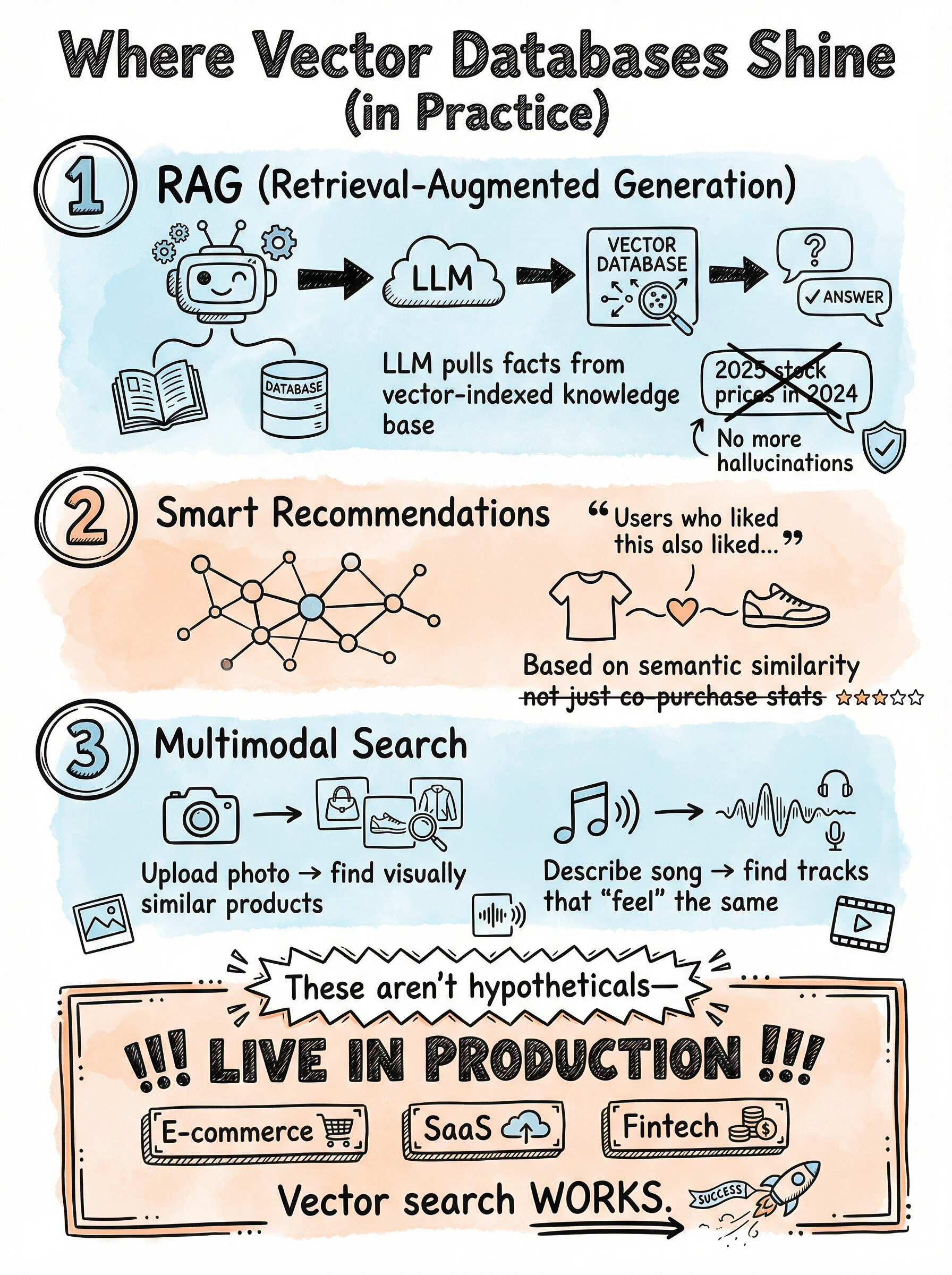
These aren’t hypotheticals—they’re live in production across e-commerce, SaaS, and fintech. Vector search works.
But here’s the catch: most teams don’t run vector search in isolation. Real applications almost always need to combine semantic similarity with structured filters—like price, category, user segment, or recency. And that’s where the standard playbook breaks down.
You end up stitching together two separate systems: an OLAP database for your business data (user profiles, transactions, product catalogs) and a dedicated vector database just for embeddings. This dual-system setup might seem manageable at first, but it quickly becomes a bottleneck for both performance and developer velocity.
let's take a look at a example:
Now try this query:
“Show me red dresses under $100 that are similar to this one.”
You’d have to:
color='red' AND price < 100.It’s slow, brittle, and requires stitching services together. Plus, you’re duplicating data and paying to keep two systems running.
Most vector databases are built as standalone systems. They’re great at one thing—vector search—but they live in isolation. Hologres takes a fundamentally different approach: it natively integrates its vector engine (HGraph) directly into its high-performance OLAP core.
This isn’t just a “connector” or a sidecar—it’s a single, unified engine that handles both analytical queries and vector similarity search on the same data, in the same table, with the same SQL interface.

Store your product catalog—id, name, price, category, description—alongside its embedding vector in a single Hologres table. No ETL pipelines. No dual writes. No eventual consistency headaches. Your business data and its semantic representation are always in sync.
That red dress query? Now it’s a single, clean SQL statement:
SELECT
  product_id, name, price,
  approx_euclidean_distance (embedding, :query_vec) AS score
FROM products
WHERE color = 'red' AND price < 100
ORDER BY score DESC
LIMIT 10;
Unlike Milvus (which lacks full SQL/OLAP support) or Elasticsearch (which struggles with complex aggregations), Hologres gives you full OLAP power + key-value lookup + vector search in a single system. This is critical for real-world apps where filters, joins, and similarity must coexist.
Vector search at scale is expensive. Full in-memory HNSW indexes? Prohibitively costly. DiskANN Indexes? Too slow. Hologres strikes a balance with hybrid-precision indexing:
According to VectorDBBench results, this approach delivers 95% of the QPS of a full-memory solution while using only 20% of the memory.
And it gets better:
The philosophy? Vector search should be ubiquitous computing capability—not a luxury. Hologres is engineered to make it affordable at petabyte scale.
Hologres integrates deeply with Apache Flink. Stream raw logs → generate embeddings in real time → write to Hologres → serve hybrid queries with millisecond latency. Perfect for:
| Evaluation Dimension | Siloed Architecture (OLAP + Vector DB) | Hologres Unified Architecture |
|---|---|---|
| Data Consistency | Eventual (requires sync) | Strong, real-time |
| Hybrid Query Perf | Slow (multi-hop, network roundtrips) | Fast (single-engine execution) |
| Dev/Ops Complexity | High (two systems, two schemas, two teams) | Low (one system, one schema) |
| Query Flexibility | Limited (vector DBs lack full SQL/OLAP) | Full SQL + vector + KV in one query |
| Total Cost | High (infra + licensing + engineering effort) | Lower (consolidated stack, less redundancy) |
In short: Hologres doesn’t just add vector search—it rethinks the entire data architecture for the AI era. You get simplicity, performance, and cost efficiency without sacrificing flexibility.
Vector search isn’t optional anymore—it’s table stakes for modern AI apps. But you shouldn’t have to over-engineer your stack to use it.
Hologres removes the friction by unifying analytics and vector search in one system. You get simpler architecture, faster development, lower cost, and the flexibility to run any hybrid query without jumping through hoops.
If you’re tired of managing two databases just to answer “what’s similar?”, it’s worth a look.
👉 Try Hologres on Alibaba Cloud or talk to our solution architect and see how one engine can handle both your BI dashboards and your RAG pipeline.
The Complete Guide to Hybrid Search: The Perfect Blend of Full-Text and Vector Search

27 posts | 0 followers
FollowAlibaba Cloud Community - February 19, 2024
Data Geek - September 4, 2026
Alibaba Cloud Big Data and AI - March 10, 2026
Alibaba Cloud Native Community - December 17, 2025
Alibaba Cloud Big Data and AI - April 15, 2026
Apache Flink Community - January 20, 2025
27 posts | 0 followers
Follow Hologres
A real-time data warehouse for serving and analytics which is compatible with PostgreSQL.
Learn More Big Data Consulting for Data Technology Solution
Alibaba Cloud provides big data consulting services to help enterprises leverage advanced data technology.
Learn More Big Data Consulting Services for Retail Solution
Alibaba Cloud experts provide retailers with a lightweight and customized big data consulting service to help you assess your big data maturity and plan your big data journey.
Learn More Vector Retrieval Service for Milvus
A cloud-native vector search engine that is 100% compatible with open-source Milvus, extensively optimized in performance, stability, availability, and management capabilities.
Learn MoreMore Posts by Alibaba Cloud Big Data and AI

