In today's data-driven world, users expect search to be both precise and intelligent. But traditional keyword-based search often fails to understand user intent, while purely semantic search can sometimes miss the mark on exact details. What if you could have the best of both worlds? Enter Hybrid Search. This guide dives into how combining full-text and vector search solves real-world problems and how a unified database architecture, like that of Alibaba Cloud Hologres, makes it simpler and more powerful than ever.
For years, we've been stuck with a trade-off.
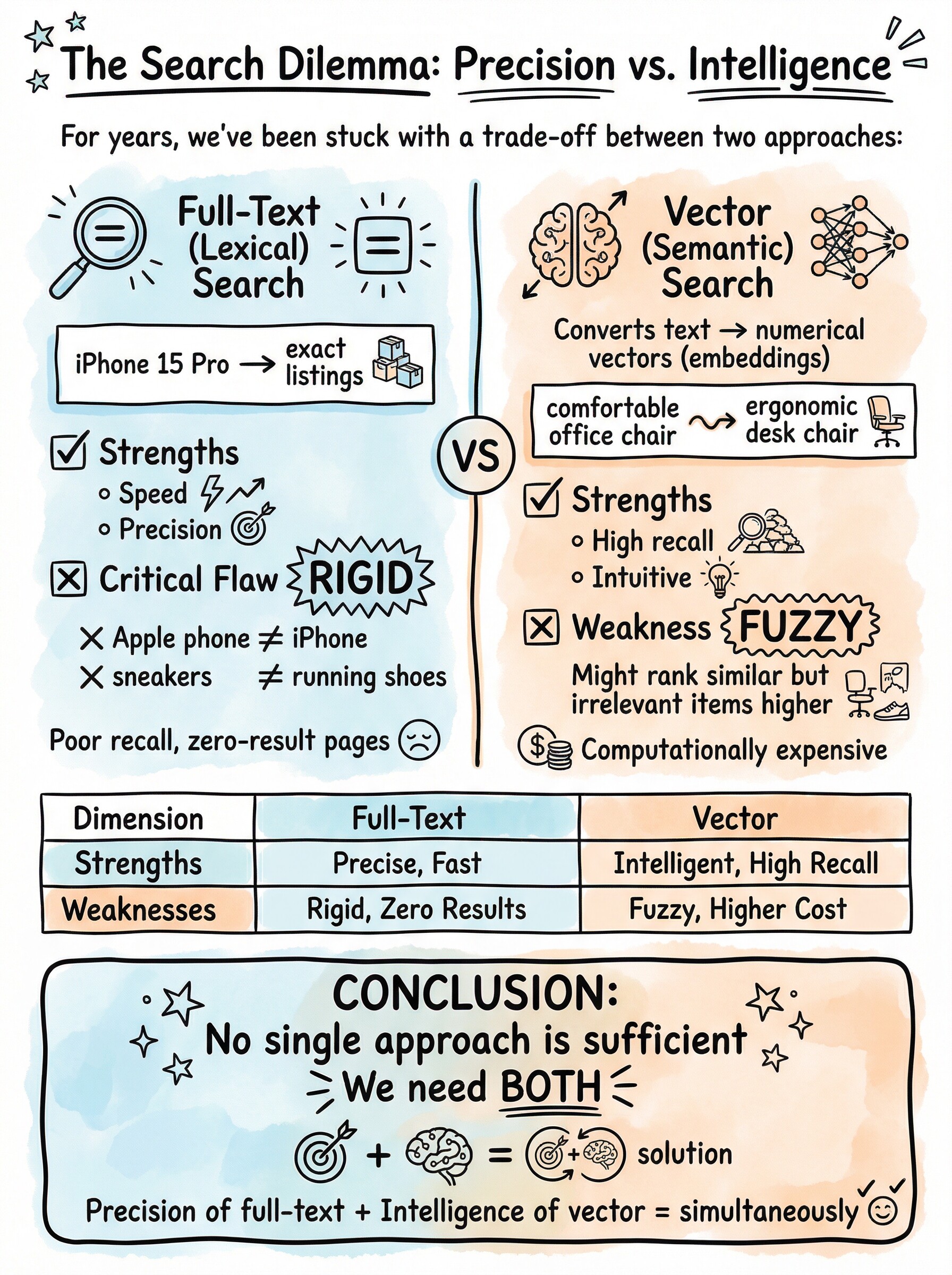
On one side, there's Full-Text (Lexical) Search, the workhorse behind most traditional search engines. It’s fantastic at finding exact matches for your keywords. Ask for "iPhone 15 Pro," and it will reliably find listings containing those exact words. Its strengths are speed and precision.
But it has a critical flaw: it’s rigid. It doesn't understand that "Apple phone" might mean the same thing as "iPhone," or that a user searching for "sneakers" might also be interested in "running shoes." This lack of semantic understanding leads to poor recall and frustrating "zero-result" pages.
On the other side, Vector (Semantic) Search has emerged as a game-changer. By converting text into numerical vectors (embeddings), it can grasp the underlying meaning and context. A search for "comfortable office chair" can return results for "ergonomic desk chair" even if the exact words don't match, because their meanings are close in the vector space. This leads to high recall and a more intuitive experience.
However, vector search isn't perfect either. It can be computationally expensive, and its "fuzzy" nature means it might sometimes rank a semantically similar but irrelevant item higher than an exact match the user actually wanted.
| Dimension | Full-Text Search | Vector Search |
|---|---|---|
| Strengths | Precise, Fast | Intelligent, High Recall |
| Weaknesses | Rigid, Prone to Zero Results | Fuzzy, Higher Computational Cost |
The conclusion is clear: no single approach is sufficient. We need a solution that leverages the precision of full-text search and the intelligence of vector search simultaneously.
Hybrid Search is exactly that solution. It’s a strategy that intelligently combines the results from both full-text and vector search to deliver a final ranking that is more relevant and robust than either method could achieve alone.
The typical hybrid search workflow involves two main steps:
This simple yet powerful combination delivers several key benefits:
From e-commerce product discovery and enterprise knowledge bases to powering the retrieval step in Retrieval-Augmented Generation (RAG) pipelines, hybrid search is quickly becoming the standard for any serious search application.
Implementing hybrid search isn't just about the algorithm; the underlying architecture plays a huge role in its performance, cost, and maintainability. Let's look at the evolution.
A common first attempt is to use two separate systems: Elasticsearch (or Solr) for full-text and a dedicated vector database for embeddings.
PostgreSQL, with extensions like pgvector, offers a more integrated path. You can store your structured data, text, and vectors in a single table.
This is where a purpose-built, unified system shines. Alibaba Cloud Hologres takes a different approach by natively integrating a high-performance OLAP engine, a full-text search engine (based on Tantivy), and a vector engine (HGraph) into a single, cohesive platform.
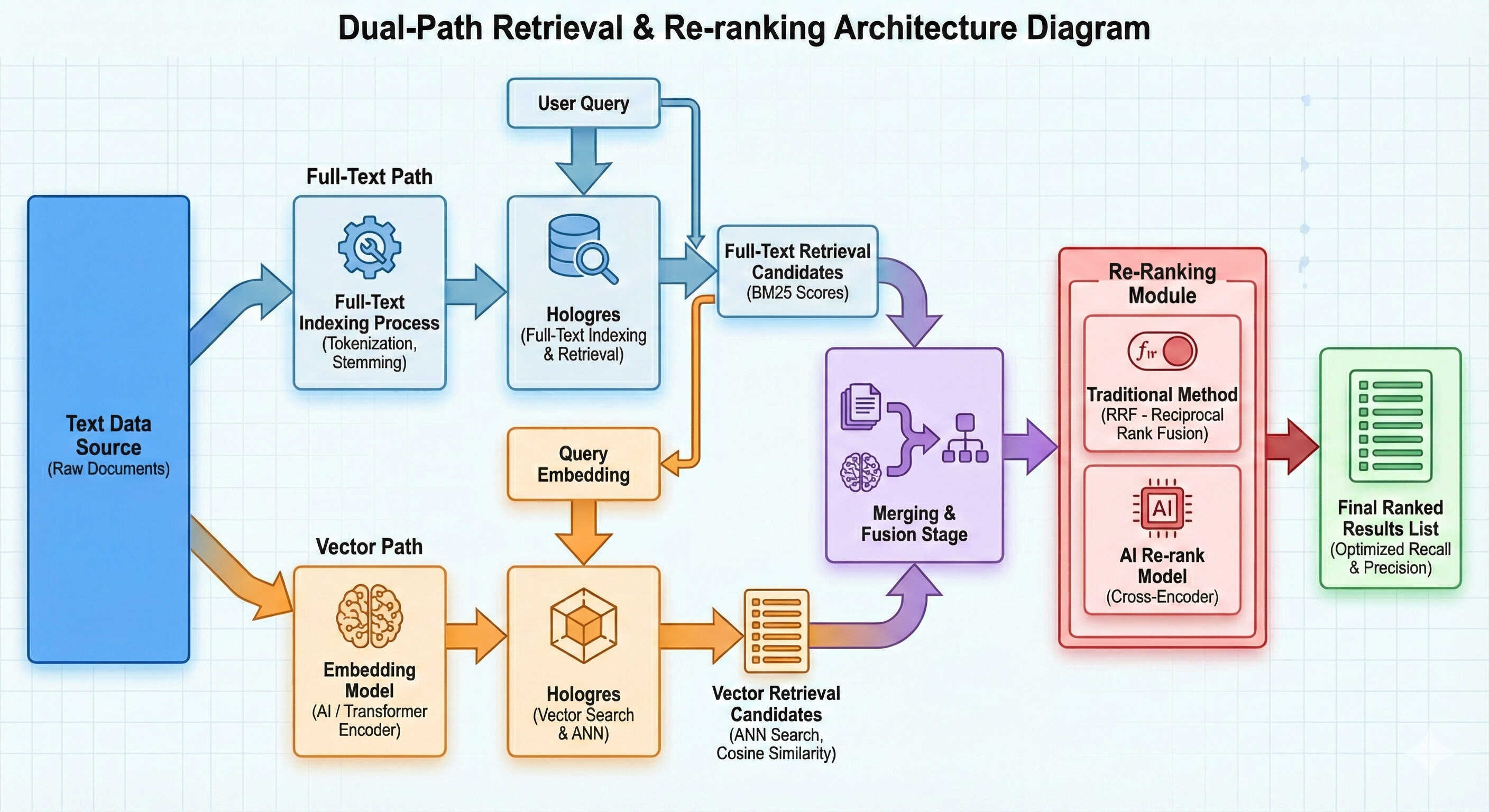
Its core advantages are transformative:
| Evaluation Criteria | Siloed Architecture | Plugin Architecture | Hologres Unified |
|---|---|---|---|
| Data Consistency | Weak | Strong | Strong |
| Operational Overhead | High | Medium | Low |
| Query Performance | Low | Medium | High |
| Real-time Capability | Weak | Medium | Strong |
| Analytical Power | Weak | Weak | Strong (OLAP) |
Theory is one thing, but seeing it in action is another. How does Hologres' hybrid search translate into real-world code? Let's walk through a practical example.
The beauty of Hologres lies in its ability to simplify the entire pipeline. By leveraging built-in AI Functions and Generated Columns, you can perform vector embedding transformations at the moment data is written, eliminating complex pre-processing steps.
First, we create a product table where the vector embedding for the description field is automatically generated upon insertion:
-- Create a products table with auto-generated embeddings
CREATE TABLE products (
    product_id int PRIMARY KEY,
    name TEXT,
    description TEXT,
    description_vector float4[] CHECK (array_ndims(description_vector) = 1 AND array_length(description_vector, 1) = 1024) GENERATED ALWAYS AS (ai_embed ('text_embedding_v4', description)) STORED
  -- A 1024-dim vector generated on-write by calling the 'text_embedding_v4' model
)WITH (
    vectors = '{
        "description_vector": {
            "algorithm": "HGraph",
            "distance_method": "Cosine",
            "builder_params": {
                "base_quantization_type": "rabitq",
                "graph_storage_type": "compressed",
                "max_degree": 64,
                "ef_construction": 400,
                "precise_quantization_type": "fp32",
                "use_reorder": true,
                "max_total_size_to_merge_mb" : 4096
            }
        }
    }'
);

-- Create a full-text index on the description
CREATE INDEX idx_products_description ON products USING FULLTEXT (description);
Now, imagine we have this products table with product_id, name, description, and its corresponding description_vector. We can execute a sophisticated hybrid search with a single, clean SQL query.
The following example demonstrates a classic Reciprocal Rank Fusion (RRF) approach to intelligently merge results from both retrieval methods:
-- A single SQL query for hybrid search

WITH
-- Step 1: Perform full-text search
fulltext_search AS (
    SELECT
        product_id,
        text_search(description, 'red dress') as score,
        ROW_NUMBER() OVER (ORDER BY text_search(description, 'red dress') DESC) AS ft_rank
    FROM products
    WHERE text_search(description, 'red dress') > 0 limit 100
),

-- Step 2: Perform vector search
vector_search AS (
    SELECT product_id,
           approx_cosine_distance (description_vector, ai_embed ('text_embedding_v4','red dress')) AS score,
           ROW_NUMBER() OVER ( ORDER BY approx_cosine_distance (description_vector, ai_embed ('text_embedding_v4','red dress')) desc) AS vec_rank
     FROM products
     WHERE approx_cosine_distance (description_vector, ai_embed ('text_embedding_v4','red dress')) > 0
     ORDER BY approx_cosine_distance (description_vector, ai_embed ('text_embedding_v4','red dress')) DESC limit 100
)

-- Step 3: Fuse and re-rank results using RRF
SELECT
    COALESCE(ft.product_id, vec.product_id) AS doc_product_id,
    -- RRF score: sum(1/(k + rank)), with constant k=60
    (CASE WHEN ft.ft_rank IS NOT NULL THEN 1.0 / (60 + ft.ft_rank) ELSE 0 END) +
    (CASE WHEN vec.vec_rank IS NOT NULL THEN 1.0 / (60 + vec.vec_rank) ELSE 0 END) AS rrf_score,
    -- Join back to the original description for clarity (optional)
    d.description
FROM fulltext_search ft
FULL JOIN vector_search vec ON ft.product_id = vec.product_id
LEFT JOIN products d ON COALESCE(ft.product_id, vec.product_id) = d.product_id
-- Sort by the final RRF score
ORDER BY rrf_score DESC
LIMIT 10;
This single query encapsulates the entire hybrid search workflow: it retrieves exact keyword matches via full-text search, finds semantically similar items via vector search, and then uses the RRF algorithm to produce a final, highly relevant ranking.
Moreover, Hologres allows you to take this a step further by integrating Large Language Models (LLMs) directly into your query for even more precise re-ranking. You can leverage a powerful model like Qwen to perform a final relevance assessment on the combined candidate set:
-- Hybrid search with LLM-powered re-ranking
WITH
-- Step 1: Full-text search
fulltext_search AS (
    SELECT
        product_id,
        description
    FROM products
    WHERE text_search (description, 'red dress') > 0
    ORDER BY text_search (description, 'red dress') DESC
    LIMIT 100
),
-- Step 2: Vector search
vector_search AS (
    SELECT
        product_id,
        description
    FROM products
    WHERE approx_cosine_distance (description_vector, ai_embed ('text_embedding_v4', 'red dress')) > 0
    ORDER BY approx_cosine_distance (description_vector, ai_embed ('text_embedding_v4', 'red dress')) DESC
    LIMIT 100
),
all_result AS (
    SELECT * FROM fulltext_search
    UNION ALL
    SELECT *FROM vector_search
)
-- Step 3: Use an LLM for final re-ranking
SELECT *
FROM all_result
ORDER BY ai_rank ('qwen3_max', 'red dress', description) DESC
LIMIT 100;
This end-to-end SQL capability empowers developers to build sophisticated, high-performance search applications without the need for complex application-layer logic to stitch together results from disparate systems.
The future of search is hybrid, and the future of data platforms is unified. Trying to bolt together disparate systems for search, vector, and analytics is a recipe for complexity and inefficiency.
Hologres’s unique architecture—combining OLAP, full-text, and vector search in a single, high-performance engine—provides a streamlined, powerful, and cost-effective foundation for building modern applications. It removes the friction of managing multiple systems and lets developers focus on delivering exceptional user experiences.
If you're looking to implement state-of-the-art hybrid search without the architectural headaches, it's time to explore a unified solution.
👉 Try Hologres on Alibaba Cloud or talk to our solution architect and see how one engine can provide hybrid search without the architectural headaches.
What’s a Vector Database, Really? And Why Your AI Stack Might Be Overcomplicated

27 posts | 0 followers
FollowAlibaba Cloud Big Data and AI - March 10, 2026
Neel_Shah - May 21, 2026
Alibaba Cloud Big Data and AI - July 9, 2026
Data Geek - September 4, 2026
ApsaraDB - January 28, 2026
Alibaba Cloud Big Data and AI - December 29, 2025
27 posts | 0 followers
Follow Hologres
A real-time data warehouse for serving and analytics which is compatible with PostgreSQL.
Learn More Big Data Consulting for Data Technology Solution
Alibaba Cloud provides big data consulting services to help enterprises leverage advanced data technology.
Learn More Big Data Consulting Services for Retail Solution
Alibaba Cloud experts provide retailers with a lightweight and customized big data consulting service to help you assess your big data maturity and plan your big data journey.
Learn More Data Lake Storage Solution
Build a Data Lake with Alibaba Cloud Object Storage Service (OSS) with 99.9999999999% (12 9s) availability, 99.995% SLA, and high scalability
Learn MoreMore Posts by Alibaba Cloud Big Data and AI

