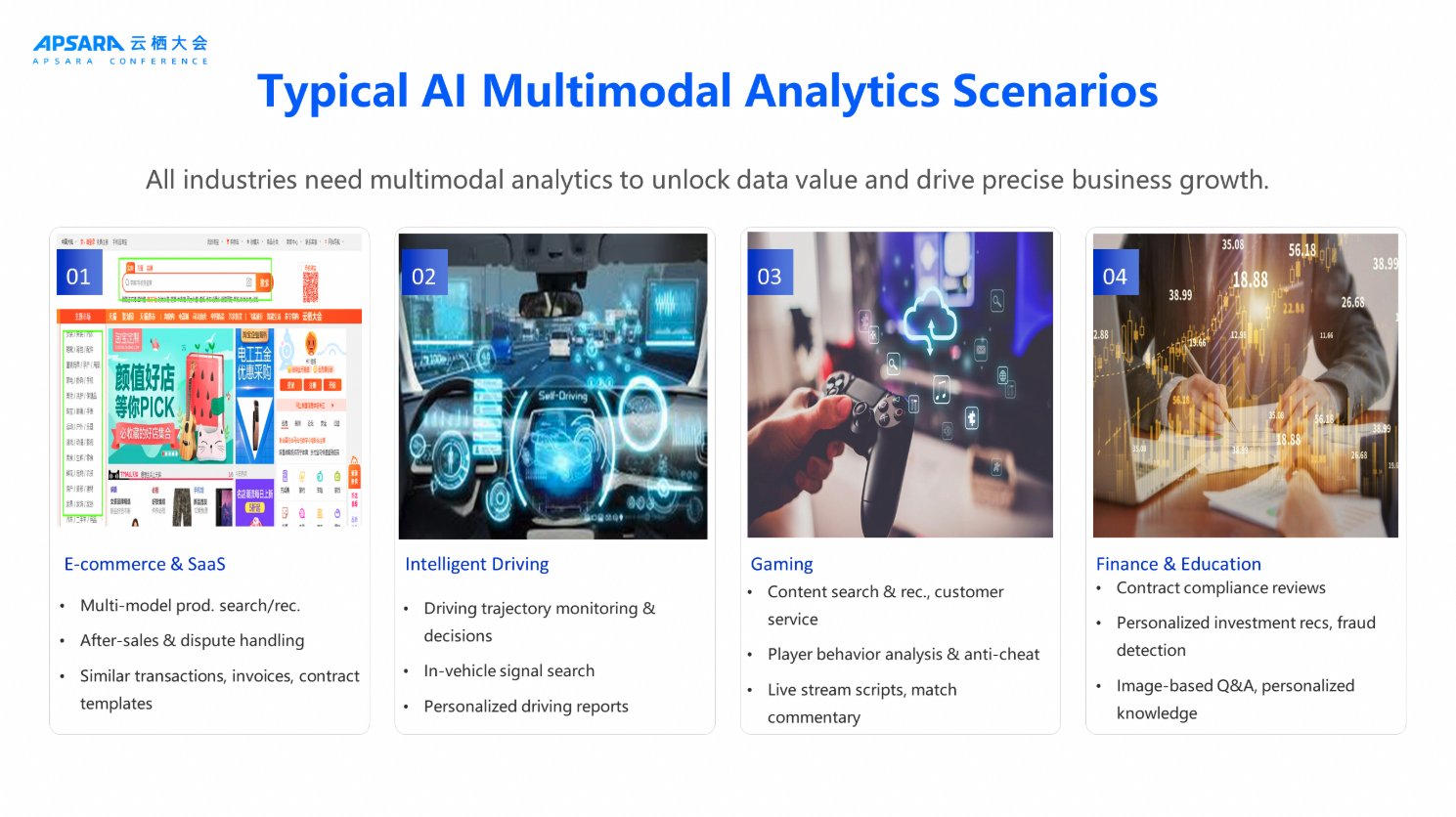
As AI advances, enterprises are moving beyond traditional structured data analysis. Industries now rely on multimodal data—combining text, images, logs, sensor signals, and more—to power intelligent decision-making across use cases like:
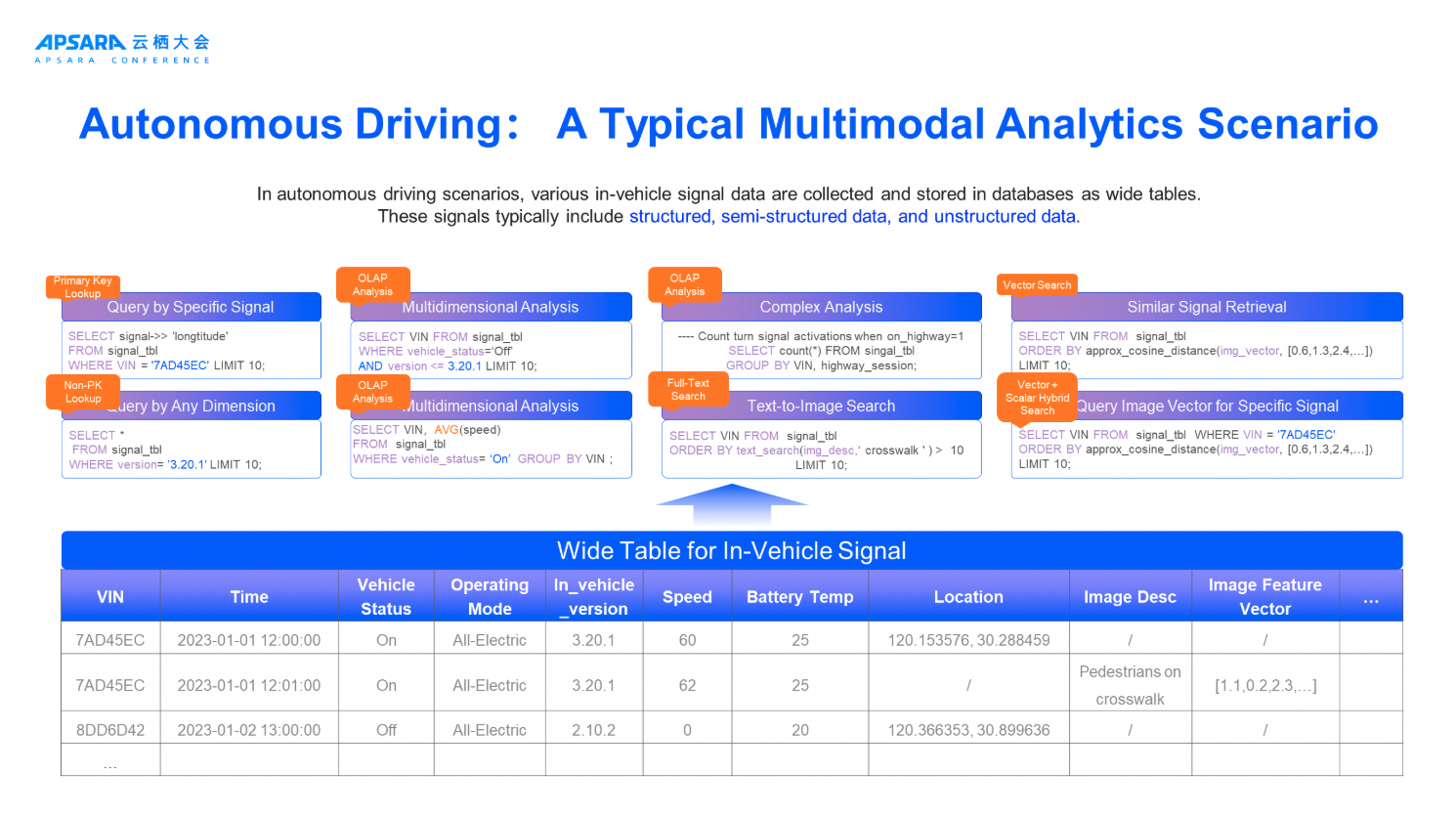
Take autonomous driving as an example: vehicle signals are stored as wide tables containing structured data (VIN, firmware version), semi-structured data (CAN bus messages in JSON), and unstructured data (trajectory images). Business applications require point lookups by VIN, OLAP aggregations, full-text search on logs, vector similarity on images, and even hybrid queries combining all modalities.
Yet today's architectures force developers to stitch together multiple specialized engines—leading to complexity, inconsistency, and high costs.
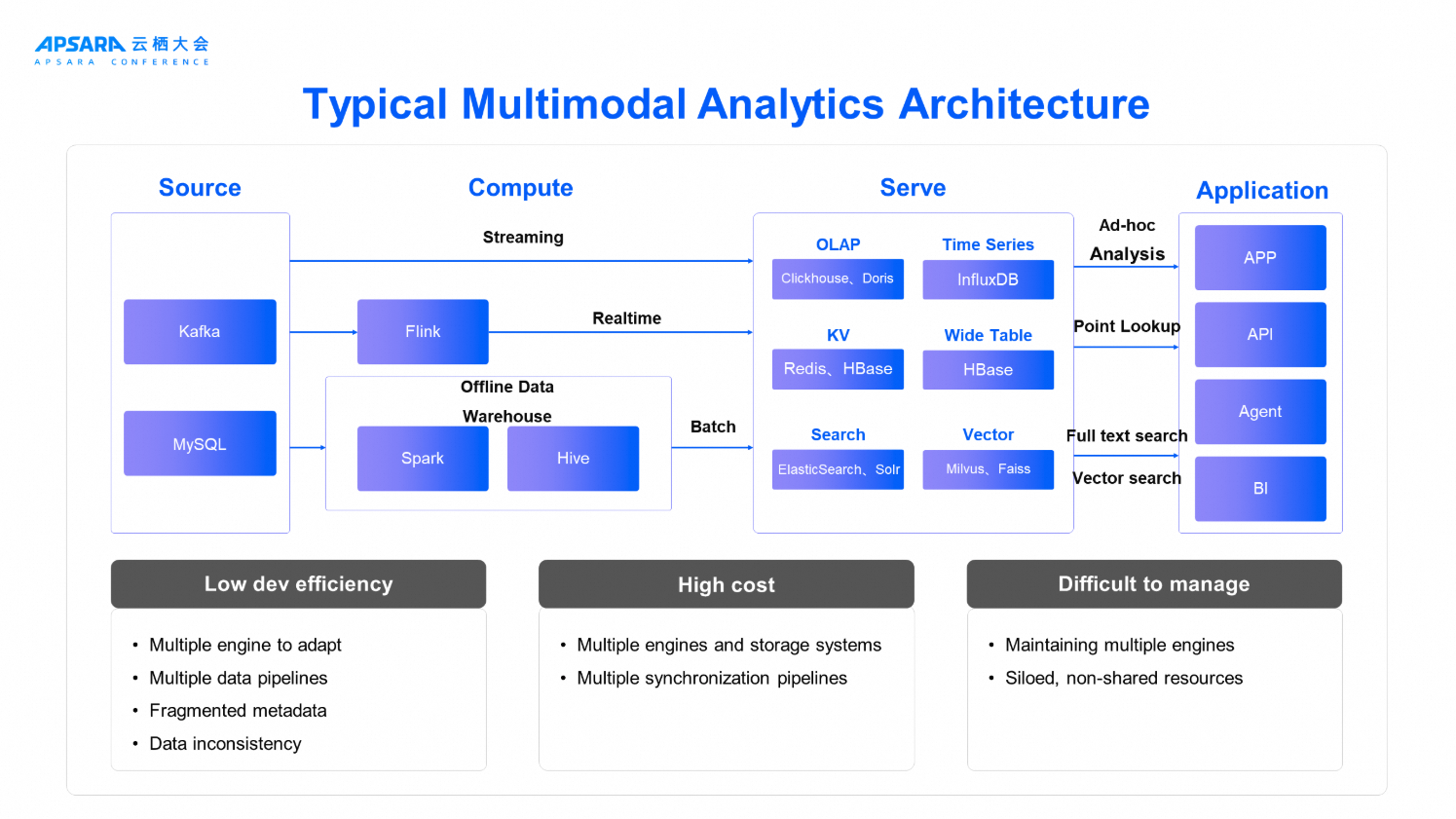
Most current systems follow a "layered data + multi-engine" model:
While each engine excels in its niche, this approach suffers from four critical flaws:
Worse, cross-modal queries—like "find vehicles with battery >40°C AND images containing crosswalks"—require manual result stitching in application code, resulting in slow, brittle logic.
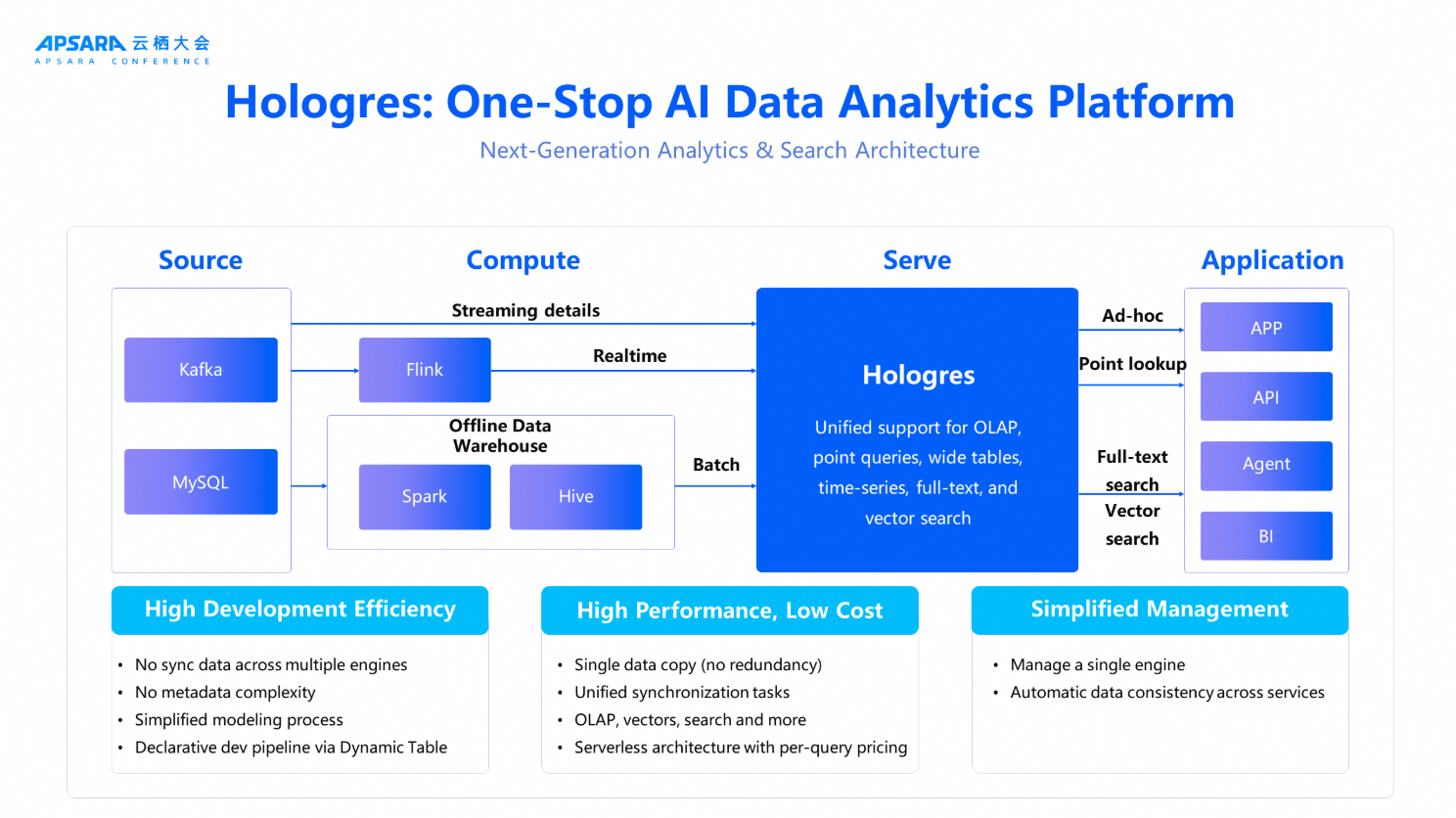
Hologres 4.0 introduces Hybrid Search/Analytics Processing (HSAP)2.0 —a unified architecture that consolidates OLAP, point lookup, full-text search, vector search, time-series, and wide-table workloads into a single engine. Dubbed the "hexagonal warrior" of analytics, it delivers:
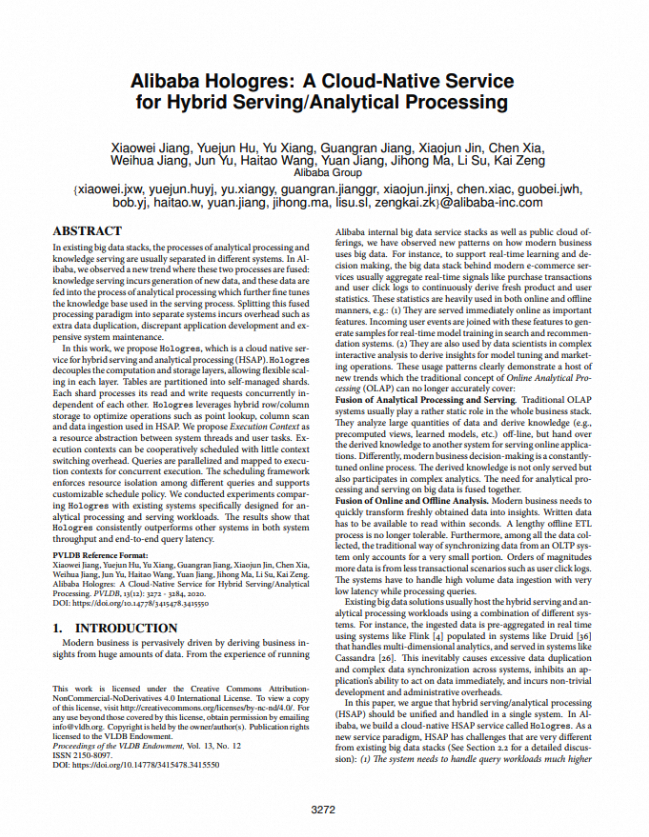
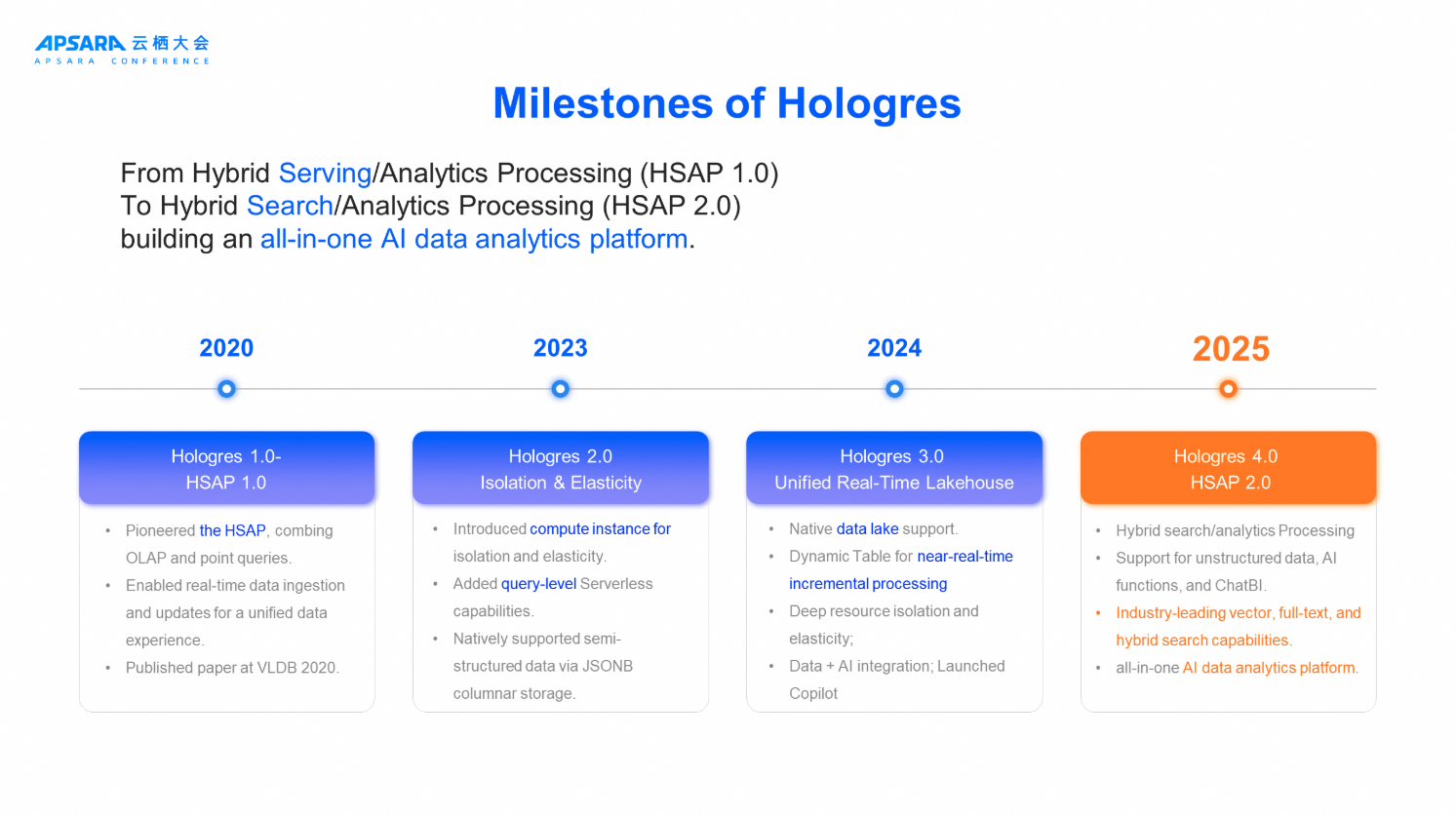
Since its launch in 2020, Hologres has been engineered from the ground up for high-performance analytics—and has consistently evolved in step with the shifting demands of modern data workloads. Its architectural journey mirrors the broader industry transition from siloed analytics to unified, AI-ready data infrastructure:
Hologres 1.0 (HSAP 1.0) introduced the concept of “unified analytics and serving processing,” seamlessly integrating OLAP and key-value point lookup in a single engine. This breakthrough eliminated the traditional divide between data warehouses and real-time serving systems. The architecture was recognized with a peer-reviewed publication at VLDB 2020.
Hologres 2.0 addressed cost and stability challenges by enhancing resource isolation, elastic scaling, and support for compute-group-based deployments. It also introduced native columnar storage for JSONB, significantly accelerating the processing of semi-structured data.
Hologres 3.0 embraced the lakehouse paradigm, enabling real-time interoperability with open data lake formats—including MaxCompute, Apache Paimon, and Apache Iceberg. With Dynamic Table, it delivered incremental computation directly on lake data, effectively replacing complex Lambda architectures with a simpler, more efficient model.
Hologres 4.0 (HSAP 2.0) marks a strategic leap into the AI era. Now reimagined as a “unified analytics and search processing” platform, it natively integrates vector search, full-text retrieval, and hybrid querying—all while embedding AI Functions that allow large language models to be invoked directly via SQL. This transforms Hologres into a full-stack engine for AI-native applications.
As enterprise demand for multimodal data processing surges—from text and images to telemetry and logs—Hologres is evolving beyond a high-performance structured data engine into the foundational infrastructure for AI-native, multimodal analytics.
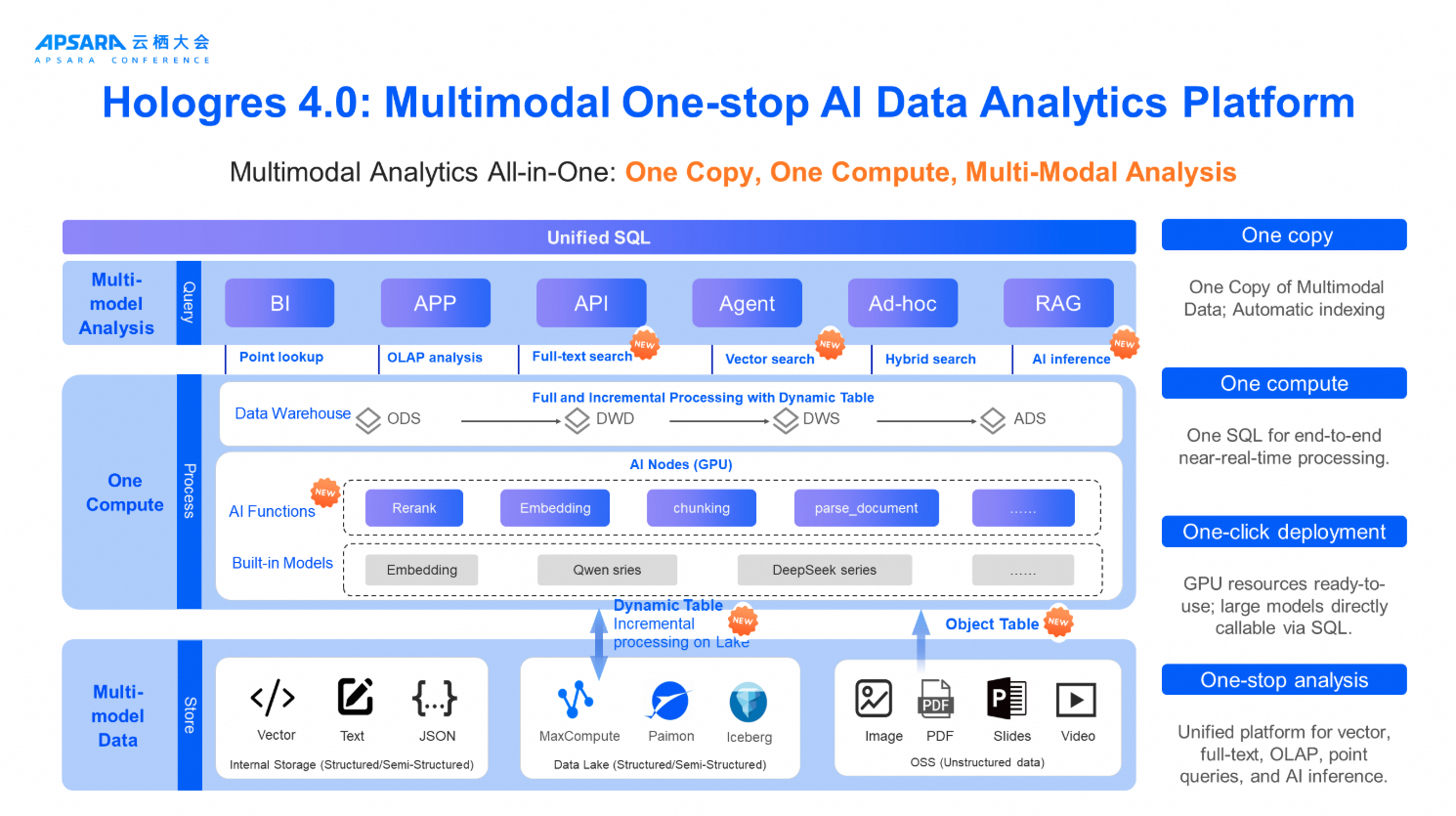
Hologres 4.0 is built around the vision of an “all-in-one multimodal analytics and search platform,” delivering a truly unified experience: one copy of data, one compute, and seamless multimodal analysis—all orchestrated through a single SQL statement that spans data ingestion, AI-powered transformation, and cross-modal querying.
Storage Layer
Hologres natively supports three types of data sources:
Processing Layer
Powered by Dynamic Table, Hologres enables near-real-time incremental computation. Users simply declare desired data freshness (e.g., “1-minute latency”), and the system automatically triggers incremental updates based on upstream changes—supporting diverse patterns like lake-to-warehouse, warehouse-to-warehouse, or lake-to-lake—while significantly reducing resource overhead.
AI Capability Layer
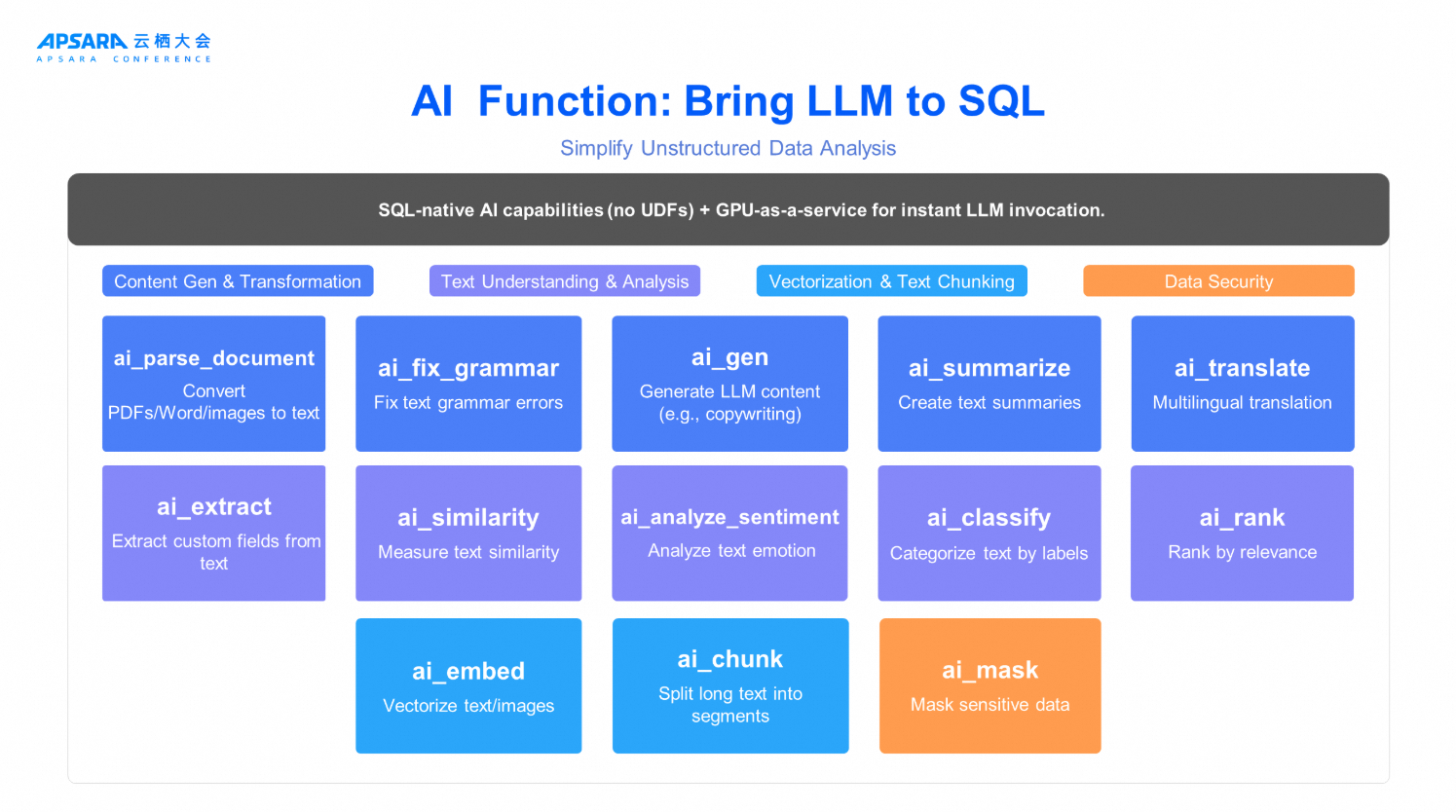
Hologres embeds a rich set of AI Functions, leveraging Alibaba Cloud's shared GPU pool and large language models like Qwen. These functions can be invoked directly in SQL for tasks such as:
ai_gen, ai_translate)ai_classify, ai_analyze_sentiment)ai_embed, ai_chunk)ai_mask)Analytics Layer
A unified SQL interface supports five core query paradigms:
Hologres 4.0 integrates OLAP analysis, point query services, full-text search, vector search, time-series processing, and KV wide tables into a single platform. However, as AI evolves rapidly, an all-in-one multimodal analytics platform requires advanced enterprise-grade capabilities to continuously enhance data processing and analysis efficiency. Hologres 4.0 introduces three key capabilities:
Directly access unstructured files (e.g., images, PDFs) in OSS via table-like interfaces, with automatic synchronization of file metadata. Users can query and process data without migrating it into the warehouse.
The system automatically detects data changes (additions, updates, deletions) in the data lake and triggers AI Functions for real-time processing.
Hologres 4.0 integrates a comprehensive suite of built-in AI Functions spanning content generation, text analysis, vectorization, and data security, enabling direct SQL-native invocation—such as ai_embed(file) for converting images/text into vectors and ai_gen('Describe the image', file) for generating image-text summaries—without requiring UDFs or external service maintenance, while leveraging Alibaba Cloud's GPU resource pool for out-of-the-box large model execution with no pre-provisioning needed.
Hologres provides unified, high-performance multimodal analytics. The entire pipeline is declaratively defined with just a few SQL lines, significantly lowering development barriers and operational costs.
Hologres 4.0 is more than a version upgrade—it's a fundamental reimagining of data analytics in the AI age. By unifying scalar, text, and vector data under one engine, integrating large models via SQL, and delivering serverless elasticity, it eliminates the fragmentation that has long plagued data architectures.
The future of analytics isn't a patchwork of tools—it's a unified, intelligent, and efficient platform. With Hologres 4.0, Alibaba Cloud empowers enterprises to build truly AI-native data systems, accelerating the journey toward intelligent, data-driven innovation.
Discover how Hologres 4.0 unifies analytics, search, and AI to power next-generation data applications—without the complexity of fragmented architectures.

27 posts | 0 followers
FollowApache Flink Community - July 28, 2025
Alibaba Cloud Community - February 3, 2026
Alibaba Cloud Native Community - November 4, 2025
Alibaba Cloud Native Community - November 6, 2025
Justin See - June 19, 2026
Alibaba Cloud Big Data and AI - January 21, 2026
27 posts | 0 followers
Follow Hologres
A real-time data warehouse for serving and analytics which is compatible with PostgreSQL.
Learn More Big Data Consulting for Data Technology Solution
Alibaba Cloud provides big data consulting services to help enterprises leverage advanced data technology.
Learn More Big Data Consulting Services for Retail Solution
Alibaba Cloud experts provide retailers with a lightweight and customized big data consulting service to help you assess your big data maturity and plan your big data journey.
Learn More Vector Retrieval Service for Milvus
A cloud-native vector search engine that is 100% compatible with open-source Milvus, extensively optimized in performance, stability, availability, and management capabilities.
Learn MoreMore Posts by Alibaba Cloud Big Data and AI

