Honorable Mention, Global AI Hackathon Series with Qwen Cloud
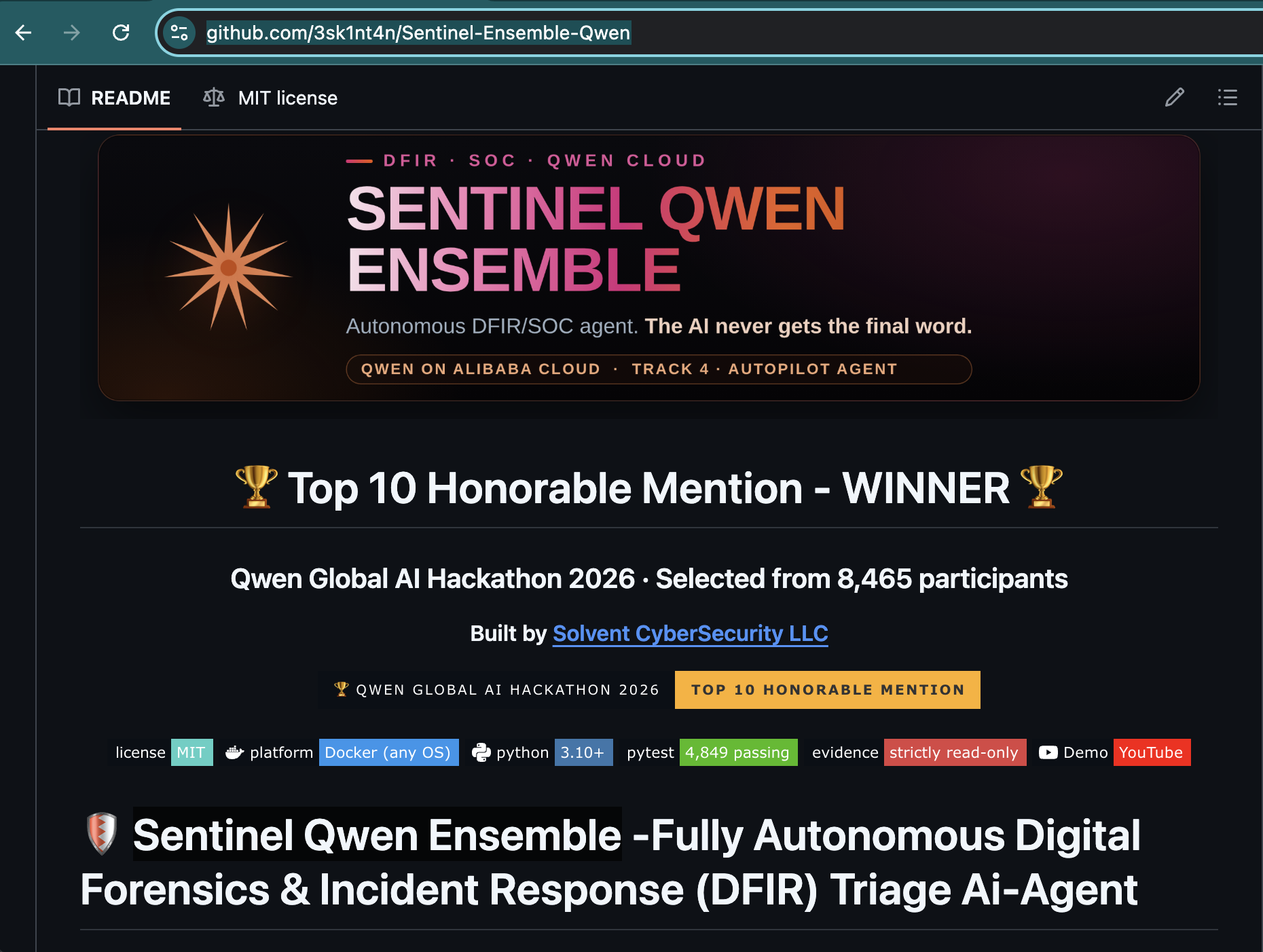
A security incident lands at 2 a.m. Memory images, disk evidence, event logs, process trees, network traces — all of it needs a specialist to sift through it, and that specialist is either asleep or already firefighting three other alerts. Sentinel Qwen Ensemble is built for that gap: a fully autonomous, agentic AI platform for Digital Forensics and Incident Response (DFIR) that uses Alibaba Cloud's Qwen models to investigate incidents, correlate forensic evidence, and generate investigation-ready reports.
But the headline isn't that it's autonomous. It's that it can't bluff. Its evidence-first architecture pairs multi-model AI reasoning with deterministic validation, so every claim is checked against real forensic artifacts before it's allowed to stand.
Cybersecurity teams face overwhelming alert volumes, complex evidence, and investigations that demand rare expertise. Traditional DFIR means manually examining memory, disks, logs, processes, and network activity — work that stretches across hours or days while an attacker's dwell time ticks upward.
Sentinel automates forensic triage, correlates evidence across sources, and produces reports an analyst can actually act on. The critical distinction from a generic AI assistant: conventional models may generate plausible-sounding but entirely unsupported conclusions, which in a security context is worse than useless. Sentinel verifies findings against actual forensic tool output, which reduces unsupported claims, improves consistency and auditability, and lets human analysts spend their attention on validated threats instead of repetitive investigation grunt work.
The system runs a deterministic 16-step investigation pipeline — a fixed, auditable procedure rather than a free-form chat. It ingests Windows memory images, disk evidence, and event logs while preserving forensic integrity through read-only access and SHA-256 verification, so the evidence chain holds up.
The genuinely novel piece is a custom Model Context Protocol (MCP) server that exposes 195 forensic tools through controlled interfaces — _without granting the AI shell access_. The model can call well-defined investigative tools, but it never gets loose on a live system. Qwen-powered agents analyze evidence, correlate suspicious activity, investigate potential attacks, and construct findings. Then a deterministic validation engine checks each AI claim against real artifacts, blocks unsupported conclusions, and triggers self-correction when a finding doesn't hold. The output is a structured report with findings, evidence references, an investigation timeline, and actionable indicators of compromise.
Alibaba Cloud Qwen models power the autonomous reasoning engine through the DashScope API. Qwen Plus and Qwen Max tiers are combined into a custom multi-model ensemble that performs forensic analysis, cross-artifact correlation, investigative reasoning, and self-correction — pairing Qwen's reasoning with the deterministic 16-step Python orchestration pipeline and the 195-tool MCP server. AI-generated findings must pass evidence-based validation before being classified as confirmed. The project was deployed on Alibaba Cloud Simple Application Server using Docker, demonstrating cloud-hosted execution with live Qwen connectivity.
The proof is in a documented public case: the Qwen-powered heavy analysis completed in about 14 minutes and 39 seconds, produced 44 findings, and reconstructed a complex intrusion involving command-and-control activity, lateral movement, data exfiltration, memory injection, and persistence. Most tellingly, the system distinguished 21 findings requiring human review from 23 benign findings — rather than incorrectly promoting unsupported conclusions to confirmed threats. That restraint is the whole point.
Adil Eskintan is a cybersecurity architect, security researcher, and co-founder of Solvent AI CyberSecurity, specializing in AI-driven security operations, digital forensics, incident response, and autonomous security systems. He designed and built Sentinel Qwen Ensemble independently, combining hands-on cybersecurity experience with agentic AI, with one goal: make advanced digital investigations faster, more accessible, explainable, and trustworthy — while keeping human analysts firmly in control of critical security decisions.
Explore the project: https://github.com/3sk1nt4n/Sentinel-Ensemble-Qwen
This project was developed as part of the Global AI Hackathon Series with Qwen Cloud.
Tarmac: Five AI Agents Negotiate the Storm, and One Mediator Signs the Ruling

140 posts | 29 followers
FollowAlibaba Clouder - June 10, 2019
Regional Content Hub - April 28, 2024
Alibaba Cloud Community - October 15, 2026
Neel_Shah - December 24, 2025
OpenAnolis - October 10, 2026
Alibaba Cloud Community - September 10, 2026
140 posts | 29 followers
Follow Token Plan
Build more, spend less. One plan, every modality.
Learn More QwenWork
 is dedicated to helping employees strengthen their professional competitiveness in the AI era and to enabling enterprises to improve organizational effectiveness.
Learn More Qwen
Full-range, open-source, multimodal, and multi-functional
Learn More
Alibaba Cloud Model Studio
A one-stop generative AI platform to build intelligent applications that understand your business, based on Qwen model series such as Qwen-Max and other popular models
Learn MoreMore Posts by Alibaba Cloud Project Hub

