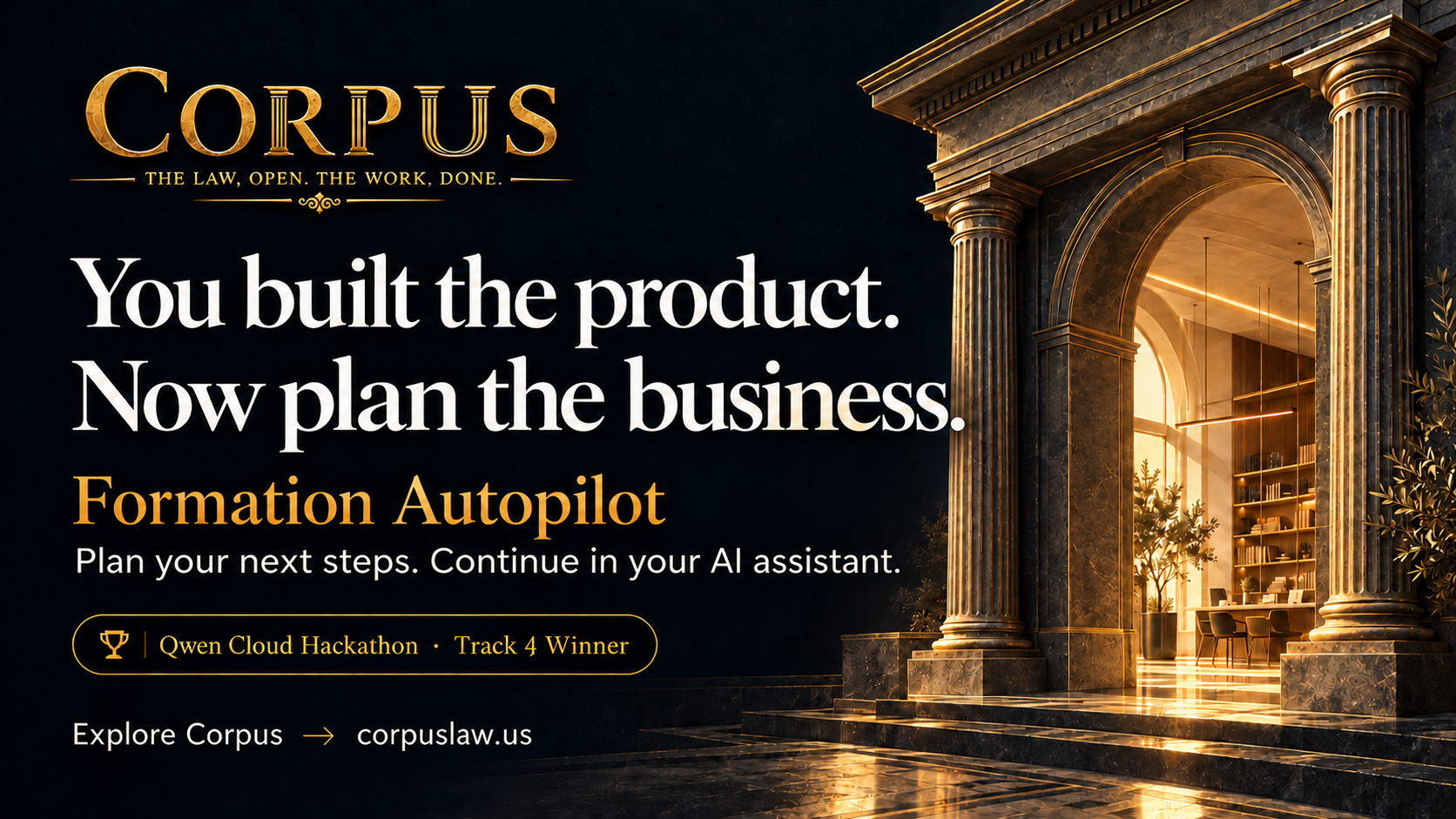
Track Winner — Track 4: Autopilot Agent, Global AI Hackathon Series with Qwen Cloud
Every founder knows the moment. The product finally works, the first customers are happy, the idea has momentum — and then someone asks a question nobody on the team can answer: what do we have to do to actually become a company? Suddenly the exciting work stops and a maze of unfamiliar rules, scattered guidance, and formation paperwork begins.
Corpus Formation Autopilot is built for exactly that moment. A Qwen-powered, open-source project and Track 4 winner of the Global AI Hackathon Series with Qwen Cloud, it connects a plain-language description of a business to legal-research and formation-draft tools, with a separate hosted workflow for reviewing details, payment, and filing. You built the product; Corpus helps you take the next step toward building the business. It began with a simple, stubborn conviction from its founder: people should be able to read the laws that govern them.
Turning an idea into a company has always meant navigating rules written for lawyers, information scattered across a dozen government sites, and formation documents that punish small mistakes. For a solo developer or an AI-assisted founder working late at night, that friction is the difference between shipping and stalling.
Corpus collapses that friction. It brings a searchable US law library, a free founder checklist, and a hosted formation workflow together with open-source AI tools, so a founder can start researching in plain language — and even reach Corpus directly from compatible AI assistants they already use. The project is refreshingly honest about its own limits, which is part of its value: legal coverage varies by jurisdiction, and generated guidance is a starting point for research that should always be checked against the underlying sources. It does not pretend to replace a lawyer; it replaces the terrified first hour of Googling.
The workflow is deliberately simple on the surface and carefully fenced underneath. You describe your business in the browser demo. Qwen then calls Corpus tools to search the available law, classify your business activity, and prepare a formation handoff. You review the returned information and follow the handoff into Corpus to check the draft details and current fees.
Developers get two more doors into the same toolkit: an open-source MCP bridge that lets compatible AI assistants connect to Corpus, and an embeddable widget for dropping the experience into another product. Crucially, the demo itself cannot charge you or file a company — payment and filing live in a separate, deliberate hosted workflow. That separation is a design choice about trust: the AI reasons and researches, while the irreversible, money-touching steps stay behind an explicit human checkpoint.
Under the hood, Qwen powers the agent, with qwen-flash and qwen3.7-max configured in an Alibaba Cloud Function Compute backend — serverless compute that scales with demand and keeps a founder-facing tool cheap to run. The Apache-2.0 Corpus Agent Kit is the connective tissue: it wires the model to law-search, business-activity, and formation-handoff tools, and ships the MCP bridge and embeddable widget so one toolkit can serve both browser experiences and compatible AI assistants.
The architecture is a clean example of a pattern more builders are adopting — connecting model reasoning to concrete, verifiable tools rather than asking the model to hallucinate an answer. Qwen decides what to look up and how to classify it; the tools return grounded results; and the money and legal-filing steps stay in a separate hosted workflow. Source accuracy and applicability still require verification, and the project says so plainly.
Corpus is led by founder Tyler Eakes and built for people turning ideas into real businesses. Its mission is to make starting a company and understanding its rules accessible to the next generation of founders. The tagline says it best: The law, open. The work, done.
Open-source toolkit: https://github.com/teakesdev/corpus-agent-kit
This project was developed as part of the Global AI Hackathon Series with Qwen Cloud.

136 posts | 29 followers
FollowAlibaba Cloud Big Data and AI - April 15, 2026
Apache Flink Community - February 20, 2025
Alibaba Clouder - March 19, 2020
Alibaba Clouder - July 22, 2020
PM - C2C_Yuan - June 24, 2026
Hosung Kim - August 17, 2026
136 posts | 29 followers
Follow Token Plan
Build more, spend less. One plan, every modality.
Learn More Qwen
Full-range, open-source, multimodal, and multi-functional
Learn More QwenWork
 is dedicated to helping employees strengthen their professional competitiveness in the AI era and to enabling enterprises to improve organizational effectiveness.
Learn More Qoder
From Assisted to Autonomous — Adapting to Every Programming Need
Learn MoreMore Posts by Alibaba Cloud Project Hub

