Track Winner, Global AI Hackathon Series with Qwen Cloud
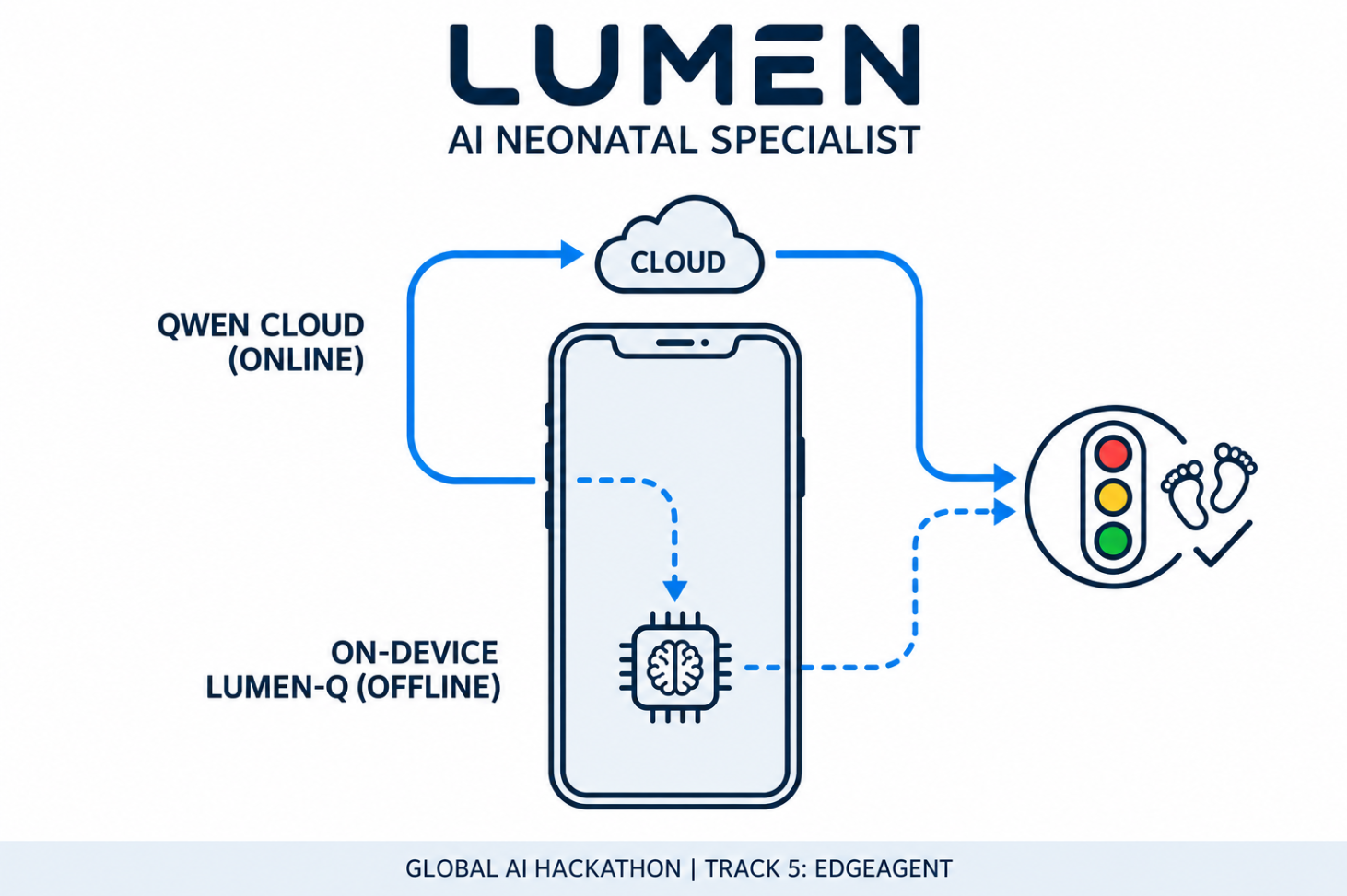
Picture a community health worker walking to a home visit in a village with no doctor, no lab, and — today — no signal. In her pocket is a phone. On that phone is LUMEN, an AI neonatal danger-sign screener that follows the WHO IMNCI protocol. When the network is up, it reasons with the full power of Qwen Cloud. When the connection drops mid-visit, it switches automatically to a fine-tuned Qwen3-VL-4B running locally on the phone or a laptop. The visit never stalls. That single design decision — cloud and device, one clinical logic — is what separates LUMEN from every cloud-only demo.
The stakes could hardly be higher. Every year 2.3 million newborns die in their first 28 days, about three quarters of them in sub-Saharan Africa and South Asia. Most of those deaths are preventable when danger signs are caught early. Yet in many villages the only health contact a baby ever gets is a community health worker, and field studies put their danger-sign detection anywhere from 33% to 91% — a range so wide it's practically a coin flip.
A paper checklist cannot read a photo, compute a drug dose, or remember last week's visit. A cloud-only AI fails exactly where the network is weakest — which is precisely where these babies live. An offline-only model gives up the strongest reasoning available. LUMEN refuses the trade-off. It gives the health worker an AI neonatal specialist in their pocket wherever the visit happens, with doses computed safely, a clear RED / YELLOW / GREEN decision, and a supervisor in the loop for every serious case.
One guided visit drives the entire workflow. Voice intake works in 12 languages. Seven camera-guided photos capture the face, eyes, chest, umbilicus, full body, foot sole, and optionally the placenta. A tap-to-count breathing-rate tool flags 60 or more breaths a minute. A 10-second cry recording is captured for audio analysis.
Behind that simple flow, a team of agents works the case: Visual, Audio, Classifier, and Triage agents, plus a Memory agent that recalls prior visits and tracks jaundice or weight trends. LUMEN returns 21 danger-sign checks, a WHO IMNCI RED / YELLOW / GREEN result, an action plan, a referral letter, and a follow-up date. And here is the safety-critical detail: every dose, z-score, and ORS volume is computed in code with hard WHO caps, so the model never writes a number. RED and YELLOW cases route to a supervisor queue for sign-off. A failover router picks cloud or device for each request based on connectivity, latency, and privacy, and offline visits are queued on the device and synced when the connection returns.
Each stage is matched to the Qwen model built for it, through Model Studio's OpenAI-compatible API: qwen3-vl-plus reads the seven photos, qwen3-omni-flash listens to the cry recording natively, and qwen3.7-plus runs the IMNCI synthesis with tool calling. The five WHO clinical skills — capped dosing, weight-for-age z-score, ORS volume, referral, follow-up — run as an MCP server consumed by Qwen-Agent, so Qwen chooses the tool and the tool computes the number. That division keeps the model out of the arithmetic entirely.
The offline path is a feat in itself. The builder fine-tuned Qwen3-VL-4B-Instruct with two-stage QLoRA on a single RTX 4070 into a model called LUMEN-Q, then exported it to a 4-bit GGUF that runs through llama.cpp on a laptop and on Android via a native JNI bridge. On 150 held-out neonatal images, LUMEN-Q raised parseable clinical answers from 65% to 100% and roughly quadrupled triage accuracy. Cloud and device share one streaming and tool-call core, so the router can hand any request to either side with identical clinical logic.
Marc Donovici is an independent AI builder based in Strasbourg, France. By day he's a technology auditor at a major French bank and the AI lead for its Internal Audit function — he built the department's AI roadmap and audited the group's own AI architecture. Outside work he builds AI projects that put help where it's hardest to reach; his tuberculosis screener, FieldScreen AI, placed 3rd in Google's MedGemma Impact Challenge, and in 2026 he was a European Patent Office CodeFest finalist. He works solo, end to end: model fine-tuning, backend, Android app, and demo film. LUMEN is open source under Apache-2.0 (github.com/Marc-Dvci/LUMEN and /LUMEN-Mobile), and his parting words were a thank-you to the Qwen and Alibaba Cloud teams "for a hackathon that fits the places where this work matters most."
Explore the project: https://youtu.be/h8hPsUjZMuU
This project was developed as part of the Global AI Hackathon Series with Qwen Cloud.

138 posts | 29 followers
FollowAlibaba Cloud Community - October 23, 2026
Alibaba Cloud Community - September 29, 2024
Alibaba Cloud Community - October 23, 2026
Alibaba Cloud Community - October 28, 2026
Kalpesh Parmar - May 5, 2026
ApsaraDB - July 22, 2026
138 posts | 29 followers
Follow Token Plan
Build more, spend less. One plan, every modality.
Learn More QwenWork
 is dedicated to helping employees strengthen their professional competitiveness in the AI era and to enabling enterprises to improve organizational effectiveness.
Learn More Qwen
Full-range, open-source, multimodal, and multi-functional
Learn More
Alibaba Cloud Model Studio
A one-stop generative AI platform to build intelligent applications that understand your business, based on Qwen model series such as Qwen-Max and other popular models
Learn MoreMore Posts by Alibaba Cloud Project Hub

