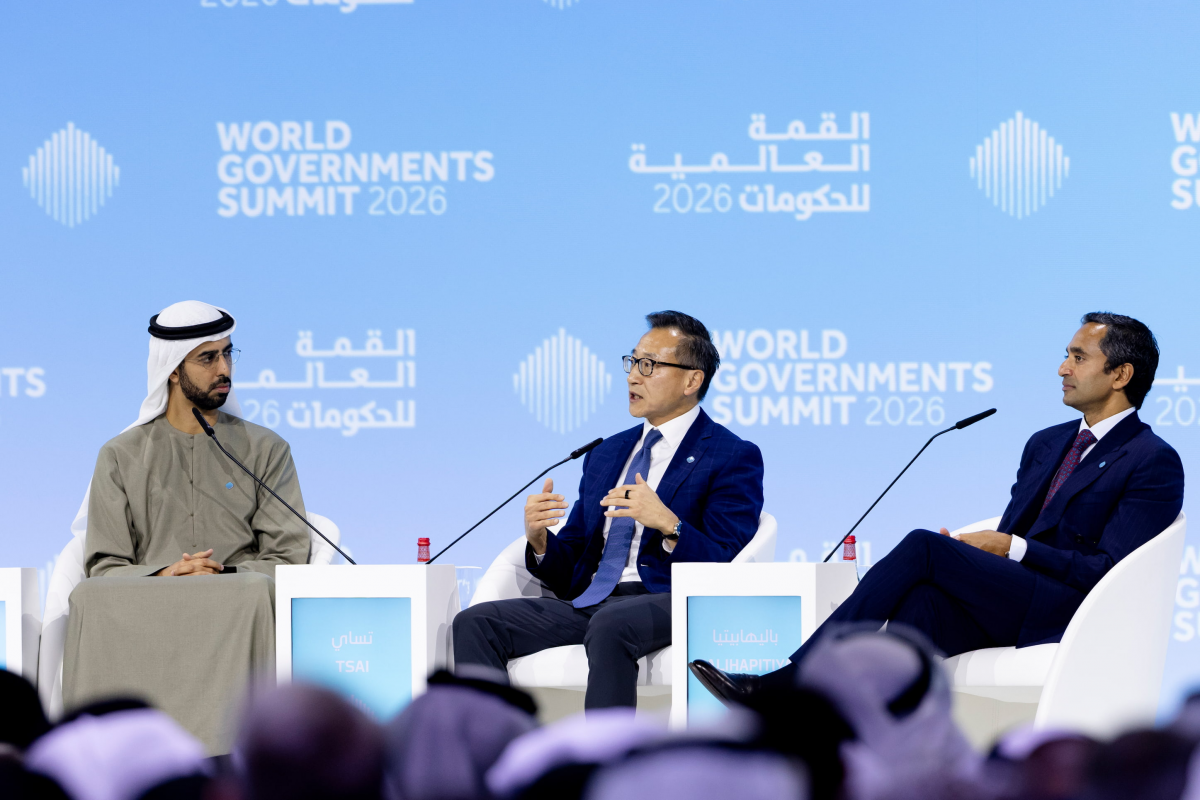
As open-source AI ascends in the global technology landscape, the key question remains centered around the economics: how might open-source AI providers generate lasting commercial value and thereby support the innovation momentum. Joe Tsai, co-founder and Chairman of Alibaba Group, presented his insights, arguing that integrated, full-stack companies hold a competitive advantage in this new paradigm.
At the recent World Government Summit (WGS) 2026 in Dubai, Tsai delineated the distinction of two types of open-source AI providers. Pure-play model developers who navigate the inherent challenges of monetizing directly from open-source models. On the other hand, full-stack technology providers, like Alibaba and Google, which operate across the entire value chain from cloud infrastructure, foundational models, to applications. This full-stack positioning allows them to capture value in other layers of tech stack, such as selling cloud computing services.
“Our Qwen model is open source, but we also run our cloud business and today we’re monetizing because people are training, developing and running inference for their models on our infrastructure,” Tsai noted during the WGS panel.
Alibaba’s full-stack positioning is already delivering results, driving continued acceleration of Alibaba Cloud revenue growth to 34% in the September quarter of 2025, with AI-related revenue posting triple-digit growth for the ninth consecutive quarter.
This unique positioning has also garnered recognition. A recent report from Goldman Sachs in mid-January highlighted that Alibaba, with its full stack AI capabilities, is one of the best positioned China mega-cap stocks into the long-term. Alibaba was also recognized by Omdia as a distinct “full stack AI service provider” in 2025.
Since the release of its first model in August 2023, Alibaba’s Qwen family of models have been the most adopted model globally, with over one billion downloads and more than 200,000 derivative models across 119 languages and dialects. The company continues to advance its model capabilities, having launched the flagship Qwen3-Max for complex tasks in 2025 and the reasoning-optimized Qwen-Max-Thinking, which delivers leading benchmark performance.
On the consumer side, the Qwen App launched in November 2025 and has already become the fastest growing AI app globally with over 100 million monthly active users. In January, Alibaba transformed the Qwen app into a multi-platform agentic assistant, integrating core ecosystem services from shopping, instant delivery to travel.
Alibaba announced an investment of over 380 billion yuan (approx. US$53 billion) in AI and cloud infrastructure, underscoring a deep commitment to building further its full stack AI capabilities.
This article was originally published on Alizila written by Jing Wang.

1,546 posts | 518 followers
FollowAlibaba Cloud Community - June 22, 2026
Alibaba Cloud Community - April 2, 2025
Alibaba Cloud Community - May 31, 2024
Alibaba Cloud Community - March 24, 2026
Alibaba Cloud Community - September 25, 2026
Alibaba Cloud Community - March 20, 2026
1,546 posts | 518 followers
Follow Alibaba Cloud Model Studio
A one-stop generative AI platform to build intelligent applications that understand your business, based on Qwen model series such as Qwen-Max and other popular models
Learn More QwenWork
QwenWork is dedicated to helping employees strengthen their professional competitiveness in the AI era and to enabling enterprises to improve organizational effectiveness.
Learn More
Token Plan
Build more, spend less. One plan, every modality.
Learn More Qwen
Qwen
Full-range, open-source, multimodal, and multi-functional
Learn MoreMore Posts by Alibaba Cloud Community

