Category: AI-Native Database Capability
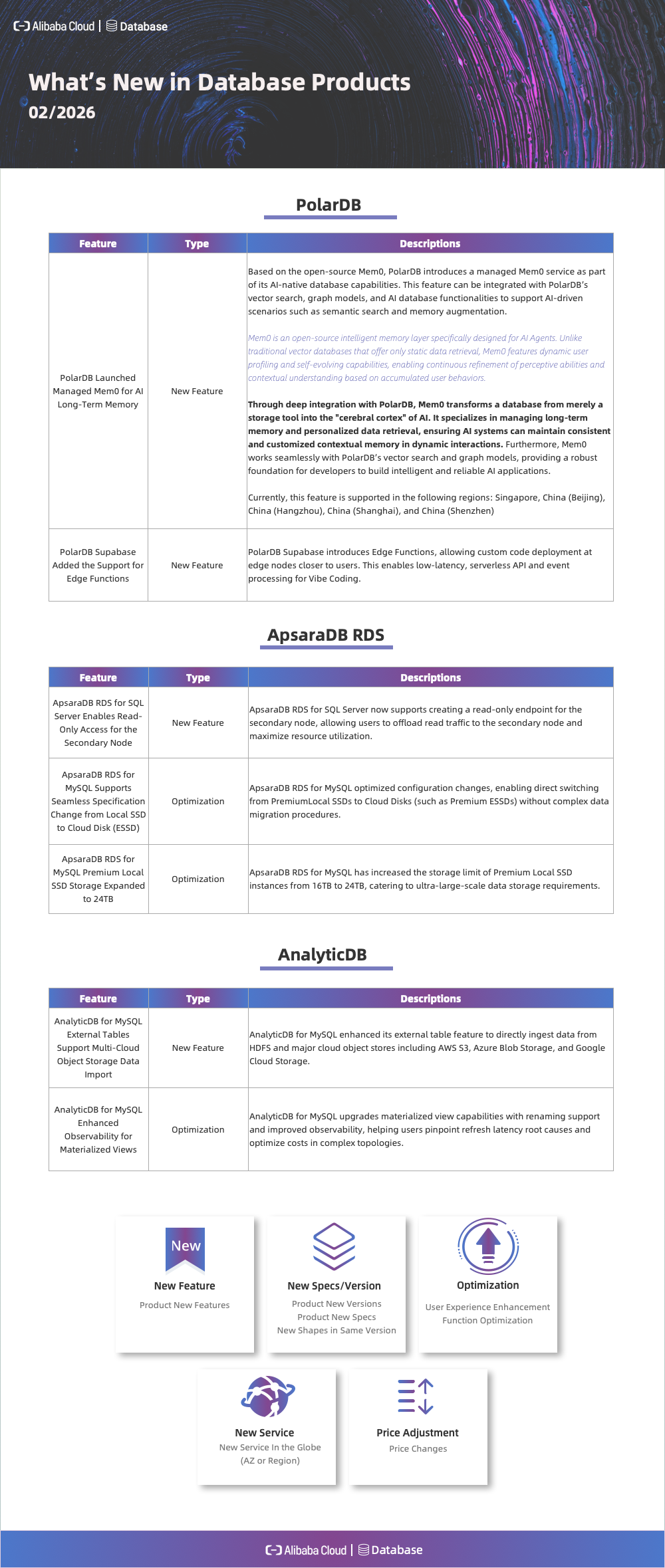
This feature marks a strategic transition from traditional databases to "AI-Native" databases. It addresses one of the most critical challenges in Generative AI today: Context Window Limits. Large Language Models (LLMs) often struggle to retain information across long conversations. Mem0 acts as an external "cerebral cortex," providing AI applications with persistent, evolving memory without requiring developers to architect complex vector database solutions from scratch.
PolarDB has integrated the open-source Mem0 framework directly into its managed service. Unlike standard vector search which offers static data retrieval, Mem0 enables dynamic user profiling. It allows the database to:
Getting Started: https://polardb.console.alibabacloud.com/ap-southeast-1/mem0
Category: Cost Optimization & Performance
This is a pure Cost Optimization and Performance win. Historically, in SQL Server Always-On availability groups, the secondary node sits idle, acting only as a passive backup waiting for failover. This feature transforms that "passive insurance policy" into an active asset, allowing businesses to extract maximum value from the hardware they are already paying for.
ApsaraDB RDS for SQL Server now supports creating a dedicated read-only endpoint connected to the secondary node. This capability allows users to:
Category: Data Flexibility & Integration
In the modern data landscape, information is rarely siloed in a single location. Organizations often manage legacy data on-premise (HDFS) or adopt multi-cloud strategies (AWS S3, Azure Blob). This feature breaks down Data Silos and enables true Data Lakehouse architectures, eliminating the pain of building and maintaining complex ETL (Extract, Transform, Load) pipelines.
AnalyticDB for MySQL has enhanced its External Table feature to directly ingest and query data from diverse sources, including:
This means data does not necessarily need to be copied into AnalyticDB first; it can be queried in place or imported seamlessly for high-speed analysis, bridging the gap between storage and compute.
Tair (Redis® OSS-Compatible) Imperceptible Switchover Technology Ensures Business Continuity
ApsaraDB - April 20, 2026
ApsaraDB - May 21, 2026
ApsaraDB - February 27, 2026
ApsaraDB - August 25, 2026
ApsaraDB - March 17, 2023
ApsaraDB - July 22, 2026
 PolarDB for PostgreSQL
Alibaba Cloud PolarDB for PostgreSQL is an in-house relational database service 100% compatible with PostgreSQL and highly compatible with the Oracle syntax.
Learn More
PolarDB for Xscale
Alibaba Cloud PolarDB for Xscale (PolarDB-X) is a cloud-native high-performance distributed database service independently developed by Alibaba Cloud.
Learn More
PolarDB for MySQL
Alibaba Cloud PolarDB for MySQL is a cloud-native relational database service 100% compatible with MySQL.
Learn More Database Migration Solution
Migrating to fully managed cloud databases brings a host of benefits including scalability, reliability, and cost efficiency.
Learn MoreMore Posts by ApsaraDB


