Today, as large model inference enters the "Age of Agents," KV Cache has evolved from a performance optimization technique into a system-level infrastructure. The traditional "in-GPU-memory caching" paradigm is no longer sustainable under demanding scenarios such as long-context processing and multi-turn interactions. Although multi-tier KV Cache architectures—embodying the "storage-over-computation" principle—have overcome capacity bottlenecks, they introduce a high-dimensional configuration space shaped by the interplay of model architecture, hardware platforms, inference engines, and caching policies. The central challenge in large-scale deployment now lies in identifying the optimal trade-off among latency, throughput, and cost while satisfying Service Level Objectives (SLOs) such as latency and throughput targets.
To address this challenge, the Alibaba Cloud Tair KVCache team, in collaboration with the Heterogeneous Computing Software-Hardware Co-Design team, introduces Tair-KVCache-HiSim—the first high-fidelity simulation and analysis tool specifically designed for distributed multi-tier KV Cache management in large language model (LLM) inference. By comprehensively modeling the full request lifecycle, multi-level KV Cache behaviors, and heterogeneous batched execution, Tair-KVCache-HiSim achieves end-to-end performance prediction with <5% error on commodity CPUs at a cost advantage of 390,000× compared to real hardware trials.
More importantly, Tair-KVCache-HiSim leverages real-world workloads to automatically explore the Pareto frontier under user-specified Service Level Objective (SLO) constraints, thereby enabling three critical decision-making capabilities:
This series of technical articles will systematically disassemble the evolution path of KVCache technology for agent inference:
Tair KVCache, as an extension of the Tair product capabilities of Alibaba Cloud Database, is essentially a three-time transition of the caching paradigm:
🔹From Redis's "cache data → Reduce I/O"
🔹To GPU KVCache's "cache calculation intermediate state → reduce repeated calculation"
🔹Then to Tair KVCache's "large-scale and agent attention state management → reconstruction of large-scale model inference cost model", it indicates that the cache is being upgraded from auxiliary components to the core capability of AI infrastructure layer-making "state" storable, shareable and schedulable, supporting the large-scale inference base in the era of agent.
In the current context of rapid deployment and large-scale adoption of Large Language Model (LLM) inference services, the performance of inference systems directly determines user experience, service cost, and resource efficiency. Key performance metrics—such as Time to First Token (TTFT), Time per Output Token (TPOT), and system-level throughput—have become core criteria for evaluating the effectiveness of inference engines. In real-world deployment scenarios, these metrics are highly sensitive to a complex interplay of multiple factors, including model architecture (e.g., parameter count, sparsity), hardware platforms (e.g., computational capacity and memory bandwidth characteristics of GPUs such as A100 or H100), inference engine implementations (e.g., scheduling and KV cache management strategies in vLLM, SGLang, TensorRT-LLM), and runtime configurations (e.g., quantization schemes, batching policies, and parallelization modes).
To support the design and optimization of efficient, low-cost inference systems, we require a performance evaluation methodology that is high-fidelity, scalable, and reproducible. Traditional approaches relying on end-to-end stress testing over real GPU clusters are not only prohibitively expensive in hardware costs and time-consuming in experimentation, but also ill-suited for systematically exploring the vast combinatorial space of configurations.
In this context, the need for a CPU-based inference performance simulation framework has emerged. Specifically, we aim to replay realistic inference workload traces—collected from production environments or representative scenarios—on commodity CPU platforms to enable fast, low-cost, and high-accuracy prediction and comparison of key performance metrics, including TTFT, TPOT, and throughput, across diverse combinations of models, target GPUs, inference engines (e.g., vLLM, SGLang, TensorRT-LLM), and their runtime configurations.
Extending further to configurations of remote KV Cache, a set of interrelated factors critically influences inference performance:
These elements become especially pivotal in agent-centric applications where inference offloading to remote storage is required. When the KV Cache cannot fully reside in local GPU VRAM and must be partially or entirely migrated to remote storage, access latency directly impacts TTFT and TPOT . Moreover, if the eviction policy mismatches the request pattern—such as frequently evicting high-reuse early-layer KV states during long-context dialogues—it can cause a sharp drop in cache hit rate, triggering redundant computation or excessive I/O overhead. Additionally, improper TTL settings may lead to either premature invalidation (reducing reuse efficiency) or memory exhaustion (starving subsequent requests of resources).
Consequently, the design of remote KV Cache systems fundamentally entails a fine-grained trade-off under four-dimensional constraints: capacity, latency, throughput, and cost. To navigate this complex space, we require a simulation methodology that integrates inference performance modeling with accurate emulation of cache hit rates and data transfer dynamics. This enables quantitative evaluation of how different KV Cache configuration combinations affect end-to-end inference SLOs—such as P99 latency ≤ 200 ms and throughput ≥ 50 req/s—thereby providing actionable insights for optimizing cache hierarchies in heterogeneous inference architectures.
To build an effective performance simulator, one must first accurately model the execution logic of real-world inference engines. Typical LLM inference serving systems—such as vLLM, SGLang, and TensorRT-LLM—commonly adopt an architecture based on asynchronous request scheduling coupled with continuous or dynamic batching, dynamically aggregating Prefill and Decode requests to maximize hardware utilization. The core components and workflow are as follows:
In high-performance LLM inference engines such as SGLang, a single request is not processed sequentially from arrival to completion; instead, it is embedded into a deeply pipelined and asynchronously coordinated processing pipeline. This pipeline leverages mechanisms including CPU-GPU co-execution, multi-level cache prefetching, and dynamic batching to maximize throughput while ensuring low latency.
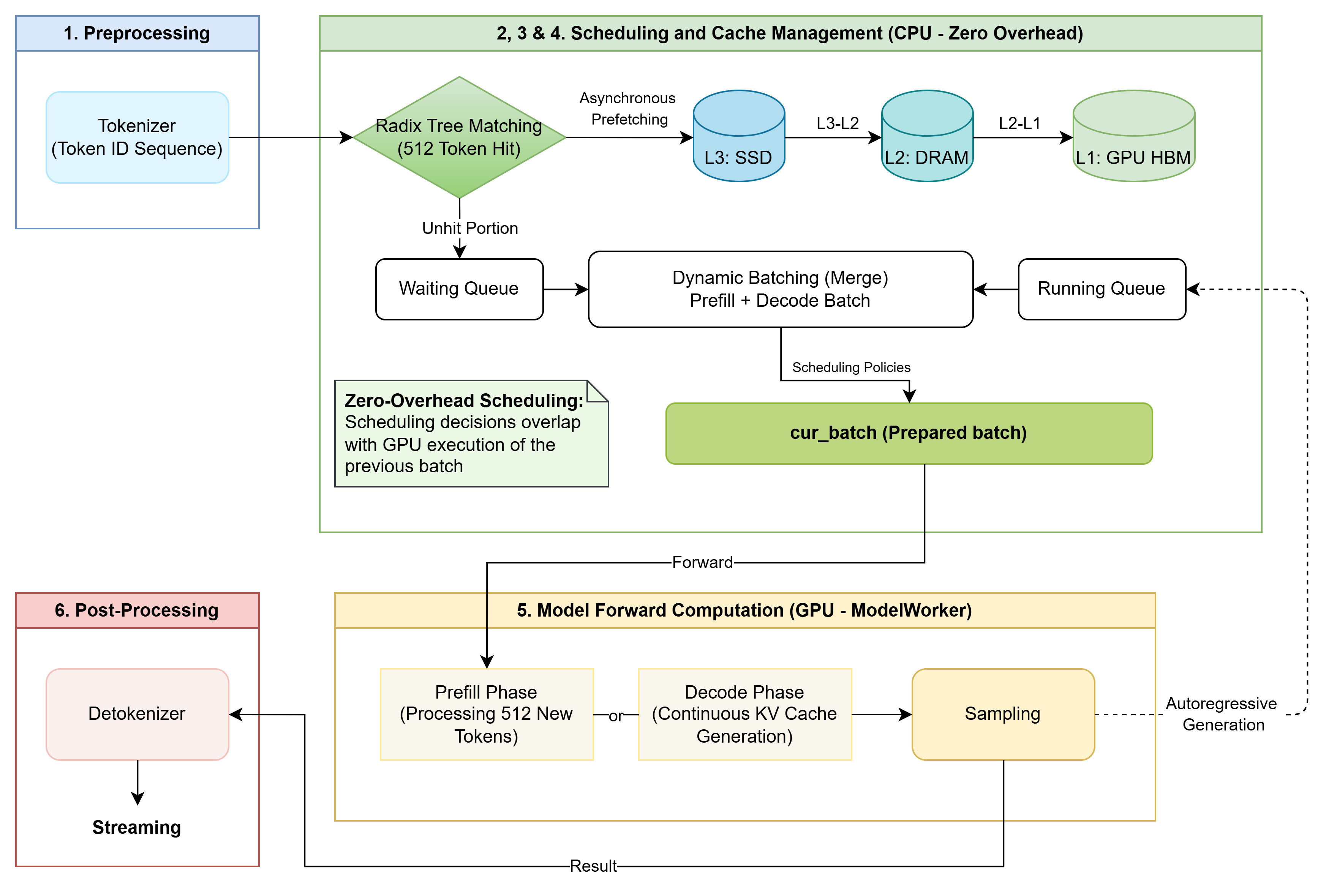
Taking a typical scenario as an example: a user submits a prompt of 1K tokens and expects to generate 512 output tokens, where the first 512 tokens of the prompt match a prefix from historical dialogue (i.e., achieving a 50% KV Cache hit rate). The complete lifecycle of this request is as follows:
1. Request Ingestion and Frontend Processing
The request is first routed by a load balancer to a specific inference instance. On the CPU, the service performs tokenization, converting the input text into a sequence of token IDs, which is then passed to the scheduler.
2. Prefix Cache Matching and State Identification
The engine rapidly searches for the prompt’s historical context on the CPU using a Radix Tree. If the first 512 tokens are found in the KV Cache, this segment is marked as “reusable”, and only the corresponding key/value tensors are loaded—eliminating redundant computation.
3. Asynchronous Cache Prefetching and Zero-Overhead Scheduling
4. Dynamic Batching Scheduling
The scheduler combines multiple ready requests—including both new Prefill requests and ongoing Decode requests—into a heterogeneous batch, based on available GPU memory, request priority, and cache readiness.
5. Phased Forward Model Execution
6. Post-processing and Streaming Output (Detokenization)
The output logits are sampled to produce token IDs, which are then converted back to text via a detokenizer. To enhance user experience, results are returned in a streaming fashion as soon as each token is generated.
Since LLM serving backends continuously receive new inference requests, determining the scheduling order of requests prior to each inference step is one of the core design considerations for the framework. With respect to scheduling policies for Prefill and Decode requests, four primary strategies can be identified:
| Framework | Prefill Priority | Decode Priority | ChunkPrefill | Prefill/Decode Separation |
|---|---|---|---|---|
| SGLang | ✅ default | ☐︎ | ❌ | ✅ |
| vLLM | ☐ | ✅ | ✅ default | ✅ |
| TensorRT-LLM | ☐ | ✅ default | ✅ | ✅ |
The strategies described above pertain to the scheduling priority between the Prefill and Decode phases. In practice, within the set of newly arrived requests (i.e., those in the Prefill phase), additional scheduling mechanisms can be layered on top. These include the widely adopted First-Come-First-Served (FCFS) policy, as well as others such as long-output-first and cache-aware longest-common-prefix-first scheduling.
As illustrated in the figure, the Prefill-first scheduling logic in SGLang structures a complete event loop of LLM inference into five main phases:
Among these, we focus primarily on the scheduling logic, which operates as follows:
● Scheduling Resource Constraints:
Whether a request can be promoted from the waiting queue to active execution is governed by four key resource limits:
All these parameters can be configured directly or indirectly via launch-time arguments.
● Scheduling Execution Order:
During scheduling, requests that were chunked in the previous iteration are prioritized for continuation. The remaining eligible requests are then ordered according to a specified priority policy (e.g., FCFS) and selected accordingly. Additionally, the scheduler dynamically decides whether to apply chunking to a request based on the remaining token capacity of the current batch.
● HiCache-Aware Scheduling with Multi-Level KV Cache:
When HiCache—a multi-tier KV Cache storage system—is enabled, the decision to schedule a request also depends on the configured prefetch policy, which can be one of:
best_effortwait_completetimeoutIf the prefetch operation has not met its termination condition under the chosen policy, the request remains in the prefetch queue and is not scheduled, allowing KV Cache prefetching to continue.
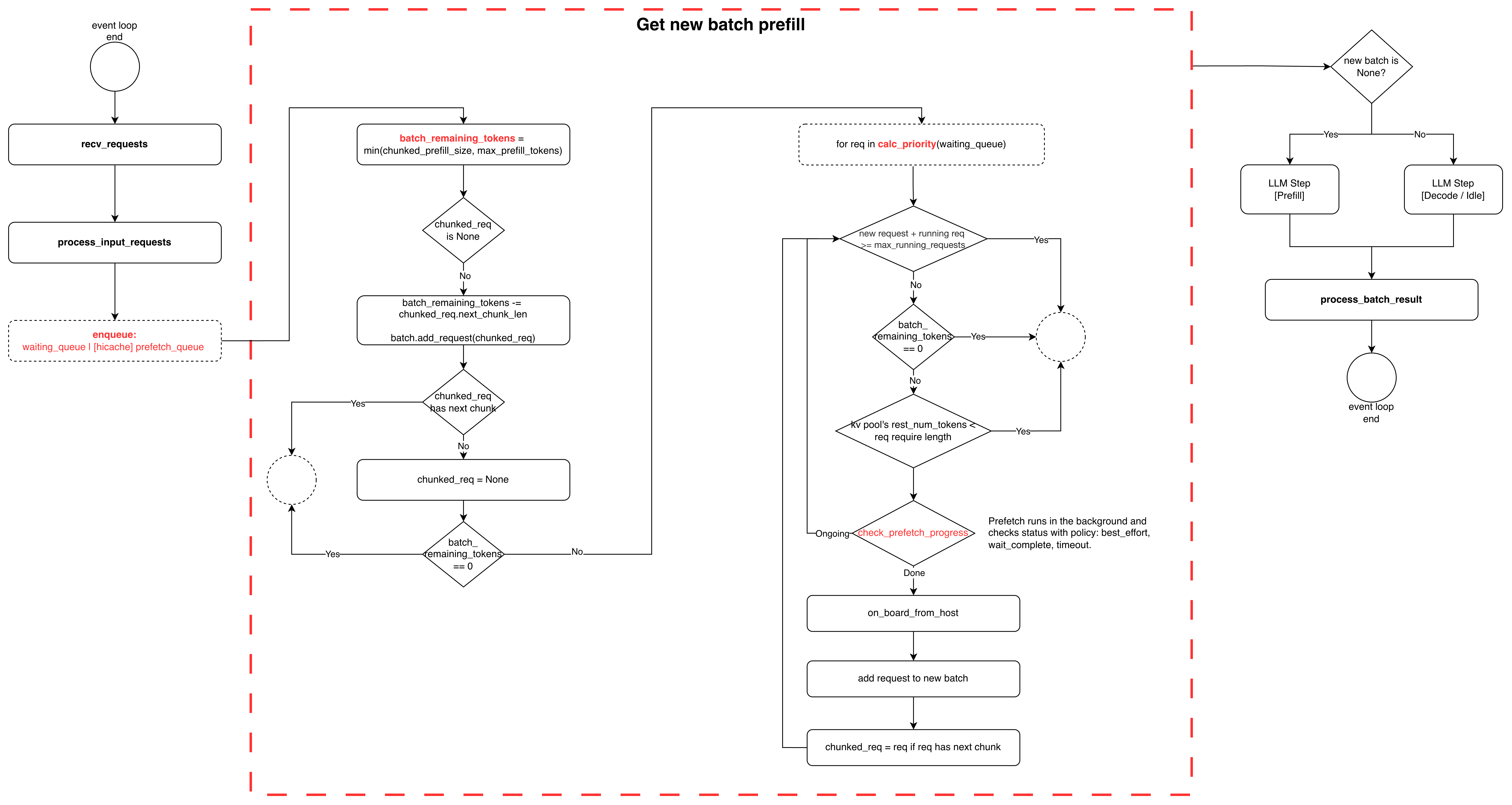
Default Request Scheduling Logic for New Requests in SGLang
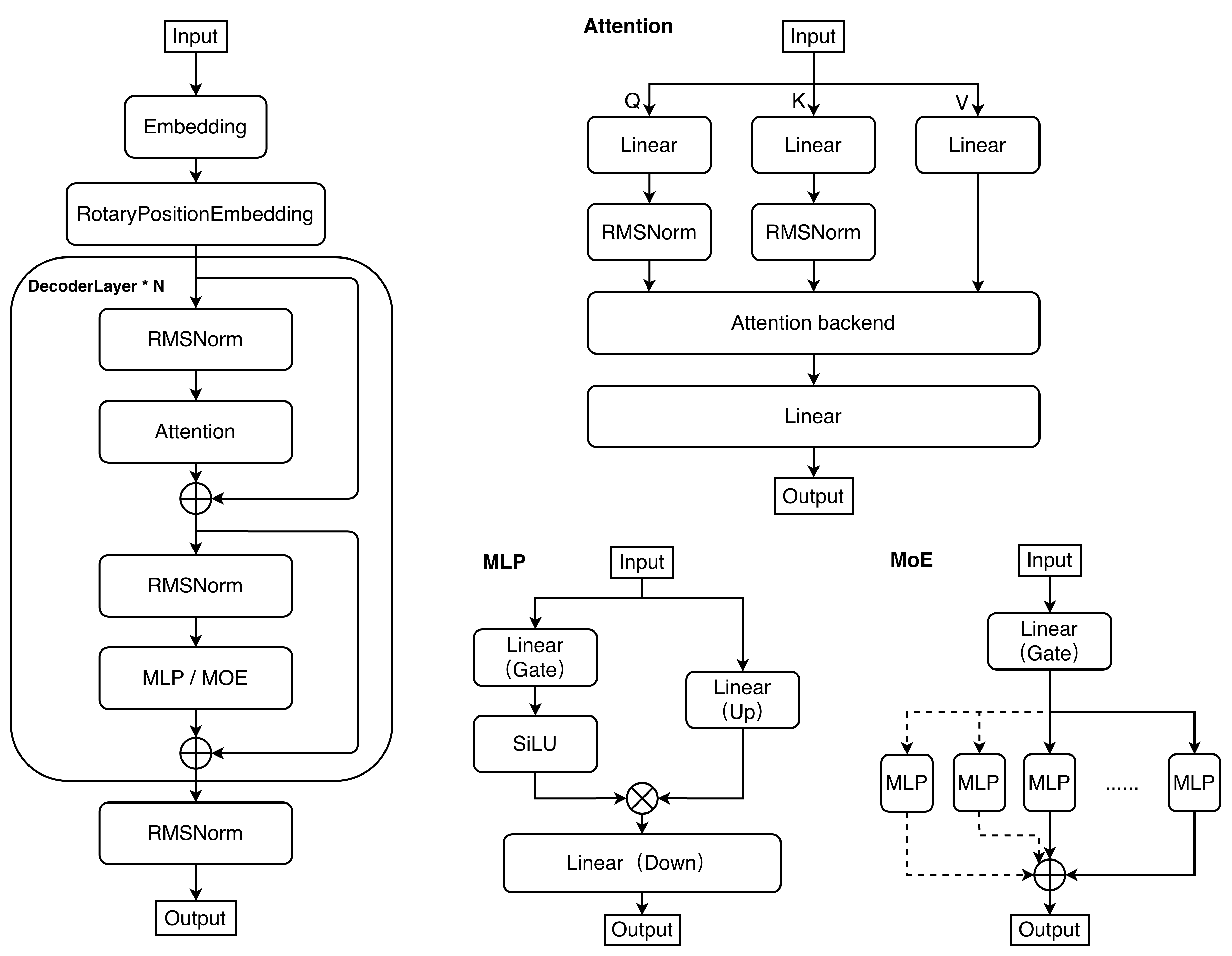
Qwen3 Model Architecture Diagram
Current mainstream large language models (e.g., the Qwen series) predominantly adopt a Decoder-Only Transformer architecture, in which the inference process sequentially processes the input token sequence through a series of structured modules. Taking Qwen3 as an example (architectural schematic shown in the figure above), a typical forward pass comprises the following key components:
Stacked Decoder Blocks (N layers total), each layer consists of:

Hardware-Specific Operator Backend Implementations
Although different LLMs are functionally highly similar, their actual inference performance is significantly influenced by low-level implementation details. Taking mainstream inference frameworks such as SGLang as an example, the same model architecture can trigger entirely different GPU kernel implementations depending on the underlying hardware and runtime configuration. More critically, even for the same operator, its launch parameters—such as block size and tiling configuration—are dynamically adjusted based on input characteristics (e.g., prompt length and KV cache length). These optimizations are typically selected automatically by the operator scheduler either at compile time or runtime to maximize hardware utilization. Consequently, during GPU-based inference, the performance impact of different operator implementations must be explicitly accounted for when modeling execution time.
LLM inference exhibits significant dynamic heterogeneity, strong state dependencies, and high sensitivity to millisecond-level Service Level Objectives (SLOs). These characteristics make traditional static performance modeling methods inadequate for accurately reproducing real system behavior. Specifically, current LLM inference simulation faces the following four key challenges:
1. High Complexity and State Density in the Full Lifecycle of Inference Requests
The lifecycle of an LLM inference request involves dynamic transitions across multiple stages, queues, and cache levels. As previously described, a typical request sequentially undergoes Tokenization → Scheduling Enqueue (Waiting Queue) → Prefill Execution → Multi-Round Decode Batching (RunBatch) → Detokenization. During this process, requests migrate between Waiting, Running, and Swapped queues under scheduler management, accompanied by multi-level KV Cache loading and eviction behaviors (e.g., triggering L3→L2 prefetching while in the Waiting Queue and completing L2→L1 Cache transfers before Prefill execution). This end-to-end state transition path, coupled with deep integration among caching, computation, and scheduling, means that any simplified modeling that ignores intermediate state transitions or cache interactions will result in significant deviations.
2. Error Cascading Due to Strong Coupling Among System Components
The core components of an LLM inference system—Scheduler, KV Cache Manager, and GPU Execution Engine—are tightly interconnected through feedback loops. For example:
This multidirectional dependency means that modeling errors in any single component can propagate and amplify through the system pipeline, leading to severe distortions in end-to-end latency predictions.
3. Nonlinear Coupling Effects on Single-Step Latency and Lack of Generalizable Fine-Grained Modeling Methods
The latency of an LLM inference batch is not solely determined by coarse-grained parameters such as batch size and input length but is influenced by a nonlinear coupling of multiple dimensions:
Meanwhile, given the rapidly evolving landscape of model architectures and hardware ecosystems, exhaustively testing every "model–configuration–hardware" combination is neither economical nor scalable. Therefore, constructing a latency prediction mechanism that can precisely characterize single-step execution behavior while maintaining generalizability across models and platforms is a core challenge for high-fidelity LLM inference simulation.
4. Efficiency Bottlenecks in Optimal Solution Search Across High-Dimensional Configuration Spaces
Even with a high-fidelity simulator, its practical value in deployment tuning remains constrained by configuration search efficiency. Typical deployment configuration spaces encompass dimensions such as parallelism, batch size, cache strategies, and quantization bitwidth, leading to combinatorial explosion issues. If each simulation run takes 1 minute, exhaustive search could take days, far exceeding acceptable tuning cycles. Thus, efficiently exploring and identifying Pareto frontiers for cost-latency-throughput trade-offs under SLO constraints becomes a critical bottleneck for the practical application of simulators.
To address the aforementioned challenges, a production-grade LLM inference system simulator must go beyond the limitations of traditional performance models and establish a hierarchical, decoupled, high-fidelity, verifiable, and efficient optimization simulation framework. Based on the preceding analysis, we propose the following four core requirements:
1. Support for Hierarchical Abstraction of End-to-End Inference Workflows
The simulator should be capable of fully reproducing the entire lifecycle behavior of requests from ingestion to response in real inference engines, including request generation, scheduling decisions, state transitions, batch execution, and result return phases. Specifically, it must meet the following criteria:
This capability ensures that simulation results align both macroscopically and microscopically with actual system behavior.
2. High-Fidelity, Independently Verifiable Delay Modeling at the Component Level
To mitigate error cascading caused by component coupling, the simulator must decouple core functional modules and ensure the accuracy and verifiability of each module's behavior:
All modules should support independent verification to ensure local errors are controlled and end-to-end deviations are traceable.
3. Fine-Grained, Generalizable Single-Step Latency Prediction
Given that single-step inference latency is highly dependent on batch composition and request prompt & cache length, the simulator must provide fine-grained latency characterization:
This capability forms the foundation for achieving high-precision, low-cost simulations.
4. Efficient Exploration of Configuration Spaces Under SLO Constraints
To support practical deployment decisions, the simulator should enable efficient exploration of the deployment configuration space:
This capability transforms the simulator from a passive performance evaluation tool into an active decision-support system for production deployments.
To systematically address these requirements and challenges, the subsequent sections will detail the overall architecture design and key technical implementation paths of Tair-KVCache-HiSim, providing a robust foundation for high-fidelity LLM inference simulation.
To meet the demand for high-fidelity modeling of the full lifecycle of LLM inference, we design and implement Tair-KVCache-HiSim—a lightweight, high-accuracy simulation tool tailored for large language model inference services. Tair-KVCache-HiSim can efficiently predict key performance metrics—such as TTFT, TPOT, and system throughput—without requiring actual deployment of models onto GPUs, by injecting either synthetic or real-world request traces.
Compared to existing simulation approaches, Tair-KVCache-HiSim is the first to support multi-level KV Cache storage hierarchy simulation (based on the HiRadixCache architecture), providing critical decision support for users in optimizing cache resource allocation and cost-performance trade-offs.
As shown in the figure, Tair-KVCache-HiSim adopts a modular architecture, comprising the following three core components that work in concert to fully reproduce the end-to-end inference process from request ingestion to result return:

Tair-KVCache-HiSim Architecture Diagram
Tair-KVCache-HiSim consists of several critical components designed to comprehensively simulate the end-to-end inference process:
1. Workload Generator: Storage-Optimized User Load Generator for Simulating Real-World Scenarios
This module supports two flexible load injection modes to accommodate different data availability conditions:
● Random Dataset Generation: Suitable for scenarios lacking original traces, it supports modeling based on open-source datasets or random tokens. Beyond typical parameters like input/output lengths, request rates, and concurrency levels, it introduces higher-order variables for scenarios with surging KV Cache demands:
● Timestamp Dataset Replay: Supports importing real user loads with original timestamps. By precisely replaying historical loads, it provides customized performance evaluations and configuration optimization suggestions for specific business lines.
2. Global Router Simulator: Global Request Scheduling Simulator
Responsible for routing pending requests to the optimal computing instance (Worker) using specific algorithms. Supported scheduling strategies include:
3. Inference Engine Simulator: Instance Inference Engine Simulator
This module provides fine-grained modeling of internal behaviors within a single inference instance, faithfully replicating the core behaviors of real inference frameworks:
Through the coordinated simulation of these three layers, Tair-KVCache-HiSim achieves high alignment with real systems both in terms of macro load characteristics and micro-execution timing. This robust foundation enables subsequent performance analysis and configuration optimization, providing critical decision support for optimizing cache resource allocation and cost-performance trade-offs.
The Inference Engine Simulator is the core module of Tair-KVCache-HiSim responsible for end-to-end simulation of LLM inference behavior. It achieves high-fidelity and independently verifiable modeling by decoupling three key subsystems—request scheduling, KV Cache management, and batched execution—and integrating them under a unified global clock mechanism to ensure temporal consistency across components. As illustrated in the figure, the simulator comprises the following three co-operating submodules:
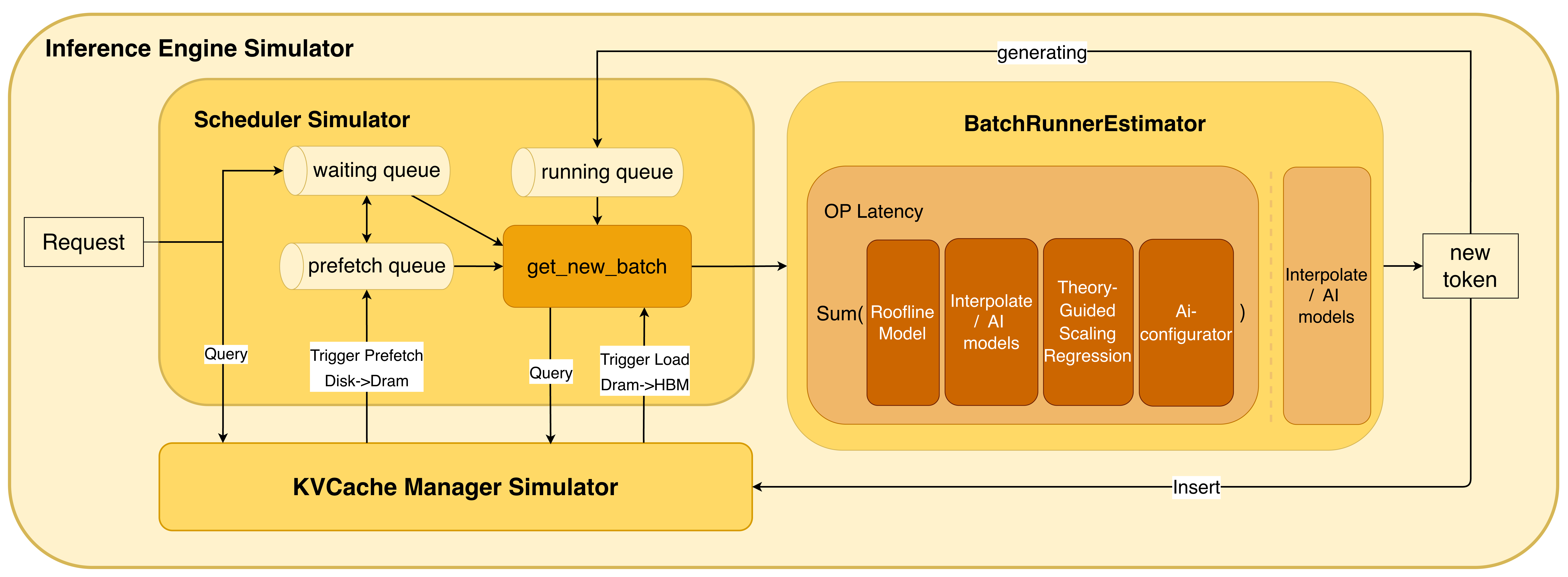
Inference Engine Simulator Structure Diagram
The SchedulerSimulator faithfully replicates the scheduling logic of mainstream LLM inference frameworks(e.g., SGLang and vLLM) and explicitly models the state transitions of requests throughout their lifecycle. Its overall workflow aligns with the scheduling pipeline described in Section 2. At the implementation level, the system explicitly maintains four key queues:
The scheduler supports the various scheduling policies introduced in Section 2 (e.g., Prefill-first, Decode-first, Chunked Prefill, PD separation), which are not repeated here for brevity.
Moreover, the SchedulerSimulator tightly interacts with the KVCacheManagerSimulator. Before deciding whether to promote a request from the Waiting Queue to the Running Queue, it queries the request’s KV Cache prefetch status and enforces the configured prefetch policy—best_effort, wait_complete, or timeout—to determine whether scheduling should be blocked. This mechanism ensures that the simulation accurately captures the real-system impact of “prefetch progress” on scheduling latency, thereby preserving high fidelity in end-to-end performance prediction.
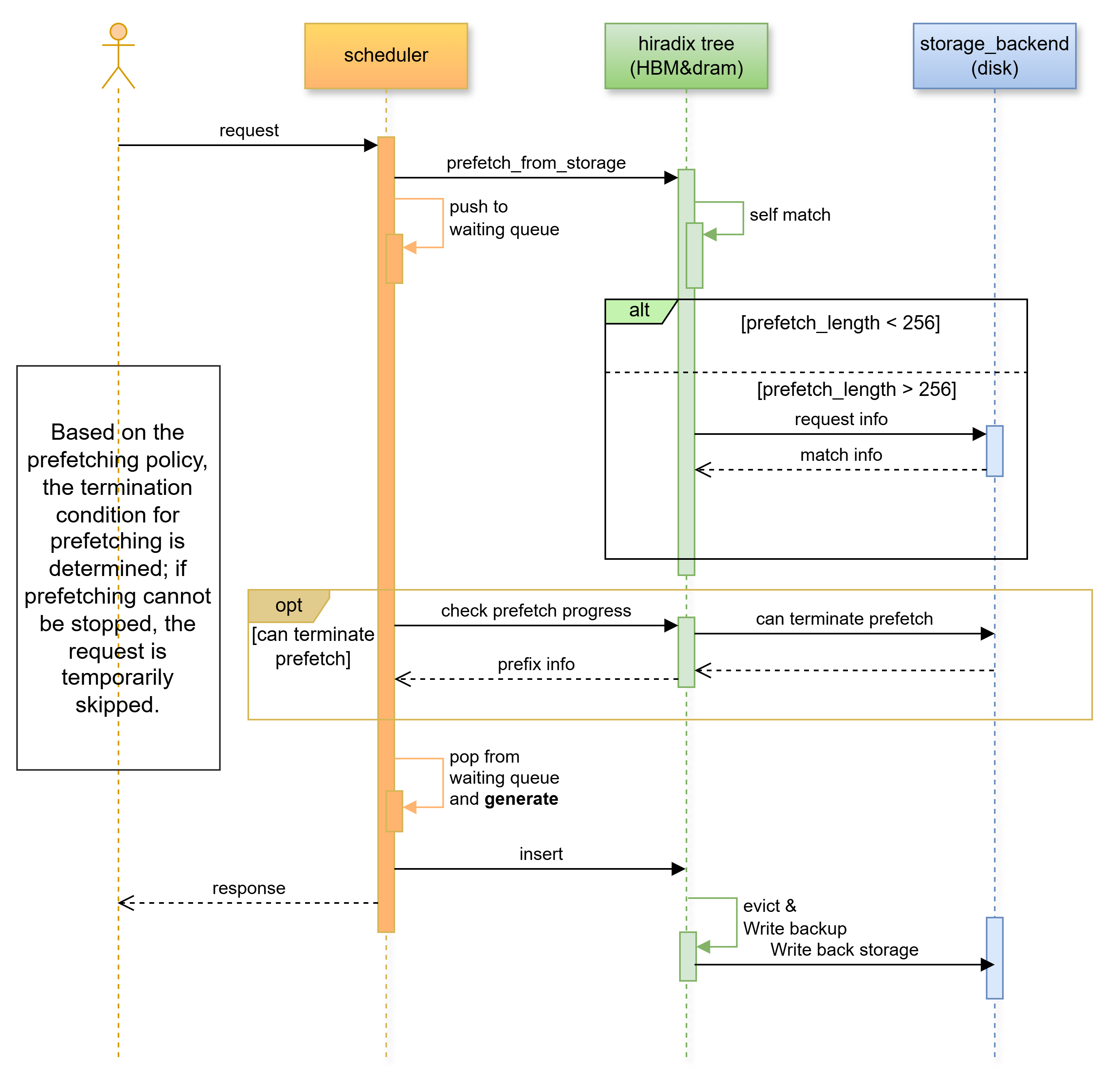
Interaction Flow Diagram Between Scheduler and KVCacheManager
The KVCacheManagerSimulator is the first open-source inference simulator to fully model a three-level KV Cache storage hierarchy (L3/L2/L1), supporting heterogeneous storage media(such as SSD, host DRAM, and GPU HBM) with differentiated configurations in terms of capacity, bandwidth, and cost.
Its core workflow is as follows:
By implementing a multi-level Radix Tree-based prefix cache and modeling memory pools, asynchronous data movement, and prefetch policies for each cache tier, this module can accurately simulate real-world execution behavior—producing precise estimates of cache hit rates, I/O volumes per level, and transfer latencies—without performing actual memory allocation or data movement. These metrics serve as critical inputs for scheduling decisions and performance prediction.
Furthermore, the simulation of HiCache eviction policies (e.g., LRU, LFU) and the Radix Tree structure ensures that cache management behavior remains consistent with that of real systems.
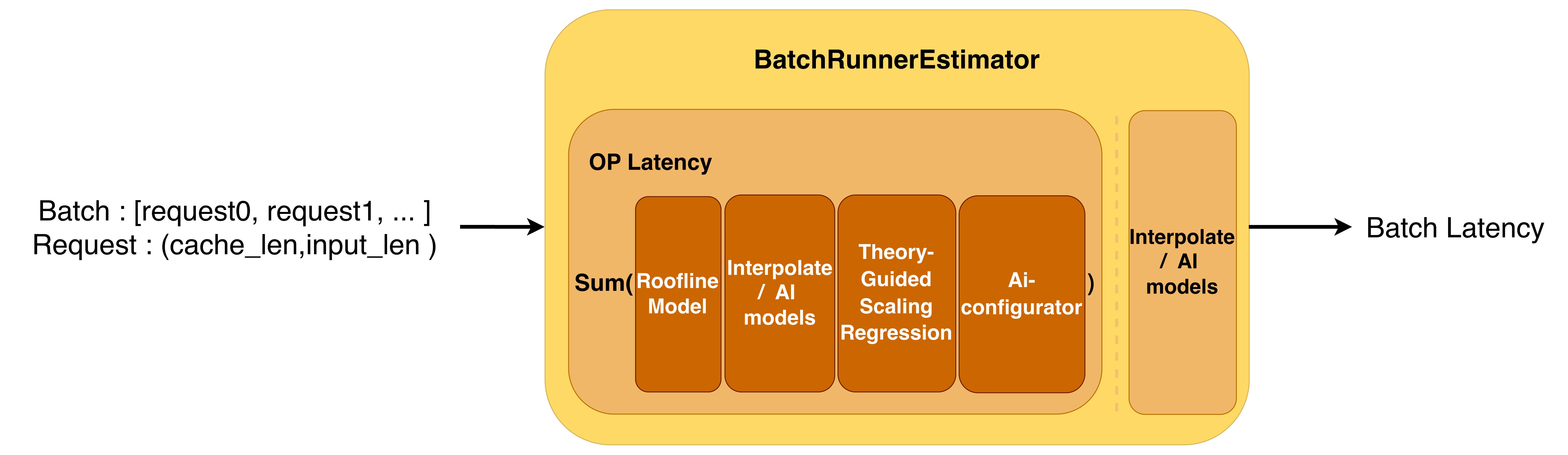
Implementation of BatchRunnerEstimator
To meet the core requirement of high-accuracy, low-cost simulation of LLM inference latency, BatchRunnerEstimator is designed as a fine-grained, multi-paradigm, and pluggable single-step latency prediction engine. Its primary objective is to accurately capture the nonlinear performance variations in execution latency caused by intra-batch request heterogeneity—such as differing prompt lengths and degrees of KV cache reuse—under dynamic batching scenarios, while maintaining reliable generalization capabilities when confronted with new models, hardware platforms, or system configurations.
BatchRunnerEstimator departs from the conventional simulation approach that relies on coarse-grained batch-level statistics (e.g., average input length) and instead adopts request-level state descriptors as the fundamental unit for latency prediction. Each batch is represented as a list of requests, where each request is characterized by a (cache_len, input_len) tuple:
Building upon this fine-grained representation, we design a pluggable hybrid latency modeling framework that supports multiple prediction strategies to balance accuracy and generalization:
● Sample-Based Interpolation/Regression Models:
Construct model-specific latency mapping functions via offline profiling, suitable for known hardware–model combinations.
● Operator-Level Latency Composition:
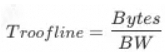
To enhance generalization—especially for unseen scenarios such as new hardware or novel model architectures—latency is estimated by summing predicted durations of individual operators:
Operator Categorization: Operators are classified into two broad types:


Users can dynamically switch between prediction backends based on scenario requirements—e.g., favoring maximum accuracy for known workloads versus rapid generalization to new models or configurations. This design enables Tair-KVCache-HiSim to deliver reliable latency estimates for previously unseen models, quantization schemes, or parallelism configurations—without requiring exhaustive offline profiling.
To accurately capture the overlaps and dependencies among asynchronous operations—such as CPU scheduling, GPU computation, and KV Cache data transfers—Tair-KVCache-HiSim introduces a unified virtual global clock as the temporal reference for all modules and employs a discrete-event simulation paradigm to drive the entire simulation workflow.
To prevent error cascading and ensure simulation fidelity, Tair-KVCache-HiSim provides isolated validation interfaces for each core module, enabling end-to-end comparison against real-system behavior independently of other components. The specific validation strategies are as follows:
● BatchRunnerEstimator (Batch Inference Execution)
Accuracy is validated via micro-benchmarking:
(cache_len, input_len) tuples—on a real GPU and record the actual execution latency for Prefill and Decode phases.● SchedulerSimulator (Scheduling Behavior)
Validated through scheduling trace replay:
1. Export a complete scheduling log from a real inference engine, including:
2. In the simulator, freeze KVCacheManager and BatchRunner behaviors (e.g., force all requests to have cache_miss = 0 and fix batch latency to a constant), and enable only SchedulerSimulator.
3. Replay the same request sequence and validate:
● KVCacheManagerSimulator (Cache Management)
Validated via cache event tracing:
1. Inject a synthetically generated multi-turn dialogue workload into a real system and use profiling tools to capture:
2. In the simulator, freeze the scheduler (fix scheduling order) and BatchRunner (fix latency), and run only KVCacheManagerSimulator with the same request sequence.
3. Compare the simulated cache event stream against ground truth, validating:
Detailed experimental results and quantitative validation metrics will be presented in Chapter 4.
To support efficient deployment decisions under SLOconstraints, Tair-KVCache-HiSim implements a hierarchical, progressive configuration space exploration mechanism. The process operates in three stages:
1. Low-Dimensional SLO-Feasible Configuration Screening:
Given user-specified TTFT and TPOT SLOs, the system leverages the high-fidelity BatchRunnerEstimator to rapidly evaluate key execution-layer configurations—such as tensor parallelism degree, quantization schemes, and operator optimizations. Using an adaptive binary search over the single-step latency prediction model, it efficiently identifies the boundary of configurations that satisfy the SLOs and constructs an initial low-dimensional Pareto candidate set.
2. Global Routing Strategy Co-Evaluation:
For this candidate set, the system jointly evaluates the impact of multiple global routing policies—including cache_aware, power_of_two, and bucket—on request queuing delay, load balancing, and cache reuse efficiency. This step ensures that inter-node scheduling behavior aligns with end-to-end performance targets.
3. Multi-Level KV Cache Structure Optimization:
Building on the feasible configurations identified above, the system further optimizes the multi-level KV Cache storage architecture, including:
By decomposing the high-dimensional combinatorial explosion problem into manageable subtasks, this three-stage pipeline can generate a three-dimensional Pareto frontier across latency, throughput, and cost within just a few hundred simulation runs. This transforms Tair-KVCache-HiSim from a passive performance evaluation tool into an active deployment recommendation engine, enabling practical, SLO-aware inference system optimization.
We conducted a comprehensive evaluation of its simulation speed and accuracy under real-world production-level workloads.
Taking a typical production scenario as an example:
| Dataset | A real user trace comprising 40,520 requests over a 6-hour (21,602-second) period, based on the Qwen3-Coder-480B model. |
|---|---|
| Real GPU Benchmark Cost | Running a full benchmark on a GPU instance with 8 × 141 GB of VRAM (priced at ¥110,000/month) would take 6 hours, incurring a total cost of ¥1,833.5. |
| Simulation Execution Cost | On a general-purpose cloud instance with 2 vCPUs and 4 GiB memory (priced at ¥47.5/month), Tair-KVCache-HiSim completes the full simulation in just 257 seconds, with a single-run cost as low as ¥0.0047. |
This achieves a cost reduction to 1/390,106 of the original expense and shortens the evaluation cycle from days to minutes, dramatically accelerating the deployment tuning and capacity planning process for LLM services.
We validate the simulator’s accuracy at two levels:
1. BatchRunnerEstimator: Single-Step Latency Prediction Accuracy
In dynamic batching scenarios, we used profiling tools to capture 958 heterogeneous batch configurations (with batch sizes ranging from 1 to 28) from a real-world deployed inference service and compared the measured execution latencies against the simulator’s predictions. The results show an average latency prediction error of only 4.24%.
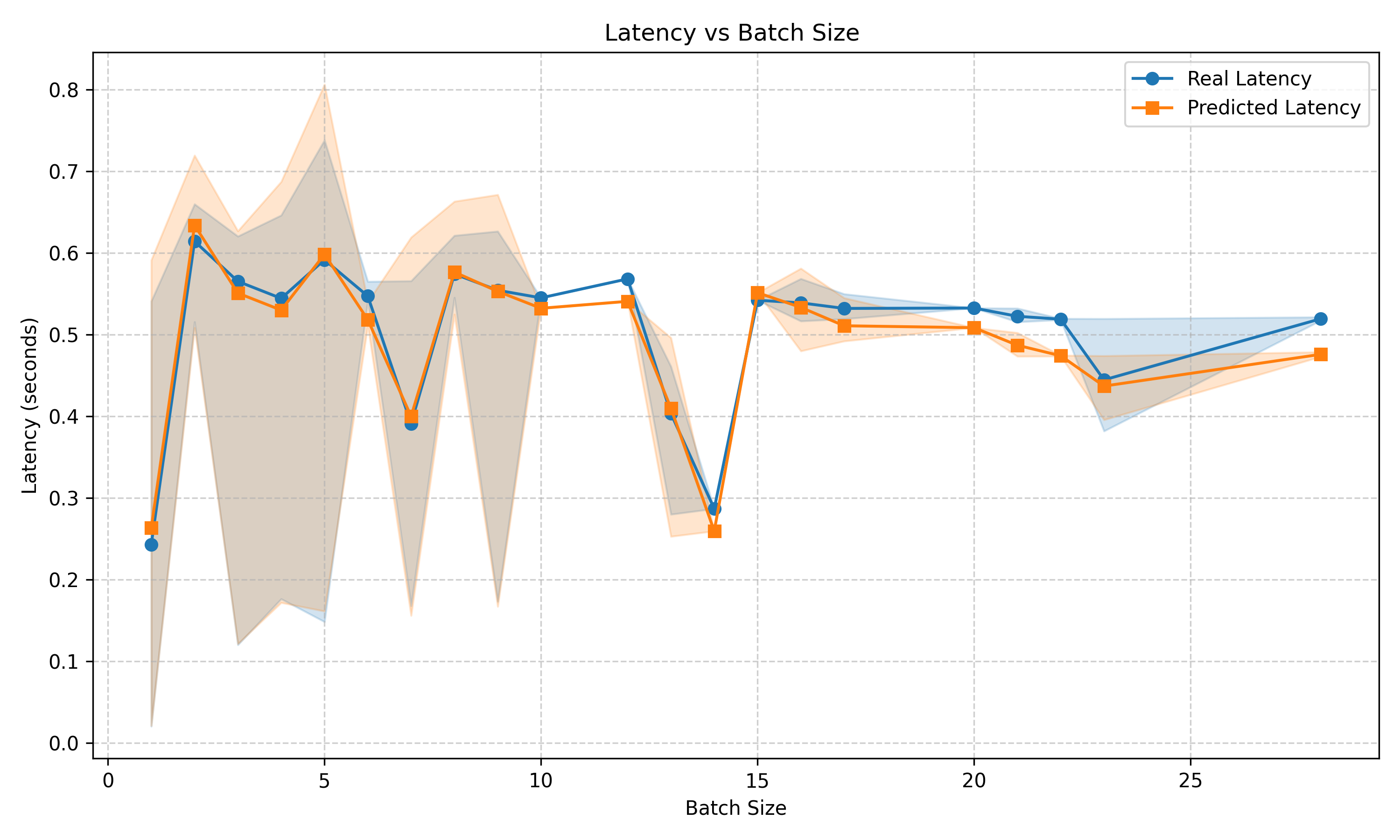
The shaded area in the figure represents the coverage range of all sample points.
2. InferenceEngineSimulator: End-to-End System Metric Accuracy
We evaluated the Qwen3-8B model on an A100-SXM4-80GB GPU using the SGLang v0.5.6 inference engine, with a multi-turn dialogue workload constructed from the ShareGPT dataset. Four KV Cache configurations were tested:
The simulation results are compared against real-system measurements as follows:
| Configuration | Avg. TTFT Error (%) | Avg. Throughput Error (%) | Cache Hit Rate Error (%) |
|---|---|---|---|
| IDLE | 3.25% | 1.37% | — |
| DEVICE | 4.49% | 1.95% | 0% |
| HOST | 5.06% | 1.99% | 0% |
| DISK | 10.75% | 1.88% | 1.2% |
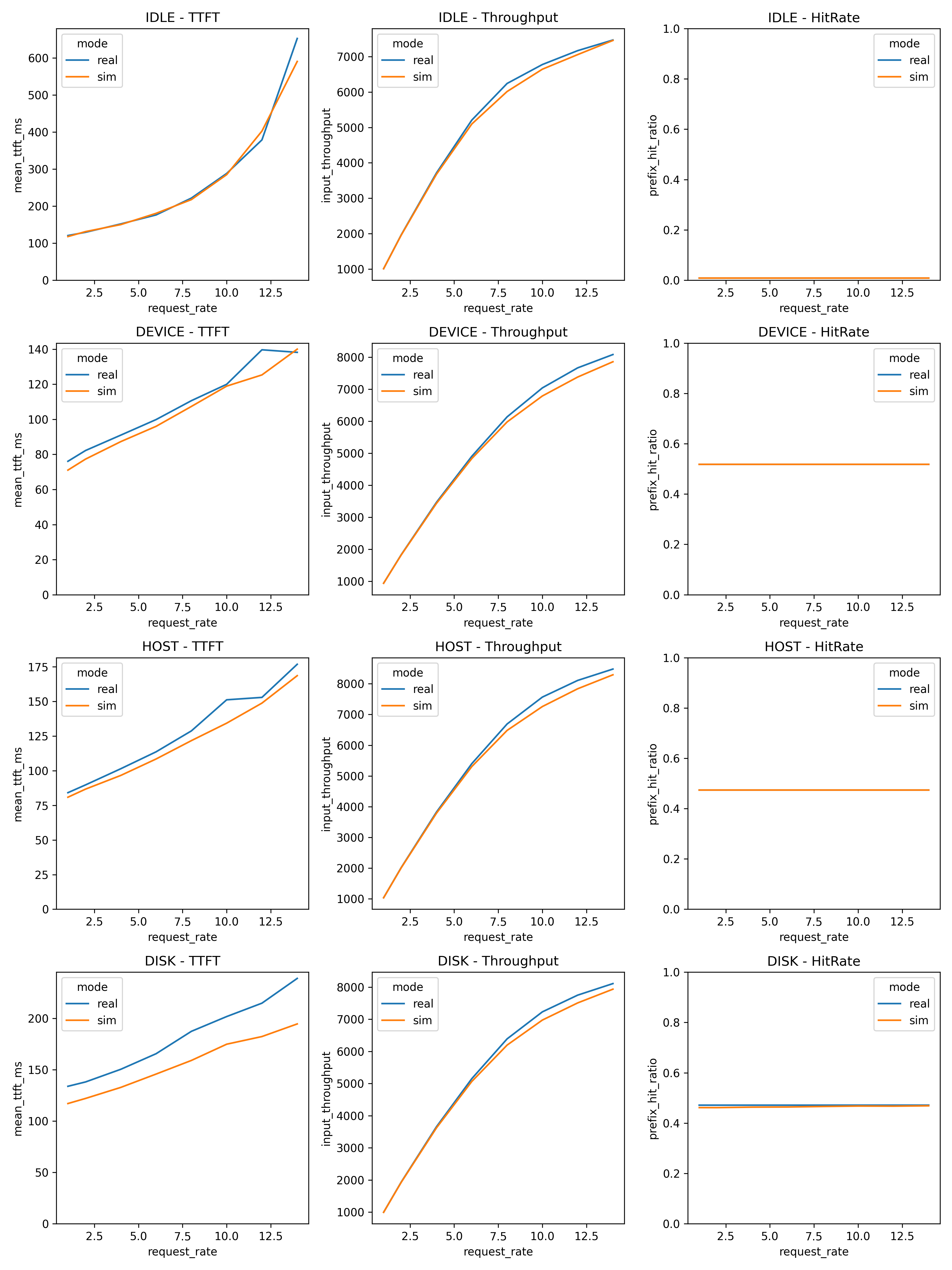
Tair-KVCache-HiSim achieves end-to-end high fidelity—with average errors below 5%—while reducing the cost and time overhead of LLM inference performance evaluation by five orders of magnitude.
The value of KV Cache simulation and analysis extends beyond optimizing existing systems—it also provides forward-looking guidance for the evolution of future AI infrastructure. By enabling end-to-end simulation across diverse workload patterns and heterogeneous hardware resources, we can rapidly respond to changing business demands, precisely identify performance bottlenecks—whether computational or storage-related—and automatically generate SLO-aware (e.g., latency, throughput) optimal configurations and tuning recommendations based on known models and hardware platforms.
Given the rapid iteration of large language models—including emerging architectures such as Mamba and hybrid attention, evolving sparsification strategies, and advanced techniques like speculative decoding—the traditional paradigm of “build hardware first, adapt software later” is no longer sustainable. Future infrastructure design must shift toward a co-design, workload-driven paradigm, where compute capabilities and KV Cache storage hierarchies are jointly evolved across multiple dimensions: server form factors, memory hierarchies, interconnect topologies, and even hyperscale node architectures—to maximize throughput and minimize cost under strict SLO constraints.
Realizing this vision requires deep integration of KV Cache as the central state carrier. The cache is no longer a mere auxiliary component but a critical nexus connecting algorithms, systems, and hardware. High-fidelity simulation serves as the core engine enabling such scientifically grounded decision-making. Looking ahead, we will continue to enhance the simulator with broader support for cutting-edge models, along with ongoing improvements in simulation speed and accuracy.
Deep Dive into Source Code: How Hermes Agent Achieves Self-Improving
ApsaraDB - December 29, 2025
ApsaraDB - May 22, 2026
ApsaraDB - February 4, 2026
ApsaraDB - February 4, 2026
ApsaraDB - February 4, 2026
Alibaba Cloud Community - December 8, 2021
 Best Practices
Follow our step-by-step best practices guides to build your own business case.
Learn More QwenWork
QwenWork is dedicated to helping employees strengthen their professional competitiveness in the AI era and to enabling enterprises to improve organizational effectiveness.
Learn More Qwen
Qwen
Full-range, open-source, multimodal, and multi-functional
Learn More Token Plan
Build more, spend less. One plan, every modality.
Learn MoreMore Posts by ApsaraDB


