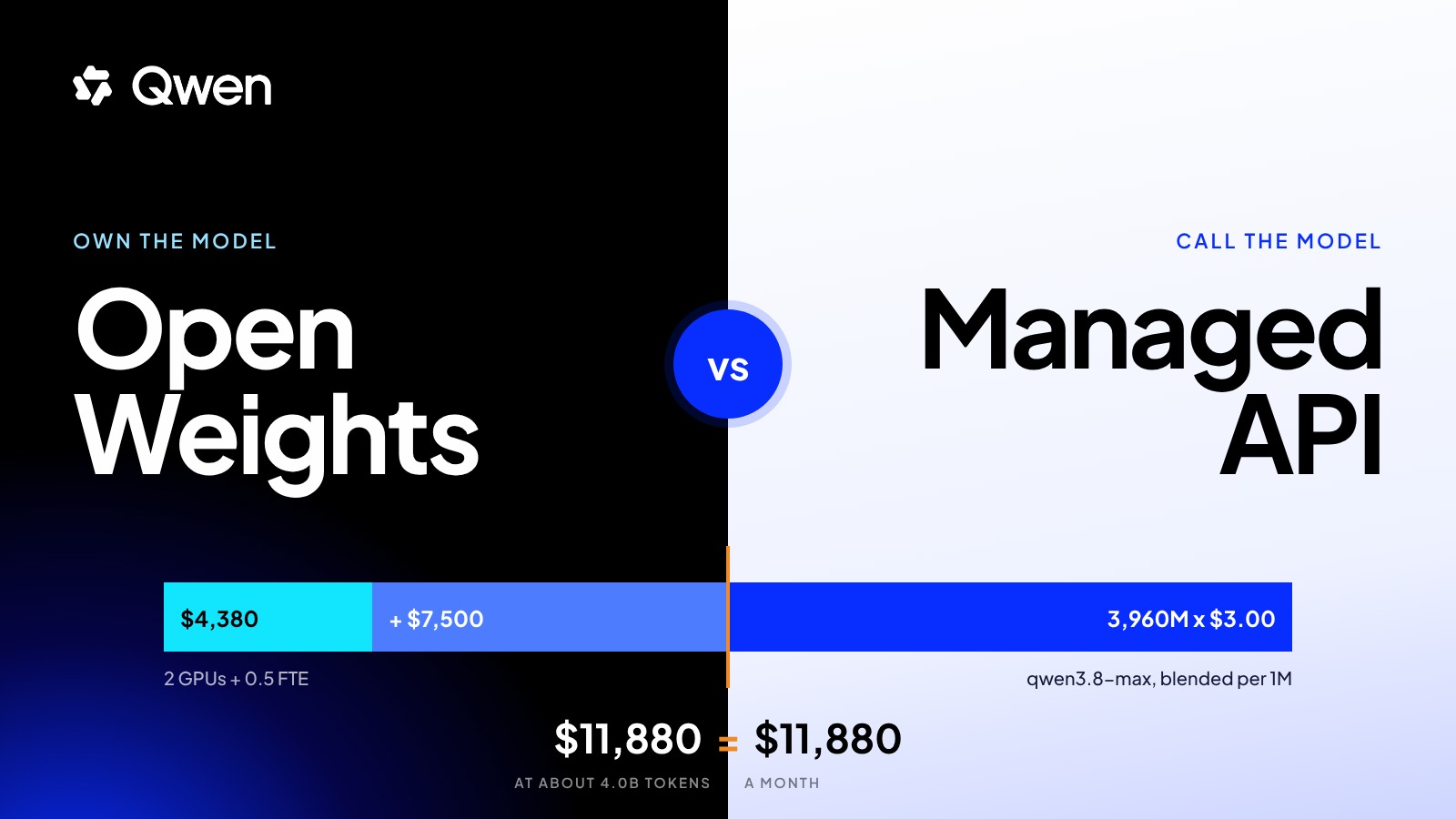
Self-hosting looks cheaper per token: $0.67 against $3.00 per 1M. At about 4.0B tokens a month, both bills land at $11,880. Below that line, the cheap option is the expensive one.
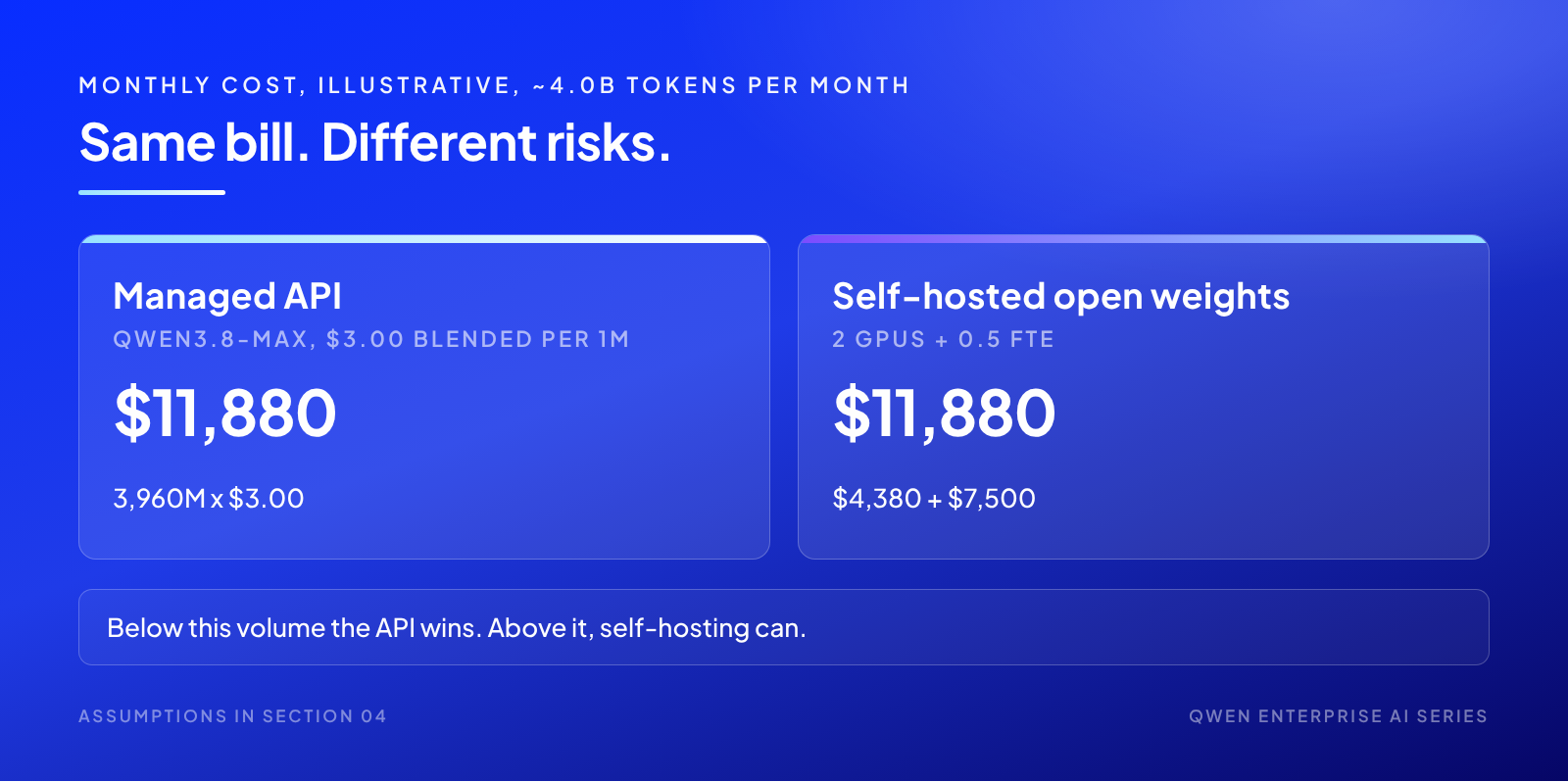
The deployment decision is not "open or closed". It is which risks you want to own, at which volume.
In this guide
A six-row decision table for the questions auditors and risk committees actually ask
A three-question filter that finds the one constraint that decides your deployment
A break-even formula with worked math, plus the two checks that usually change the answer
License literacy for Qwen open weights before anyone architects around them
A five-day plan to decide on evidence instead of opinion
Every workload starts with one decision: run the model yourself, or call it.
Gartner forecasts that 55% of AI-optimized IaaS spending will support inference in 2026, $23.3B of a $42B market (Gartner, AI-optimized IaaS forecast, August 2026).
If you run architecture for a bank, an insurer, a hospital group or a public agency, you feel two fears at once. The first is losing control: data leaving your boundary, a model version changing under a validated workflow, a regulator asking where inference happened. The second is owning too much: a GPU fleet, an on-call rotation and a patch cycle for an unfamiliar stack.
They point at two deployment models:
1. Open weights, self-hosted. You run the weights on infrastructure you control and own everything from serving engine to uptime.
2. Managed API. You call a hosted endpoint, such as Qwen on Alibaba Cloud Model Studio, and pay per token. The provider owns serving and scaling; you own the integration, the data you send and the controls around it.
Qwen ships both, from one model family, so you can start on the API and move a workload to self-hosted open weights later with the same prompts and evaluation sets.
The answer up front: most regulated enterprises should start on the managed API in a region that matches their residency needs, measure real volume for a quarter, and self-host only the workloads that cross a break-even line or a hard control requirement.
Not sure which side of that line your first workload sits on? Map your first workload to API or self-hosted with the team before anyone orders a GPU.
Decide per workload, not per company.
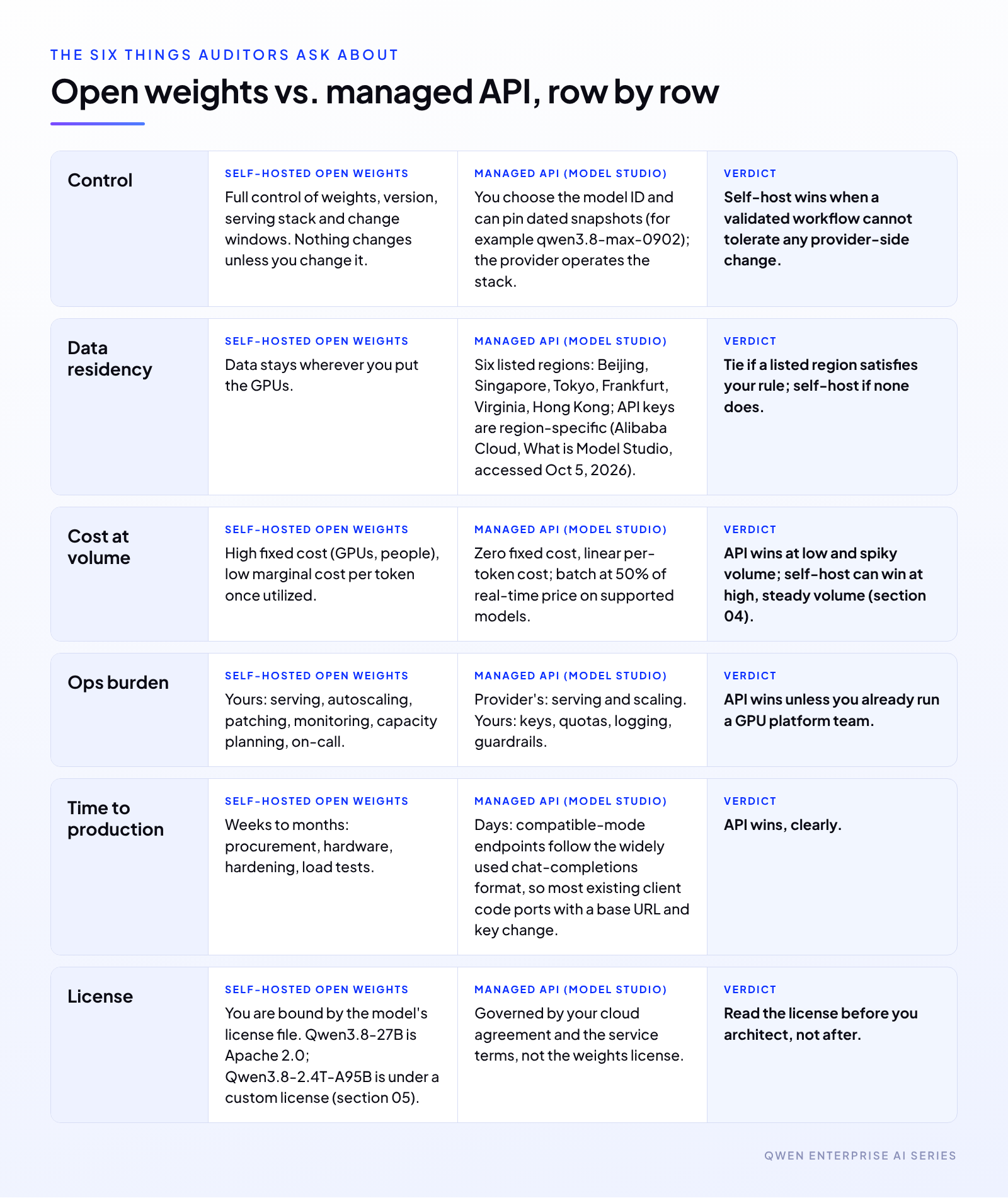
Six rows a risk committee asks about, one verdict each.
Data use. The managed side has a written commitment: "Alibaba Cloud strictly protects your data privacy and will never use your data for model training," with transmitted data encrypted with AES-256 and SOC 2 coverage for Security, Availability and Confidentiality (Alibaba Cloud, Model Studio privacy notice, accessed Oct 5, 2026). That is a provider commitment, not a compliance outcome; your obligations still need your own legal review.
New regions. At Apsara Conference 2026, Alibaba Cloud said it will establish its first cloud regions in Türkiye, Finland and the Netherlands "over the next 12 months" (Alibaba Cloud blog, Apsara Conference 2026, September 2026). Plan on what is live today.
Score all six rows; expect only one to decide.
One row binds; the rest are tie-breakers.
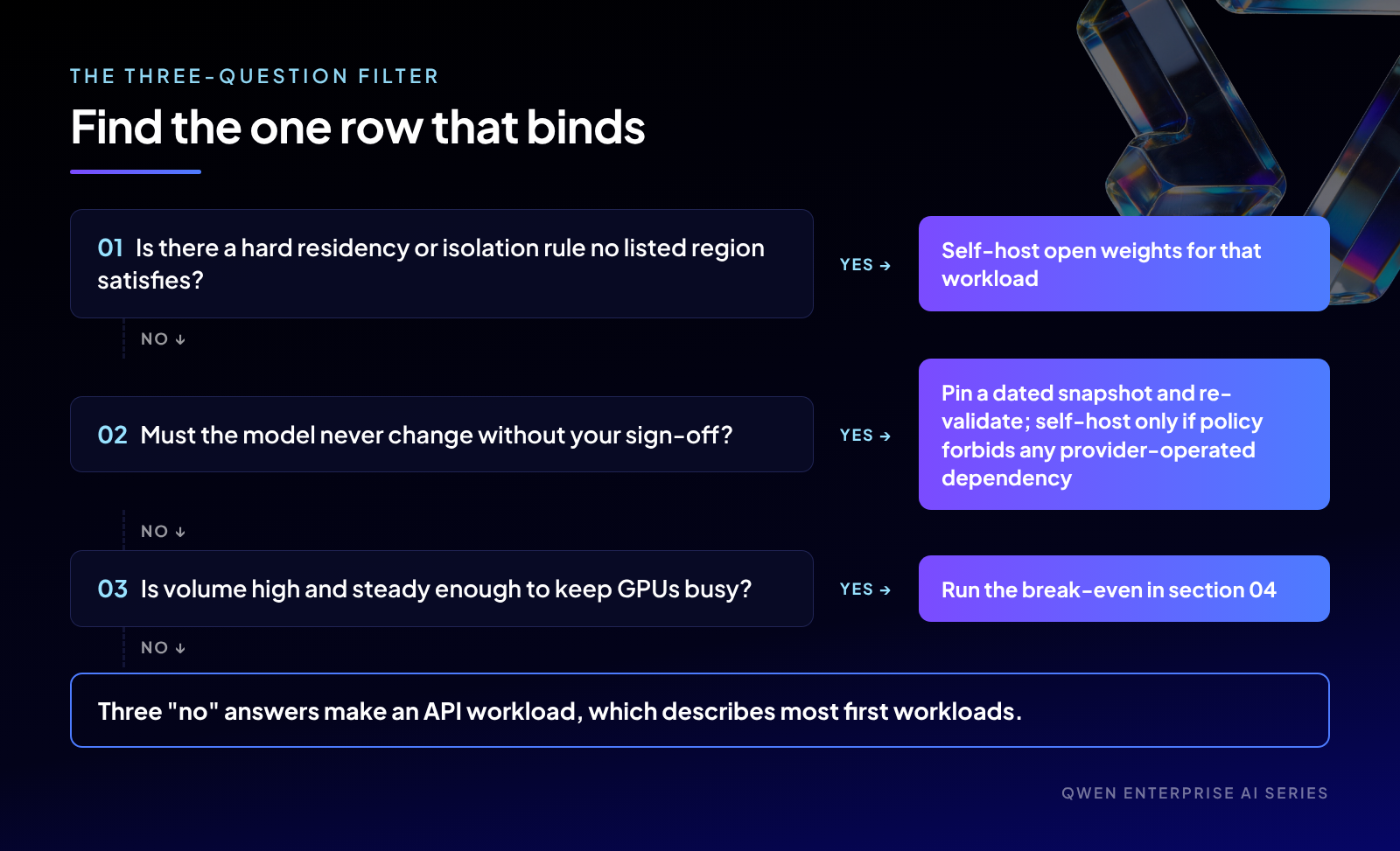
Three questions find it in one meeting:
1. Is there a hard residency or isolation rule no listed region satisfies? If inference must happen inside your own data center, or in a jurisdiction with no listed region, the decision is made: self-host open weights for that workload. Do not let cost math reopen it.
2. Must the model never change without your sign-off? If a model is embedded in a validated process (credit decisioning support, clinical documentation, regulatory reporting), you need version control. On the API, pin a dated snapshot and re-validate before moving. If your policy forbids any provider-operated dependency at all, self-host.
3. Is volume high and steady enough to keep GPUs busy? If not, self-hosting means paying for idle hardware. Run the break-even in section 04 before anyone orders a server.
Three "no" answers make an API workload, which describes most first workloads. A "yes" to the first makes cost secondary. A "yes" only to the third makes it pure economics.
This is the same shape as the build-or-partner call we broke down in Build vs. Buy, or Both? The Enterprise AI Decision: the binding constraint decides the default, and the default is reviewed when the constraint moves.
Find the row that binds, then stop debating the others.
Break-even is one formula, a short list of assumptions you replace with your own, and five steps of arithmetic.
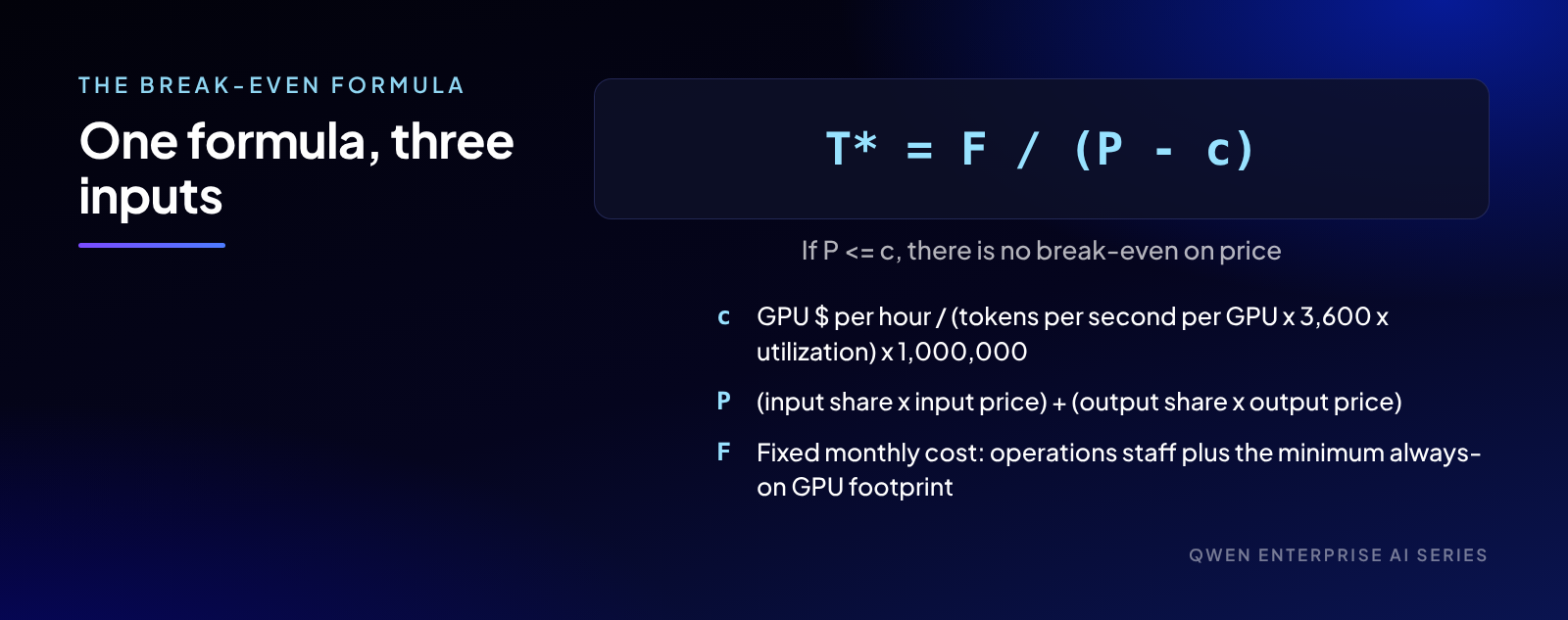
The formula. Self-hosting has a fixed monthly cost F (operations staff plus the minimum always-on GPU footprint) and a marginal cost per million tokens c (GPU cost to produce the next million tokens at your real utilization). The API has a blended price per million tokens P. Break-even monthly volume is:
Stated assumptions. Every self-hosting number below is an illustrative assumption, not a price quote. Replace each with your own quote and load test.
Workload mix: 3 input tokens for every 1 output token.
GPU cost: $3.00 per GPU-hour, fully loaded (illustrative assumption, not a price quote).
Throughput: 2,500 output-equivalent tokens per second per GPU for a 27B-class model with batching (illustrative assumption; measure yours).
Utilization: 50% averaged over the month (real traffic has nights and weekends).
Minimum footprint: 2 GPUs always on for redundancy, 730 hours per month.
Operations: 0.5 FTE of platform engineering at $15,000 per month loaded (illustrative assumption).
Quality: your evaluation set shows the self-hosted model passes for this workload. Without that, the comparison is meaningless.
Steps 1 to 4. The API price is the qwen3.8-max Singapore list, $2.00 input and $6.00 output per 1M tokens (Alibaba Cloud Model Studio pricing, accessed Oct 5, 2026).
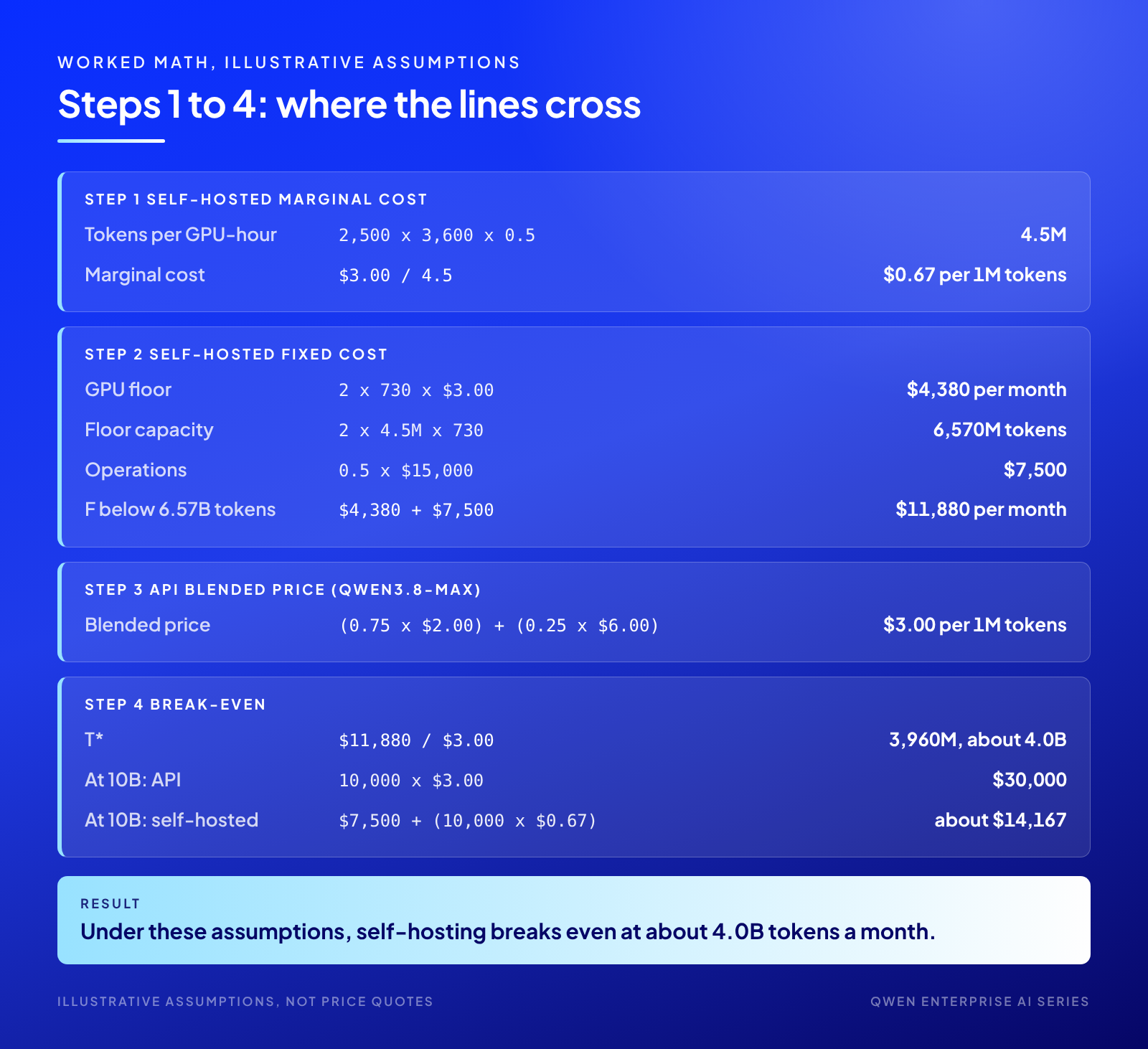
Result: under these assumptions, self-hosting breaks even at about 4.0B tokens a month. Above that line, every extra million costs $3.00 on the API and roughly $0.67 in GPU time once you add capacity.
Step 5: the two checks that change the answer.
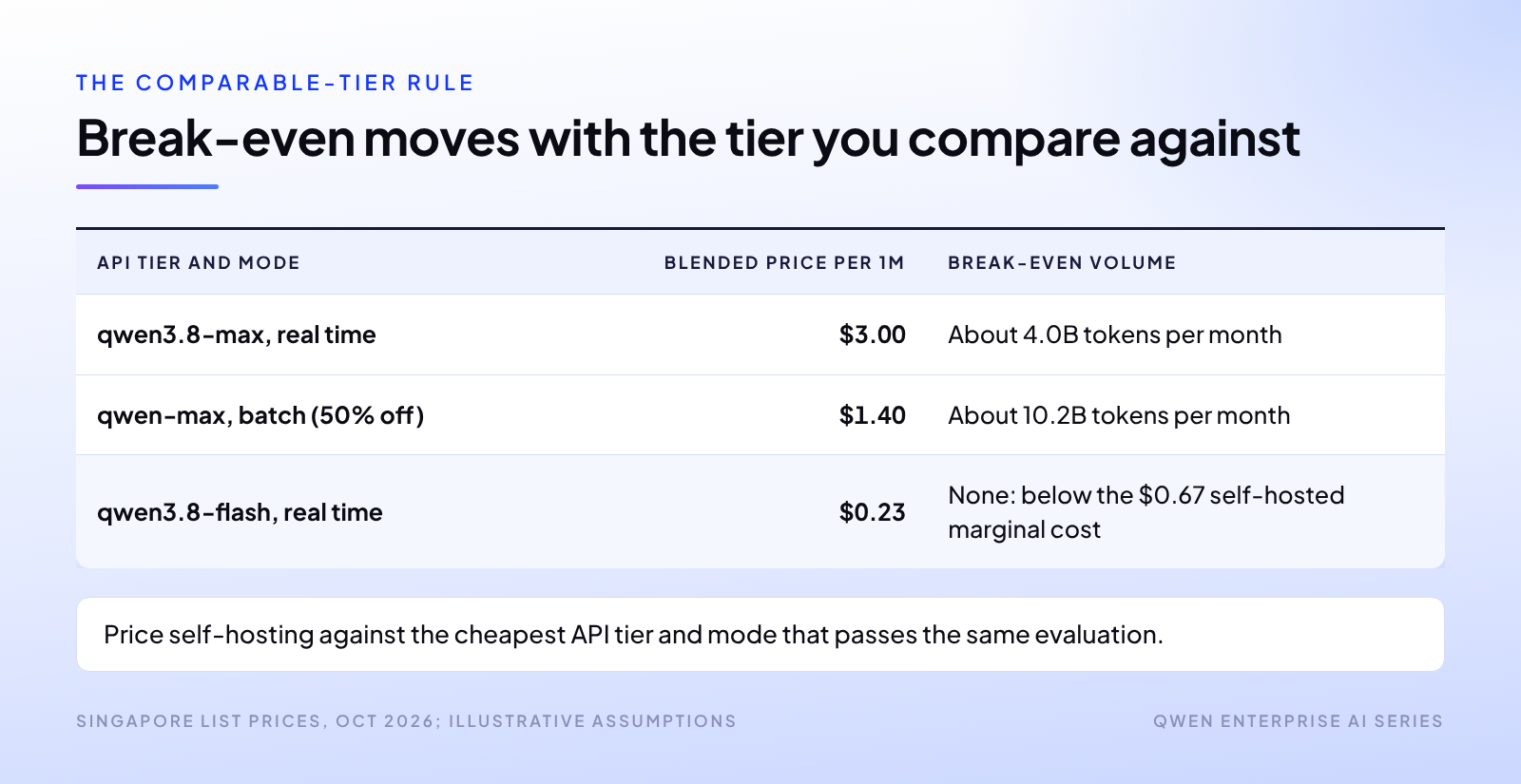
Compare against the right tier. If the workload passes on qwen3.8-flash ($0.15 input, $0.47 output per 1M tokens, Singapore list), the blended price is (0.75 x $0.15) + (0.25 x $0.47) = $0.23 per 1M. That is below the $0.67 self-hosted marginal cost, so under these assumptions there is no break-even on price at any volume.
Check the batch price. If the workload can wait and passes your evaluation on the batch-eligible qwen-max (Singapore list $1.60 input, $6.40 output per 1M tokens, 50% batch discount), the batch price blends to (0.75 x $0.80) + (0.25 x $3.20) = $1.40 per 1M. Above the GPU floor, T* = $7,500 / ($1.40 - $0.67) = about 10.2B tokens per month. Batch more than doubles the volume you need before self-hosting pays.
Call this the comparable-tier rule: price self-hosting against the cheapest API tier and mode that passes the same evaluation, never against the flagship's real-time list price.
Bring your GPU quote; leave with your break-even volume
Send your token mix, one real GPU quote and your utilization curve through a short form, and the team will work through these five steps on your inputs, comparable tier and batch checks included. You get the formula with your numbers, including the rows that argue against us. Get your break-even priced on your numbers →
Break-even is a volume, not a belief: calculate it per tier before you buy hardware.
"Open weights" is not one license.
For regulated buyers the license file is a contract term, read by counsel before architecture.
1. Qwen3.8-27B: Apache 2.0. The Hugging Face model card lists the license as apache-2.0 (Hugging Face, Qwen/Qwen3.8-27B model card, accessed Oct 5, 2026). Apache 2.0 permits commercial use, modification and redistribution, with conditions such as preserving notices.
2. Qwen3.8-2.4T-A95B: custom license. The model card lists a custom license named qwen3.8-max, not Apache 2.0 (Hugging Face, Qwen/Qwen3.8-2.4T-A95B model card, accessed Oct 5, 2026). Do not assume Apache terms apply. Read the license text in the repository, and have legal review any use, redistribution or derivative terms before you build on it.
Three license questions belong in the architecture review:
Which exact repository and license file? License is per model, not per family. A fine-tuned derivative inherits obligations from its base.
What do we redistribute? Shipping weights inside a product to customers is a different legal act from serving answers through an internal endpoint.
Who signs off on upgrades? A newer model in the same family can carry a different license. Treat every upgrade as a license review.
The license travels with the weights: read it per model.
Five situations make self-hosting the expensive choice, whatever the per-token math says.
1. When volume is below the break-even. Under the line, you pay for idle GPUs and a pager rotation to save nothing. Most first workloads sit here.
2. When a cheaper API tier passes your evaluation. The comparable-tier rule usually ends the cost debate.
3. When you have no GPU platform team today. Reliable serving means batching, autoscaling, failover and patching. The half-FTE in section 04 assumes that platform already exists.
4. When traffic is spiky or seasonal. Utilization is the denominator in c. Quarter-end peaks and idle weeks push the real cost per token far above steady state.
5. When the residency rule is already met by a listed region. Then self-hosting adds operational risk without adding a control you need.
Many regulated enterprises end up with both: the API for most workloads, self-hosted open weights for the few pinned by control or volume.
Self-host for a constraint or a margin, never for a feeling.
"Both" does not mean two of everything.
Four practices keep a hybrid manageable:
1. One evaluation set, two targets. Run one workload evaluation against both models; Model Studio Model Evaluation supports LLM-as-judge scoring, string match, text similarity and human annotation (Alibaba Cloud, Model Evaluation, accessed Oct 5, 2026).
2. One client interface. Model Studio's compatible-mode endpoints use the chat-completions format that most open-source serving engines also expose. Keep routing in configuration, not code, so moving a workload is a deploy, not a rewrite.
3. Pinned versions on both sides. Dated snapshots on the API, pinned weight hashes on your side. Change either one only through the same validation gate.
4. One cost ledger. Record API spend and self-hosted GPU plus staff cost per workload, and re-run the break-even each quarter.
Customization follows the same path. Model Studio fine-tunes models including Qwen3.8-27B in Singapore (supervised fine-tuning, full-parameter or LoRA), billed per training token, with snapshot export (Alibaba Cloud, Model training overview, accessed Oct 5, 2026). A fine-tune can start managed and move in-house later.
A hybrid is cheap only when the evaluation, the interface and the ledger are shared.
You need five working days, not a six-month study.
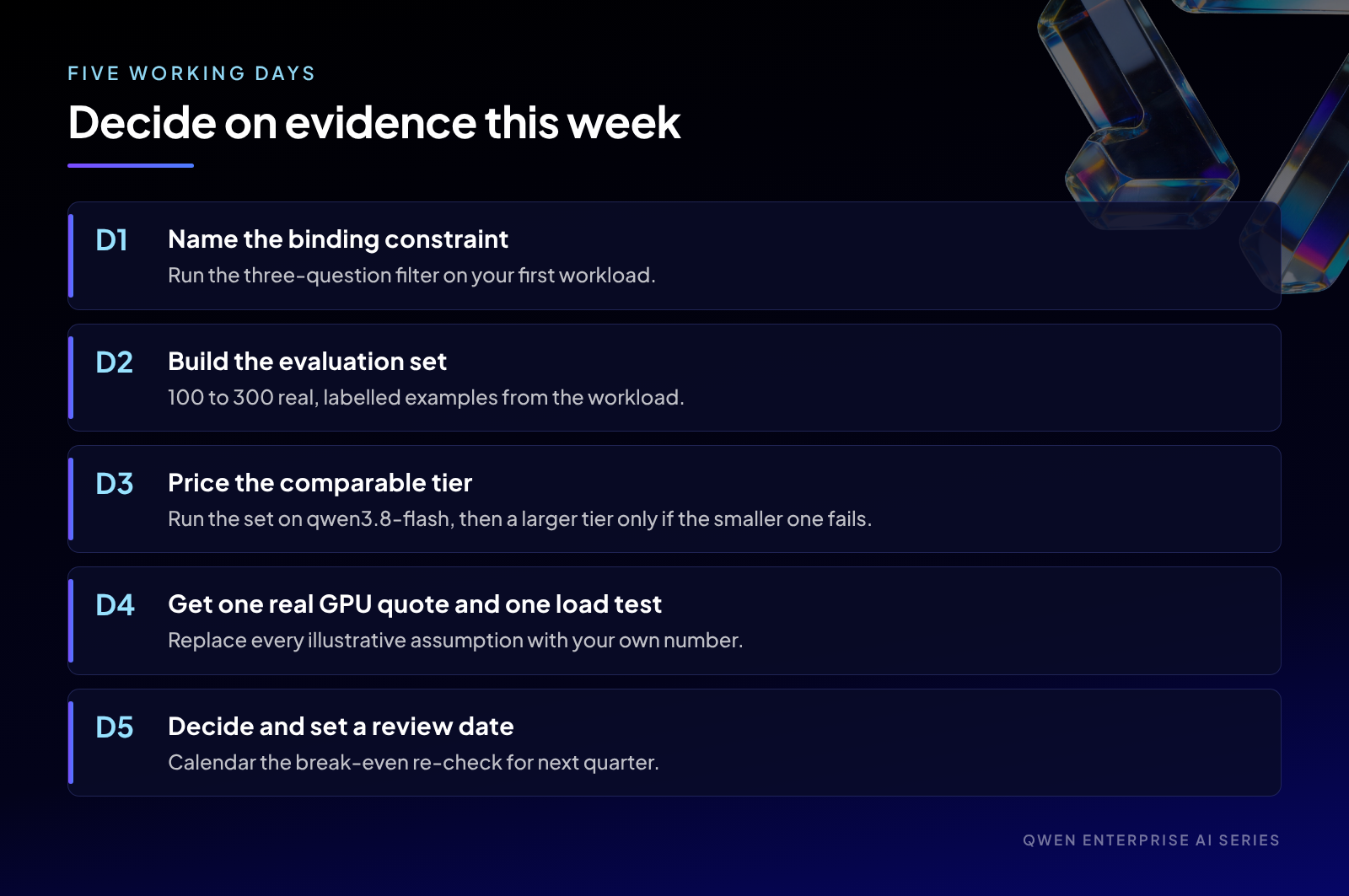
1. Day 1: Name the binding constraint. Run the three-question filter from section 03 on your first workload and write down the row that binds.
2. Day 2: Build the evaluation set. 100 to 300 real, labelled examples from the workload. No evaluation, no deployment decision.
3. Day 3: Price the comparable tier. Run the set on qwen3.8-flash, then a larger tier only if the smaller one fails. Record the blended price per 1M tokens.
4. Day 4: Get one real GPU quote and one load test. Replace every illustrative assumption in section 04 with your own number.
5. Day 5: Decide and set a review date. Start where the math and the constraint point, usually the API in a matching region, and calendar the break-even re-check for next quarter.
Free quota. New Model Studio users in Singapore get a free quota of 1M tokens per model for 90 days (Alibaba Cloud, Model Studio pricing, accessed Oct 5, 2026), enough to run a serious evaluation before spending anything.
Decide on evidence this week, and re-decide on volume every quarter.
Key takeaways
Decide per workload. The binding constraint (residency, version control or volume) sets the default; cost math only breaks ties.
Price the comparable tier. Under the stated assumptions, break-even sits near 4.0B tokens a month against qwen3.8-max and disappears against qwen3.8-flash.
Read the license per model. Qwen3.8-27B is Apache 2.0; Qwen3.8-2.4T-A95B carries a custom license your counsel should review.
Know which row binds before your next risk committee
Tell us the workload, the residency rule and today's volume, and the team will walk through the six auditor rows and the three-question filter with you. You leave with a per-workload default and a date to re-check it, from a short form: one minute, no login. Review my workload against the six rows →
See more of the enterprise AI portfolio at qwen.ai. Lasting returns come from treating AI like infrastructure: planned over years, delivered in stages, with Qwen alongside you so the early choices hold up and the value keeps growing.
About Qwen. Qwen gives enterprises an open route into production AI: one model family covering language, vision, audio, coding, embeddings, and agents, as open weights and managed APIs. Built on curated data and ongoing research, Qwen supports creating, testing, and running AI systems for decisions that matter, from self-serve developer access to dedicated inference.
Sources: Gartner, Gartner Forecasts Worldwide AI-Optimized IaaS Spending to Grow 96% Through 2026 (August 2026); Hugging Face, Qwen/Qwen3.8-27B model card (accessed Oct 5, 2026); Hugging Face, Qwen/Qwen3.8-2.4T-A95B model card (accessed Oct 5, 2026); Alibaba Cloud, Model Studio pricing (accessed Oct 5, 2026); Alibaba Cloud, What is Model Studio (accessed Oct 5, 2026); Alibaba Cloud, Model Studio privacy notice (accessed Oct 5, 2026); Alibaba Cloud, Batch inference (accessed Oct 5, 2026); Alibaba Cloud, Model training overview (accessed Oct 5, 2026); Alibaba Cloud, Model Evaluation (accessed Oct 5, 2026); Alibaba Cloud blog, Apsara Conference 2026 (accessed Oct 5, 2026).
Johnny Mai - Director, Gen AI Product Strategy & GTM, Qwen.
Disclaimer: This post is provided for general information only. Worked examples are illustrative and use stated assumptions; your costs will vary. Prices are Alibaba Cloud Model Studio list prices for the Singapore region as published in October 2026, vary by region, and may change over time. Figures from third-party research (Gartner 2026) are quoted as published in those reports and are not independently verified by Qwen or Alibaba Cloud. Product and service availability, features, and program terms vary by region and may change over time. Nothing in this post constitutes professional, legal, or investment advice. © 2026 Qwen. All rights reserved.
Pricing Enterprise AI Products: Lessons from Real-World Production
Model Routing Explained: Send Each Request to the Cheapest Model That Passes

14 posts | 2 followers
FollowAlibaba Cloud Community - August 5, 2026
Community Builder - July 13, 2026
Johnny Mai - October 7, 2026
Johnny Mai - August 18, 2026
Johnny Mai - October 7, 2026
Neel_Shah - August 3, 2026
14 posts | 2 followers
Follow Token Plan
Build more, spend less. One plan, every modality.
Learn More Qwen
Qwen
Full-range, open-source, multimodal, and multi-functional
Learn More
Alibaba Cloud Model Studio
A one-stop generative AI platform to build intelligent applications that understand your business, based on Qwen model series such as Qwen-Max and other popular models
Learn More AgentLoop
An Agent self-evolution platform designed to make your Agents progressively smarter and more attuned to users.
Learn MoreMore Posts by Johnny Mai

