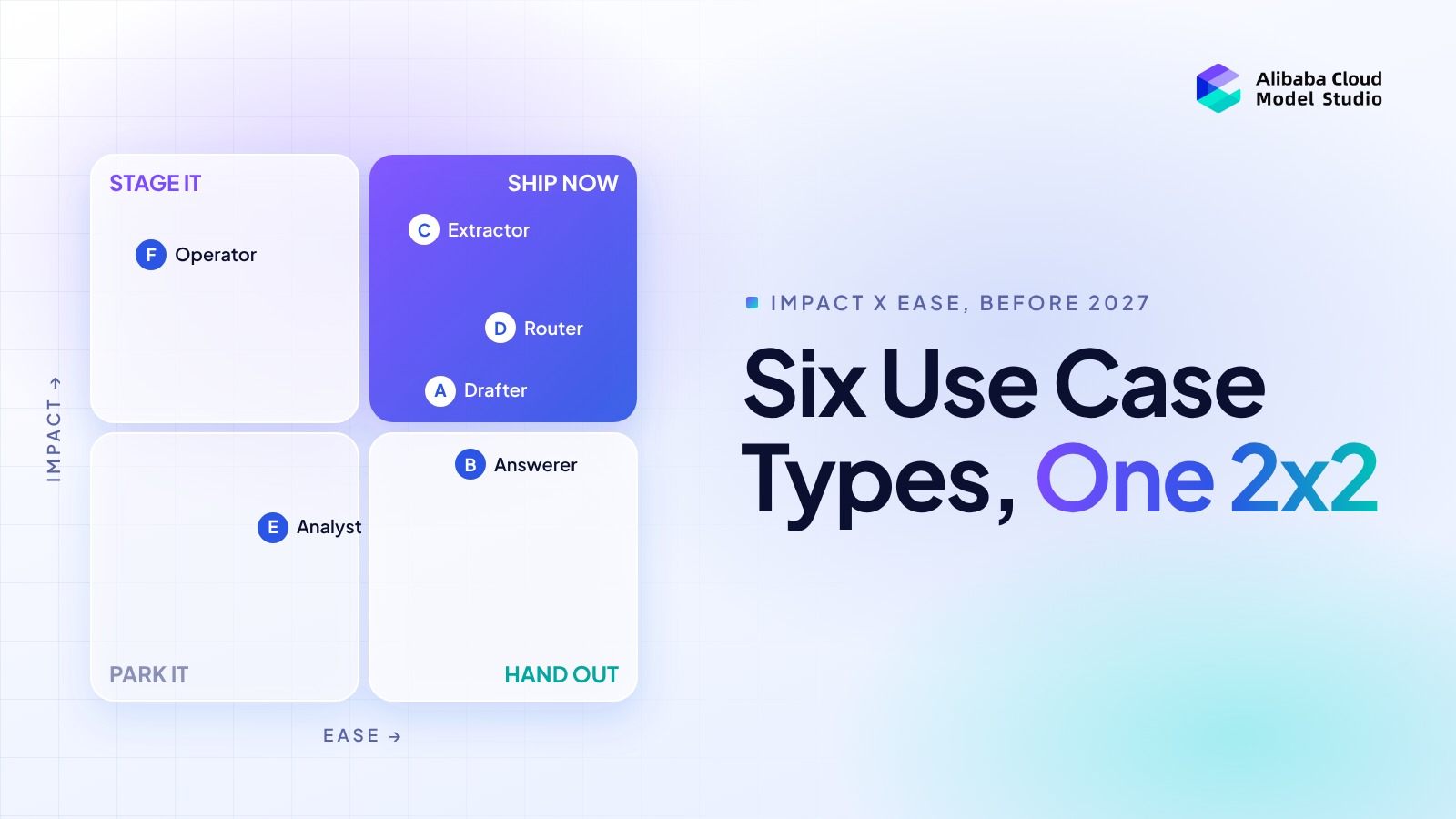
89% of organizations now use AI in at least one function. Only 37% report any impact on enterprise EBIT (McKinsey, The State of AI in 2026: On the Road to ROI, 2026). The gap is not the model. It is the backlog, ranked by whoever presented last.
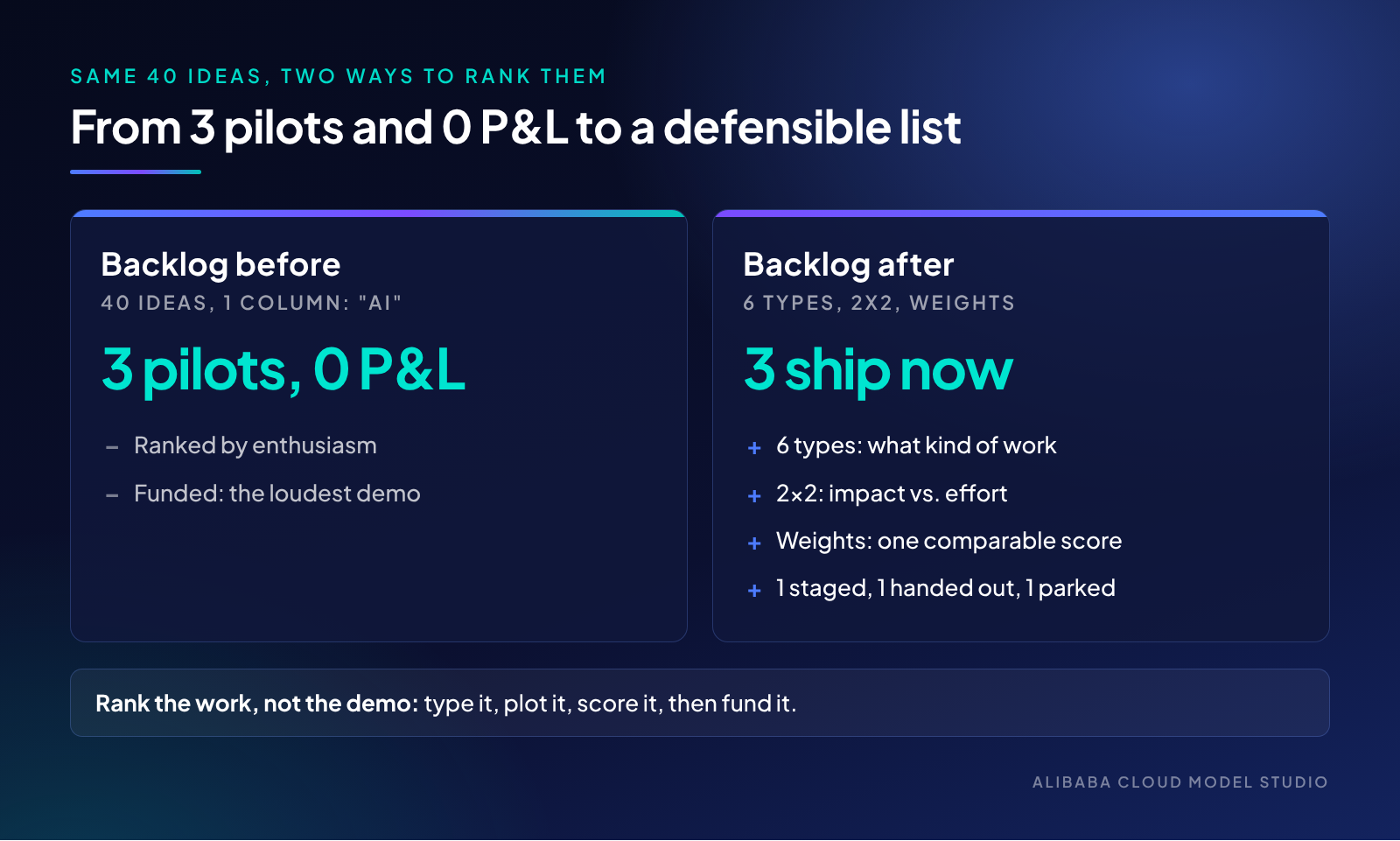
Rank the work, not the demo: type it, plot it, score it, then fund it.
In this guide
Six use case types that predict effort before anyone writes code
An impact x ease 2x2 with a funding move for each quadrant
Six weighted criteria so ideas from different functions compete on one scale
A worked ranking of six candidates, plus a one-page plan template
The 2027 plan gets written this quarter, and the AI line is growing.
Gartner forecasts worldwide AI spending of $2.7 trillion in 2026, rising to $3.637 trillion in 2027 (Gartner, Worldwide AI Spending Forecast, September 2026). The money is spreading out: more than 80% of AI spending now sits outside enterprise IT (BCG, Applied AI Index 2026, September 2026). Your backlog arrives from every function at once, with no common unit.
A strategy or PMO director faces two bad options. Fund everything a little and you get a dozen pilots that never reach production. Fund only the boldest idea and you bet the year on the hardest thing to build.
The answer is a sorting method for one workshop:
1. Type every idea. Six types cover nearly every request, and the type predicts effort before anyone writes code.
2. Plot it. Impact against effort, on a 2x2 with four named moves.
3. Score it. Six weighted criteria, so a finance idea and a customer service idea compete on the same scale.
Already holding ideas from every function? Sort your backlog into the six types with the team before the scoring meeting.
A backlog without a common unit is a popularity contest.
Backlogs mix ideas that differ by an order of magnitude in effort.
"Summarize meeting notes" and "let an agent approve purchase orders" both arrive labeled "AI". Typing them is the cheapest step you will take.
Here are the six types we use with enterprise teams, each with an example and the Qwen and Alibaba Cloud Model Studio capability that usually fits.
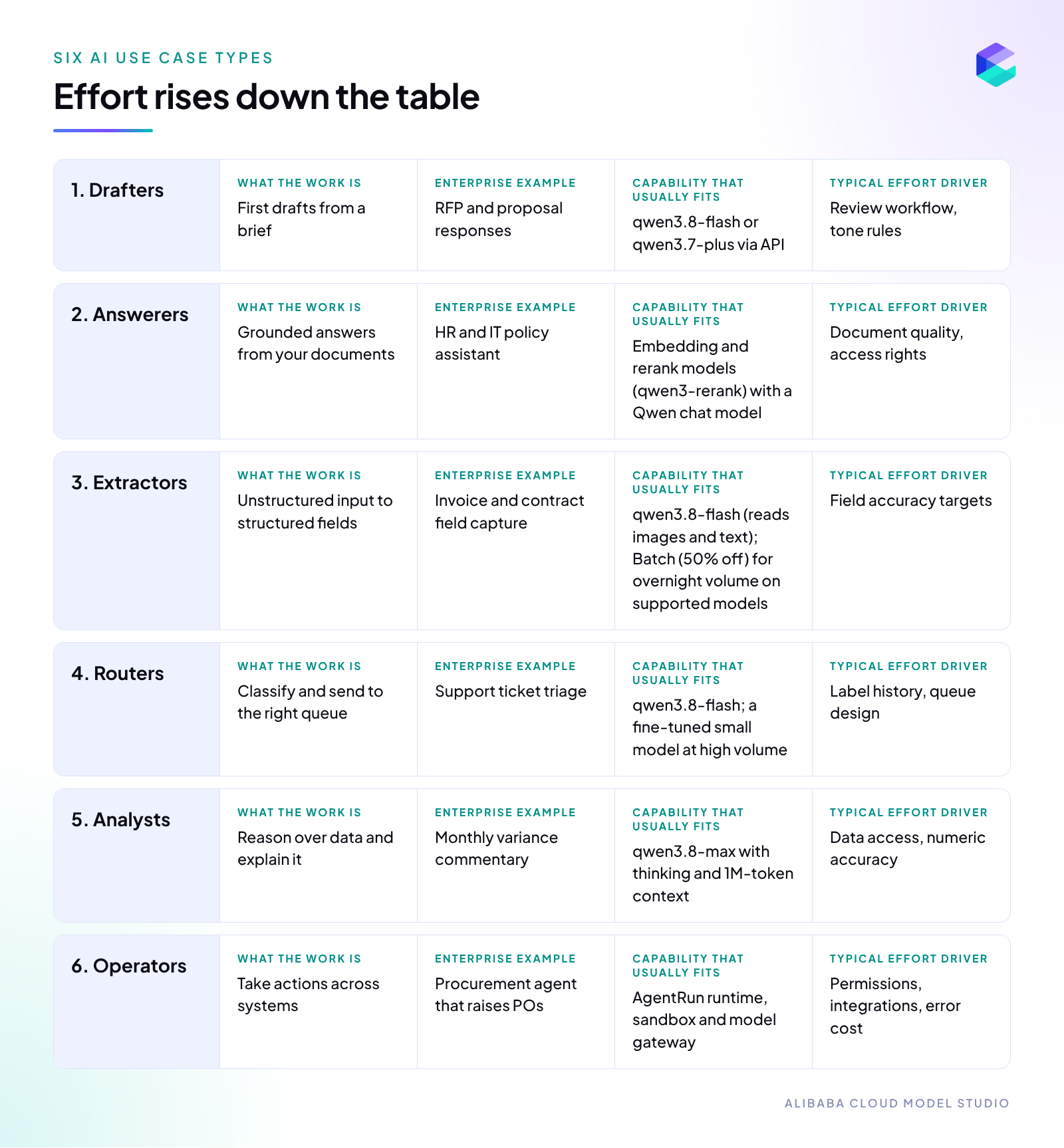
Table 1. Six AI use case types, mapped to capability and effort. (Qwen.)
Two planning patterns:
1. Effort rises down the table. Drafters and Routers mostly need a model and a prompt. Operators need permissions, integrations, and a plan for what happens when the agent is wrong.
2. Many high-value Operators are built from lower types. A procurement agent is an Extractor (read the request), a Router (pick the approval path) and an Analyst (check against budget) before it is an Operator. Fund the parts first and the agent gets cheaper.
Call the hidden variable data distance: how far a use case sits from data that is already clean, accessible and permissioned. In our experience it predicts effort far more reliably than model choice.
Type first, because the type predicts the effort.
Plot every typed idea: impact on the vertical axis, ease on the horizontal (ease, not effort, so "up and to the right" means "better").
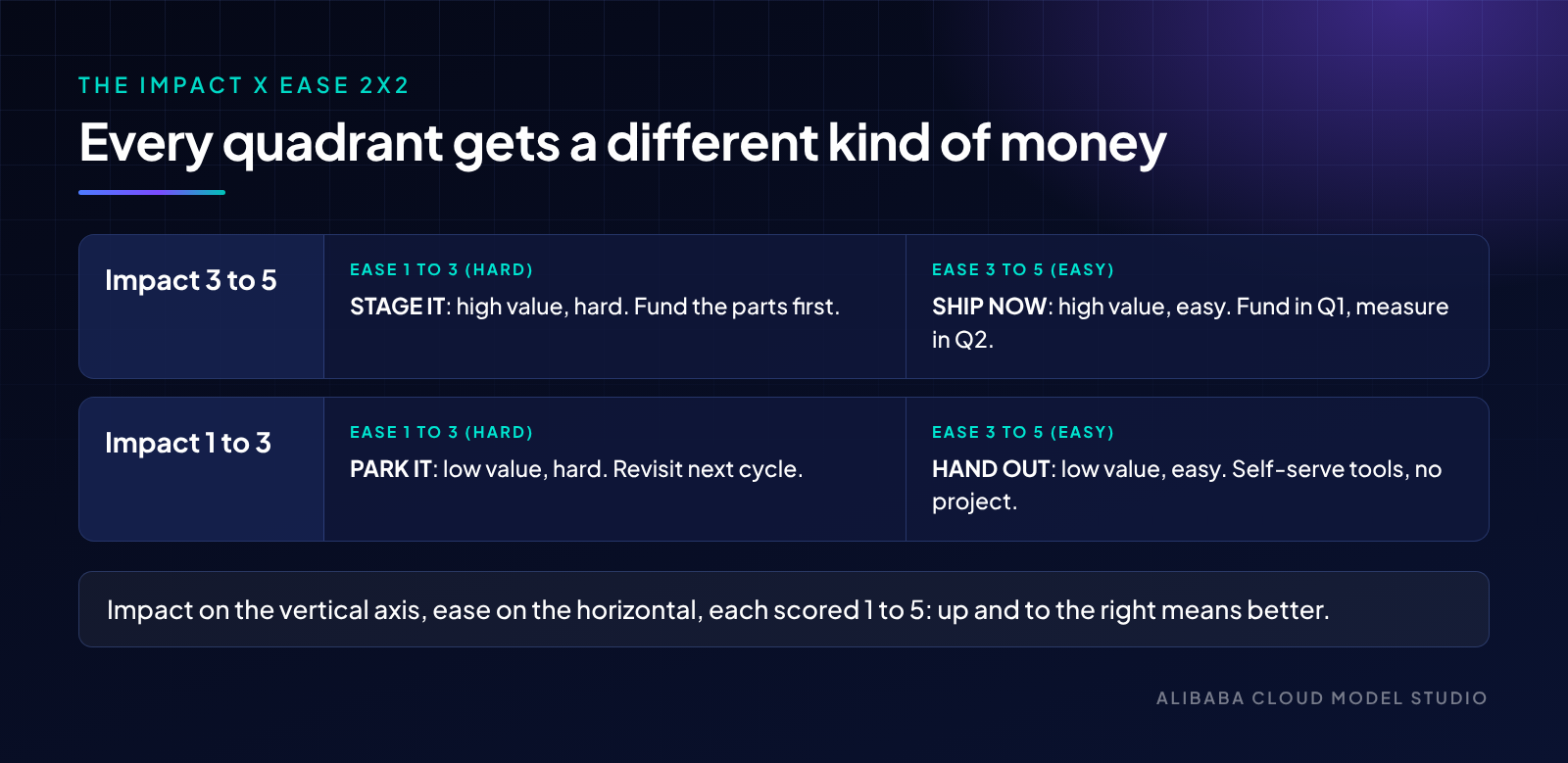
Figure 1. The impact x ease 2x2 with four named moves. (Qwen.)
Each quadrant is a funding decision:
1. Ship now. High impact, high ease. Fund it as a project with a production date and a metric in Q1.
2. Hand out. Low impact, high ease. No project: give teams self-serve access and a usage policy, then watch which uses spread.
3. Stage it. High impact, low ease. Fund the components that reduce its data distance, and set a gate review rather than a launch date.
4. Park it. Low impact, low ease. Write down why; revisit next cycle when the data or the models change.
The common error: treating "Stage it" like "Ship now", with a launch date on a project whose data does not exist yet.
Every quadrant gets a different kind of money.
A 2x2 drawn by hand drifts toward the sponsor's preference; a weighted score keeps the conversation on criteria.
We use six, three for impact and three for ease, each scored 1 to 5.
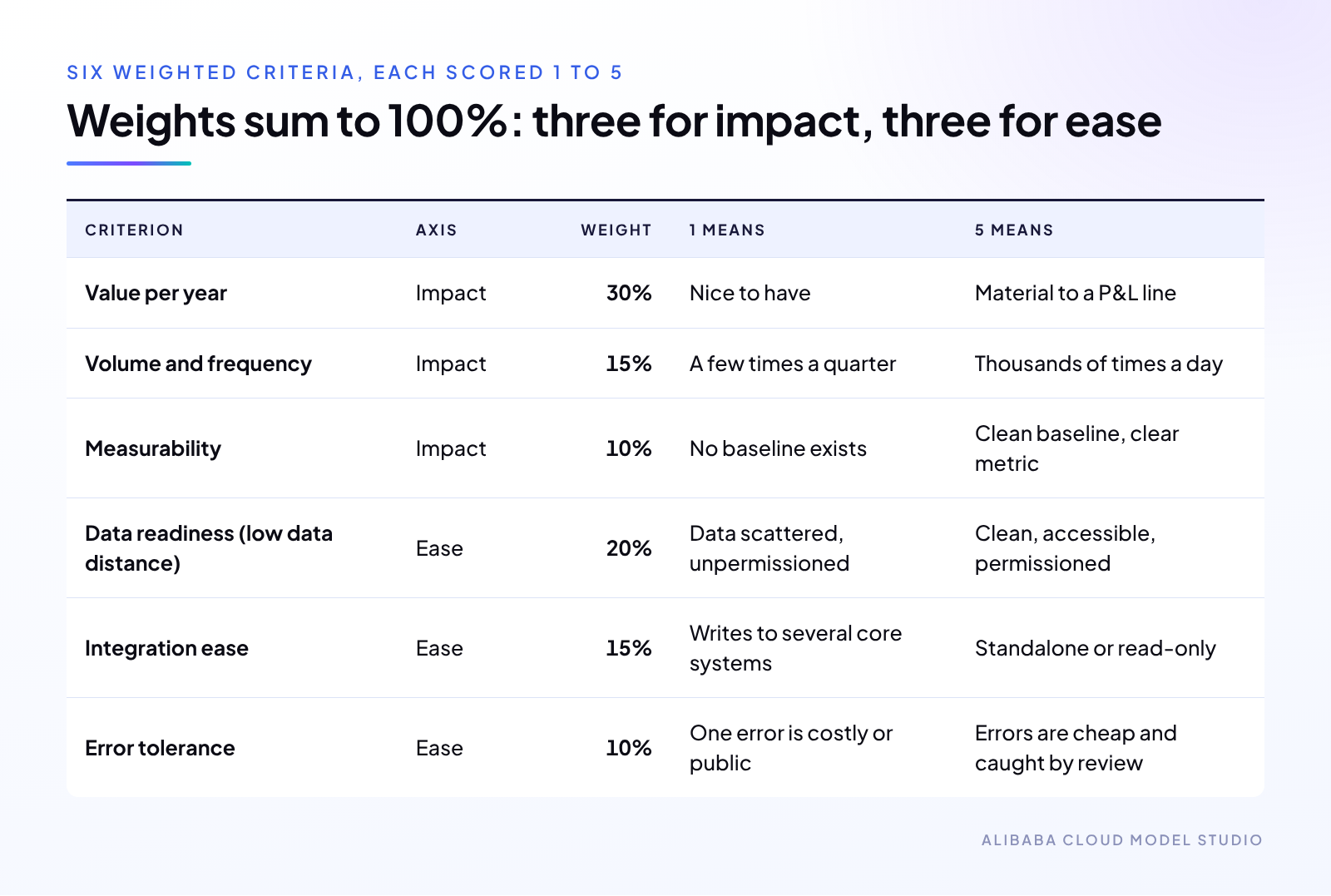
Table 2. Six weighted criteria for prioritizing AI use cases. Weights sum to 100%. (Qwen.)
Three rules for using it:
1. Score in the room, not in advance. Sponsor, data owner and engineer score together. Disagreement on data readiness is the most useful output of the meeting.
2. Compute two numbers, not one. The impact score is the weighted average of the first three rows; the ease score, of the last three. Those place the idea on the 2x2; the weighted total ranks ideas inside a quadrant.
3. Keep model cost out of the score. At current list prices, run cost rarely decides the rank (see the worked example). Put it in the business case, not the prioritization.
Weights are a value decision: write them down before you see the candidates.
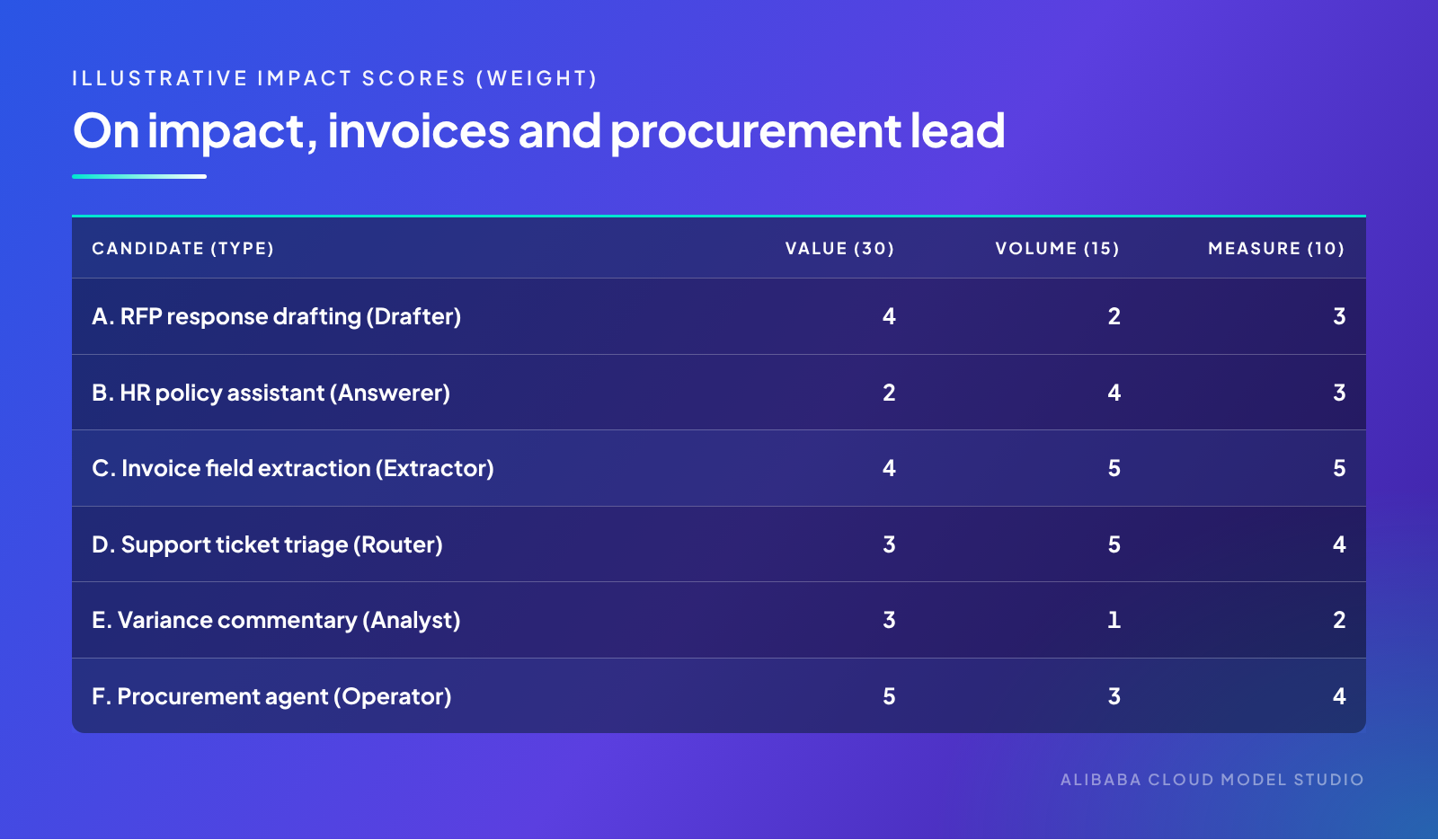
Assumptions: a company of about 5,000 employees, one shared AI platform team, and six candidates submitted for 2027, with illustrative scores.
Impact criteria
Ease criteria
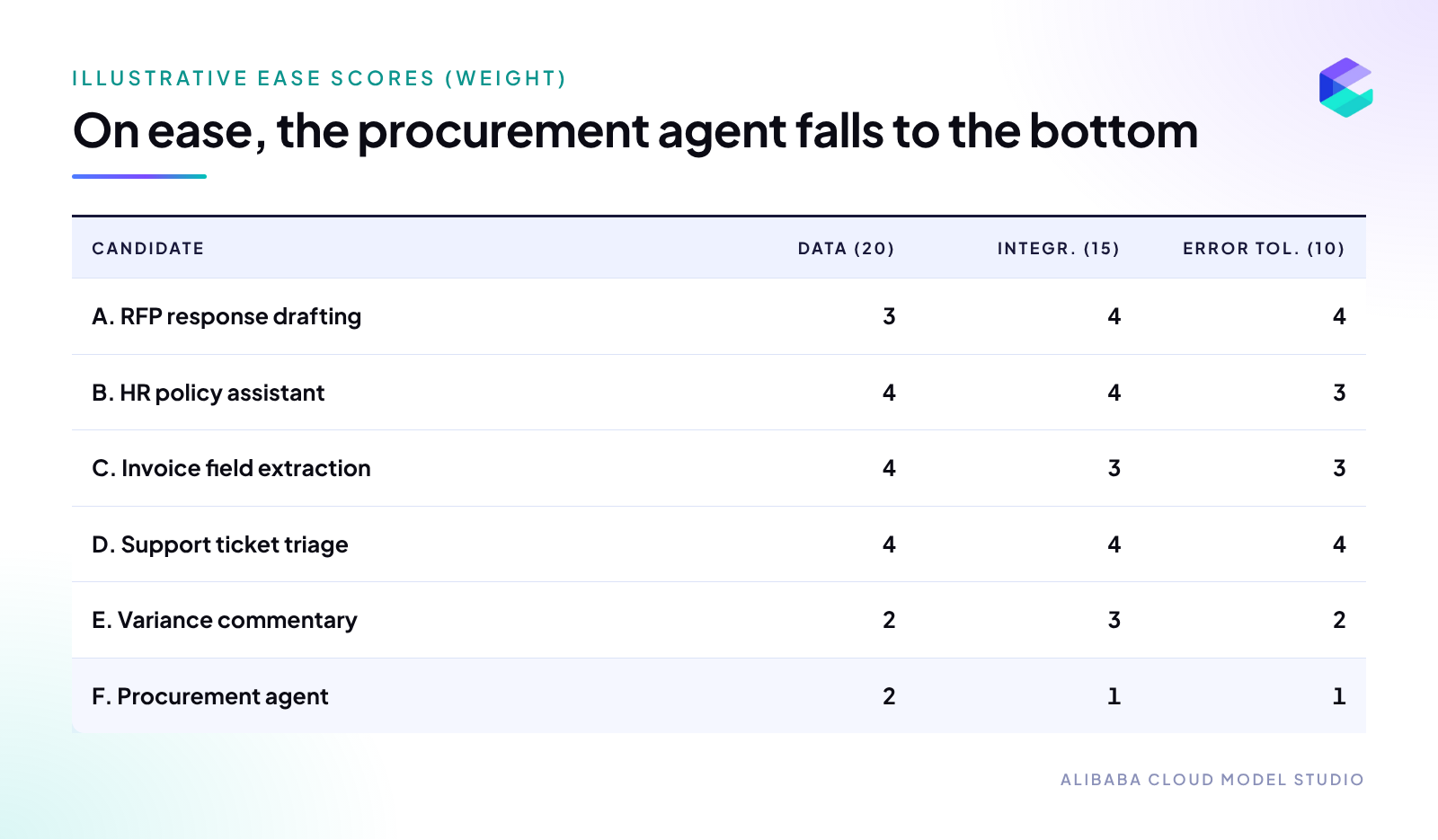
Table 3. Raw scores for six candidates. (Qwen.)
Now the math, shown for candidate C:
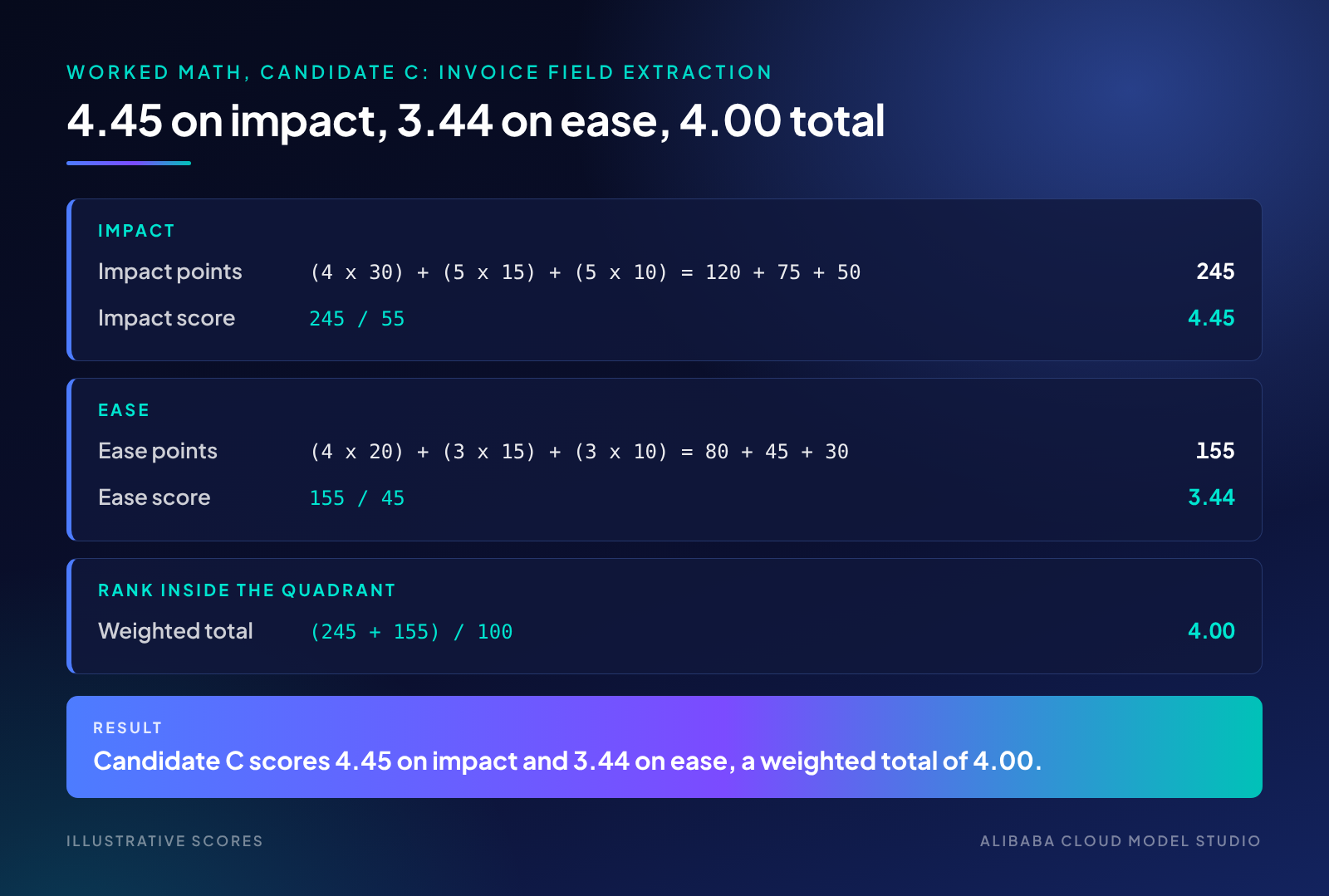
Result: candidate C scores 4.45 on impact and 3.44 on ease, a weighted total of 4.00.
The same arithmetic for all six:
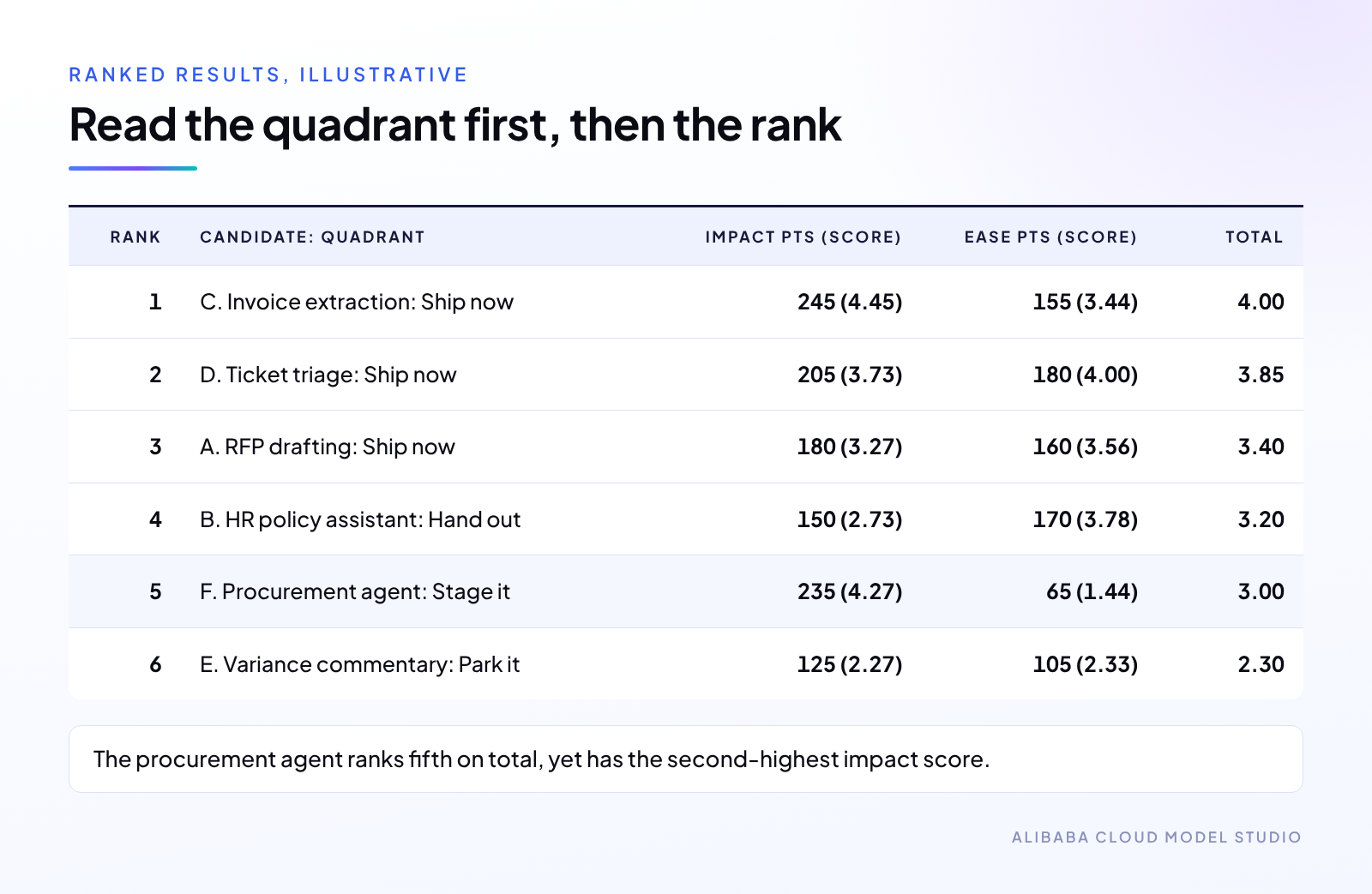
Table 4. Ranked results. Quadrant cut-off is 3.0 on each axis. (Qwen.)
Three readings for a PMO director:
1. The weighted total hides "Stage it" items. The procurement agent ranks fifth on total, yet has the second-highest impact score. Read the quadrant first, then the rank.
Fund C and D now: an extractor and a router are two of the parts the agent will need.
2. Model cost did not move the rank. Take candidate C at an assumed 40,000 invoices a month, 3,000 input tokens and 500 output tokens each, on qwen3.8-flash in Singapore ($0.15 input and $0.47 output per 1M tokens; Model Studio pricing page, accessed Oct 5, 2026):
Input:   40,000 x 3,000 = 120M tokens x $0.15 = $18.00
Output:  40,000 x 500   =  20M tokens x $0.47 =  $9.40
Total:   about $27.40 a month at list price
Result: about $27.40 a month, with no Batch discount: Batch runs at 50% of the real-time price, but the Singapore batch list currently covers qwen-max, qwen-plus, qwen-flash and qwen-turbo, not qwen3.8-flash.
The effort sits in data readiness and integration, not in tokens. That is data distance in one number.
3. Hand out is not a rejection. The HR assistant is easy and moderately useful: give HR self-serve access and a policy, measure usage for a quarter, and re-score.
The payoff: a ranked list you can defend line by line in a budget review.
Rank your 2027 shortlist on one scale
Send up to 30 candidate ideas through a short form, one line each. The team will review the typing, weights and quadrant placement with you, so the list you take to budget review holds up line by line. Get your shortlist typed, scored and plotted →
A token bill of $27 a month can still take two quarters to ship. Price the data distance, not the model.
The most protective thing a planning process can do is say no early.
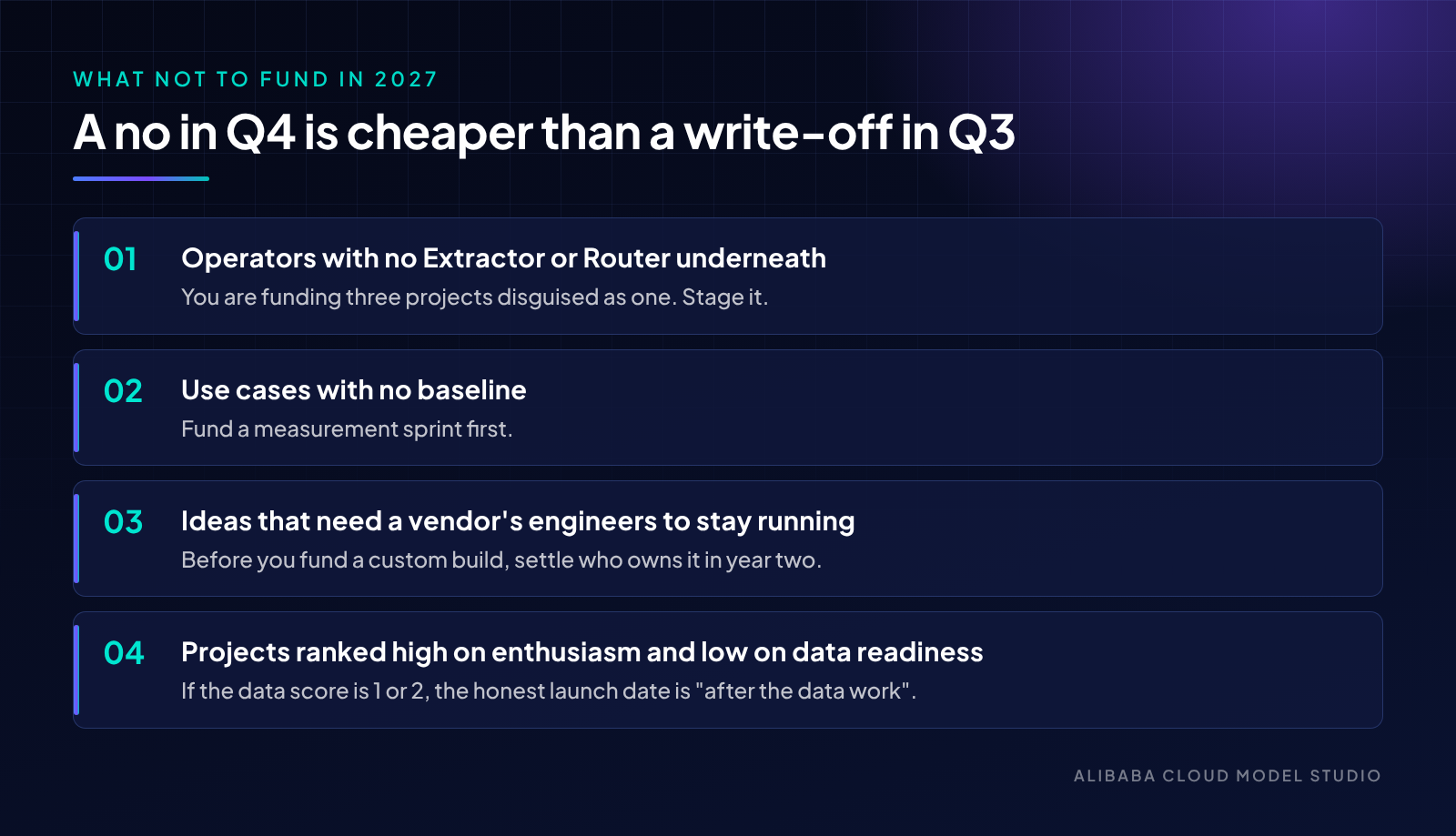
Four patterns we would not fund as written:
1. Operators with no Extractor or Router underneath. If the agent's inputs are not structured and its decisions not classified, you are funding three projects disguised as one. Stage it.
2. Use cases with no baseline. If nobody can say how long the work takes today or how often it goes wrong, you cannot prove impact next year. Fund a measurement sprint first.
3. Ideas that need a vendor's engineers to stay running. Gartner predicts that 70% of enterprises will abandon agentic AI built by vendor forward-deployed engineering by 2028 (Gartner, press release, September 2026). Before you fund a custom build, settle who owns it in year two: the build-or-partner call we broke down in Build vs. Buy, or Both? The Enterprise AI Decision.
4. Projects ranked high on enthusiasm and low on data readiness. If the data score is 1 or 2, the honest launch date is "after the data work". Say so in the plan.
When not to use this method at all: if a use case is mandated by regulation, a customer contract, or a security incident, fund it on its own line. The 2x2 is for choices, not obligations.
A no in Q4 is cheaper than a write-off in Q3.
One meeting, one spreadsheet, and this template:
2027 AI USE CASE: ONE-PAGE PLAN
------------------------------------------------------------
Name:                       Sponsor:            Data owner:
Type (1-6):                 Drafter / Answerer / Extractor /
                            Router / Analyst / Operator
Problem today (1 line):
Baseline metric + value:    e.g. 11 days to close, 3% error
Target metric + date:
Scores (1-5): Value __ Volume __ Measure __
              Data __  Integr. __ Error tol. __
Impact score __  Ease score __  Total __  Quadrant ________
Data distance: what must exist before build?
Run-cost estimate: volume x tokens x list price (model ID)
Guardrails needed on day one:
Gate review date:           Kill criterion:
------------------------------------------------------------
Figure 2. One-page planning template. (Qwen.)
A five-day sequence that fits inside Q4:
1. Day 1: collect. Ask every function for its top three ideas on the template. Cap the list at 30.
2. Day 2: type. Assign each idea one of the six types. Merge duplicates.
3. Day 3: score. Run the scoring session with sponsor, data owner and engineer in the room.
4. Day 4: estimate. For Ship-now items only, compute run cost from volume x tokens x list price. Model Studio gives you one place to test this: Qwen models from qwen3.8-flash to qwen3.8-max behind one API, a free quota of 1M tokens per model for 90 days for new users in Singapore, and Model Evaluation to score outputs against your own test set before you commit.
5. Day 5: decide. Publish the 2x2 with four lists: ship now, hand out, stage it, park it. Attach a gate date to every staged item.
Plan the portfolio like a pipeline: a few ships, a few stages, and a written reason for every no.
Key takeaways
Type before you rank. The type predicts effort, and data distance predicts it better than model choice.
Read the quadrant, then the total. The procurement agent ranks fifth on total but has the second-highest impact score: stage it, do not park it.
Token cost rarely decides the rank. Invoice extraction runs about $27.40 a month in tokens; the effort sits in data and integration.
Stage the big bets before the 2027 budget locks
Bring the high-impact ideas that sit far from clean data. We will work through which Extractors and Routers shorten their data distance, and what each gate review should check before you fund the agent. Plan your Stage it items part by part →
See more of the enterprise AI portfolio at qwen.ai. Lasting returns come from treating AI like infrastructure: planned over years, delivered in stages, with Qwen alongside you so the early choices hold up and the value keeps growing.
About Qwen. Qwen gives enterprises an open route into production AI: one model family covering language, vision, audio, coding, embeddings, and agents, as open weights and managed APIs. Built on curated data and ongoing research, Qwen supports creating, testing, and running AI systems for decisions that matter, from self-serve developer access to dedicated inference.
Sources: McKinsey, The State of AI in 2026: On the Road to ROI (August 2026); Gartner, Gartner Forecasts Worldwide AI Spending to Grow 49.5% in 2026 (September 2026); Gartner, Gartner Predicts 70% of Enterprises Will Abandon Agentic AI Built by Vendor Forward-Deployed Engineering by 2028 (September 2026); BCG, Applied AI Index 2026 press release (September 2026); Alibaba Cloud Model Studio, Model pricing, Models, What is Model Studio, Batch inference, Model Evaluation; Alibaba Cloud, What is AgentRun (accessed Oct 5, 2026).
Johnny Mai - Director, Gen AI Product Strategy & GTM, Qwen.
Disclaimer: This post is provided for general information only. Worked examples are illustrative and use stated assumptions; your costs will vary. Prices are Alibaba Cloud Model Studio list prices for the Singapore region as published in October 2026, vary by region, and may change over time. Figures from third-party research (McKinsey 2026; Gartner 2026; BCG 2026) are quoted as published in those reports and are not independently verified by Qwen or Alibaba Cloud. Product and service availability, features, and program terms vary by region and may change over time. Nothing in this post constitutes professional, legal, or investment advice. © 2026 Qwen. All rights reserved.
Prompt, RAG, or Fine-Tune? A Decision Guide Priced in Dollars
How a Video Team Runs Wan3.0 in Production: Pipeline, Review Gates, Reliability

14 posts | 2 followers
FollowAlibaba F(x) Team - March 1, 2023
Alibaba Cloud Native Community - October 22, 2025
Iain Ferguson - March 11, 2022
Alibaba Cloud Community - September 22, 2026
Alibaba Cloud Community - January 4, 2024
Farruh - June 23, 2025
14 posts | 2 followers
Follow Qwen
Qwen
Full-range, open-source, multimodal, and multi-functional
Learn More Alibaba Cloud Model Studio
A one-stop generative AI platform to build intelligent applications that understand your business, based on Qwen model series such as Qwen-Max and other popular models
Learn More
Token Plan
Build more, spend less. One plan, every modality.
Learn More Alibaba Cloud for Generative AI
Accelerate innovation with generative AI to create new business success
Learn MoreMore Posts by Johnny Mai

