An illustrative 19-asset product launch generates 1,275 seconds of Wan3.0 video for $168.75 at list price. The review hours to approve it, at an assumed $75 an hour, cost $648.75. Most AI video cost plans price the cheap line to the cent and guess the expensive one.
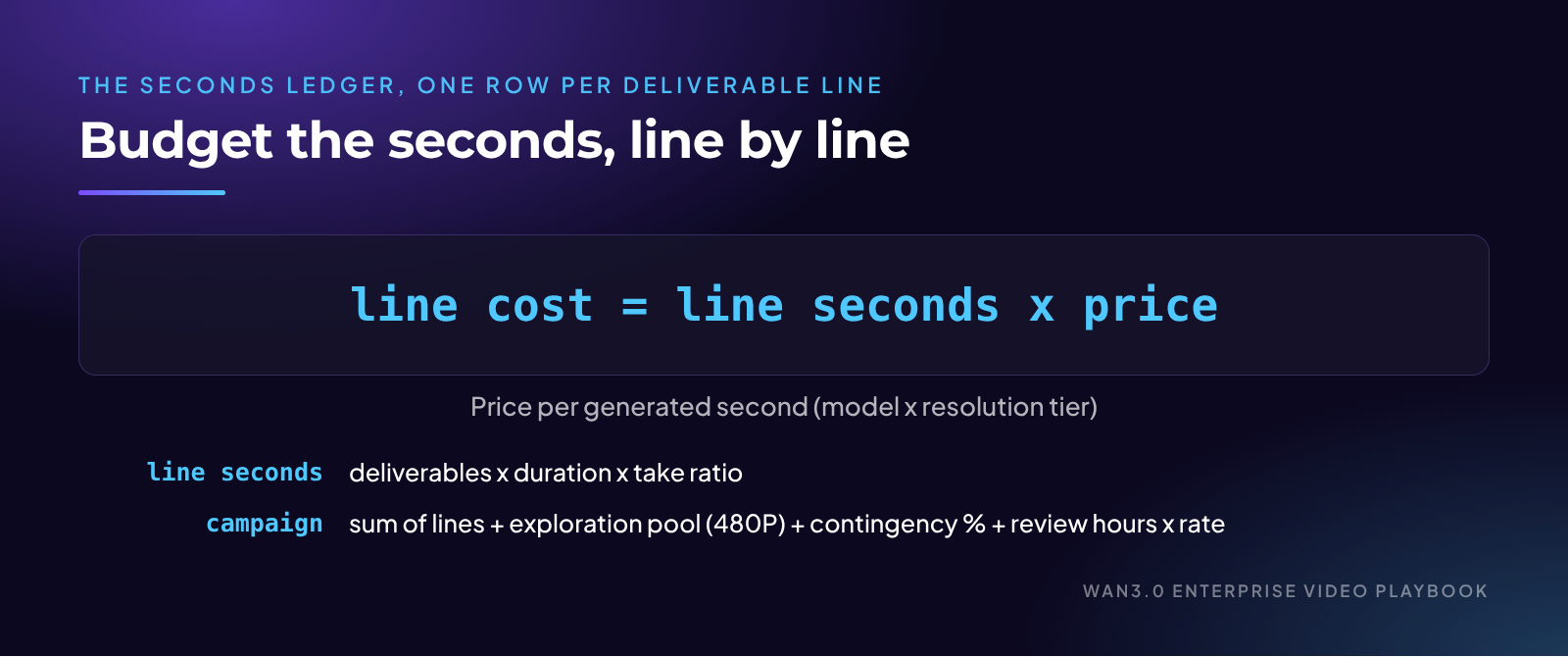
Price every line in seconds before anyone writes a prompt, and the budget becomes a plan instead of a guess.
In this guide
A five-factor template that turns any deliverables list into generated seconds and dollars
Starting take ratios and resolution tiers by deliverable type, to replace with your own data
Three worked campaign budgets with every multiplication shown
How to size contingency, review time and promotions so the number you send survives the client call
Wan3.0 bills per generated second, so the budget question is not "how many videos" but "how many seconds will we generate to ship them".
That changes the planner's job. In a traditional shoot, cost tracks crew days. With Wan3.0, cost tracks seconds, and seconds track three things you already know at kickoff: how many assets, how long each one runs, and how many attempts each one usually takes.
The trap is planning from the delivered runtime. A 30-second hero spot does not cost 30 seconds of generation. It costs every take generated on the way to the approved one, at whatever resolution those takes ran.
Two operating facts shape the template. Each Wan3.0 generation runs 2 to 30 seconds, at 480P, 720P or 1080P, as 30 fps MP4 (Alibaba Cloud Model Studio, Video generation overview, accessed Oct 6, 2026). And pricing is per generated second, by resolution tier and model.
If your team already holds a deliverables list for next quarter, get your shot list costed before kickoff → and walk into the planning meeting with a number.
Budget the seconds you will generate, not the seconds you will ship.
The template has one row per deliverable line and five inputs per row.
I call it the Seconds Ledger: a deliverables list where every row carries its own seconds and its own price, so a producer can defend each line and a finance partner can audit it.
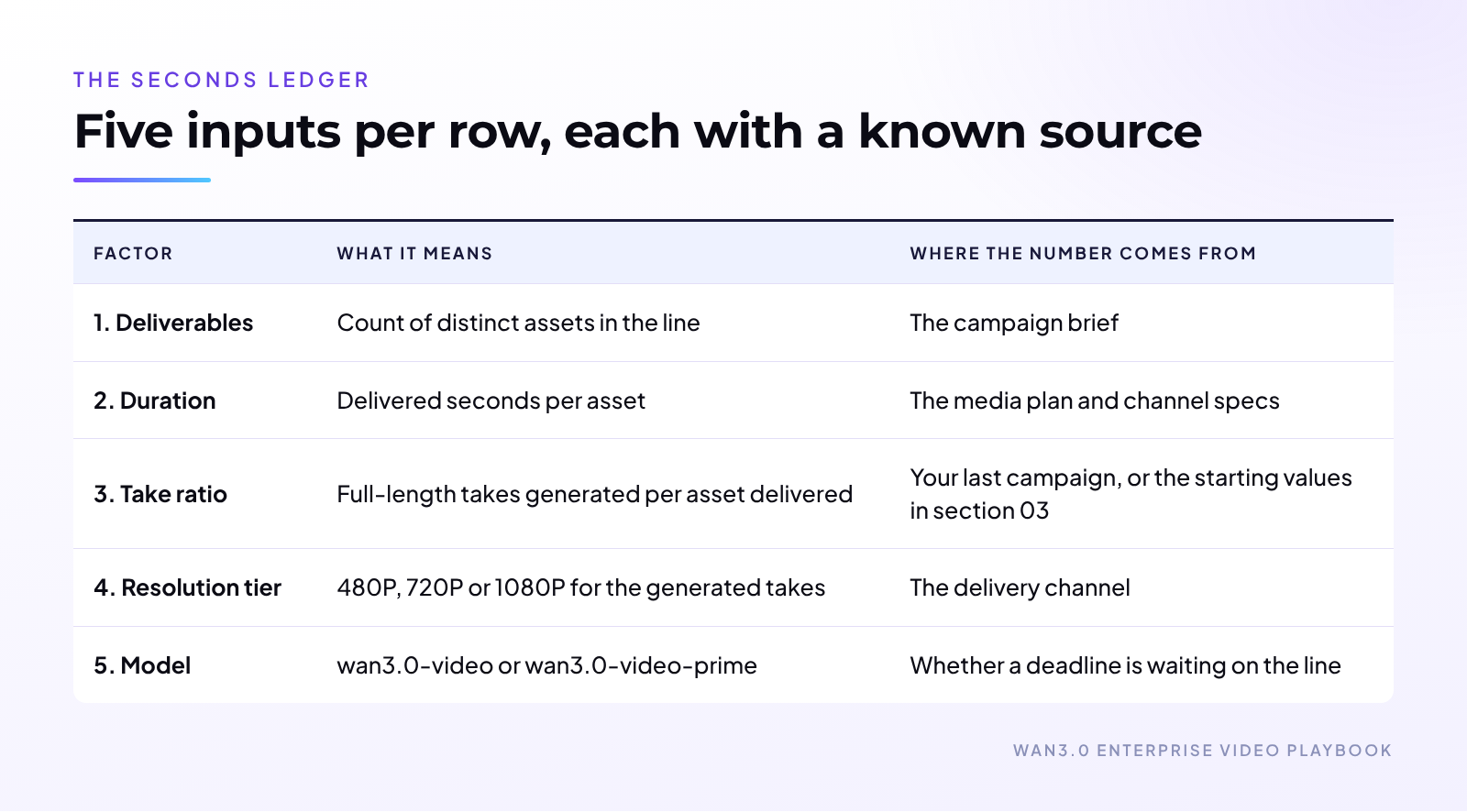
The five factors of the Seconds Ledger. (Wan.)
Two rules keep the rows honest.
First, a deliverable longer than 30 seconds is several lines, not one. A 60-second spot is at least two generations of up to 30 seconds each, and each segment carries its own take ratio.
Second, exploration is a separate pool. Concept and style tests at 480P do not belong to any one deliverable, so they sit in their own row, sized as a percentage of the campaign's line seconds.
If a row has no take ratio, it has no budget; it has a hope.
The take ratio is the factor planners skip and the one that moves the total most.
It is the number of full-length takes you generate, at delivery resolution, for each asset you ship. A ratio of 4 on a 15-second cutdown means 60 generated seconds per delivered asset.
These are starting assumptions for a first campaign, not benchmarks. Replace every value with your own after one campaign closes.
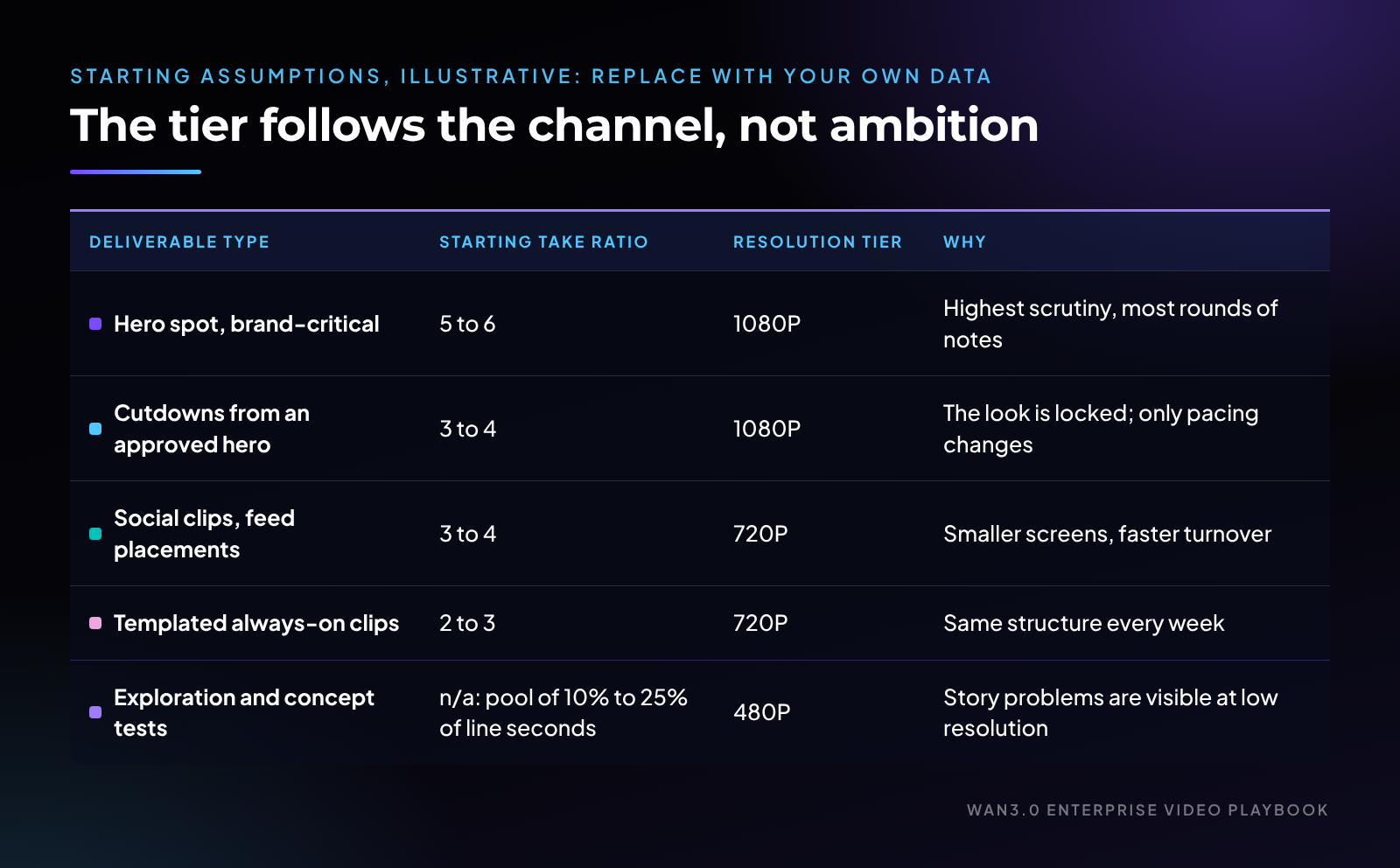
Starting take ratios and tiers by deliverable type: illustrative, replace with your own data. (Wan.)
The tier column follows the channel, not ambition. If the placement will never display above 720P, a 1080P take doubles the line cost for pixels nobody sees: $0.20 against $0.10 per generated second on wan3.0-video in Singapore.
The take ratio is a fact about your team, so measure it once and stop guessing it.
The model is the fifth factor, and it is a per-line choice, not a campaign-wide one.
Both models are listed in Alibaba Cloud Model Studio, Singapore region, per generated second (accessed Oct 6, 2026):
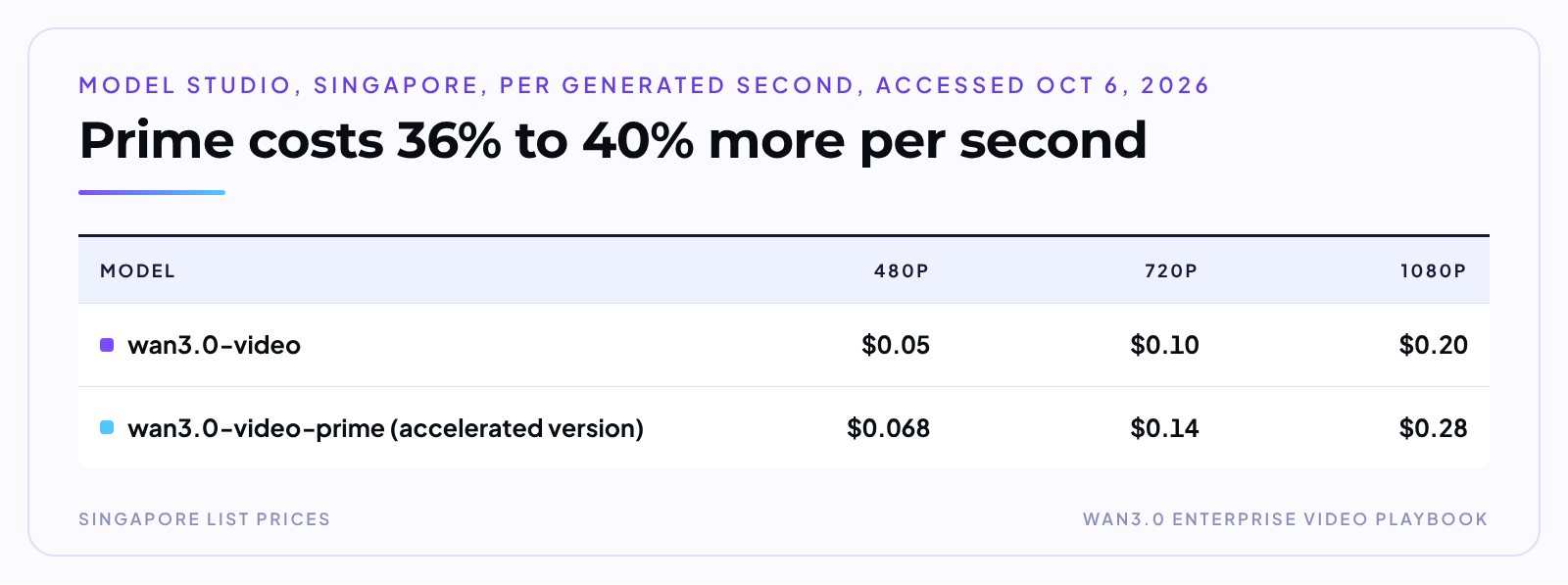
Wan3.0 list prices per generated second, Singapore. (Alibaba Cloud Model Studio.)
Prime costs 36% more at 480P and 40% more at 720P and 1080P. Article 07 in this series covers how to time it on your own queue; for the planner, the rule is simpler.
Put a line on Prime only when a dated deadline sits on that line: same-day event recaps, reactive social, a launch-hour cut. Everything with a normal review cycle stays on wan3.0-video.
Pay for speed on the line where the clock is, and nowhere else.
A seconds subtotal is not a budget until it carries contingency and review.
Contingency covers technical retries, a brief that changes mid-flight and a take ratio that runs hot. Use a percentage of the generation subtotal, set by how new the work is:
1. 10% for repeatable work. Always-on formats your team has shipped before.
2. 20% for new formats or hard deadlines. A first launch on Wan3.0, or anything tied to an event date.
Review is the line most AI video cost plans leave out, and on the numbers below it is the largest. Every take someone watches and every deliverable someone signs off is paid time. Price it as two lines: minutes per take reviewed, and minutes per deliverable signed off, both times a loaded hourly rate.
In the worked examples I use an assumed blended rate of $75 per hour for producer and brand review. Use your own rate card.
A budget without review hours is a generation quote, not a campaign budget.
Here are three illustrative campaigns run through the Seconds Ledger. All prices are Singapore list prices per generated second (Model Studio, accessed Oct 6, 2026). Takes, minutes and the $75 rate are labelled assumptions.
Campaign A: product launch (19 deliverables, new format, 20% contingency)
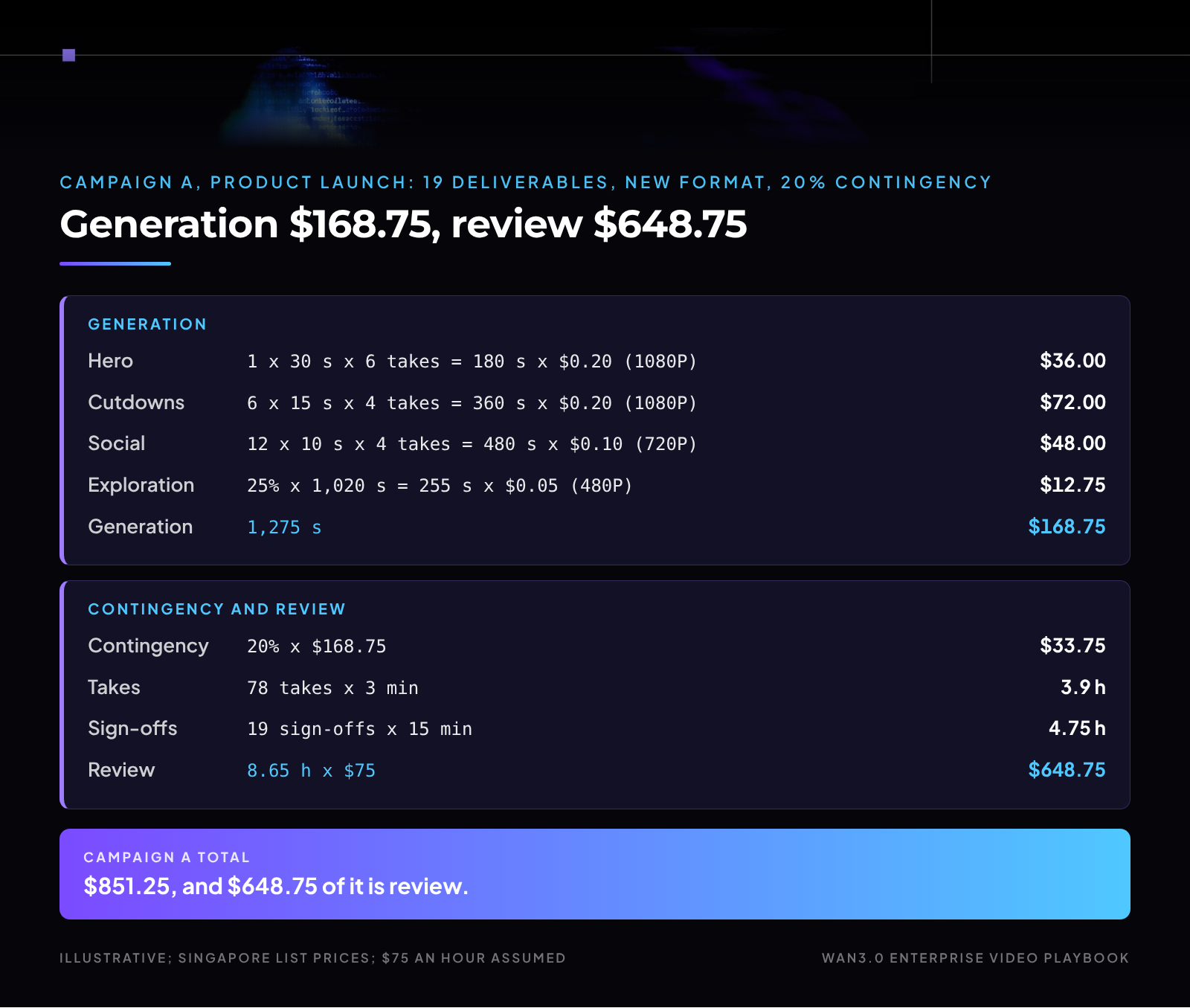
Result: Campaign A totals $851.25, and $648.75 of it is review.
Campaign B: always-on social, one month (48 deliverables, repeatable, 10% contingency)
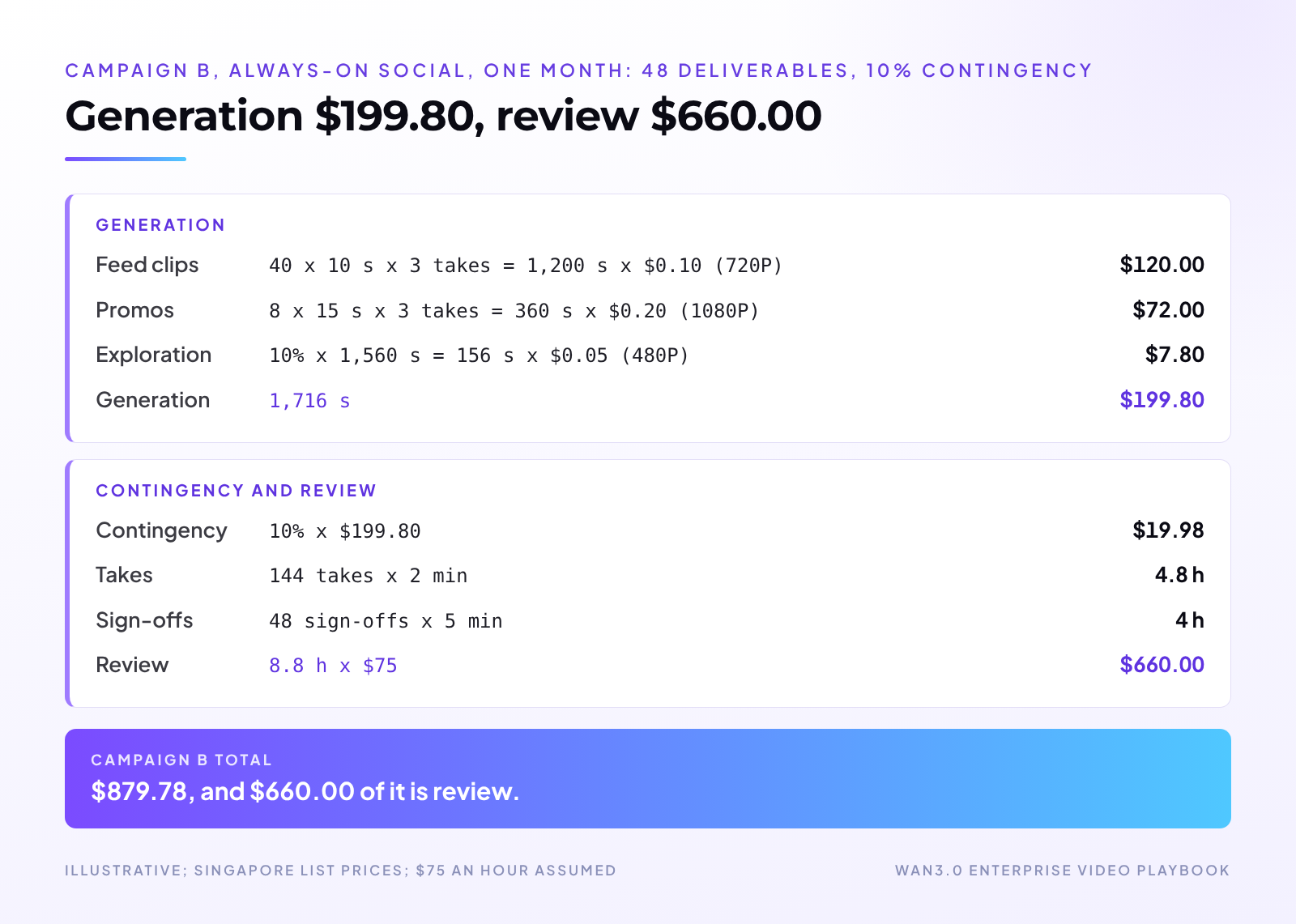
Result: Campaign B totals $879.78, and $660.00 of it is review.
Campaign C: three-day event (17 deliverables, deadline, 20% contingency)
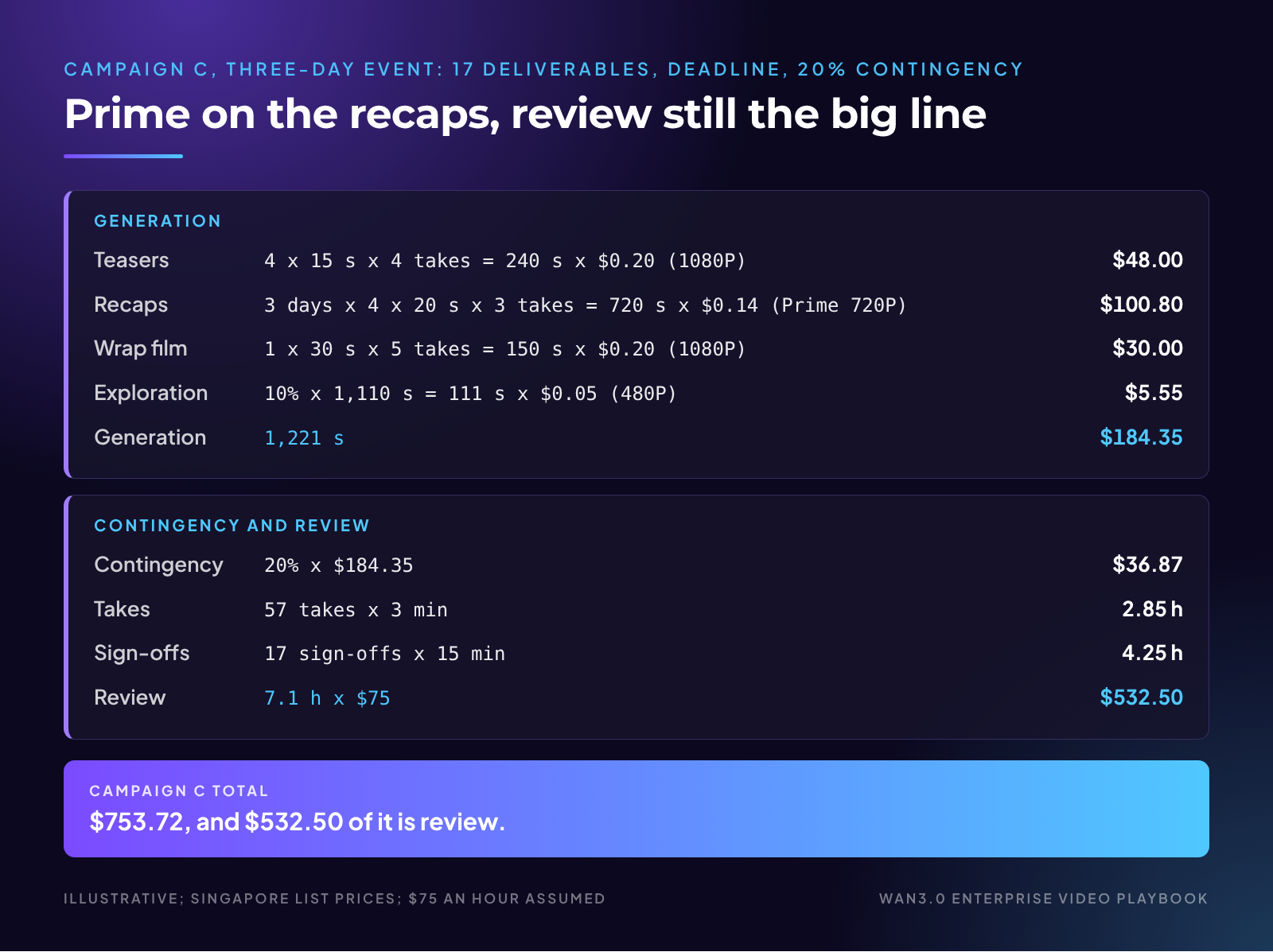
Result: Campaign C totals $753.72, and $532.50 of it is review.
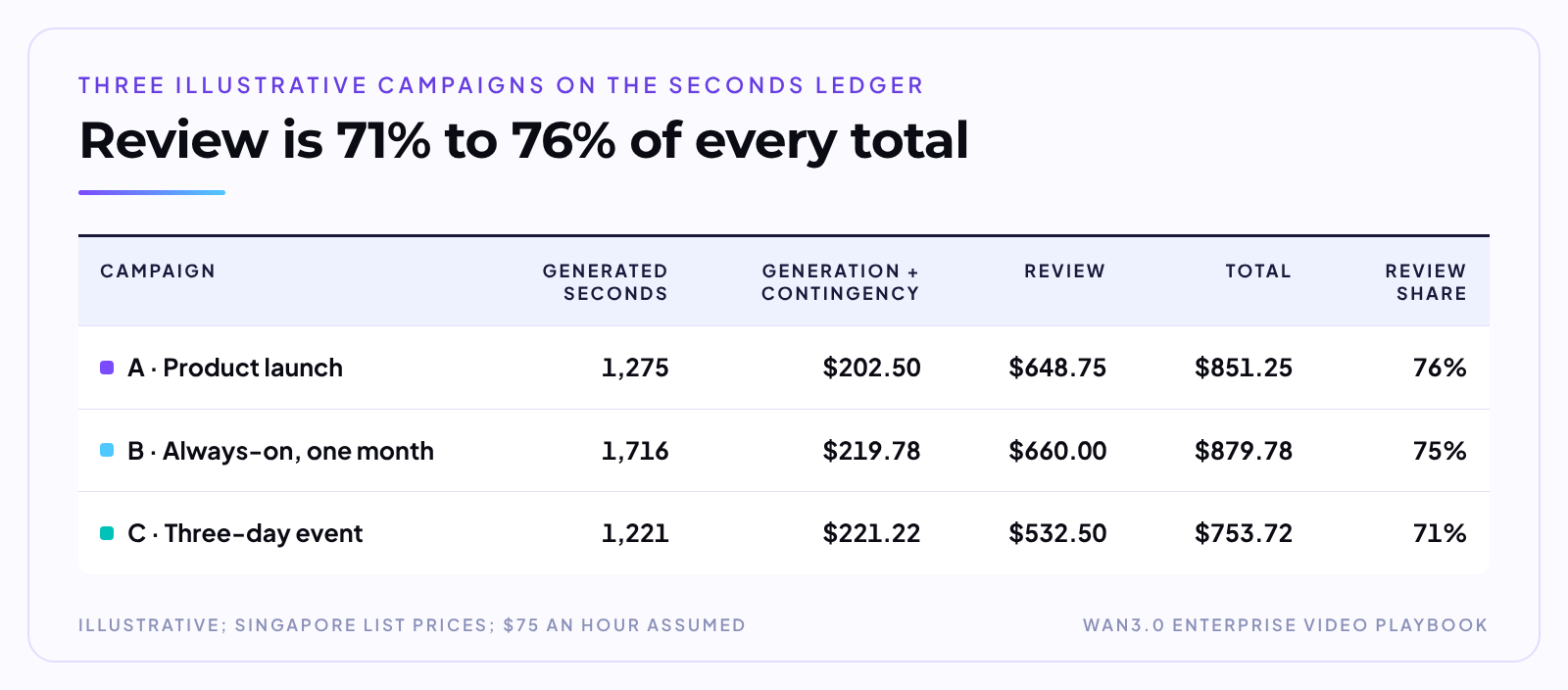
Three illustrative campaign budgets on the Seconds Ledger. (Wan.)
Result: on these assumptions, generation plus contingency is about $200 to $220 per campaign, and review is 71% to 76% of every total.
Two readings matter for the plan.
First, Prime is a small line. Campaign C's recaps on wan3.0-video at 720P would be 720 x $0.10 = $72.00, so the deadline premium is $28.80 across the three days of same-day recaps.
Second, review minutes move the total more than any model choice. Cutting Campaign A's take review from 3 minutes to 2 saves 78 x 1 min = 1.3 h x $75 = $97.50, more than three times the Prime premium in Campaign C.
Price your next campaign on the Seconds Ledger
Send your deliverables list with durations, channels and any hard dates. The Wan team will work through take ratios, the wan3.0-video and Prime split per line, and the contingency and review lines with you, at list price for your region. Build your campaign's seconds budget →
When review is three quarters of the budget, the cheapest second is the take nobody has to watch.
The ledger needs one rate card, and it should be the list price.
The Model Studio wan3.0-video page states that it "only shows the original price for model calls, excluding any limited-time promotions" (Alibaba Cloud Model Studio, wan3.0-video, accessed Oct 6, 2026). Promotions vary by platform and change over time. On Oct 6, 2026, the Qwen Cloud wan3.0-video page showed a 30% limited-time discount with no end date published, while its wan3.0-video-prime page showed list prices.
Three rules keep promotions from breaking the plan:
1. Budget at list, report savings as variance. If a discount applies when you generate, the campaign comes in under plan. If it has ended, nothing breaks.
2. Price in the region you will call. Outside Singapore, the other listed regions (Beijing, Tokyo, Frankfurt, Virginia, Hong Kong) list wan3.0-video at $0.041256 / $0.082513 / $0.165025 and wan3.0-video-prime at $0.0636 / $0.1272 / $0.2544 per generated second for 480P / 720P / 1080P. API keys are region-specific, so the region is a planning decision, not a billing surprise.
3. Date the rate card. Put the access date in the ledger header. A budget approved in one quarter and spent in the next should be rechecked against the pricing page before kickoff.
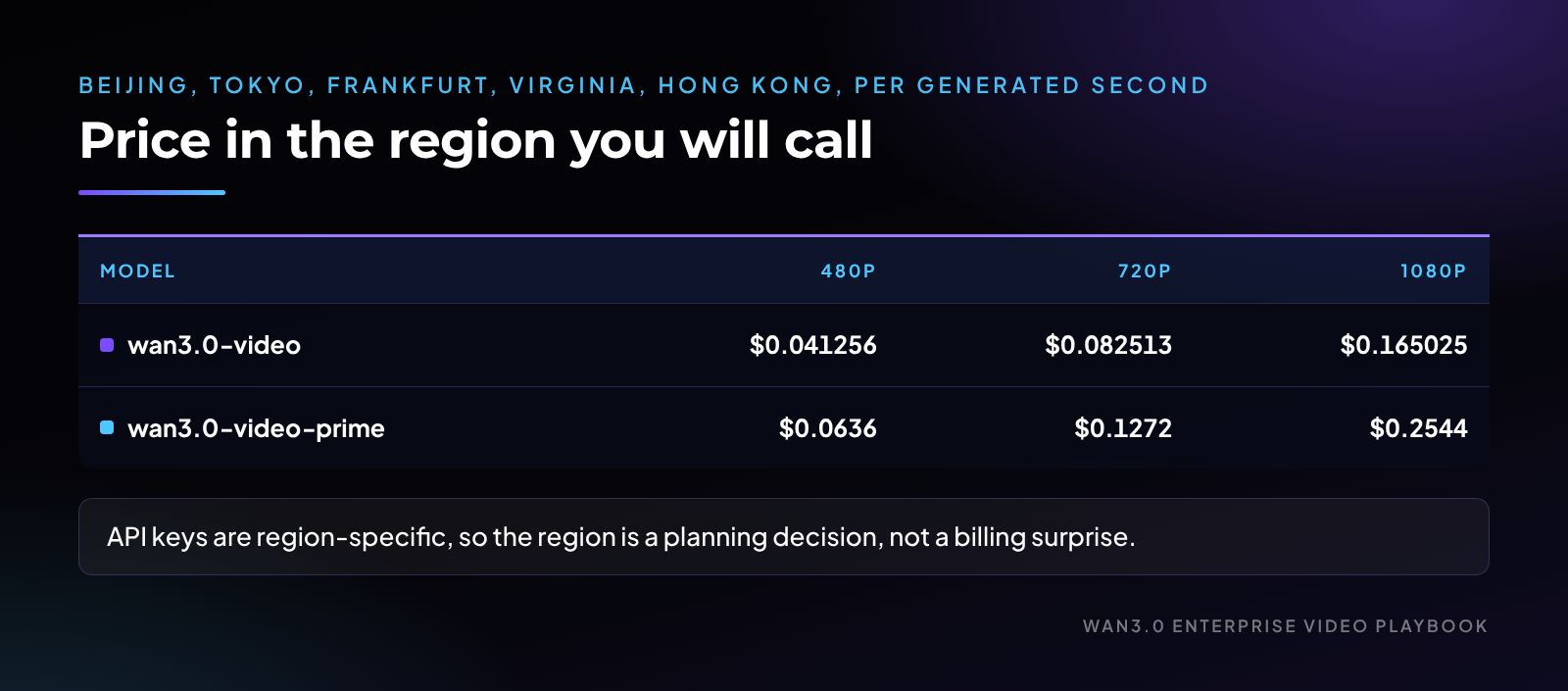
Plan at the price you can defend; spend at the price you can get.
The Seconds Ledger is a planner's tool. In some situations it is the wrong one.
You are buying finished video at a fixed fee. If an agency quotes per asset, your budget is the contract. Use the ledger only to sanity-check the quote. Whether to run generation in-house or through a partner is the build-or-partner call we broke down in Build vs. Buy, or Both? The Enterprise AI Decision.
You have never shipped a Wan3.0 campaign. Without your own take ratios, every row is a guess. Run a one-week calibration sprint on two deliverable types, record takes per approved asset, then build the ledger.
The deliverable is mostly on-screen text or a voice performance. Generated seconds are not the main cost there. Plan the edit and the audio as their own lines, outside the ledger.
It is a single clip. One asset does not need a template. Multiply duration by takes by price and move on.
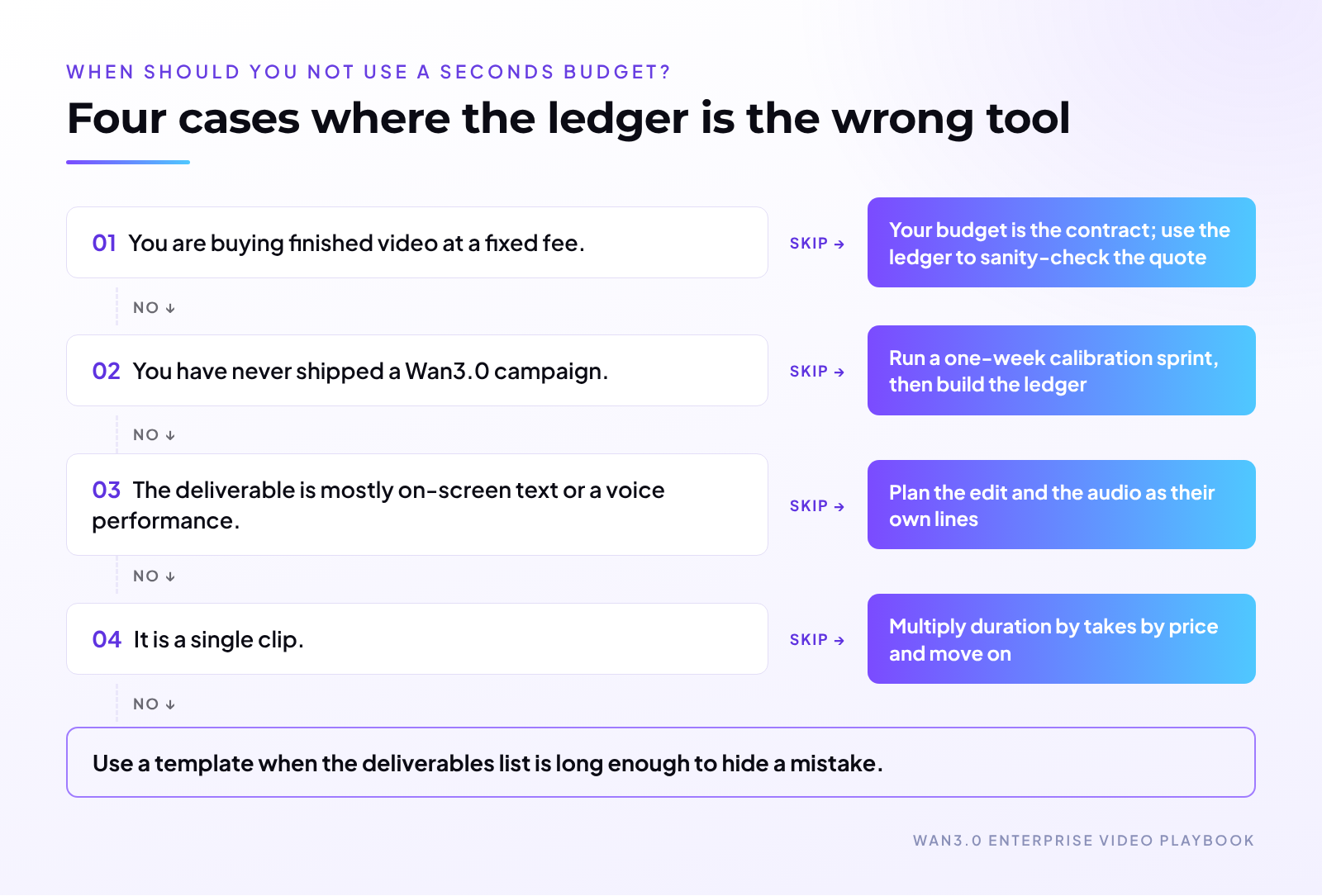
Use a template when the deliverables list is long enough to hide a mistake.
You can build the first version in an afternoon:
1. List every deliverable line. Count, duration and channel for each; split anything over 30 seconds into segments.
2. Assign a take ratio and a tier per line. Start from the table in section 03, then mark every value you are guessing.
3. Mark the deadline lines. Only those go on wan3.0-video-prime.
4. Add the exploration pool, contingency and review. 10% to 25% at 480P for exploration; 10% or 20% contingency; review minutes times your loaded rate.
5. Close the loop after delivery. Record actual takes per asset and actual review minutes, and overwrite the assumptions before the next campaign.
Model prices are on the wan3.0-video and wan3.0-video-prime pages in Model Studio.
The second campaign's budget is only as good as the first campaign's ledger.
Key takeaways
Budget in generated seconds. Deliverables x duration x take ratio x price per generated second, one row per line, with exploration in its own pool.
Review is the big line. In all three worked campaigns it is 71% to 76% of the total, so minutes per take matter more than the model choice.
Plan at list, by region. wan3.0-video lists at $0.05 to $0.20 per generated second in Singapore; promotions vary by platform and count as variance.
Bring the brief; leave with the budget line
Share the campaign you are planning next, even as a rough deliverables list. The Wan team will walk through each ledger row with you, from take ratios and tiers to where Prime earns its place, so the number you send to the client or CFO holds up. Plan your campaign's Wan3.0 budget →
See Wan3.0 in action at wan.video.
About Wan. Wan is Alibaba Cloud's generative video model family. Wan3.0 is available through Alibaba Cloud Model Studio and Qwen Cloud, with API pricing billed per generated second.
Sources: Alibaba Cloud Model Studio, wan3.0-video model page, https://www.alibabacloud.com/help/en/model-studio/wan3-0-video (accessed Oct 6, 2026); Alibaba Cloud Model Studio, wan3.0-video-prime model page, https://www.alibabacloud.com/help/en/model-studio/wan3-0-video-prime (accessed Oct 6, 2026); Alibaba Cloud Model Studio, Video generation overview, https://www.alibabacloud.com/help/en/model-studio/video-generation (accessed Oct 6, 2026); Alibaba Cloud Model Studio, What is Model Studio, https://www.alibabacloud.com/help/en/model-studio/what-is-model-studio (accessed Oct 6, 2026); Qwen Cloud, wan3.0-video and wan3.0-video-prime model pages, https://www.qwencloud.com/models/wan3.0-video (accessed Oct 6, 2026).
By Johnny Mai, Director, Gen AI Product Strategy & GTM.
Disclaimer: This post is provided for general information only. Worked examples are illustrative and use stated assumptions; your costs will vary. Prices are Alibaba Cloud Model Studio list prices for the Singapore region as published in October 2026, vary by region, and may change over time. Product and service availability, features, and program terms vary by region and may change over time. Nothing in this post constitutes professional, legal, or investment advice. © 2026 WAN. All rights reserved.
Wan3.0 vs. Wan3.0-Prime: Speed, Price, and Which One Your Workflow Needs

14 posts | 2 followers
FollowKalpesh Parmar - May 6, 2026
Alibaba Cloud Big Data and AI - June 3, 2026
Alibaba Clouder - August 10, 2020
Johnny Mai - October 7, 2026
CloudNative - May 10, 2022
Alibaba Cloud Big Data and AI - May 27, 2026
14 posts | 2 followers
Follow Qwen
Qwen
Full-range, open-source, multimodal, and multi-functional
Learn More Token Plan
Build more, spend less. One plan, every modality.
Learn More
Alibaba Cloud Model Studio
A one-stop generative AI platform to build intelligent applications that understand your business, based on Qwen model series such as Qwen-Max and other popular models
Learn More AgentLoop
An Agent self-evolution platform designed to make your Agents progressively smarter and more attuned to users.
Learn MoreMore Posts by Johnny Mai

