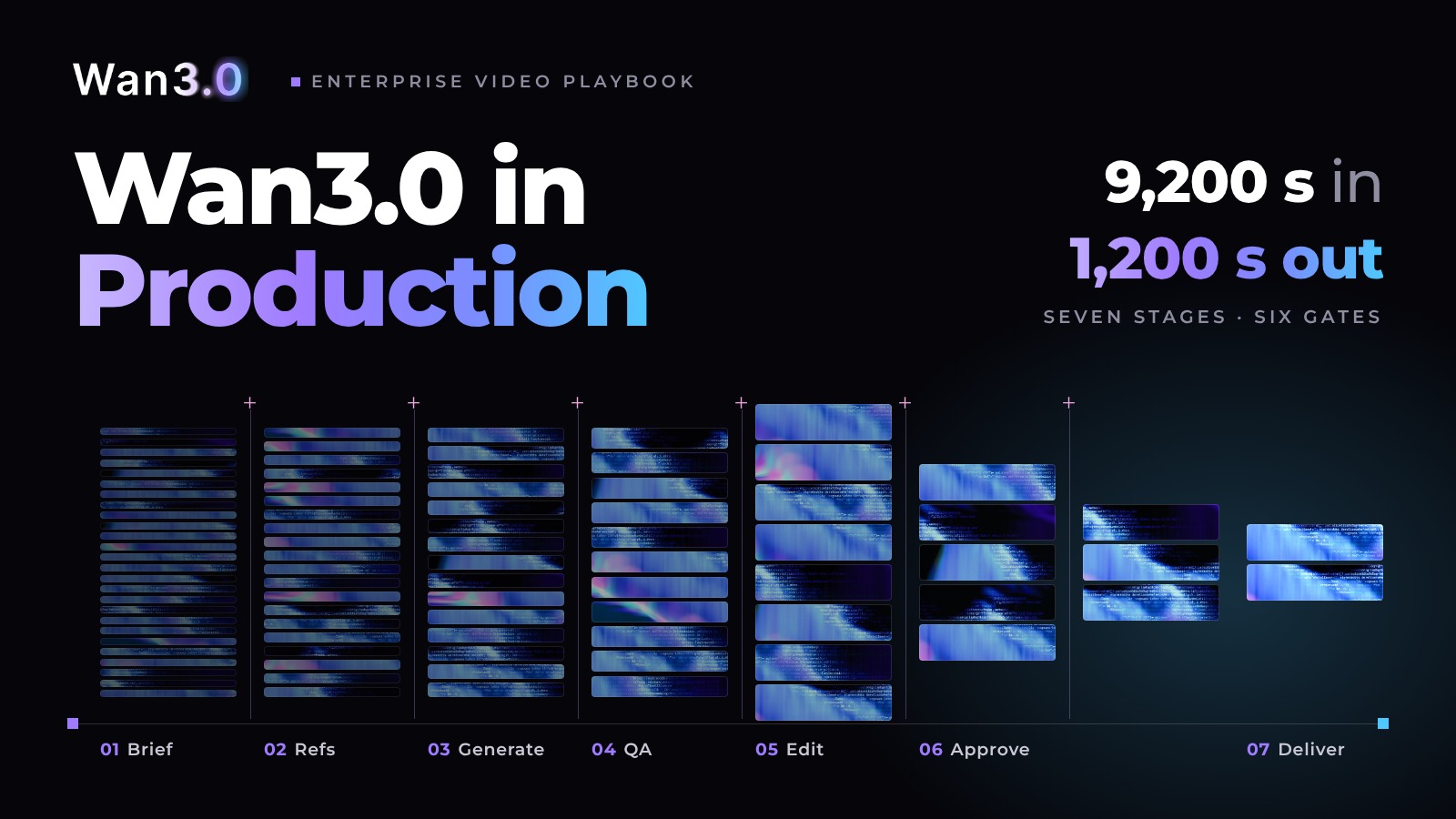
Ship 1,200 seconds of finished Wan3.0 video a month, generate about 9,200. At list price that is $1,000, not $240. The extra $760 is not waste. It is the pipeline. Did you design it, or did it design itself?
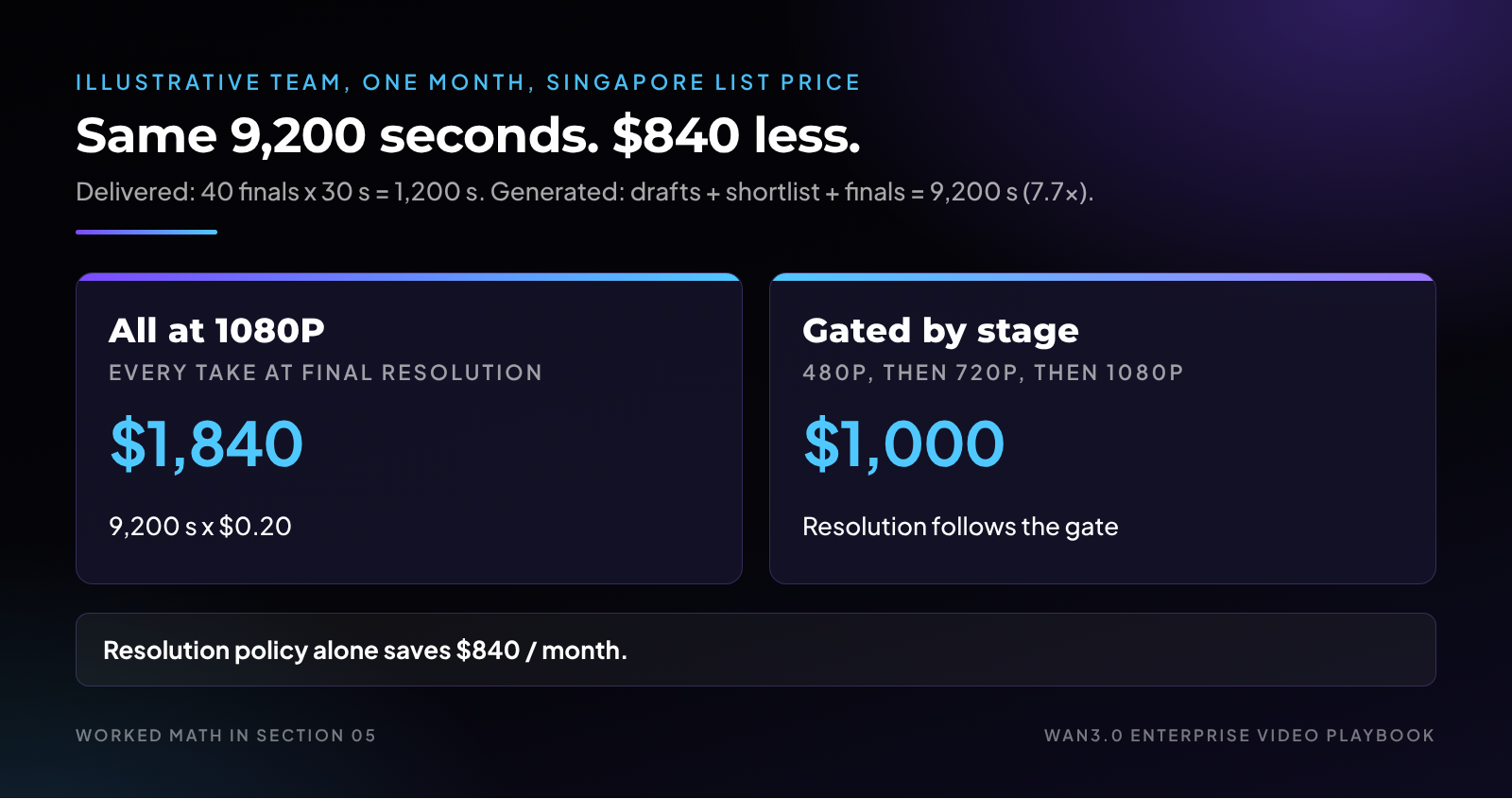
Budget by gate: every review gate gets a seconds allowance and a resolution, and the model only spends what the gate allows.
In this guide
A seven-stage pipeline where every handoff is a file with one owner
Six review gates with pass criteria a newcomer can apply without asking
Six reliability fixes that stop double billing, lost files and jammed queues
A monthly cost model showing how resolution by gate saves $840 a month
Wan3.0 made a single generation long enough to matter.
One call can return up to 30 seconds of 1080P video with audio, from text, images, audio, video, and reference documents (Wan3.0 at General Availability, Alibaba Cloud, Aug 2026). A five-second clip is a toy for one designer. A usable 30-second cut is a production line, and production lines need stations, inspections, and a ledger.
This article follows one illustrative team: a composite of the patterns I see when marketing and creative operations groups move Wan3.0 from a trial account into a monthly delivery commitment. It is not a customer, and every number is a stated assumption.
Picture a six-person in-house video group at a consumer brand: one creative lead, two producers who write briefs and prompts, one editor, one brand and legal reviewer shared with another team, and one developer who owns the integration with Alibaba Cloud Model Studio.
Producers generated from a notebook, at 1080P, one call at a time. Timed-out calls were re-run, finished files went undownloaded, and nobody could say which prompt produced the approved cut.
The bill was fine. The process was not repeatable.
What follows is the architecture they landed on and what they changed. If your producers are still generating from a notebook, walk through your pipeline stage by stage with the Wan team and see where the first gate belongs.
A model that can make the final cut needs a pipeline, not a playground.
The team named seven stages.
Each stage has one owner and one output artifact, so a handoff is a file, not a conversation.
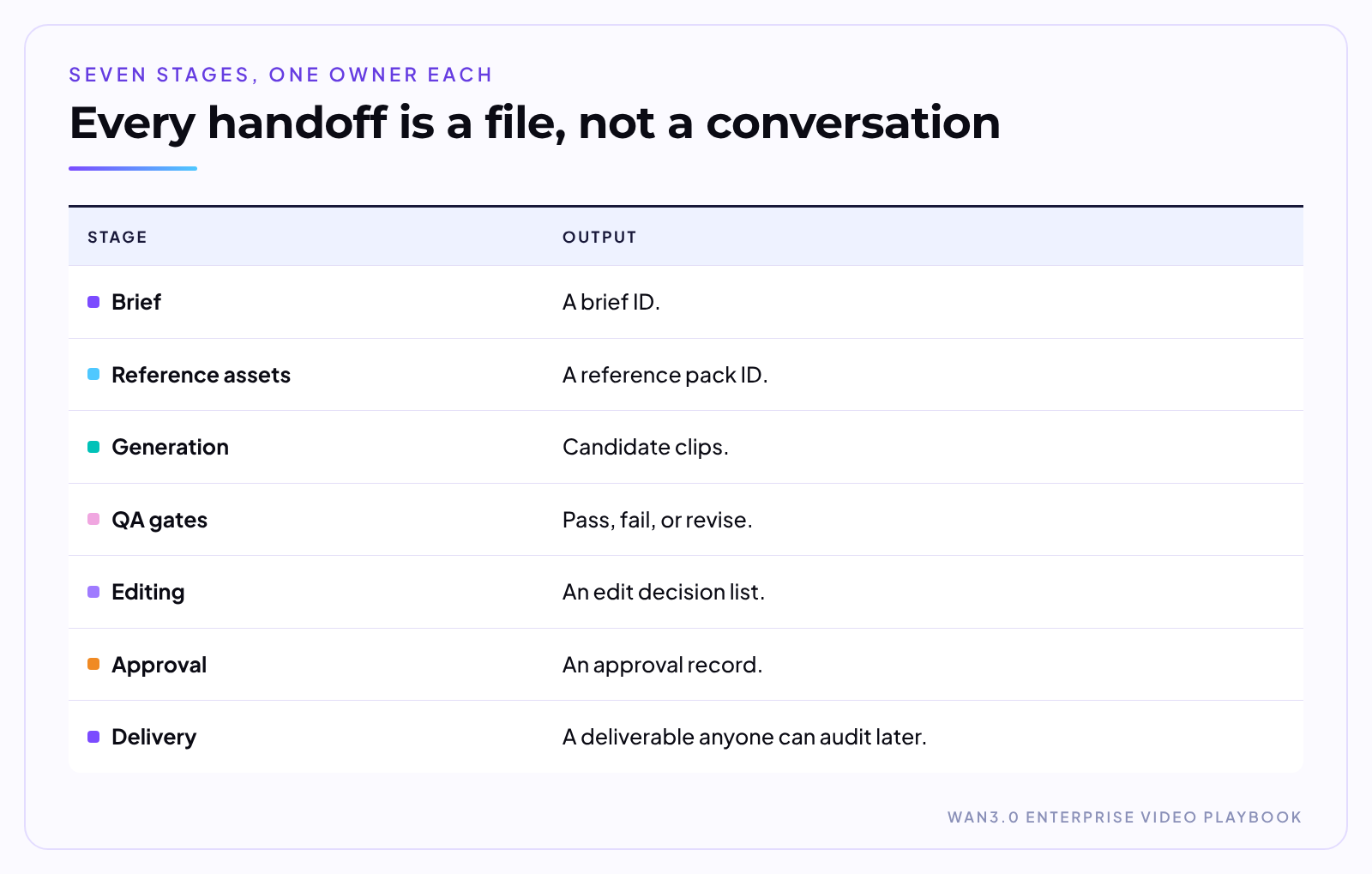
1. Brief. The producer writes a one-page brief: objective, audience, duration, aspect ratio, target resolution, mandatory shots, approved claims, and what must never appear. Output: a brief ID.
2. Reference assets. Product stills, logo lockups, voice or music references, and any document Wan3.0 should read. Every asset carries a rights status and a version. Output: a reference pack ID.
3. Generation. Prompts are built from the brief and pack, submitted as jobs, and stored with the model ID, resolution, duration, and returned task ID. Output: candidate clips.
4. QA gates. Automatic checks first, human review second (section 03). Output: pass, fail, or revise.
5. Editing. The editor assembles, trims, adds on-screen text and legal supers in the editing tool, and mixes audio. Output: an edit decision list.
6. Approval. Creative lead and brand reviewer sign off against the brief. Output: an approval record.
7. Delivery. Masters go to the asset library with a provenance record: brief ID, prompts, model ID, reference pack, task IDs, approvers. Output: a deliverable anyone can audit later.
The shape, from the team wiki:
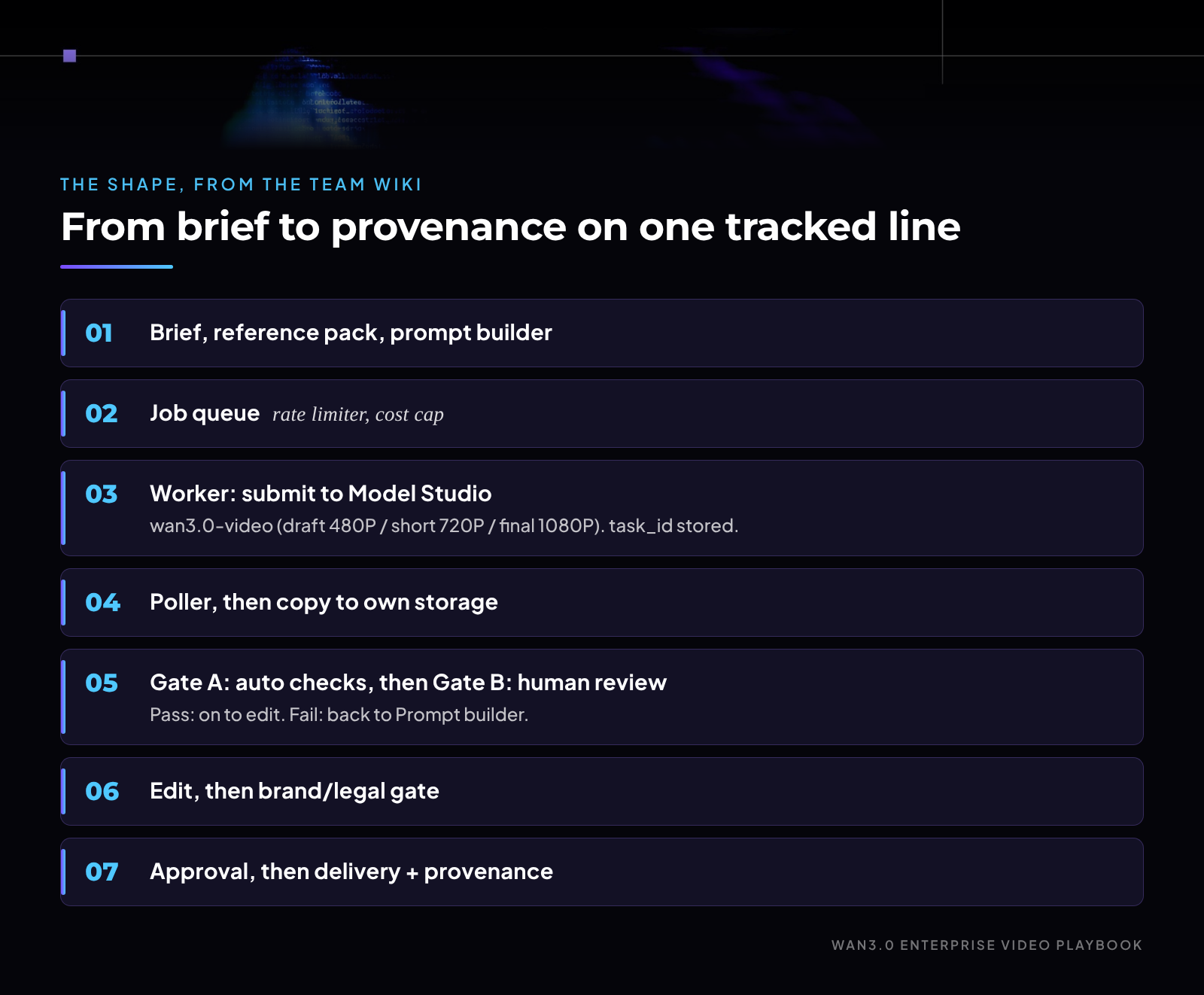
If a stage has no owner and no output file, it is not a stage; it is a delay.
The first version of the pipeline had one gate: "the creative lead likes it."
That gate was slow, inconsistent, and expensive, because every rejection happened after the 1080P render. The team split it into six gates, each with a pass criterion a newcomer could apply without asking.
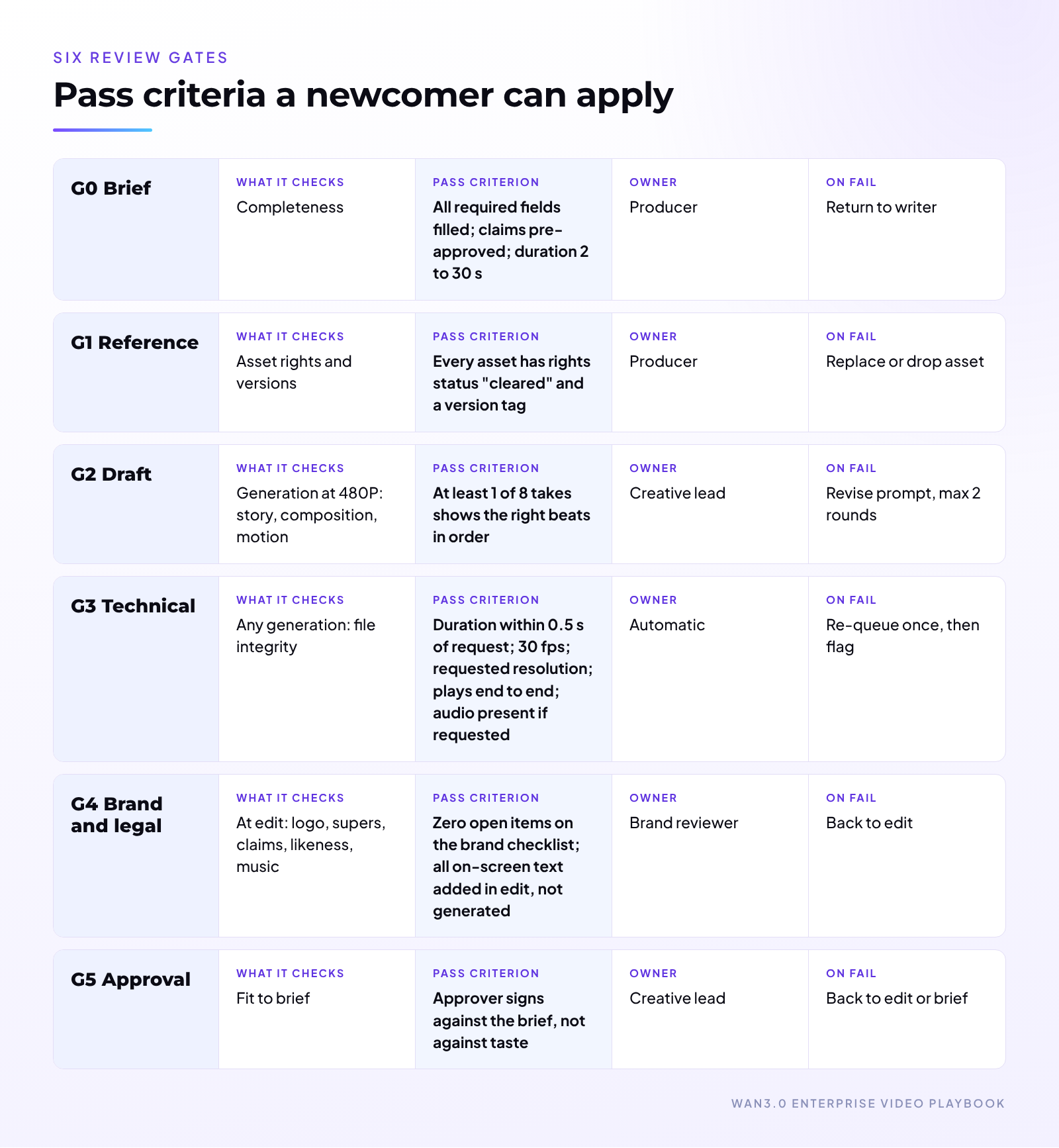
"A gate you cannot write a pass criterion for is not a gate. It is a meeting."
Two choices in that table did most of the work.
First, G2 runs at 480P. Story problems are visible at low resolution, so expensive renders only happen on concepts that already passed.
Second, G4 says on-screen text is added in edit. That follows Alibaba Cloud's own caveat at launch: "Audio texture and on-screen text rendering accuracy are still maturing" (Alibaba Cloud, Wan3.0 GA post, Aug 2026). Design around where the model is still maturing, instead of discovering it in review.
Write the pass criterion before the first render, or the gate will be argued, not applied.
In the illustrative team, every item below started as an incident.
Each is written twice: once for the marketing ops lead who owns the calendar, once for the developer who owns the code.
1. Treat every generation as an async job. Model Studio's video APIs run asynchronously: you create a task, receive a task ID, and poll until it reaches SUCCEEDED or FAILED (Alibaba Cloud Model Studio, Wan3.0 Video Generation API Reference, accessed Oct 5, 2026). The team's first script re-ran the call whenever a client-side timeout gave up.
Ops view: a job is "submitted", "running", or "done"; never "I think it hung".
Dev view: the worker submits, writes the task ID to the database, and exits. A separate poller checks status on an interval. The reference suggests an interval such as 15 seconds.
2. Make submissions idempotent. The double-billing incident: a retry after a network blip created a second task for the same take.
Ops view: one take, one charge.
Dev view: each take gets an idempotency key (brief ID + take number + resolution). Before submitting, the worker checks whether that key already has a task ID. Retries re-poll the existing task; they never re-create it.
3. Copy outputs to your own storage on success. The same Wan3.0 API reference states that task IDs and video URLs are valid for 24 hours, after which the video is automatically purged.
Ops view: nothing approved lives on a temporary link.
Dev view: the poller's success handler downloads the MP4 to object storage and writes the storage path, checksum, and task ID to the provenance record before anyone reviews it.
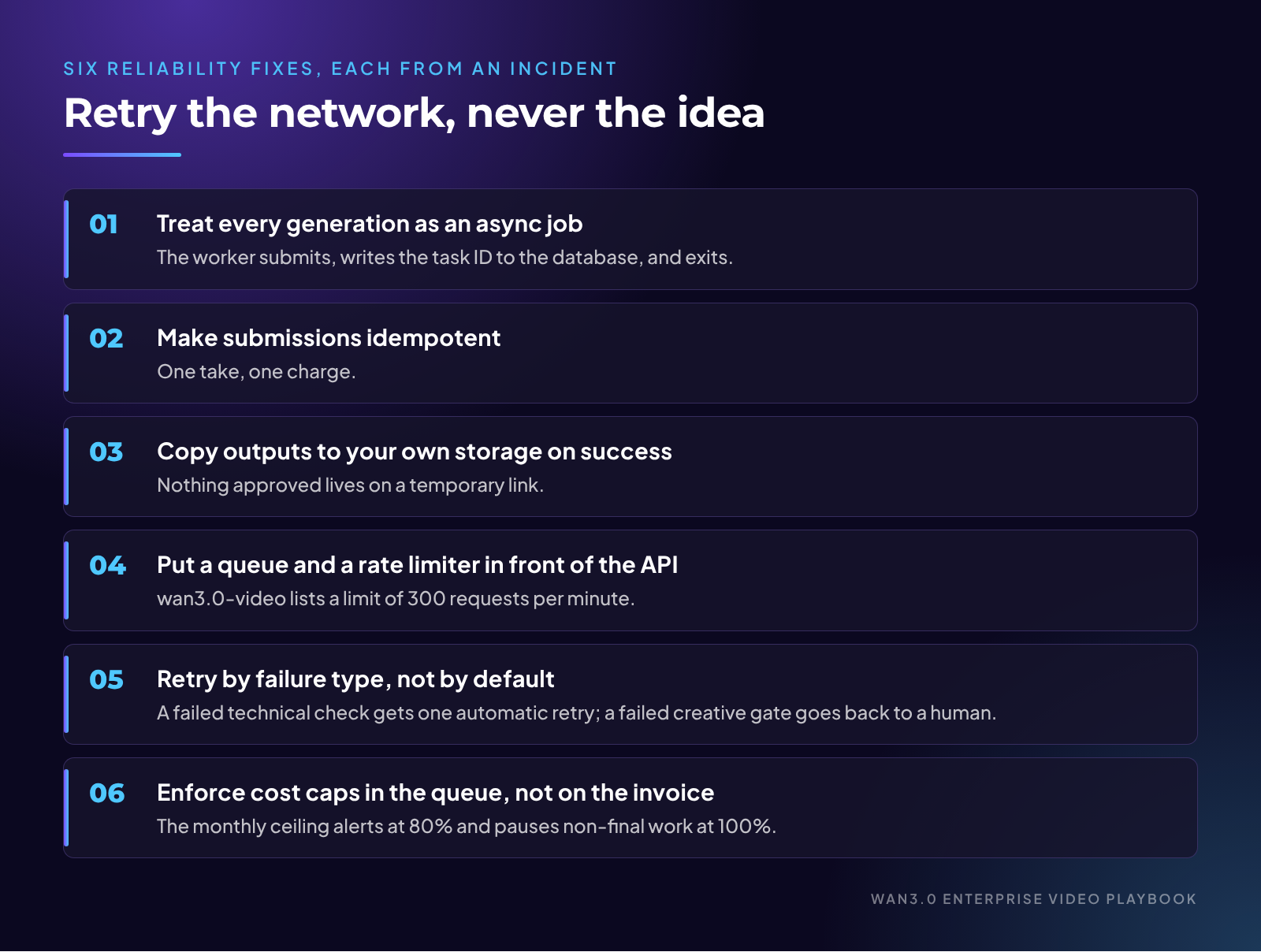
4. Put a queue and a rate limiter in front of the API. wan3.0-video lists a limit of 300 requests per minute (Model Studio, accessed Oct 5, 2026). Four producers batch-submitting drafts at a campaign kickoff can hit that.
Ops view: drafts queue up during the morning and land before the afternoon review.
Dev view: a token bucket set well under the published RPM, with backoff on throttling responses, and separate queues for drafts and finals so a draft burst never delays a final.
5. Retry by failure type, not by default.
Ops view: a failed technical check gets one automatic retry; a failed creative gate goes back to a human.
Dev view: retry FAILED tasks and G3 failures once with the same idempotency lineage; never auto-retry a G2 rejection, because a rejected creative idea re-rendered is the same idea billed twice.
6. Enforce cost caps in the queue, not on the invoice.
Ops view: each brief has a seconds budget per gate (section 05), and the month has a ceiling.
Dev view: the queue computes seconds x price before submitting, debits the brief's allowance, and refuses jobs that would exceed it; 1080P jobs require a G2 pass record. The monthly ceiling alerts at 80% and pauses non-final work at 100%.
Retry the network, never the idea.
Assumptions for the illustrative team, all stated so you can swap in your own:
Volume: 40 finished 30-second spots a month.
Model and price: wan3.0-video, Singapore list prices of $0.05 (480P), $0.10 (720P), and $0.20 (1080P) per generated second (Alibaba Cloud Model Studio, wan3.0-video, accessed Oct 5, 2026). List prices exclude any limited-time promotions; promotions vary by platform.
G2 drafts: 8 takes of 10 seconds each at 480P per spot.
Shortlist: 3 full-length 30-second takes at 720P per spot.
Finals: 2 takes of 30 seconds at 1080P per spot (one accepted, one retake on average).
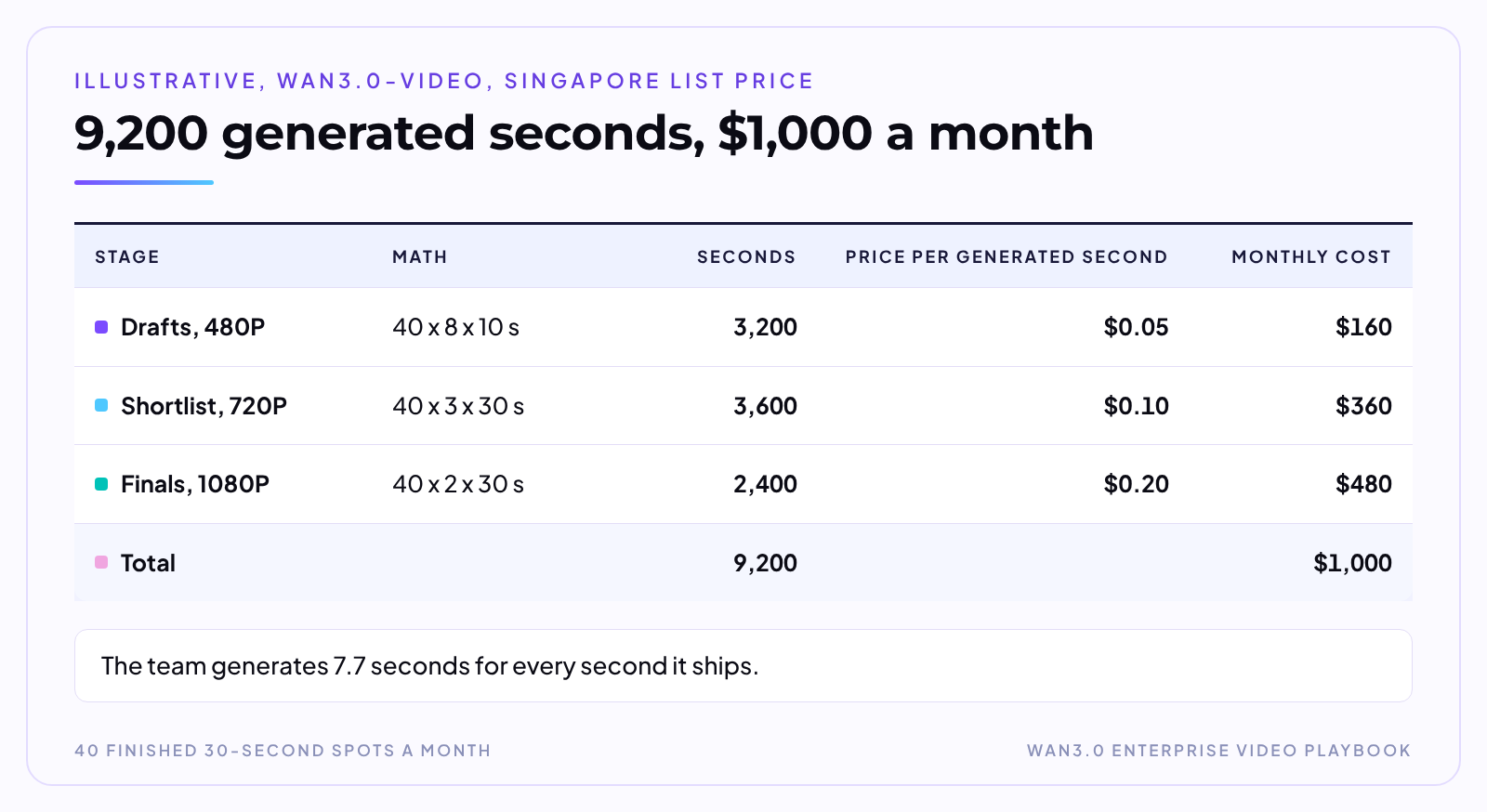
Result: 9,200 generated seconds and $1,000 a month at list price, to ship 1,200 seconds.
Check the multiplication: 3,200 x $0.05 = $160; 3,600 x $0.10 = $360; 2,400 x $0.20 = $480. Delivered video is 40 x 30 s = 1,200 seconds, so the team generates 7.7 seconds for every second it ships. Watch that ratio month over month, not the invoice.
The same 9,200 seconds at 1080P would cost 9,200 x $0.20 = $1,840. The resolution policy saves $840 a month, a 46% cut, with no change in what ships. Add a 10% buffer for technical retries and the monthly cap sits at $1,100.
Two levers move the total more than anything else:
Fewer draft takes. Cutting draft takes from 8 to 6 saves 40 x 2 x 10 s x $0.05 = $40.
Fewer final retakes. Cutting the average final retakes from 2 to 1.5 saves 40 x 0.5 x 30 s x $0.20 = $120.
The second lever lives in the brief, not the model: retakes fall when G0 is strict.
Turn your volumes into a seconds budget by gate
Send your monthly spots, takes per gate and resolution per gate: one minute, no login. The team will work through your generated seconds, list-price cost and resolution policy, gate by gate, the way the table above does. Price your pipeline gate by gate →
Price the pipeline in generated seconds per delivered second, then let resolution follow the gate.
Four changes came out of the illustrative team's first quarter, each from a specific failure:
1. Prompts drifted from briefs. Producers improvised prompts and the approved cut could not be reproduced. Change: a prompt builder that fills a template from brief and reference pack fields, with free text allowed only in one "direction" field.
2. Reviewers judged against taste. G5 rejections cited "energy" and "feel." Change: the approver signs against the brief's objective line, and taste notes go into the next brief.
3. Generated text failed brand review. Product names in generated signage were close, not right. Change: every super and on-screen word moved to the edit stage, consistent with Alibaba Cloud's own caveat on text rendering.
4. Finals queued behind drafts. A Monday draft burst delayed a Friday deliverable. Change: separate queues and a reserved share of the rate budget for finals.
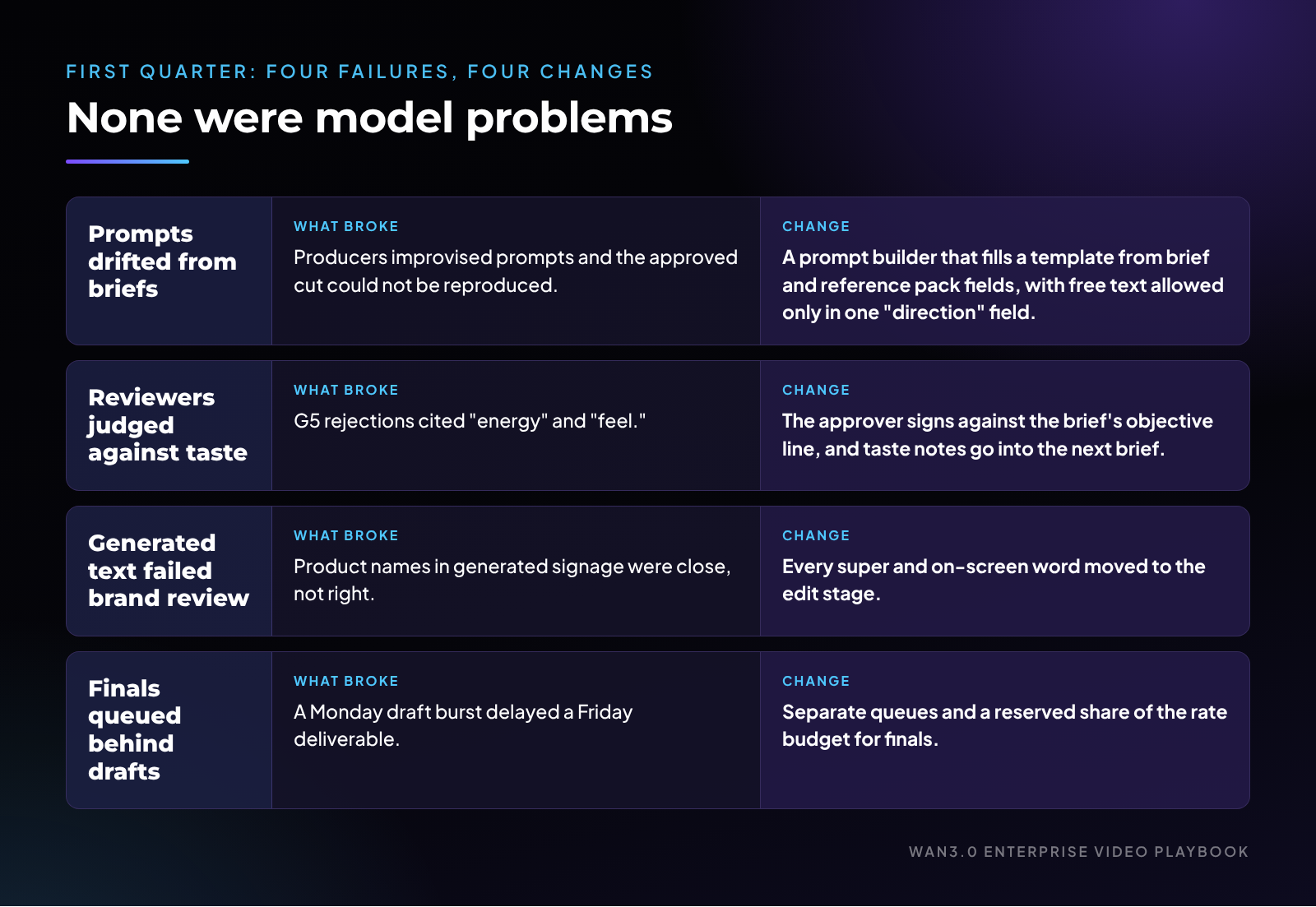
None were model problems. They were operating problems the model made visible faster.
When a pipeline fails, fix the stage before you blame the model.
Skip most of this if any of the following is true:
You ship fewer than about ten clips a month. A shared checklist and a folder convention will do; the queue and cost-cap code would cost more to maintain than the generations.
Your output is mostly on-screen text. Typography explainers, price cards, and legal-heavy supers lean on exactly the dimension Alibaba Cloud says is still maturing. Generate the motion plate and set the type in your editor.
Audio is the product. If the deliverable lives or dies on voice texture, record or license the audio and use Wan3.0 for picture.
Your agency already runs the pipeline. Then your job is the brief, the gates, and the provenance record in the contract, not the code. It is the same build-or-partner call we broke down in Build vs. Buy, or Both? The Enterprise AI Decision: own what differentiates you, partner for the rest.
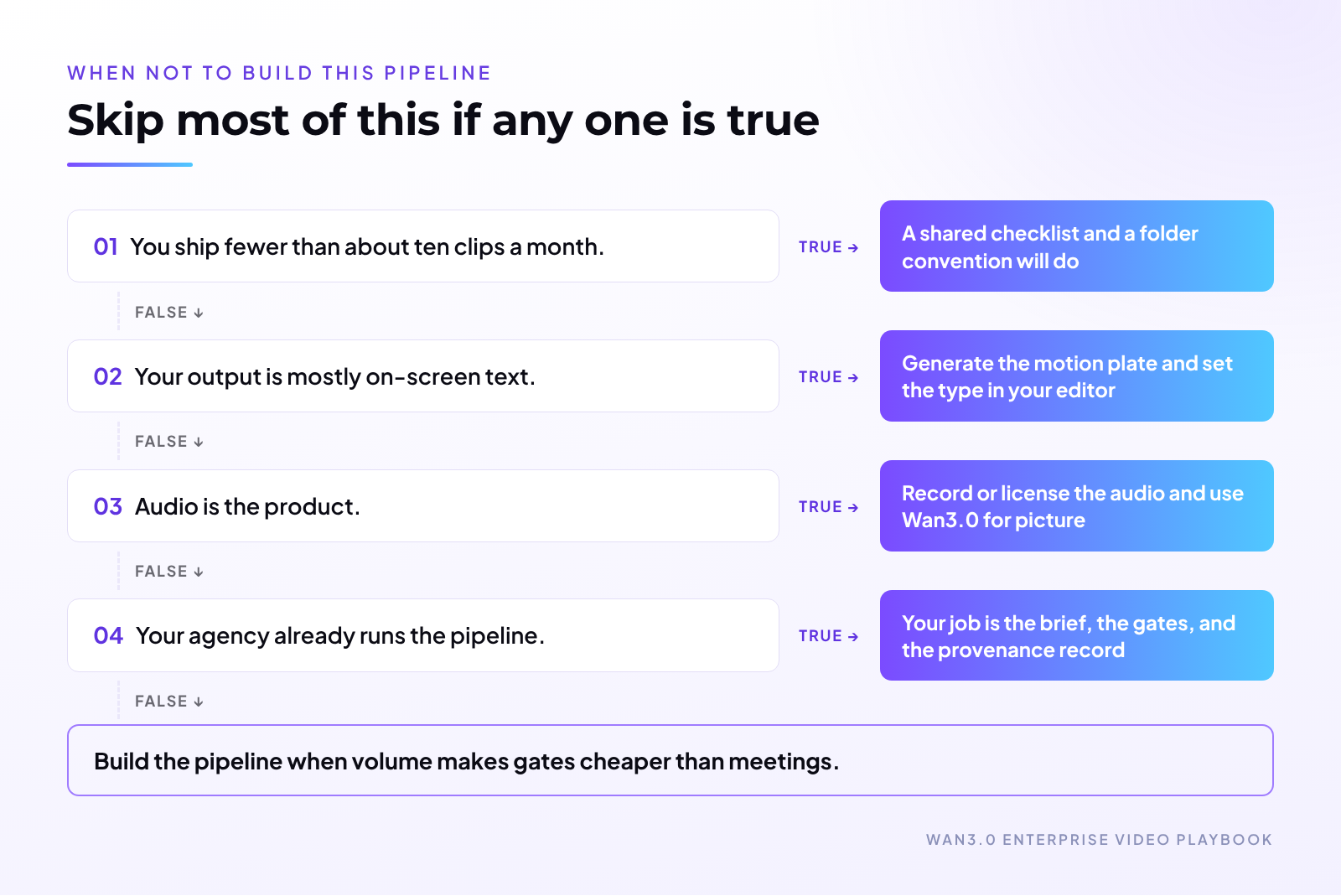
Build the pipeline when volume makes gates cheaper than meetings, and not before.
A one-week plan for a marketing ops lead and one developer:
1. Day 1: write the gate table. Copy the six gates above and rewrite every pass criterion in your own words. If you cannot write one, delete the gate.
2. Day 2: set the seconds budget. Pick your monthly volume, takes per gate, and resolution per gate. Compute generated seconds and dollars at list price.
3. Day 3: wire async, idempotency, and storage. Submit, store the task ID, poll, copy to your storage on success. Nothing else yet.
4. Day 4: add the queue, rate limit, and cost cap. Separate draft and final queues; refuse jobs that exceed the brief's allowance.
5. Day 5: run one real brief end to end. Measure generated seconds per delivered second and the time from brief to approval. That is your baseline.
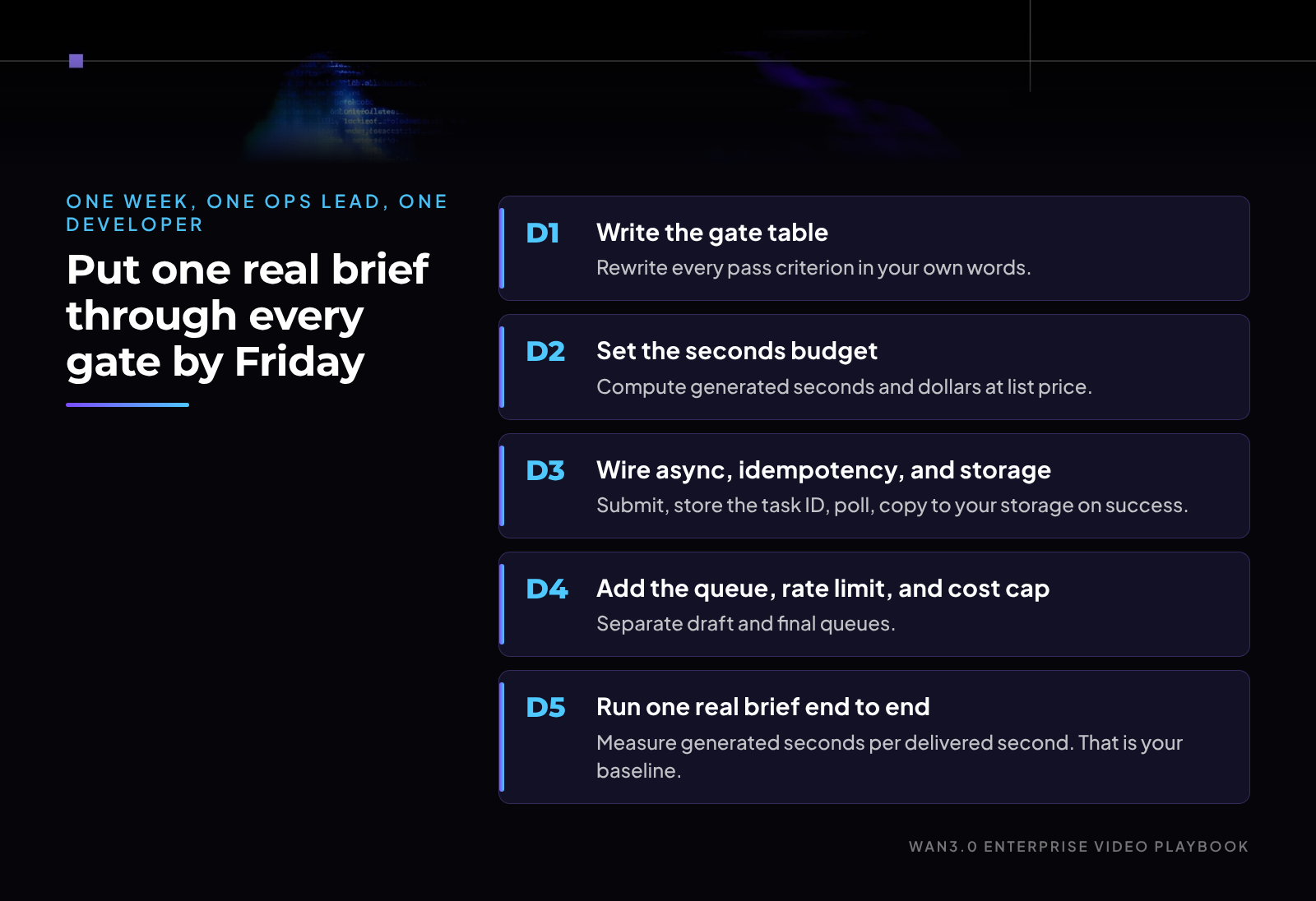
One brief through every gate teaches more than ten briefs through none.
Key takeaways
Gate by resolution. Drafts at 480P and finals at 1080P: the same 9,200 seconds cost $1,000 instead of $1,840.
Write pass criteria before the first render. A gate a newcomer cannot apply is a meeting, not a gate.
Engineer for the bill and the archive. Async jobs, idempotency keys and copying outputs inside the 24-hour window stop double billing and lost files.
Put your first brief through the six gates
Tell us your monthly delivery target and where reviews stall today. The Wan team will review your gates, pass criteria and reliability setup with you, from async jobs and idempotency to cost caps. Review your Wan3.0 gates with the team →
See Wan3.0 in action at wan.video.
About Wan. Wan is Alibaba Cloud's generative video model family. Wan3.0 is available through Alibaba Cloud Model Studio and Qwen Cloud, with API pricing billed per generated second.
Sources: Alibaba Cloud, Wan3.0 at General Availability (Aug 2026), https://www.alibabacloud.com/blog/603505 (accessed Oct 5, 2026); Alibaba Cloud Model Studio, wan3.0-video model page, https://www.alibabacloud.com/help/en/model-studio/wan3-0-video (accessed Oct 5, 2026); Alibaba Cloud Model Studio, Video generation overview, https://www.alibabacloud.com/help/en/model-studio/video-generation (accessed Oct 5, 2026); Alibaba Cloud Model Studio, Wan3.0 Video Generation API Reference, https://www.alibabacloud.com/help/en/model-studio/wan3-video-generation-api-reference (accessed Oct 5, 2026).
By Johnny Mai, Director, Gen AI Product Strategy & GTM.
Disclaimer: This post is provided for general information only. Worked examples are illustrative and use stated assumptions; your costs will vary. Prices are Alibaba Cloud Model Studio list prices for the Singapore region as published in October 2026, vary by region, and may change over time. Product and service availability, features, and program terms vary by region and may change over time. Nothing in this post constitutes professional, legal, or investment advice. © 2026 WAN. All rights reserved.
How to Prioritize AI Use Cases Before 2027: Six Types and One 2x2
Wan3.0 vs. Wan3.0-Prime: Speed, Price, and Which One Your Workflow Needs

14 posts | 2 followers
FollowJohnny Mai - October 7, 2026
Johnny Mai - October 7, 2026
Johnny Mai - August 27, 2026
Johnny Mai - August 27, 2026
Alibaba Cloud Community - August 13, 2026
Johnny Mai - August 27, 2026
14 posts | 2 followers
Follow Qwen
Qwen
Full-range, open-source, multimodal, and multi-functional
Learn More Alibaba Cloud Model Studio
A one-stop generative AI platform to build intelligent applications that understand your business, based on Qwen model series such as Qwen-Max and other popular models
Learn More
Token Plan
Build more, spend less. One plan, every modality.
Learn More Alibaba Cloud for Generative AI
Accelerate innovation with generative AI to create new business success
Learn MoreMore Posts by Johnny Mai

