On May 26, 2026, the Qwen Conference, hosted by Alibaba Cloud, was held in Singapore. As Alibaba Cloud’s flagship conference for global developers and enterprise clients, this year’s Qwen Conference focused on the real-world implementation of large language models and Agent applications within enterprise scenarios.
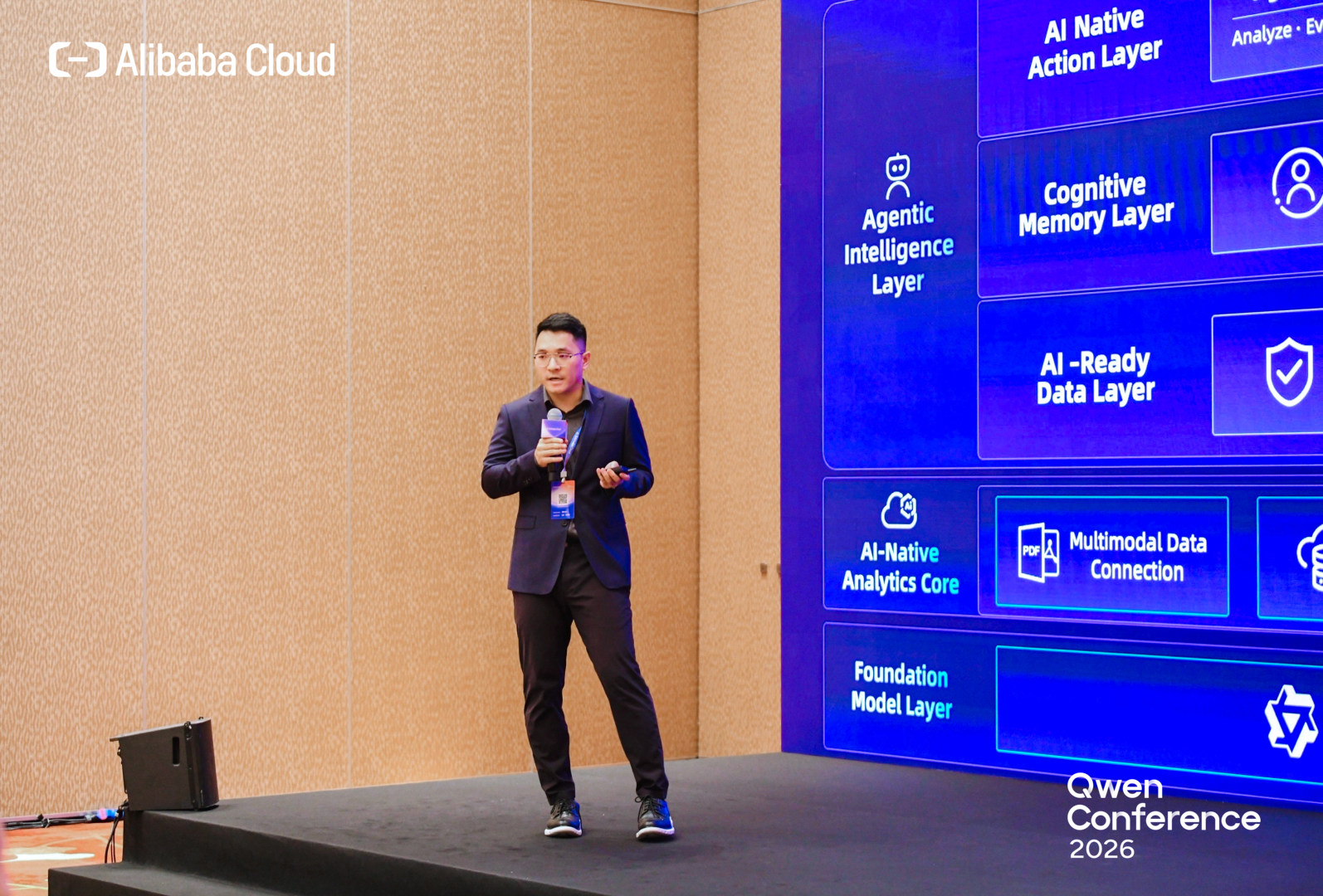
At the Agent Application Forum, Chris—a Solutions Architect representing Lingyang—delivered a keynote presentation titled "Quick BI: Your AI Data Analyst, From Insights to Action." He provided a systematic overview of Quick BI's product evolution in the realm of Agentic Analytics, alongside real-world scenarios and customer use cases from international enterprises.
Over the past year, the number of "Agents" within enterprises has surged—customer service Agents, marketing Agents, process Agents, R&D Agents—each capable of articulating their points with impressive coherence. However, when it comes to the data itself, the underlying problems are starkly exposed: three different Agents provide three conflicting definition for the exact same "sales revenue"; regarding a single report, no one is able to effectively enforce the access boundaries between different departments; and behind those polished, eloquent responses, no one actually dares to use the output to make concrete business decisions.
While general-purpose agents address the question of whether a response can be generated, what enterprises truly lack is _credibility_. This constitutes the core insight shared by Quick BI during this presentation: in the era of AI, enterprise-grade analytics is no longer a contest of model capabilities alone; rather, the true differentiator lies in who can effectively "feed" an agent with the metrics systems, access governance frameworks, and business semantics that an enterprise has cultivated over years—thereby enabling the agent to provide answers that are not only credible but also directly actionable.
Over the past decade, enterprise BI has primarily addressed two issues: "data retrieval" and "report generation"—business users would simply open a dashboard, review the data, and the analysis would end there. However, in the era of Agents, this value chain has been extended: systems no longer merely answer the question of "what happened," but must instead continuously monitor for changes within a business context, infer underlying causes, and propose actionable next steps.
Quick BI summarizes this shift in a single sentence: an evolution from "Tools → Queries → Reports" to "Goals → Inferences → Actions."There are three fundamental differences between Agentic Analytics and traditional BI: a shift from "passive report generation" to "always-on business monitoring"; a move beyond the limitations of isolated point queries to a comprehensive understanding of the enterprise's complete business context; and an analytical process endowed with cross-session memory, enabling insights to be directly linked to action. Guided by this vision, Quick BI has constructed an underlying, AI-native analytics architecture. This architecture spans from the bottom up, encompassing foundational large language models, an AI-ready data layer, a cognitive and memory layer, and an action-oriented execution layer—thereby ensuring that when an Agent invokes Quick BI, it accesses consistent metric definitions, accurate permission boundaries, and authentic business semantics. This constitutes the most fundamental distinction between enterprise-grade analytics Agents and "general-purpose large language models."
Agentic Analytics is not an abstract concept. Quick BI breaks it down into six business domains, each corresponding to a specific job function:
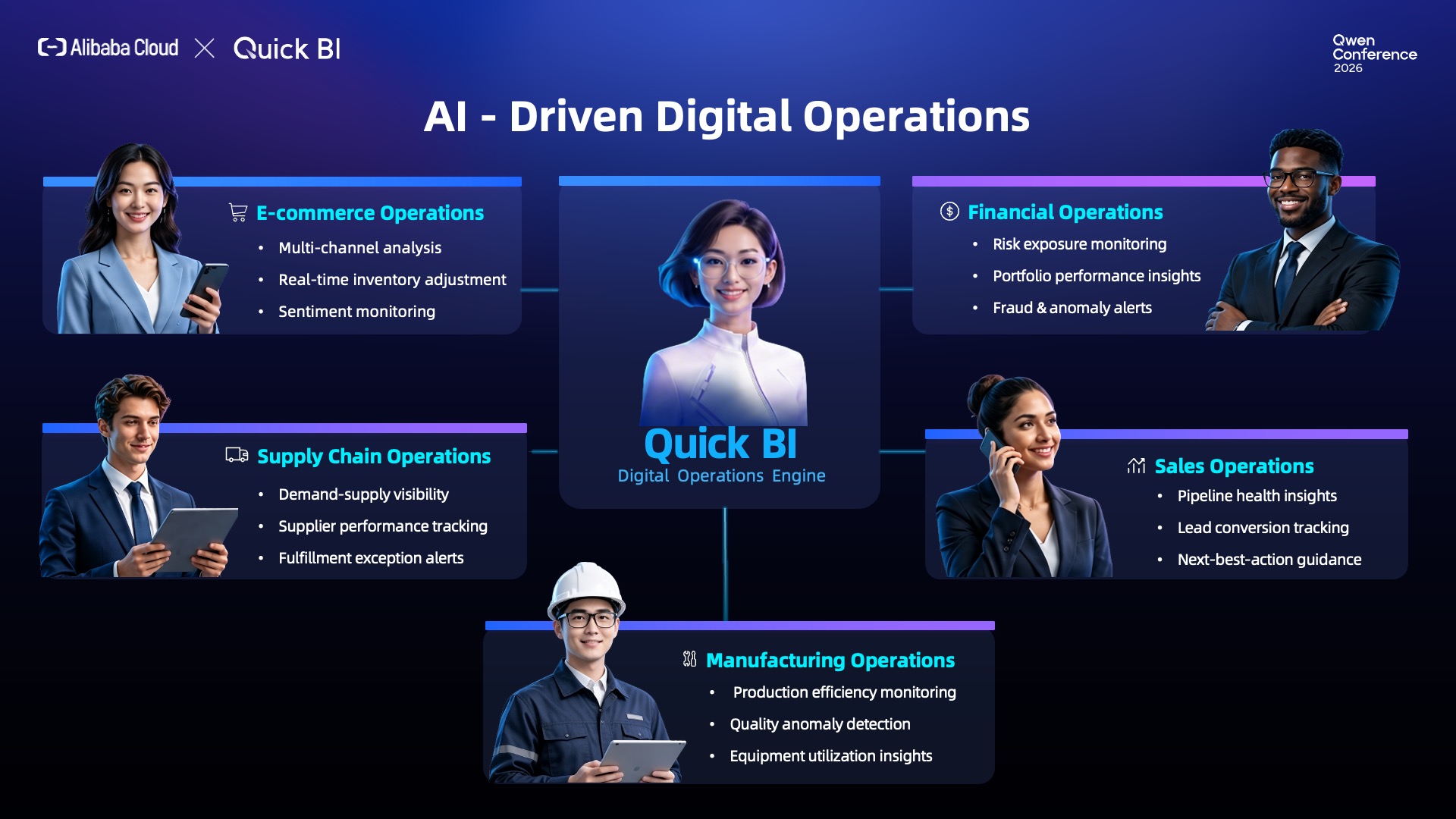
It has permeated the daily work of every type of business role. The three scenarios below illustrate how this capability "takes shape" within real-world enterprises.
For cross-border e-commerce teams, a typical day begins like this: across multinational channels, Amazon, independent websites, and social media platforms—the data formats for sales, refunds, and ad spend differ for every single one. Product codes must be cross-checked, metrics standardized, and financial reconciliations completed—all before they can even begin to answer the boss's inevitable question: "How were the overall market figures yesterday?" Consequently, an operations team often spends the better part of a day doing nothing more than simply making sense of the previous day's data.
With the introduction of Quick BI, this entire rhythm was completely rewritten:
The ultimate result is that the workload associated with manual daily reporting has dropped by approximately 90%; the operations team no longer "misses" a single anomaly around the clock; and the speed at which issues are detected and resolved has increased tenfold. Consequently, the role of the Head of Operations has shifted from merely "organizing data" to actively "making decisions."This is precisely the difference between enterprise-grade agents and general-purpose agents: only when they provide accurate, consistent responses will business teams truly feel confident entrusting their decision-making to them.
For the manufacturing sector, "going global" presents a distinct set of complexities. A typical manufacturing enterprise operating internationally often simultaneously manages a network of factories across multiple countries, alongside a production and sales portfolio comprising tens of thousands of distinct products. Underlying these operations are various disparate systems—including Enterprise Resource Planning (ERP), warehouse management, logistics management, and supplier portals—that frequently lack seamless integration.Whenever sales decline in a specific market or yield rates fluctuate on a production line, the business team is tasked with answering "why." This often requires analysts to sift through numerous spreadsheets and reconcile data definitions across multiple systems—a cross-border attribution exercise that, more often than not, takes a full week to complete.
Quick BI acts like an "always-on business analyst":
From a business perspective, the most tangible change is this: cross-border sales attribution—a task that previously took a full day or even a week to complete—can now be handed off to an AI Agent by an analyst, yielding conclusions and actionable improvement recommendations within mere minutes. Furthermore, during weekly operational meetings, the head of supply chain can—for the very first time—engage in discussions with international subsidiaries based on a unified set of metrics and a single source of truth. This precisely encapsulates the value of an enterprise-grade data foundation: it not only accelerates individual tasks but also empowers the entire organization to make decisions grounded in a shared reality.
For many enterprise IT and data leaders, the greatest obstacle to transitioning from traditional BI to Agentic Analytics is not the choice of a new platform, but rather the immobility of the legacy system: thousands of reports, complex metric processing logic, and hundreds of business users long accustomed to the original environment—any disruption in service would trigger immediate complaints from the business departments.
The solution offered by Quick BI is an AI-driven migration pathway: it begins with assessment and strategy formulation, followed by automated migration and AI-driven data validation; next, a dual-run phase on both the old and new platforms ensures zero business interruption; finally, AI capabilities are continuously rolled out on the new platform. The feedback from a client who has already completed this journey is straightforward:
"Alibaba Cloud's intelligent migration process enabled us to complete a complex data platform migration in a very short timeframe; business continuity remained unaffected, while the accuracy and efficiency of our analytics actually improved significantly."
The benefits for the business side are clear: the manual verification workload previously required of the technical team during report migration has dropped by over 50%. Furthermore, business departments experienced no disruption; on the contrary, they gained capabilities on the new platform that they previously lacked—specifically, automated attribution, cross-metric linkage, and AI-agent-assisted analysis. Consequently, BI modernization has transformed from a "disruptive, root-and-branch overhaul" into a seamless evolution that delivers incremental capabilities without any perceptible impact on business operations.
At the Qianwen Conference, a consensus is taking shape: while general-purpose Agent platforms are becoming increasingly powerful, the true differentiator—the capability that gives enterprises the confidence to actually deploy AI—lies not in the models themselves, but in whether the data, metrics, access controls, and business semantics accumulated by the enterprise over years can be effectively "digested" by the AI.This constitutes the fundamental distinction between Quick BI and general-purpose Agent platforms: while general platforms address the ability to "speak," Quick BI focuses on ensuring that the output is "correct, precise, and actionable." At a time when everyone else is racing to pursue ever-more-powerful models, Lingyang has chosen to invest its deeper efforts in a path that is more challenging—yet offers far greater barriers to entry—namely, enterprise-grade data capabilities.
AI has not devalued data; on the contrary, it has—for the first time—made it possible for enterprises to "directly leverage" the data assets they have accumulated over the past decade or more. This is the true value that Quick BI aims to amplify in the era of AI.Leveraging its presence across nine overseas availability zones and a base of tens of thousands of enterprise clients, Quick BI is continuously extending its "hard skills" for enterprise-grade analytics—including trusted metrics, semantic governance, and access compliance. This initiative ensures that every AI-enabled employee within an organization operates upon a unified, trusted data foundation to answer questions and drive action. In the next phase, Lingyang will continue to collaborate with an expanding network of ecosystem partners in key overseas markets—such as Southeast Asia, the Middle East, and Japan—to truly transform the journey "from insight to action" into a daily reality for enterprises.

Sharing Data Without Risking Leaks? Let Ticket-Based Enhanced Embedding Strike the Perfect Balance

1,565 posts | 524 followers
FollowAlibaba Cloud Community - September 27, 2025
Alibaba Cloud Community - July 15, 2026
Alibaba Cloud Community - May 26, 2026
Alibaba Cloud Community - May 27, 2026
Alibaba Cloud Community - May 25, 2026
Alibaba Cloud Community - August 17, 2026
1,565 posts | 524 followers
Follow QwenWork
QwenWork is dedicated to helping employees strengthen their professional competitiveness in the AI era and to enabling enterprises to improve organizational effectiveness.
Learn More Big Data Consulting for Data Technology Solution
Alibaba Cloud provides big data consulting services to help enterprises leverage advanced data technology.
Learn More Token Plan
Build more, spend less. One plan, every modality.
Learn More Big Data Consulting Services for Retail Solution
Alibaba Cloud experts provide retailers with a lightweight and customized big data consulting service to help you assess your big data maturity and plan your big data journey.
Learn MoreMore Posts by Alibaba Cloud Community

