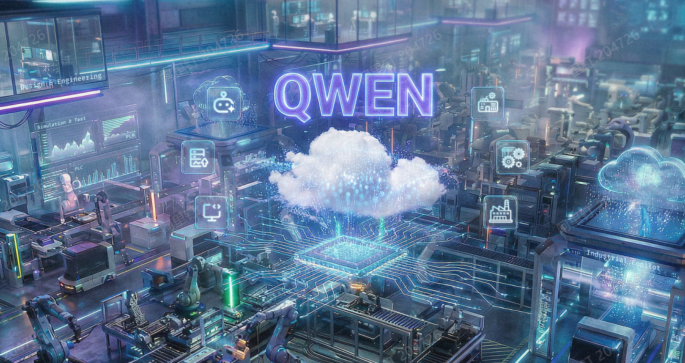
As the convergence of artificial intelligence and physical devices accelerates, Qwen, Alibaba’s inhouse LLM and multimodal AI model family, is increasingly becoming a foundational component for next-generation AI hardware. With over 150,000 smart hardware manufacturers in China now integrated with Qwen—including leaders in robotics, automotives and smartphone sectors—the model is helping to further advance the capabilities of Physical AI in China.
Unlike traditional software-only AI applications, Physical AI requires models that can perceive, reason, and act within the real world. Qwen’s architecture – characterized by its wide range of modalities (including text, image, video, audio), sizes (from 0.5 billion to 480 billion parameters) and openness (over 400 opensource versions) – has made it a versatile choice for developers across diverse sectors, from humanoid robotics to children’s educational devices.
A prominent example of this integration is LimX Dynamics, a robotics company focused on autonomous general-purpose humanoid robots. The company recently unveiled LimX Luna, a full-size interactive humanoid robot designed for commercial performance scenarios such as shopping mall assistance and theme park interactions.
Standing 160cm tall with 27 degrees of freedom, LimX Luna leverages Qwen Omni, a multimodal model, to power its interaction capabilities. By integrating Qwen, the robot gained the ability to process visual and audio inputs simultaneously, allowing it to “see, hear, and speak” in real-time. This integration enables the robot to learn new tasks, such as dance movements, by analyzing video clips and to call external tools to complete complex user requests.
Behind the scenes, the development of LimX’s “VLA” (Vision-Language-Action) model required significant computational resources. With training data reaching 1.5PB and peak throughput hitting hundreds of TBs, LimX leveraged Alibaba Cloud’s machine learning platform and edge computing to develop its proprietary model training and simulation systems. Additionally, both parties have jointly developed FluxVLA Engine, a full-stack, end-to-end engineering platform for deploying embodied intelligence applications. The platform is now hosted on Alibaba Cloud’s machine learning platform PAI.
Beyond industrial robotics, Qwen is also empowering consumer-facing devices. Dr. Look.AI, an interactive AI learning camera for children, has integrated Qwen to transform from a simple recognition tool into a multimodal AI companion.
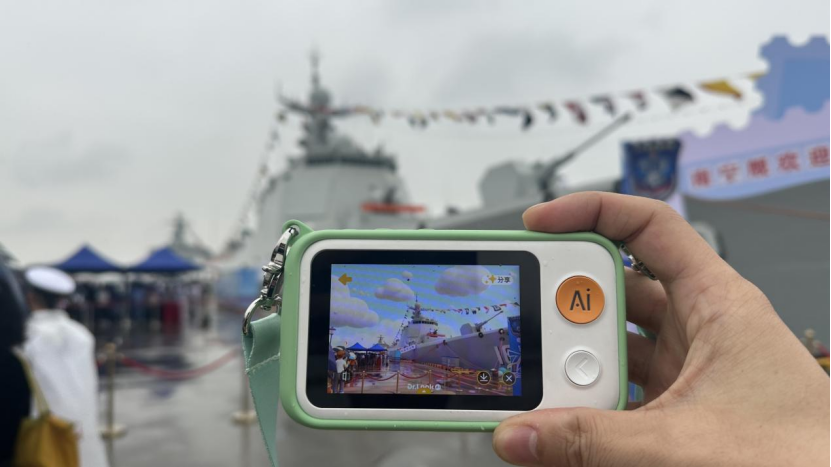
Previously focused on identifying objects like plants or museum exhibits, the device now offers deep visual reasoning, real-time interaction, and personalized storytelling after children take photos of the objects. Since integrating Qwen, Dr. Look.AI has grown to serve over 250,000 users globally, processing more than 50 million photo recognitions per month across 20+ countries.
It also employs Alibaba Cloud’s infrastructure for global business expansion, as well as other cloud resources to build its agent featured with long-term memory, allowing the AI companion to output more customized, safe content for children.
Other hardware manufacturers from AI glasses, smart phones, smart home and drones are also actively adopting Qwen and Alibaba Cloud’s infrastructure to inspire innovation and create new values. For example, on the smart phone front, OPPO is using Alibaba Cloud’s machine learning platform PAI for post-training Qwen to support various AI scenarios, while Honor has partnered with Alibaba Cloud to improve visual question-answering accuracy by nearly 40%; Ecovacs robots, serving 38 million households globally, is using a hybrid architecture where edge-size smaller Qwen models handle intent recognition and cloud-based larger Qwen models handle complex dialogue; the drone maker Insta360 is using Qwen for intelligent video production while the glasses brand Rayneo V3 is leveraging Qwen to enable real-time visual Q&A.
Supporting these innovations is Alibaba Cloud’s full-stack AI infrastructure. By providing leading compute, storage, network, and security capabilities alongside a global infrastructure footprint, Alibaba Cloud allows hardware startups and established manufacturers alike to deploy training and inference workloads in a secure and cost-effective way.
This article was originally published on Alizila written by Crystal Liu.
Introducing Qoder: Agentic Coding Platform for Real Software

1,551 posts | 523 followers
FollowAlibaba Cloud Community - June 30, 2025
Alibaba Cloud Community - September 23, 2026
Alibaba Cloud Community - July 20, 2026
Alibaba Cloud Community - June 17, 2026
Farruh - June 23, 2025
Alibaba Cloud Community - December 5, 2025
1,551 posts | 523 followers
Follow Qwen
Qwen
Full-range, open-source, multimodal, and multi-functional
Learn More Alibaba Cloud Model Studio
A one-stop generative AI platform to build intelligent applications that understand your business, based on Qwen model series such as Qwen-Max and other popular models
Learn More QwenWork
QwenWork is dedicated to helping employees strengthen their professional competitiveness in the AI era and to enabling enterprises to improve organizational effectiveness.
Learn More
Token Plan
Build more, spend less. One plan, every modality.
Learn MoreMore Posts by Alibaba Cloud Community

