Here's a 30-second test. Ask your AI coding agent three things: what language your project uses, what your team's commit message convention is, and what bug you fixed yesterday that you agreed not to re-introduce. Now run the same test across two or three other AI coding agents you've used. The answers vary wildly.
Almost every major AI coding agent now ships some form of cross-session memory. Having memory is no longer the differentiator. Memory that actually compounds, retrieves at the right moment, and forgets on your behalf is.
On our internal coding-memory benchmark, three systems score 87, 77, and 50 out of 100 on the scenarios every memory system is meant to handle. The 87 is Qoder's. All three ship memory. Only one is designed to compound.
Qoder is an agentic coding platform for developers. What follows is a tour of the memory system sitting underneath all three: what it stores, how it retrieves, and how we measure whether it helps.
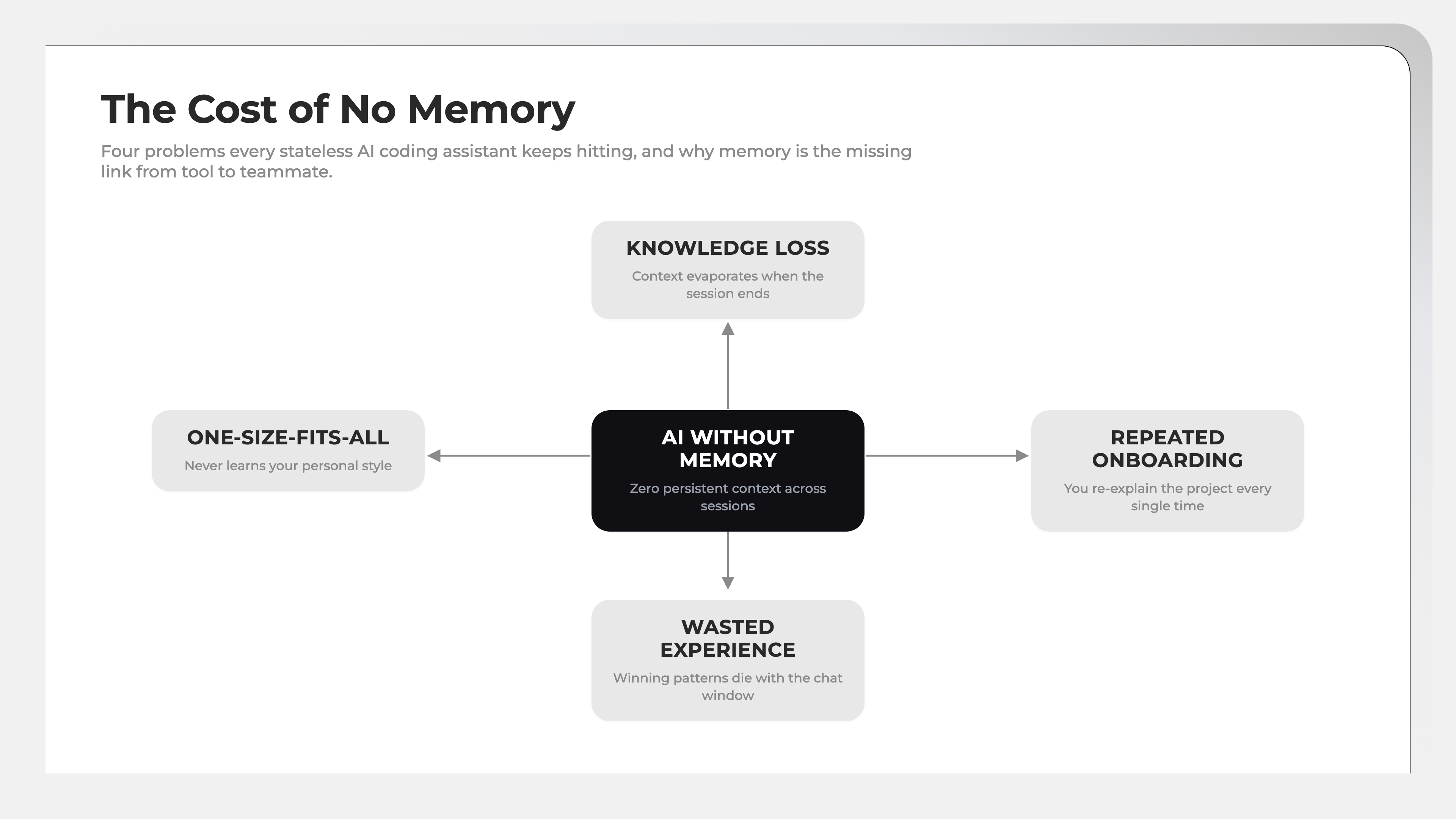
Adding memory is table stakes. Building memory that compounds across sessions is the harder problem. Four failure modes show up even with memory turned on:
Having memory isn't the bottleneck anymore. Having memory that compounds is. The rest of this post is about how we got there.
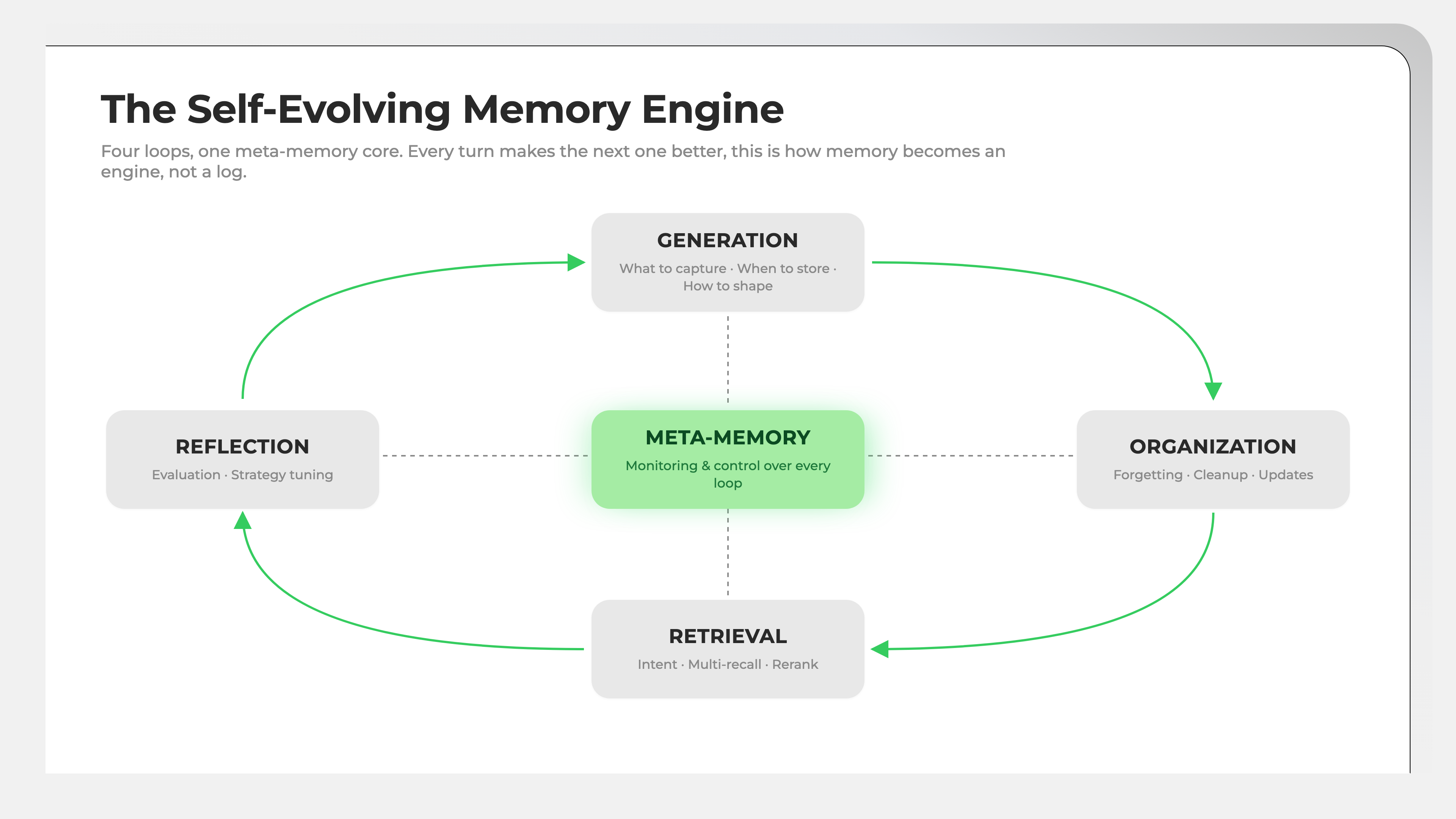
At the core of Qoder's memory system is a loop: generate → organize → retrieve → reflect → generate again. Every turn of the loop makes the next turn better. It's built on three primary capabilities plus one governing layer on top.
The rest of this post walks through each stage, then the meta-memory layer that closes the loop, then how we measure whether any of it works.
Generation is where the loop begins. Three questions drive it.
What do we remember? Qoder organizes memory around three subjects: the agent (tool experience, MCP experience, skill experience), the project (project info, lessons learned, development conventions), and the user (user preferences, dev preferences, expert knowledge). Those nine subcategories roll up into 5 major categories and 26 subcategories:
Each subcategory gets its own subgraph (an isolated partition of the memory store) so unrelated memories don't interfere with each other. A note about "prefer tabs over spaces" never contaminates a retrieval about database schema conventions.
A concrete memory entry looks roughly like this (simplified for illustration):
memories:
  - id: mem_b7f2c...
    title: Validate Payment Signature Before State Change
    category: lessons_learned
    content: |
      On payment endpoints, always validate signature
      before touching the order state. A race in the
      old flow caused double refunds in Feb 2026.
The entry is machine-generated, machine-maintained, and retrievable from any of the six recall paths described later. You don't hand-write it, and you don't hand-edit it. The memory agent does.
When do we remember? We place five trigger points along the interaction lifecycle:
How do we remember? Every extraction runs through a seven-step pipeline from scene trigger to conflict resolution. The extraction prompt is the load-bearing piece, structured in six segments. One principle runs through the design:
Don't hand to the model what engineering can solve.
We trim input parameters to reduce hallucination risk, let the model handle only the core semantic extraction, and fill in metadata from the engineering side. The model does fewer things, more accurately.
More memory is not better memory. Organization keeps the store useful instead of letting it rot into a dumping ground.
Organization runs on two tracks. The user track lets people add, update, delete, or query memories through natural-language commands or a settings page. The system track handles this automatically through seven capabilities:
Both tracks write to the same memory list. The user keeps full control, and the system keeps the store healthy in the background. Neither works alone.
Writing memory down is the easy half. The hard half is pulling the right memory back at the right moment, in the right form.
Let's thread a concrete example through this section. A developer opens a chat and says:
"Help me build a payment API."
On the surface, this is a payment-feature request. Underneath, it touches the project's tech stack, the team's API conventions, and, critically, a security issue the same team hit six weeks ago on a different payment feature. All of that should arrive in the model's context before the first line of code gets written.
Here's how Qoder pulls that off.
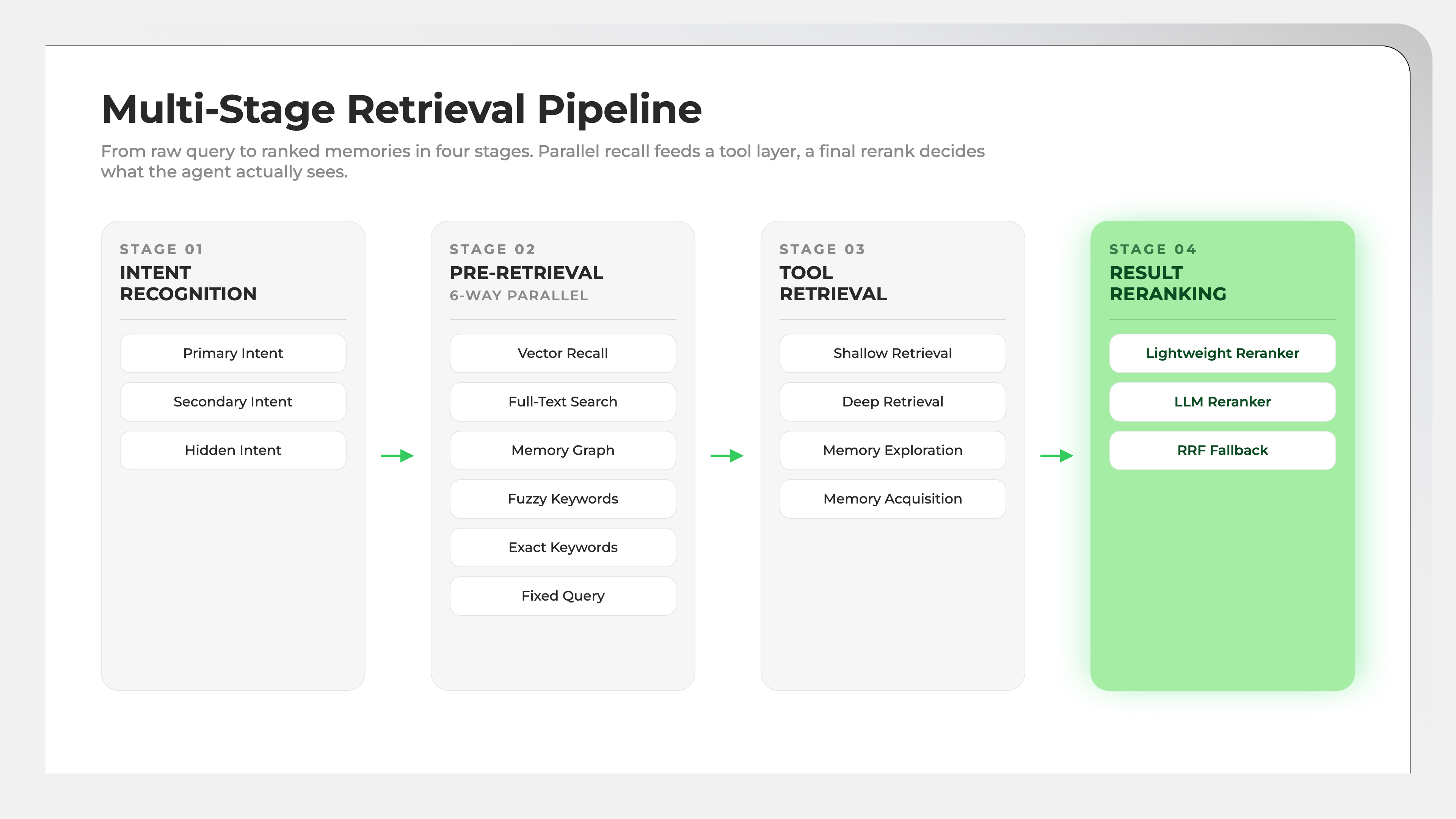
We parse the user's input into three layers:
What users actually need is often underneath the literal request. Intent recognition is how we make sure the hidden layer doesn't get ignored.
We fan the query out into six recall strategies running in parallel. Each path catches a different kind of relevance.
| Path | What it catches |
|---|---|
| Vector recall | Semantic similarity |
| Full-text search | Exact terms and phrases |
| Memory graph | Associated memories via graph edges (see below) |
| Fuzzy keyword | Semantic drift, typos, synonyms |
| Exact keyword | Disambiguation when the query is terminology-heavy |
| Fixed query | Always-on "meta" memories, for example, communication style |
The last one matters more than it sounds. Fixed query is how we preload user communication style and behavioral conventions before the first token of the actual task is processed. These meta-level memories don't depend on what the user is asking, but they shape every answer.
The agent picks from shallow, deep, exploratory, and direct-fetch modes depending on query complexity. Fast paths for fast questions, slow paths for reasoning-heavy ones.
A scenario-appropriate reranker makes the final cut: a lightweight ranker for real-time conversation, a large model for complex reasoning, with RRF as a fallback.
Beyond the multi-stage pipeline, two structures carry a lot of the weight.
Memory Graph is a graph of keyword nodes and memory nodes linked by weighted edges. Retrieval runs a two-layer activation:
Back to the payment API example. A traversal can light up a path like order flow → inventory reservation → inventory system and another like checkout → discounts → coupons → marketing system. Neither shares keywords with "payment API," but both are logically part of the same feature surface. That's the multi-hop payoff.
Topic Tree is the complement. Where the Memory Graph is good at lateral association, the Topic Tree is good at vertical precision. It organizes memory indices in a category hierarchy. Retrieval descends through "overview → branch → deeper branch → hit," which avoids both information overload and missing a relevant leaf.
Retrieval is where the flywheel either spins or stalls, and it's where we hit the hardest problem:
Large models don't reliably use retrieval tools correctly. They don't always call memory retrieval at the right moment, and they don't always construct the best query when they do.
Prompt finetuning helps, up to a point. Beyond prompt finetuning, we've explored two deeper directions.
Some memory systems expose memory as a file system: the main agent reads and writes memory files, users hand-edit them. Simple and intuitive, but it hits a ceiling in real coding scenarios. The main agent won't pause a coding task to scroll through memory files looking for a note it doesn't know exists.
Two judgments came out of that comparison:
An independent memory system gives you stronger generation (global-view extraction instead of "by the way" notes), precise retrieval (six-way parallel recall instead of "open file and search"), and real self-evolution (continuous scoring, decay, and pruning).
We also tried wrapping the memory system behind a virtual file-system interface, because models use files better than tools. Model willingness to interact went up, but hidden-intent retrieval and multi-hop associations were impossible to express through a file interface. The open question is how to build a file-style interface that still exposes strong indexing.
The second exploration flips the direction entirely. Instead of the main agent pulling memory on demand, the meta-memory system pushes memory to the main agent as context evolves.
It watches task progress, reads the conversation, predicts which memories the next step will need, and injects them into the main agent's context between turns. When it works, the agent just "knows things" at the right moment, without having decided to look them up.
Proactive memory also unlocks real-time correction. When the main agent is about to make a decision that contradicts a prior lesson, the meta-memory system can inject the relevant experience before the decision crystallizes. The agent effectively gets an "experience intuition" running in parallel.
The shift from pull-based retrieval to push-based surfacing lets the main agent focus on the task. The right memory shows up at the right time on its own.
This is a direction, not a finished product. But it's where we think retrieval is heading.
Sitting on top of generation, organization, and retrieval is the meta-memory layer. It has two jobs.
Meta-memory is what turns the four-stage loop from a mechanical cycle into a system that gets better over time.
Self-evolution operates through two interlocked flywheels:
The memory data flywheel accumulates high-quality memories through reflection, organization, and natural decay, while pruning low-quality ones.
The strategy data flywheel sits on top. Meta-memory watches how current strategies perform, then optimizes them. Better strategies deposit higher-quality memories, which give the next round of optimization better data. The two flywheels lock teeth: the system gets smarter about what it remembers, not just accumulates more of it.
A self-evolving system has to be measurable, or nobody should trust it. We run two evaluation tracks: an offline benchmark and an online monitoring setup.
We built an in-house evaluation suite covering the same five generation triggers described above, across 26 memory categories. Each run scores three dimensions: generation quality, retrieval quality, and memory effectiveness (whether the recalled memory changed the output).
Scenarios 1-2 (project initialization, code adoption) only Qoder supports out of the box. To keep the comparison honest, we report a core head-to-head on scenarios 3-5, the three scenarios every memory system is meant to handle.
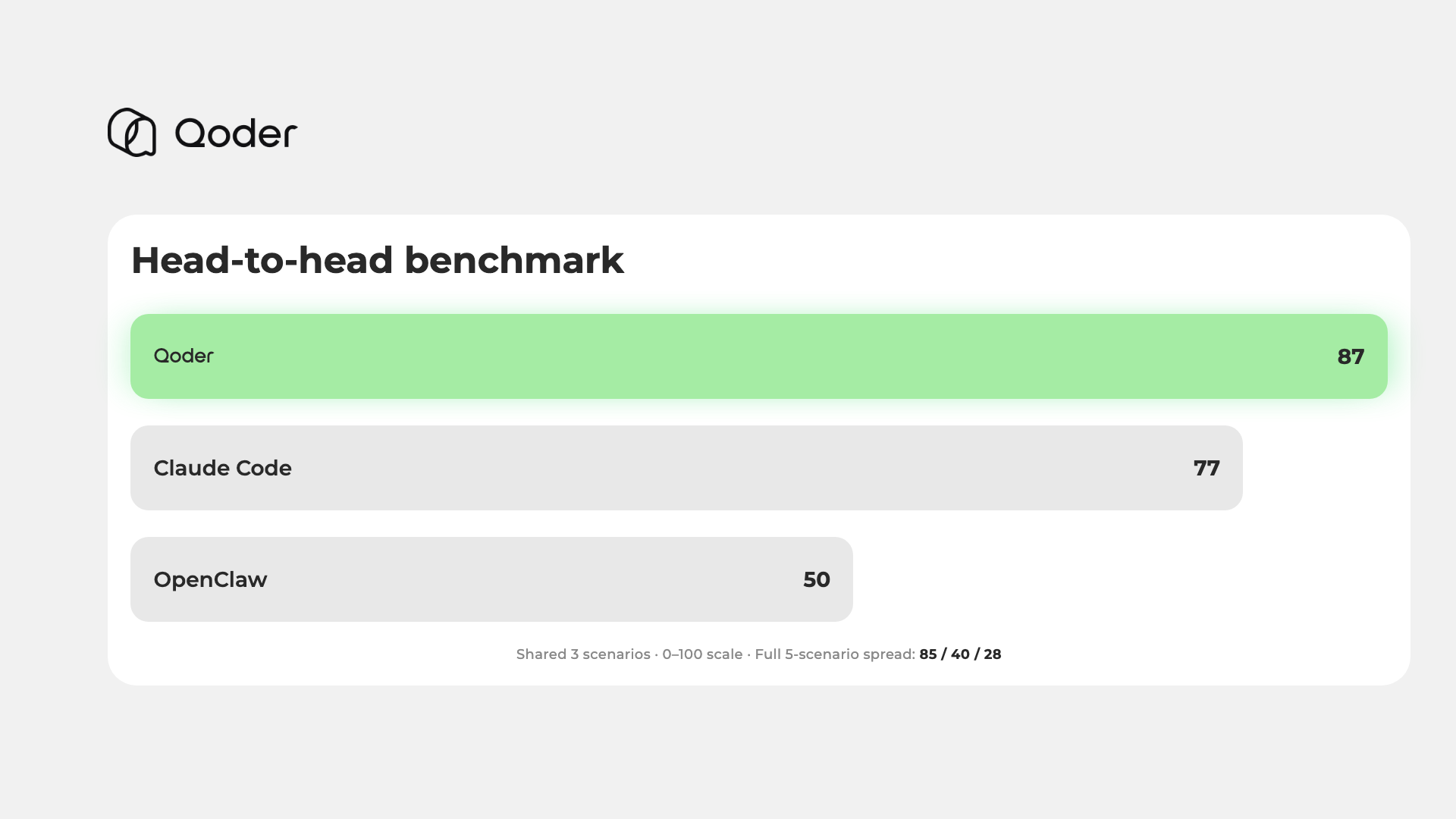
In the core head-to-head, we observed two patterns:
On the apples-to-apples scenarios (0-100 scale):
The gap here reflects quality on shared ground. On the full five-scenario benchmark, which adds Qoder-specific project initialization and code adoption, the spread widens to 85 / 40 / 28. That's a coverage effect layered on top of the quality gap.
Online, the methodology is same-scenario A/B between memory-on and memory-off. For each recalled memory, a model judges whether the memory was used or not. We then compare outcomes across the used vs not-used splits, grouped by scenario type. The data below covers three days, top 5 scenarios.
We report per-scenario because memory's impact flips direction: in Q&A scenarios it reduces tokens (context reuse), in complex task scenarios it increases them (the agent does more work to meet actual expectations). A global "tokens saved" metric would average those out and lie.
Across the top 5 scenarios, the rounded A/B deltas line up like this:
Two aggregate numbers for the memory-on cohort: 85% session engagement (share of sessions where memory gets exercised) and 60% memory effectiveness (share of recalled memories that actually changed the output).
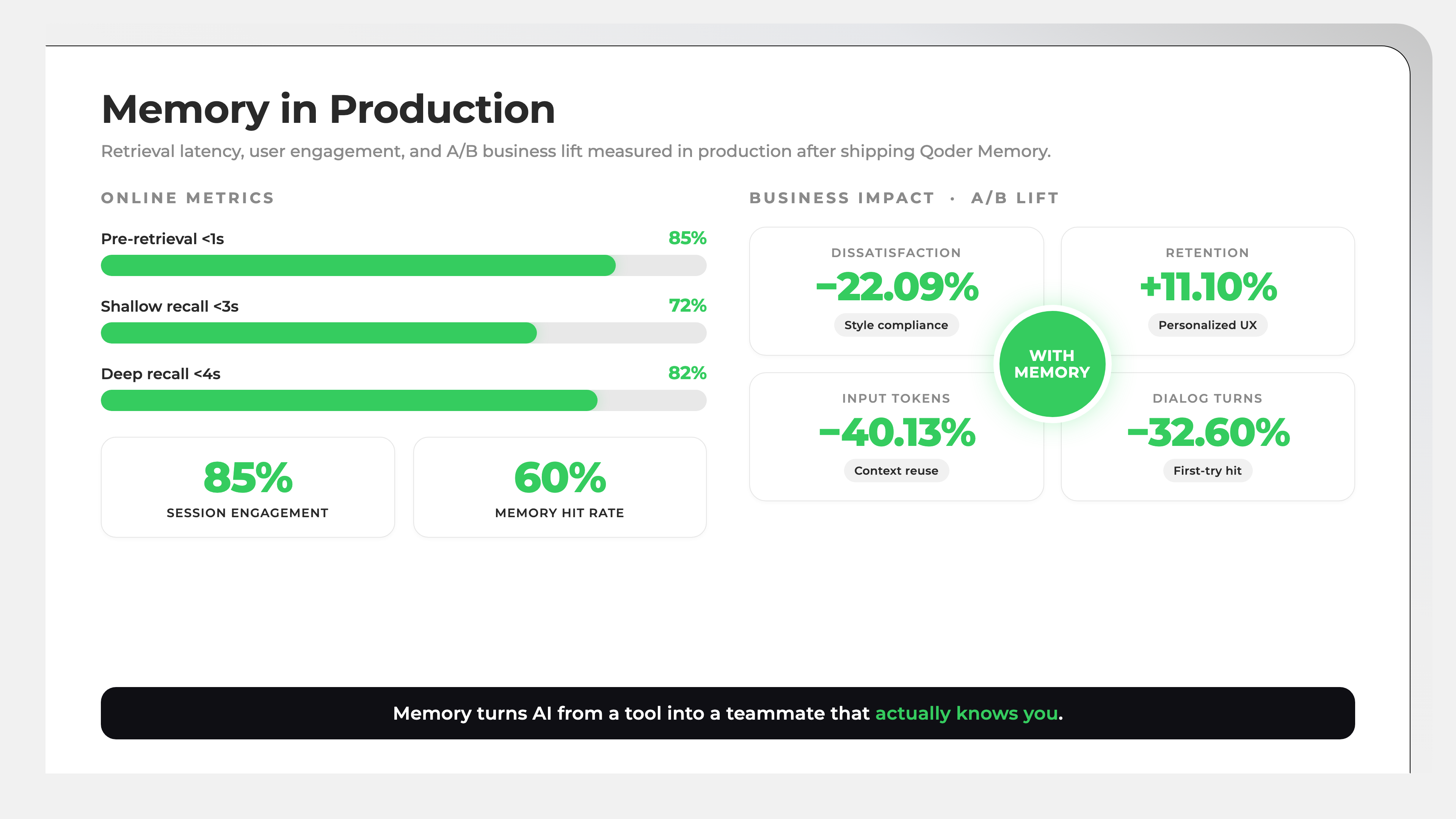
The consistent finding across scenarios:
Memory gives the agent a sharper model of the user. Through convention adherence, personalization, first-time accuracy, context reuse, and precise output, it raises quality across scenarios and reduces resource use where the task allows it.
A few practical notes:
Three directions are live on our roadmap right now:
Most of what's in this blog applies beyond Qoder. If you're building or evaluating memory for your own agent, these are the design choices that carried the most weight for us:
If you run the same teardown on your own agent's memory layer, the bottleneck is almost always retrieval. Get the index right first.
The original question was: what does it take for an AI agent to know you? The answer is memory that compounds, not just a bigger model or another storage layer.
Qoder's memory system uses the generate > organize > retrieve > reflect loop to deliver a simple, long-horizon promise to developers:
The longer you use it, the better it gets.
When your AI agent stops needing you to reintroduce your project, proactively avoids the trap you fell into last time, and writes suggestions that track your style more closely with each week, it stops feeling like a tool. It starts feeling like a partner growing alongside you. That's the system we're building.
In Practice: QODER CLI × HARNESS ENGINEERING — Building a 7×24 Autonomous Feedback Processing System

1,565 posts | 524 followers
FollowAlibaba Cloud Community - July 17, 2026
Alibaba Cloud Community - July 8, 2026
Alibaba Cloud Community - August 5, 2026
Alibaba Cloud Community - July 30, 2026
Alibaba Cloud Community - July 29, 2026
Alibaba Cloud Community - January 12, 2026
1,565 posts | 524 followers
Follow QwenWork
QwenWork is dedicated to helping employees strengthen their professional competitiveness in the AI era and to enabling enterprises to improve organizational effectiveness.
Learn More Qoder
Qoder
From Assisted to Autonomous — Adapting to Every Programming Need
Learn More Token Plan
Build more, spend less. One plan, every modality.
Learn More
Alibaba Cloud Model Studio
A one-stop generative AI platform to build intelligent applications that understand your business, based on Qwen model series such as Qwen-Max and other popular models
Learn MoreMore Posts by Alibaba Cloud Community

