A common pain point in many AI coding assistants is the lack of long-term memory. Each new session feels like starting from scratch—preferences, coding conventions, and past histories are forgotten, forcing developers to repeat explanations and rework solutions. This not only slows down development but also undermines the promise of AI as a collaborative partner.
So, how can we move beyond stateless interactions and build AI coding agents that remember, learn, and evolve alongside developers?
Traditional AI coding agents operate in isolation, with no persistent understanding of the user or their environment. This leads to several key limitations:
Without memory, AI remains a reactive tool—not a proactive collaborator.
To overcome these limitations, our system introduces a long-term memory framework that enables AI agents to retain, recall, and refine knowledge over time.
The agent continuously analyzes developer interactions, extracts valuable insights, and stores them as semantic notes. When a relevant task arises, it retrieves these memories to inform its decisions—enabling faster, more accurate, and personalized assistance.
We categorize memories into three core types:
1. Personal Preferences
2. Historical Experience
3. Project Knowledge
This structured memory allows the agent to act with context, not just prompt.
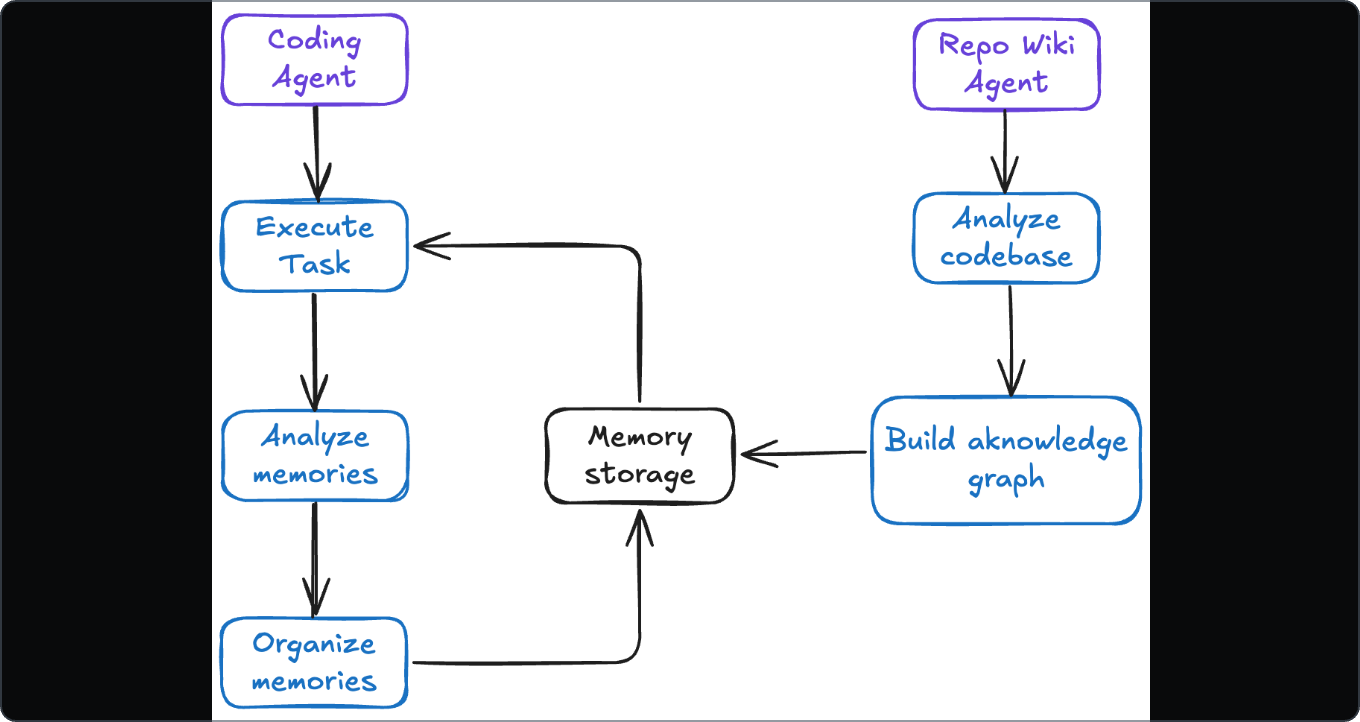
The memory system gathers information from multiple sources to build a comprehensive and up-to-date knowledge base:
By combining these inputs, the system ensures that memory is both deep and actionable.
Not all memories are equally valuable. To maintain quality, the system evaluates each extracted memory based on:
After each coding task, the agent assesses how effectively recalled memories contributed to the outcome. Low-value or outdated entries are automatically flagged and removed.
This ensures the memory remains lean, accurate, and useful.
Unmanaged memory can quickly become fragmented and redundant. To prevent this, the system performs regular maintenance:
This ongoing organization keeps the agent’s memory efficient and coherent—like a well-maintained knowledge base.
The AI agent operates in a continuous loop of recall, action, learning, and refinement:
Over time, this cycle enables the agent to self-evolve, becoming more accurate, efficient, and personalized with every use.
Our internal evaluations show that the long-term memory system significantly improves agent efficiency and reduces repetitive mistakes.
We’re just beginning to unlock the potential of self-evolving AI assistants. Future enhancements include:
By equipping AI coding assistants with long-term memory and self-optimization, we move beyond one-off code generation to continuous collaboration. The result is not just faster coding, but smarter, more adaptive development—where the AI truly learns from you, for you.
Welcome to the era of self-evolving AI assistants.
Alibaba's Latest AI Agent Benchmark Awarded Best Resource Paper at ACL 2026

1,550 posts | 523 followers
FollowApsaraDB - June 26, 2026
Alibaba Cloud Native Community - July 1, 2026
Alibaba Cloud Community - July 3, 2026
Alibaba Cloud Community - May 21, 2026
Alibaba Cloud Native Community - July 17, 2026
Alibaba Cloud Native Community - June 2, 2026
1,550 posts | 523 followers
Follow QwenWork
QwenWork is dedicated to helping employees strengthen their professional competitiveness in the AI era and to enabling enterprises to improve organizational effectiveness.
Learn More Token Plan
Build more, spend less. One plan, every modality.
Learn More
Alibaba Cloud Model Studio
A one-stop generative AI platform to build intelligent applications that understand your business, based on Qwen model series such as Qwen-Max and other popular models
Learn More Qwen
Qwen
Full-range, open-source, multimodal, and multi-functional
Learn MoreMore Posts by Alibaba Cloud Community

