AI is reshaping the craft of software development. Three shifts are already underway.
Once, opening a tool meant facing files, directories, and functions. Now you hand over a task: turn this data into a report, turn this idea into a clickable prototype, trace last night's timeout.
Code is still there, but it has become an agent's working material, not the thing you directly shape. Tasks carry state and lifecycle. They run for hours, pause for your word, and keep going after you close the lid. Centering on the task is the essential interface between people and agents.
When an agent can carry a task from start to finish, the human role changes. The scarce resource is no longer typing speed—it is attention. Five tasks in motion; which needs you now, which can wait, which is drifting off course?
Delegating and reviewing an agent's work calls for a different interface than writing code.
Code is the lingua franca of the digital world. Coding is becoming a universal skill.
Product managers need working prototypes. Designers need mockups that run. Testers need scripts from use cases. Operators need that weekly report automated. They know what they want and can judge the result—they shouldn't need to install a dev environment first. So Qoder meets each role in the form they already know, so the shape of the product never blocks the use of agents.
These three shifts point to one answer: a resident, task-centered desktop workbench where you can observe and step in. That is the Qoder Agent Desktop. It carries the same Qoder agent across terminal, IDE, and desktop. Where earlier tools asked, "Which files should we edit?" the workbench asks, "Is it done?"
A new frontier model arrives almost every month. Qoder stays untethered to any single model, integrating the latest SOTA options as they appear.
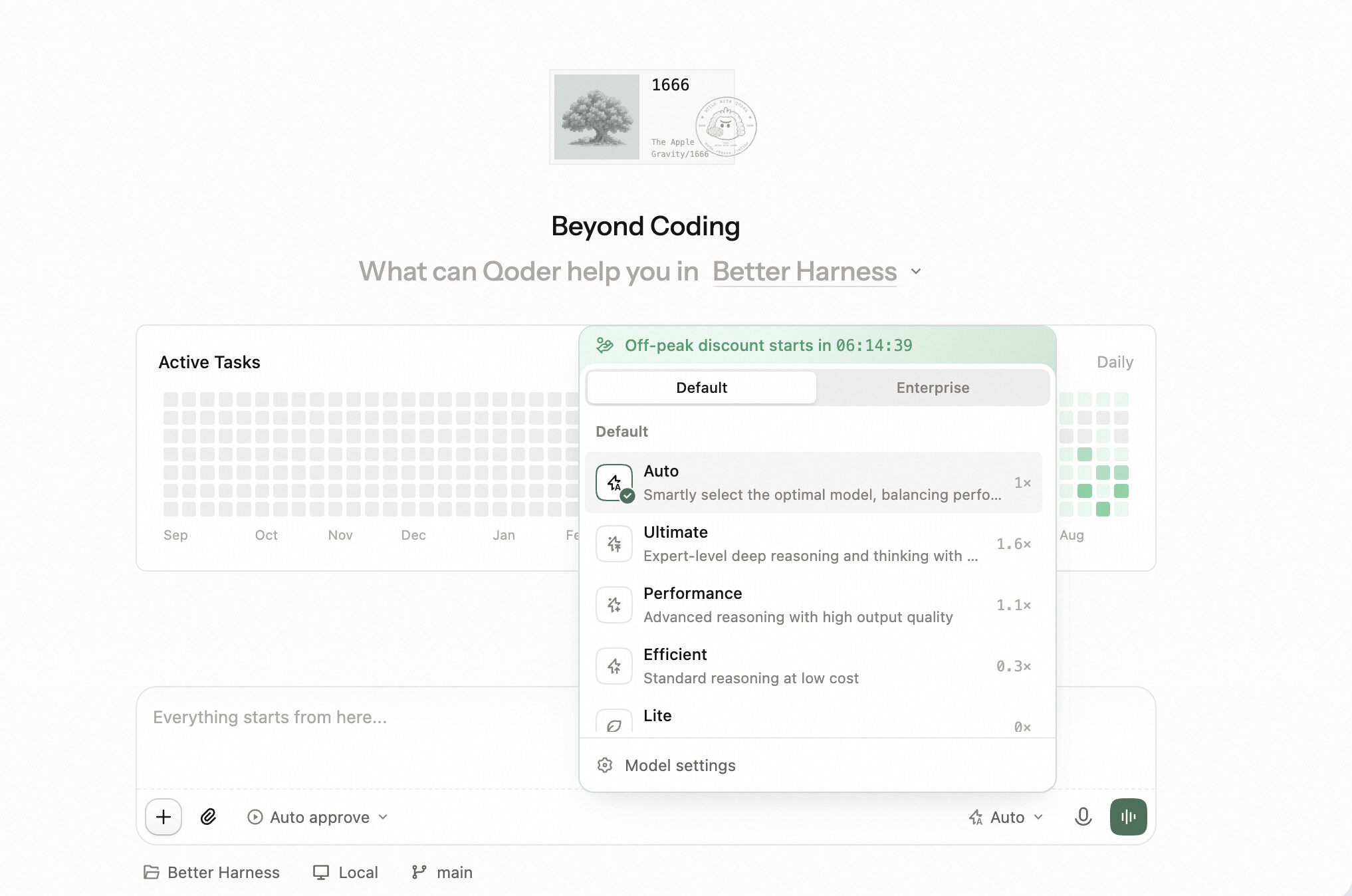
Different tasks—quick fixes, deep refactoring, long-chain debugging, writing docs—demand different strengths. Experts can choose and configure. Everyone else can lean on Ultimate, Performance, Efficient, and Auto routing, which balances quality, speed, and cost.
You choose when you care. Qoder chooses when you don't.
Model intelligence only matters if it can be delivered. The same model in different harnesses can differ several-fold in whether it finishes the job. Real tasks are not single Q&As; they are long chains of decomposition, missteps, surprises, and recovery. The model thinks. Harness sees it through.
Qoder uses the latest agentic-loop technology to hold long tasks steady:
The result: longer, harder tasks with less hand-holding.
Qoder is not only for programmers. Product managers turn ideas into interactive prototypes; designers make mockups live; operators automate weekly reports. Developers turn personal workflows into reusable apps.
We aim at real work, not demos. Real tasks usually fail not from lack of ability, but from lack of context. Qoder reads the actual workplace, so you don't have to enumerate every assumption—the unclear parts, it investigates itself. The more you use it, the deeper its model of your environment becomes. Model power is a commodity; context is your asset.
Through Browser Use and Computer Use, the agent acts in real environments, not just chat windows and codebases. Pause, take over, or point at output and ask for a fix. Qoder keeps the work visible and the choice yours.
Coding is the foundation, but the agent must reach into every place work happens. Qoder ships with 70+ expert suites, 20,000+ skills, and 40+ connectors, and lets you turn your own workflows into reusable patterns. Connectors link code hosting, documents, data sources, collaboration tools, and live business systems—databases, internal APIs, tickets, monitoring. An agent that cannot touch your real environment can only play with demos.
One workbench now covers documents and proposals, data cleaning and analysis, design-to-code, ops automation, test scripts, and alert root-cause analysis. With Qoder, you do not learn to code; you gain a team-sized capability that grows more personal over time.
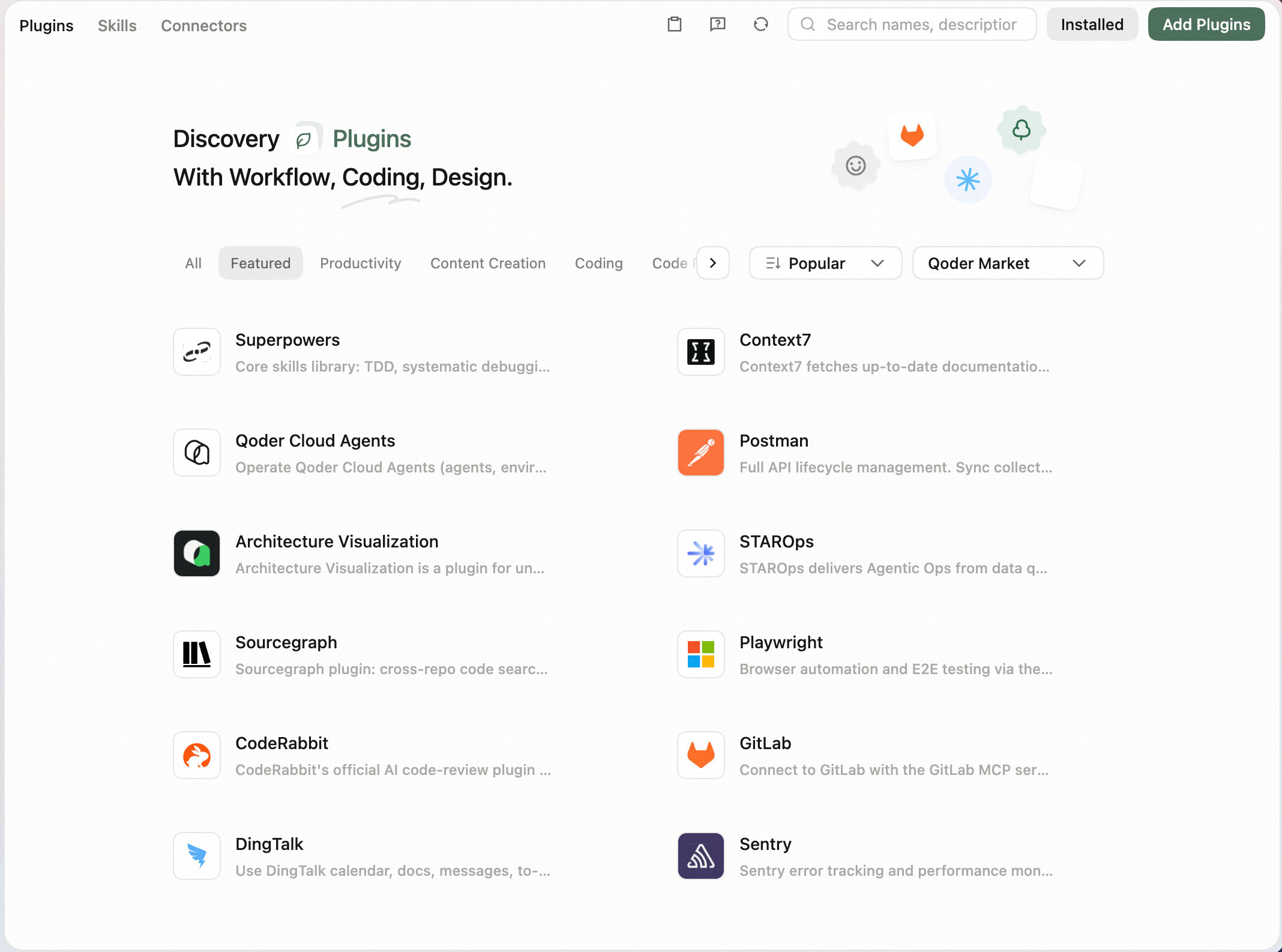
Instead of waiting for you to remember everything, Qoder brings the unhandled error, the missing test, the inconsistent logic to your attention. You decide; it remembers.
The Qoder desktop app launches today, but the road ahead is long.
Our aim is clear: less human intervention, more trustworthy results. The two must advance together—autonomy without trust breeds rework; trust without autonomy is merely a cautious assistant.
Next comes coordination across tasks, joint orchestration of people and agents, and turning a single success into a reusable capability.
When coding becomes a universal skill, a coding agent becomes the power to turn ideas into reality.
We want that power in everyone's hands.

1,565 posts | 524 followers
FollowAlibaba Cloud Community - July 27, 2026
Alibaba Clouder - May 8, 2018
Alibaba Cloud Community - August 6, 2026
Alibaba Cloud Community - October 15, 2026
Alibaba Cloud Community - June 16, 2026
Alibaba Cloud Community - July 10, 2026
1,565 posts | 524 followers
Follow QwenWork
QwenWork is dedicated to helping employees strengthen their professional competitiveness in the AI era and to enabling enterprises to improve organizational effectiveness.
Learn More Qoder
Qoder
From Assisted to Autonomous — Adapting to Every Programming Need
Learn More Token Plan
Build more, spend less. One plan, every modality.
Learn More
Alibaba Cloud Model Studio
A one-stop generative AI platform to build intelligent applications that understand your business, based on Qwen model series such as Qwen-Max and other popular models
Learn MoreMore Posts by Alibaba Cloud Community

