If 2023 was the year generative AI captured the public imagination, and 2024 was the year the industry raced to build infrastructure, 2025 felt like the year AI started showing up in everyday life, reliably, at scale, and with measurable impact.
For Alibaba, that shift was powered by a major commitment of RMB 380 billion (US$53 billion) announced in February 2025 to strengthen cloud and AI infrastructure over the next three years. Over the past 12 months, Alibaba accelerated the development of proprietary models, expanded open-source contributions, and moved AI beyond the lab into practical use cases, from consumer devices to healthcare and climate science.
At the core of Alibaba’s AI progress is Qwen, its family of large language models. In September at Alibaba’s annual Apsara conference, the company unveiled Qwen3-Max, a flagship model built for complex coding and agentic tasks.
But 2025 wasn’t just about scale. It was also about capability. Alibaba released a series of specialized Qwen models that broaden AI’s usefulness in real-world scenarios. There was Qwen3-Coder for agentic developer workflows, and multimodal models like Qwen3-VL and Qwen3-Omni, which enable real-time vision-language understanding that supports applications such as autonomous navigation.
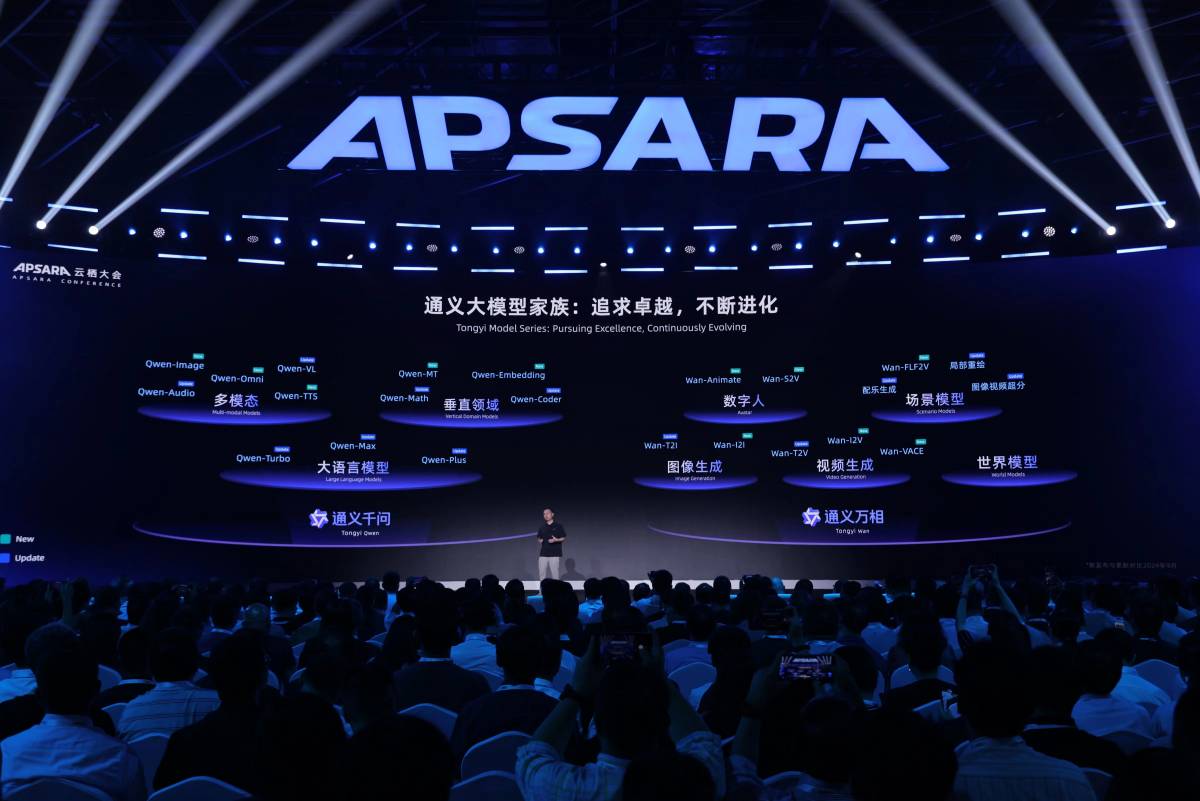
Among researchers, one closely watched milestone was a breakthrough in attention mechanisms: Alibaba’s Qwen team received NeurIPS 2025 Best Paper Award for research that has since been incorporated into the Qwen3-Next, which introduced architecture innovations combining Gated DeltaNet and Gated Attention.
A defining feature of Alibaba’s AI approach in 2025 has been its commitment to openness. Rather than gatekeeping capabilities, Alibaba has leaned into open-source software. This has helped developers and companies build faster and at lower cost.
That momentum is visible in adoption, as Qwen has become a widely used foundation for community and enterprise experimentation across languages and use cases. It has recorded over 700 million downloads on Hugging Face, with more than 180,000 derivative models across 119 languages and dialects.
Alibaba also pushed more efficient “Small Language Models” (SLMs), lowering the compute and cost barrier for teams that want high performance without hyperscale resources. The ripple effects are already appearing globally. In Nigeria, the startup Cereloop is using Qwen2.5-Math-1.5B to deliver STEM lessons to students in areas with limited internet access. In Vietnam, Arcee-VyLinh, which is built on Qwen2.5-3B, was fine-tuned to better handle local linguistic nuances. In the U.S., NVIDIA Cosmos-Reason1-7B, the world foundation model platform for physical AI, was post-trained based on Qwen2.5-VL-7B-Instruct for embodied reasoning and physical-world understanding. And researchers at UC Berkeley demonstrated a low-cost “aha moment” reproduction (TinyZero) using a Qwen2.5-3B model, showing how quickly advanced techniques can be explored by the broader research community.
If Qwen is about reasoning and productivity, Alibaba’s Wan series is about creativity. First introduced in 2023, Wan advanced the ability to generate and edit image and video content in ways that are more controllable, realistic, and creator-friendly in 2025.
The pace was rapid. Wan 2.1 arrived in January and ranked highly on video-generation benchmarks; by April, releases expanded creative control that supported use of start and end frames to shape transitions; and by December, Wan 2.6 introduced features designed for richer storytelling, including enabling creators to appear in AI-generated videos as themselves and in their own voices, with flexible multi-shot narratives.
For creators and small studios, the translation is simple: higher-end production capabilities at lower cost and with less complexity.
For most consumers, the value of AI isn’t measured in parameters. It’s measured in usefulness. In 2025, Alibaba pushed AI deeper into everyday experiences by integrating it across its ecosystem.
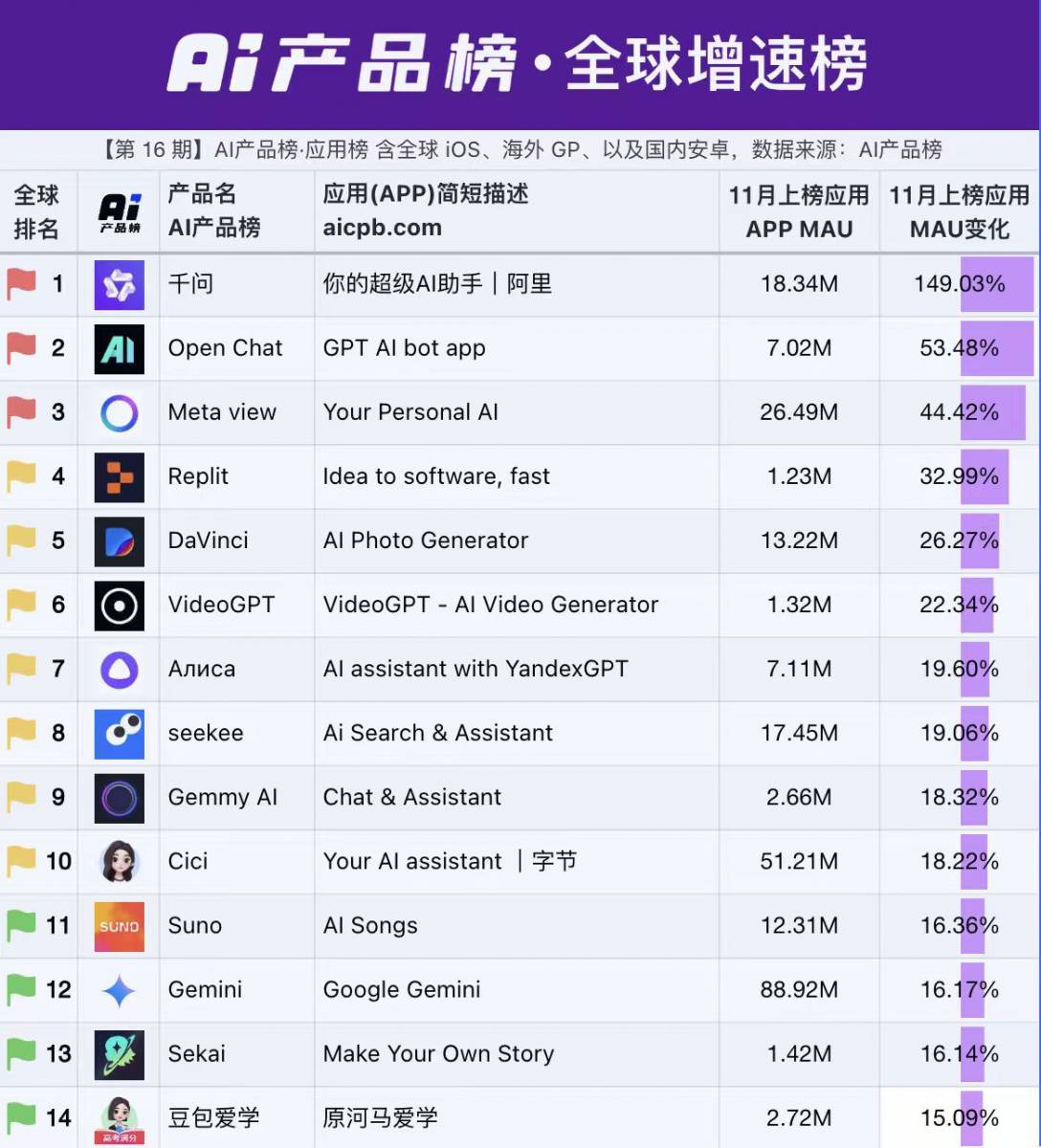
In November, Alibaba launched the Qwen App, positioning it not only as a chatbot but as a “do-er.” It is an assistant that can plan and complete tasks by connecting with services across map navigation, travel booking and e-commerce in Alibaba’s ecosystem. The market response was fast: the app reached 30 million monthly active users within 23 days.
Alibaba also began exploring what a post-smartphone experience could look like. Quark AI Glasses pointed toward a more ambient, hands-free interface, supporting capabilities like near-eye navigation and real-time translation while staying connected to the broader ecosystem.
2025 also showed what happens when AI is applied to problems that matter beyond convenience.
At COP30 in Brazil, Alibaba unveiled Baguan-Seasonal, a climate model designed to forecast conditions up to 12 months in advance, supporting longer-term planning for climate resilience and agriculture.
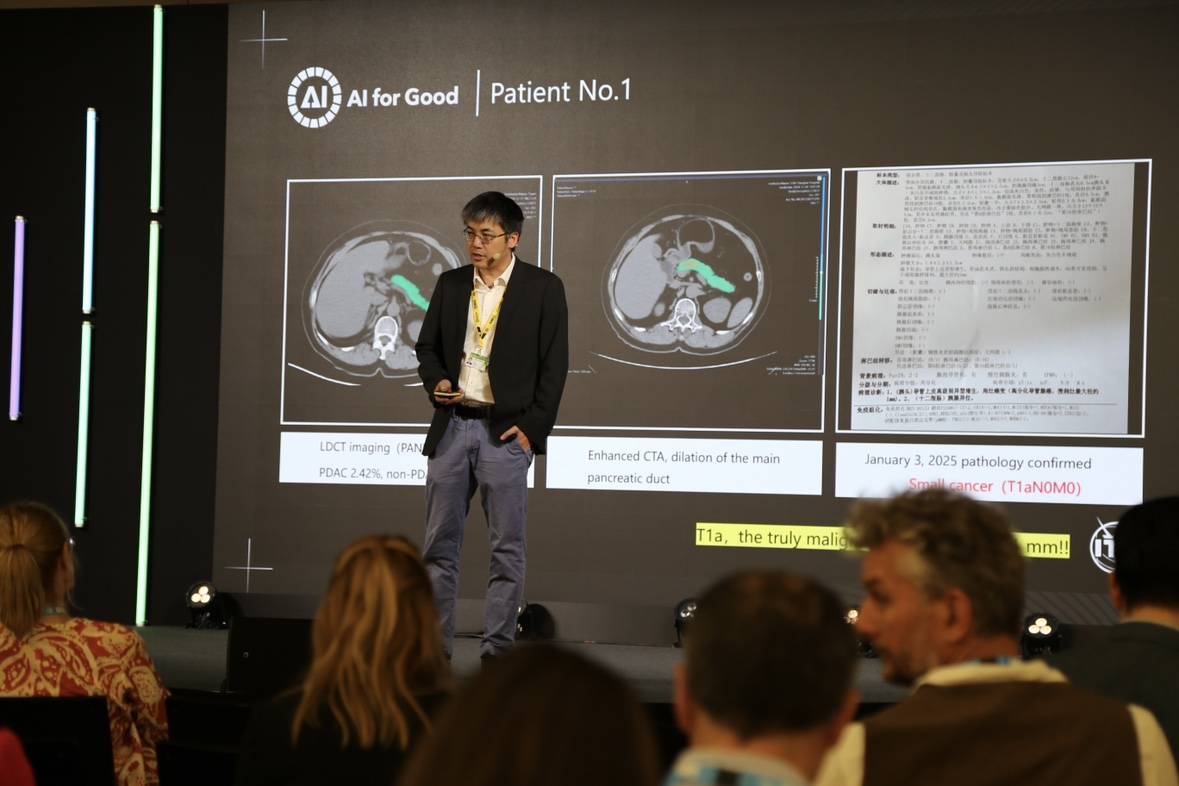
In healthcare, DAMO Academy’s “Non-Contrast CT + AI” technology supports early screening for Acute Aortic Syndrome (AAS) and other critical diseases without the use of injected contrast dyes. As of July 2025, the technology had been used over 50 million times in hospitals and other settings across China. This is an example of AI lowering marginal costs while expanding access.
And in education and inclusion, the “Starlight AI” program uses creative AI to support children with autism spectrum disorder (ASD), generating customized picture books tailored to individual needs. In China, an estimated 2 million children have been diagnosed with ASD. Built with the open-source agent framework “MM-StoryAgent” using Qwen, the tool transforms simple story outlines into personalized audible books with visuals, narration, and adaptive text. Since its launch in June 2025, it has been used nearly 400,000 times, supporting more than 20,000 children. Looking ahead, Alibaba plans to partner with more special education schools nationwide, equipping tens of thousands of families and teachers.
Looking back at 2025, the public narrative around AI continued to shift. It went from speculative fears to practical outcomes that improve daily life, accelerate innovation and support social good. The challenges are real, but the direction is clear: AI is moving faster, becoming more useful, and reaching more people.
This article was originally published on Alizila written by Alizila Staff
Qwen3-VL-Embedding and Qwen3-VL-Reranker: For the Next Generation of Multimodal Retrieval

1,529 posts | 514 followers
FollowAlibaba Cloud Community - March 24, 2026
Alibaba Cloud Community - June 30, 2025
Alibaba Cloud Community - January 4, 2026
Alibaba Cloud Community - March 20, 2026
Alibaba Cloud Community - November 17, 2025
Alibaba Cloud Community - January 26, 2025
1,529 posts | 514 followers
Follow Token Plan
Build more, spend less. One plan, every modality.
Learn More QwenWork
QwenWork is dedicated to helping employees strengthen their professional competitiveness in the AI era and to enabling enterprises to improve organizational effectiveness.
Learn More
Alibaba Cloud Model Studio
A one-stop generative AI platform to build intelligent applications that understand your business, based on Qwen model series such as Qwen-Max and other popular models
Learn More Qwen
Qwen
Full-range, open-source, multimodal, and multi-functional
Learn MoreMore Posts by Alibaba Cloud Community

